
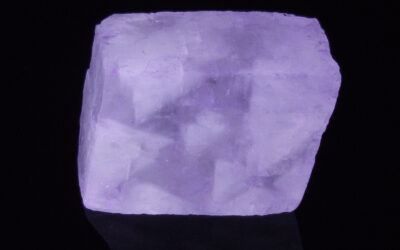
Can you use a mineral to test your UV flashlight? 365nm vs 395nm
How do you know whether your UV flashlight is really producing the wavelength it claims? You could use a spectrometer, of course, but there is a much simpler option that is especially appealing to mineral collectors: use a fluorescent mineral as a rough UV wavelength...
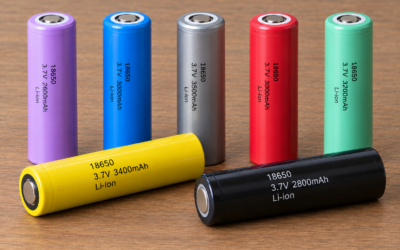
Selecting the proper battery for your 365nm UV flashlight
A good UV flashlight is only as reliable as the battery powering it. For 365nm lights using rechargeable 18650 or RCR123 cells, the battery affects runtime, output, reliability, and safety. The biggest rule is simple: don't buy lithium batteries based on the biggest...
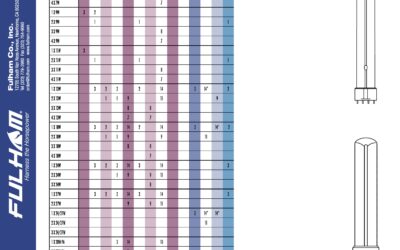
Ballasts to drive fluorescent bulbs/tubes
Our display UV lights are mostly based on fluorescent bulbs. These bulbs require a special ballast to operate. Lots of folks buy surplus transilluminators on Ebay and upgrade them to very powerful SW lights using off-the-shelf bulbs and new electronic ballasts. When...
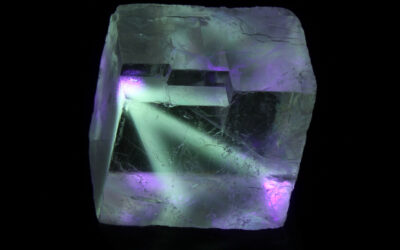
405nm Laser Pointers for Fluorescent Minerals
Can a 405nm blue-violet laser pointer be useful for fluorescent minerals? A long discussion among fluorescent mineral collectors came to a fairly clear conclusion: yes—but it is a specialized tool and not a replacement for proper UV lighting. A 405nm laser can excite...
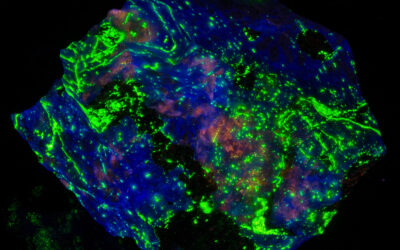
Cataract Surgery and Fluorescent Minerals: Changes in Color and UV Sensitivity
Cataract surgery can produce noticeable changes in the way fluorescent minerals—and colors in general—appear. These changes result primarily from removing the eye's natural crystalline lens, which typically becomes progressively yellow with age, and replacing it with...
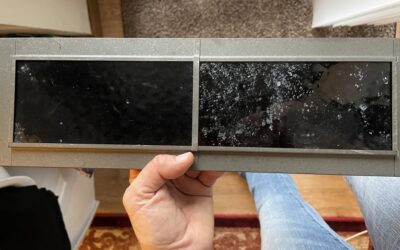
Does your Hoya shortwave filter have white scum disease?
GREAT DISCOVERY! (For me anyway). In my mobile fluorescence museum I have 1504 square inches of Hoya U325C filter glass. It's been there for 3 or 4 years and all of it, to a greater or lesser extent, has developed an ugly white encrustation. Why? I don't know. But...
Ozone: What’s that smell, is it dangerous, and how can it be reduced?
UV lighting intended for fluorescent mineral displays should normally produce little or no ozone, so it is important to use lamps specifically designed as low-ozone or ozone-free types. A distinctive sharp smell around a UV lamp may be ozone, and if a mineral display...
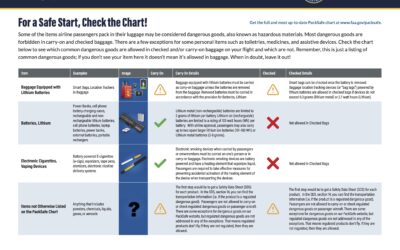
Can I carry my battery pack on a plane?
This question always comes up when we're traveling to some far off, glorious glow rock haven. Luckily, the FAA has published rules that are easy to understand - covers lithium batteries, lead acid, and all other batteries. Generally speaking, the answer is yes, when...
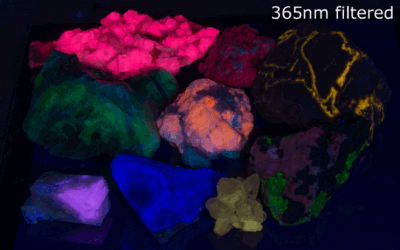
Comparison of 365nm to 395nm UV flashlight
I recently had the opportunity to test a 395nm 100 LED unfiltered flashlight. It is advertised as having 100 high power LEDs and claims to have high radiant intensity, a flood effect, and an 18-watt UV beam suitable for commercial and domestic use, even in ambient...
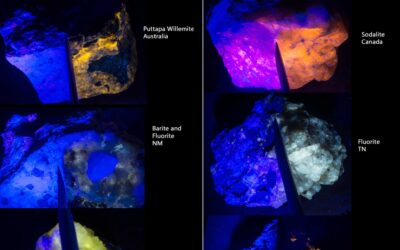
What kind of flashlight do I need? 365nm vs 395nm unfiltered UV flashlights
Friends don't let friends use crappy unfiltered 390nm flashlights. This is an educational post, directed towards folks new to the hobby. There has been discussion in our FB group lately about using cheap 395nm flashlights for fluorescent minerals. I am passionate...