
I have a nickname for esperite pieces – I call them “hard rocks”, very hard to photograph. Our rocks “glow” like a lightbulb. Imagine trying to take a picture of a Christmas tree. The lights end up looking overexposed, colors shifted, little stars, etc. That’s OK for a holiday shot, but when trying to show the detail in a mineral specimen, it makes our job hard. And combination specimens with different colors and intensities like willemite and esperite (and especially those with hardystonite and calcite) really make it “hard”.
The answer isn’t a simple one, and somewhat beyond the scope of this column. But a few quick pointers might help. For one, forget trying to take a decent photo with today’s point and shoot cameras, or smart phones. The ones I’ve seen just don’t have the capabilities required for a good shot. A decent SLR or camera which shoots RAW is a good starting point.
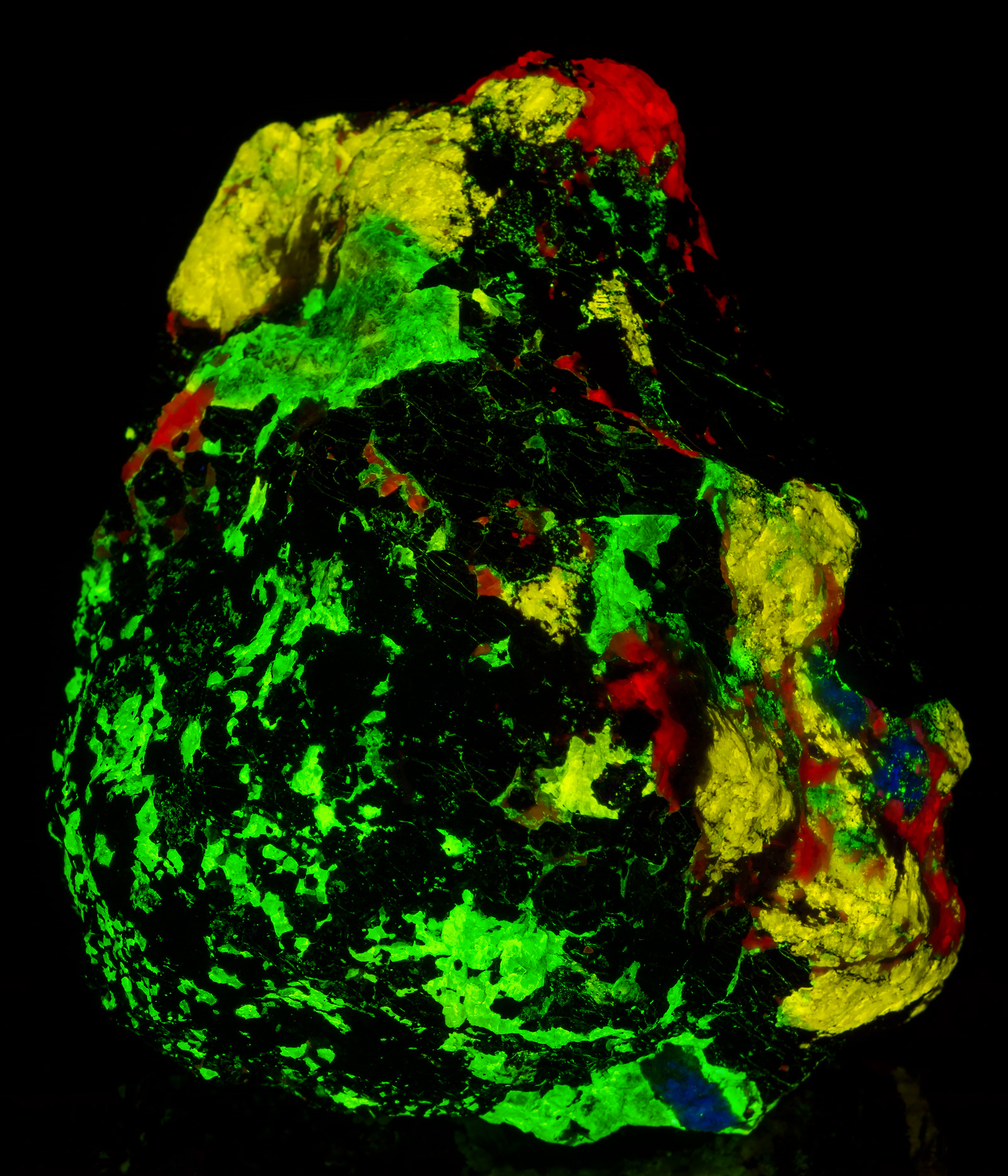
Once you have a set of properly exposed photos they must be merged. This is easily done using image editing software (Photoshop for example) and layers, but an introduction to Photoshop isn’t possible in this column – you’ll have to learn that on your own. In the editing software you combine the various photos, erasing the parts that are overexposed, and end up with a single picture which looks like the rock (the most important factor in this exercise). (Another blog post explores this technique in depth – find it here in the photography section.)
This procedure is not limited to esperite/willemite pieces. It can be very helpful for any mineral which fluoresces brightly in one area, dim in another.