
Multi-color and Multi-wavelength Specimen – Sar-e-Sang, Afghanistan
Contributed by: Michael Crawford
Date: Aug 16th, 2026
Locality: Sar-e-Sang, Kuran wa Munjan District, Badakhshan, Afghanistan (See on Mindat)
Size: 7 x 9 cm
Description:
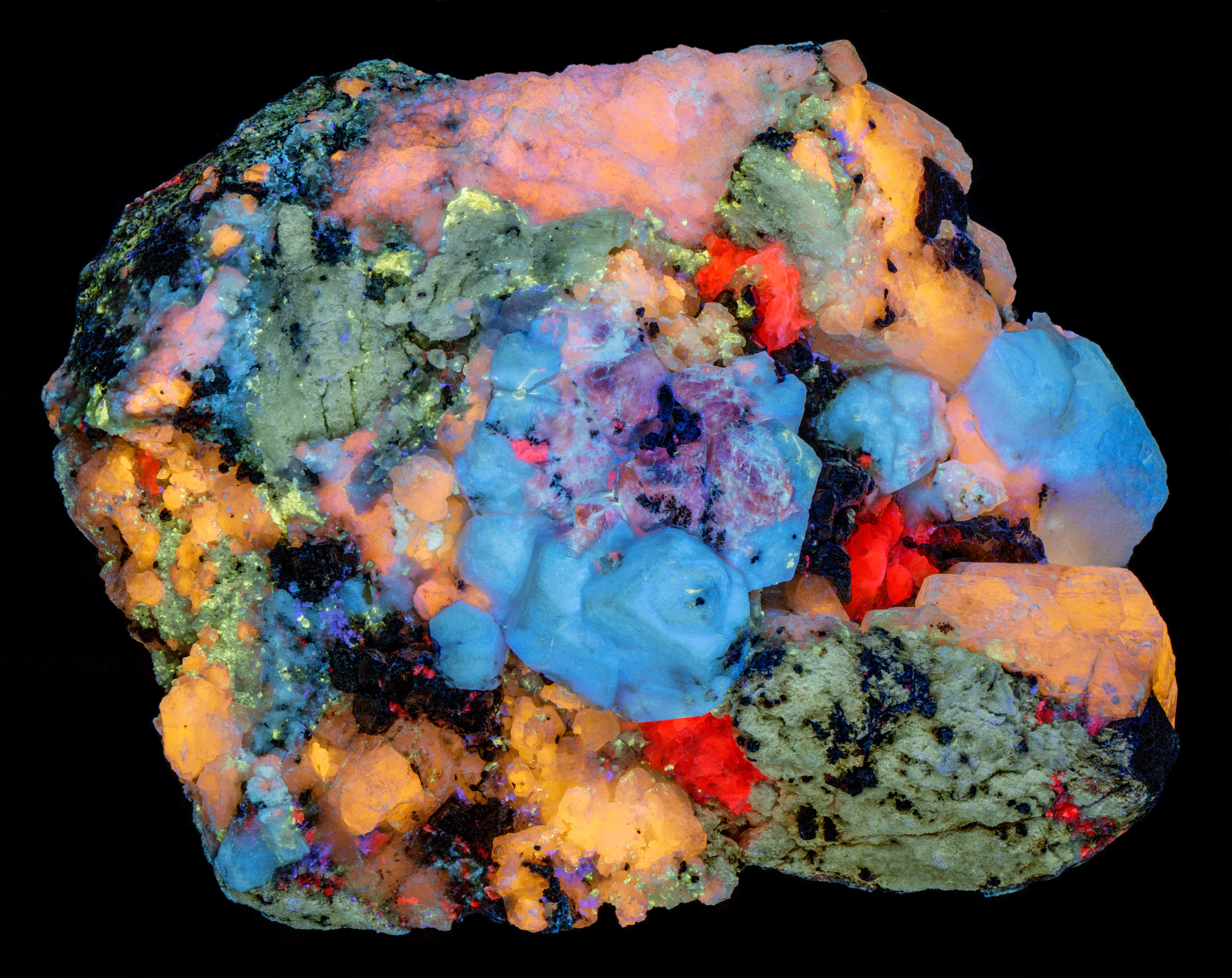
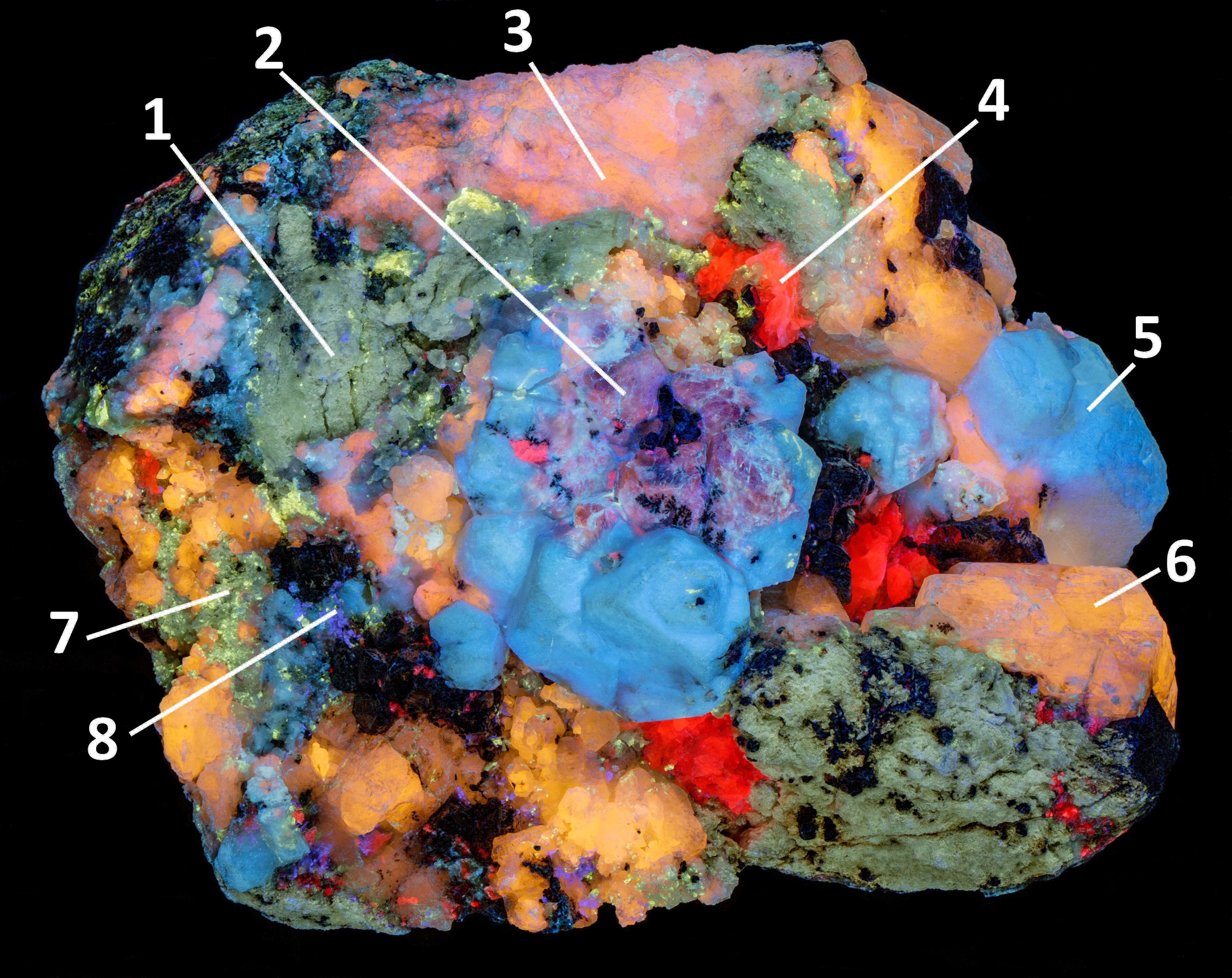
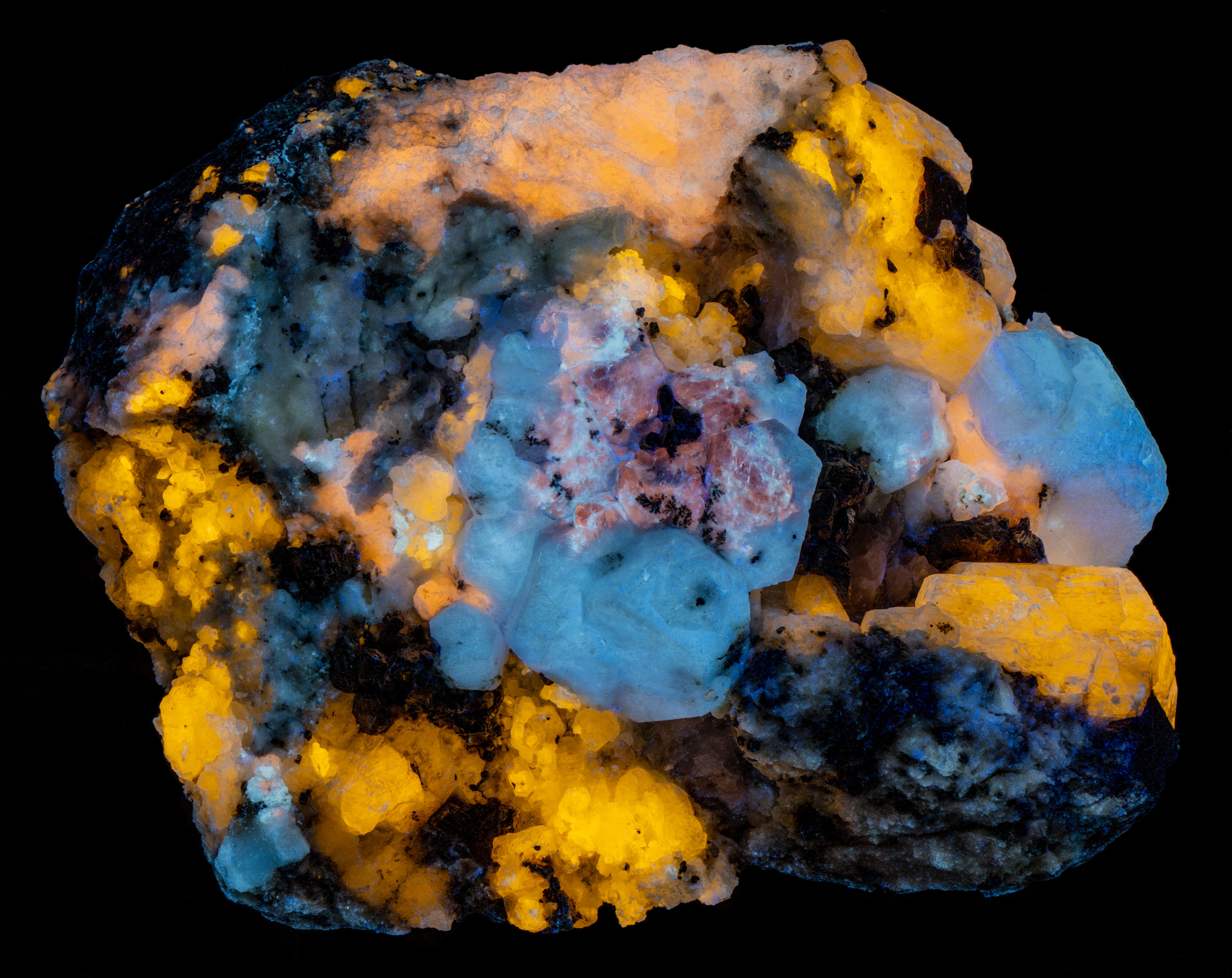
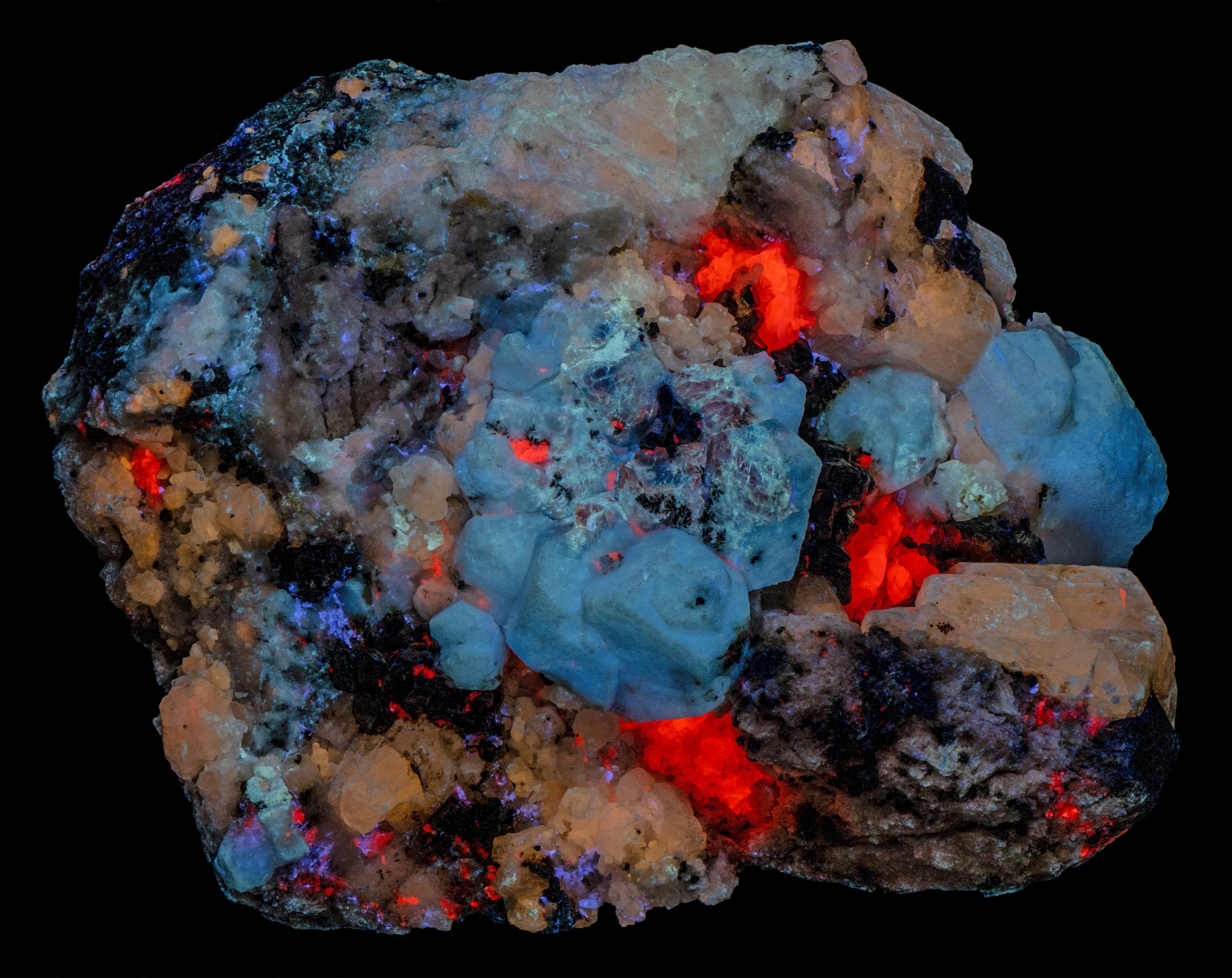
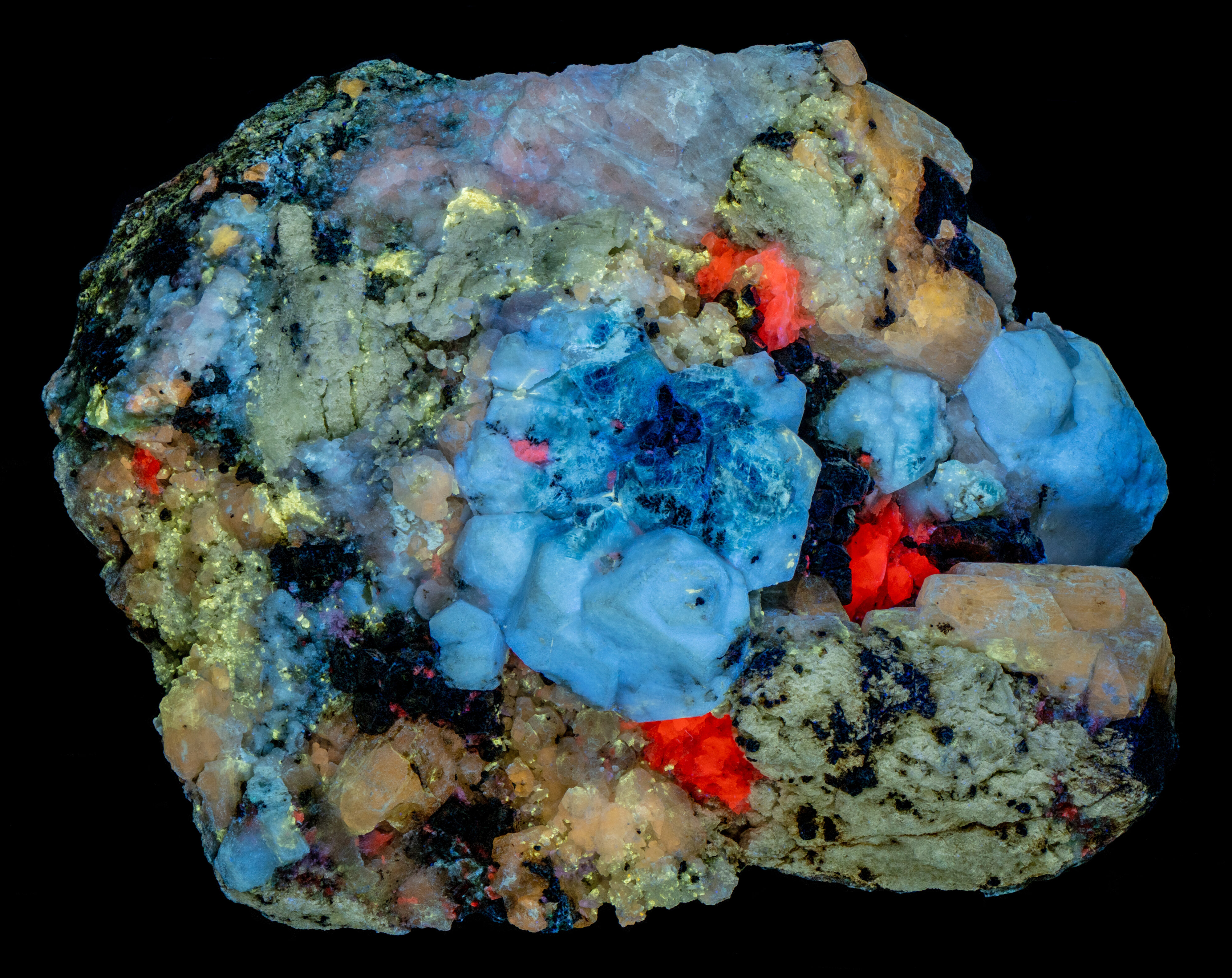
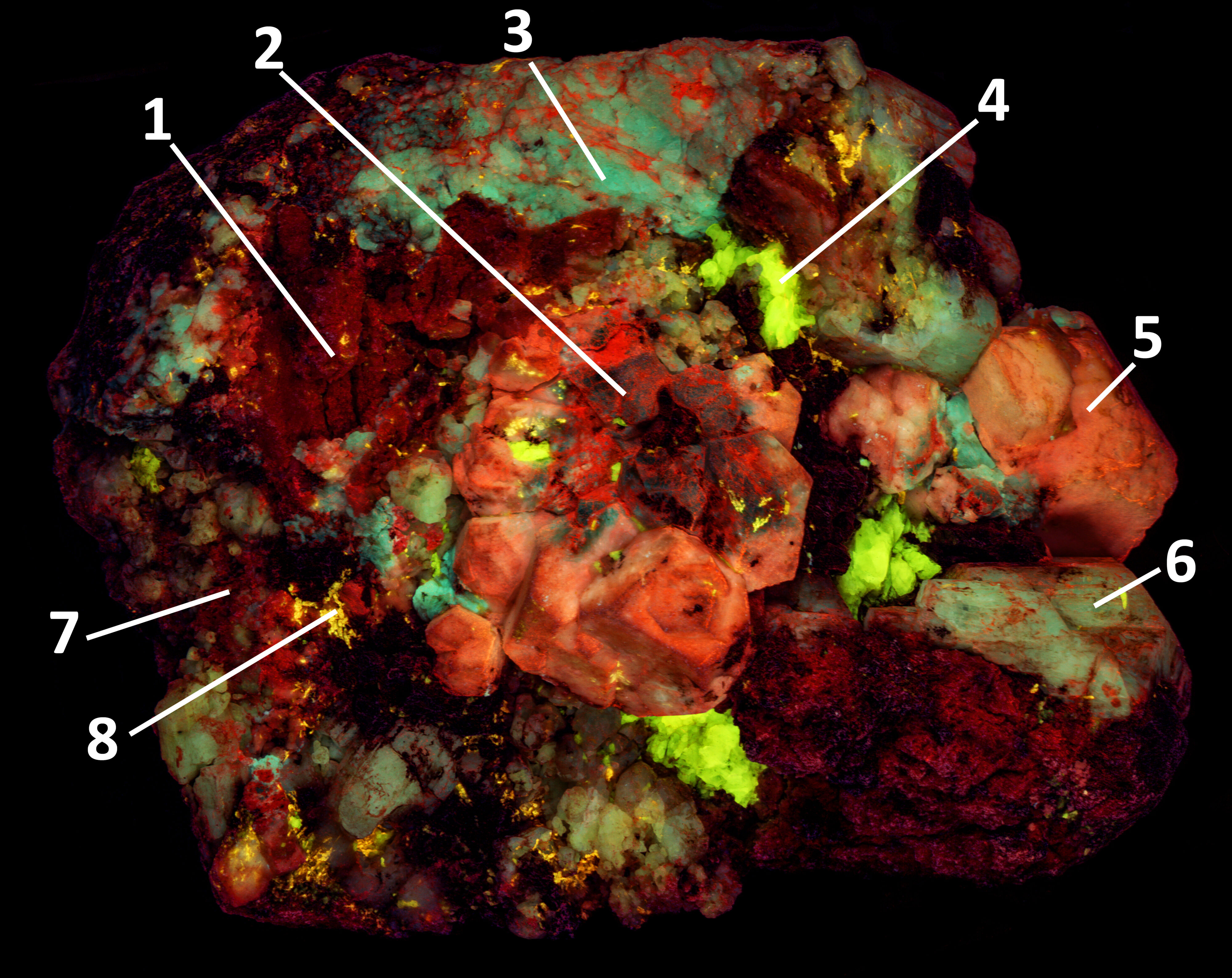
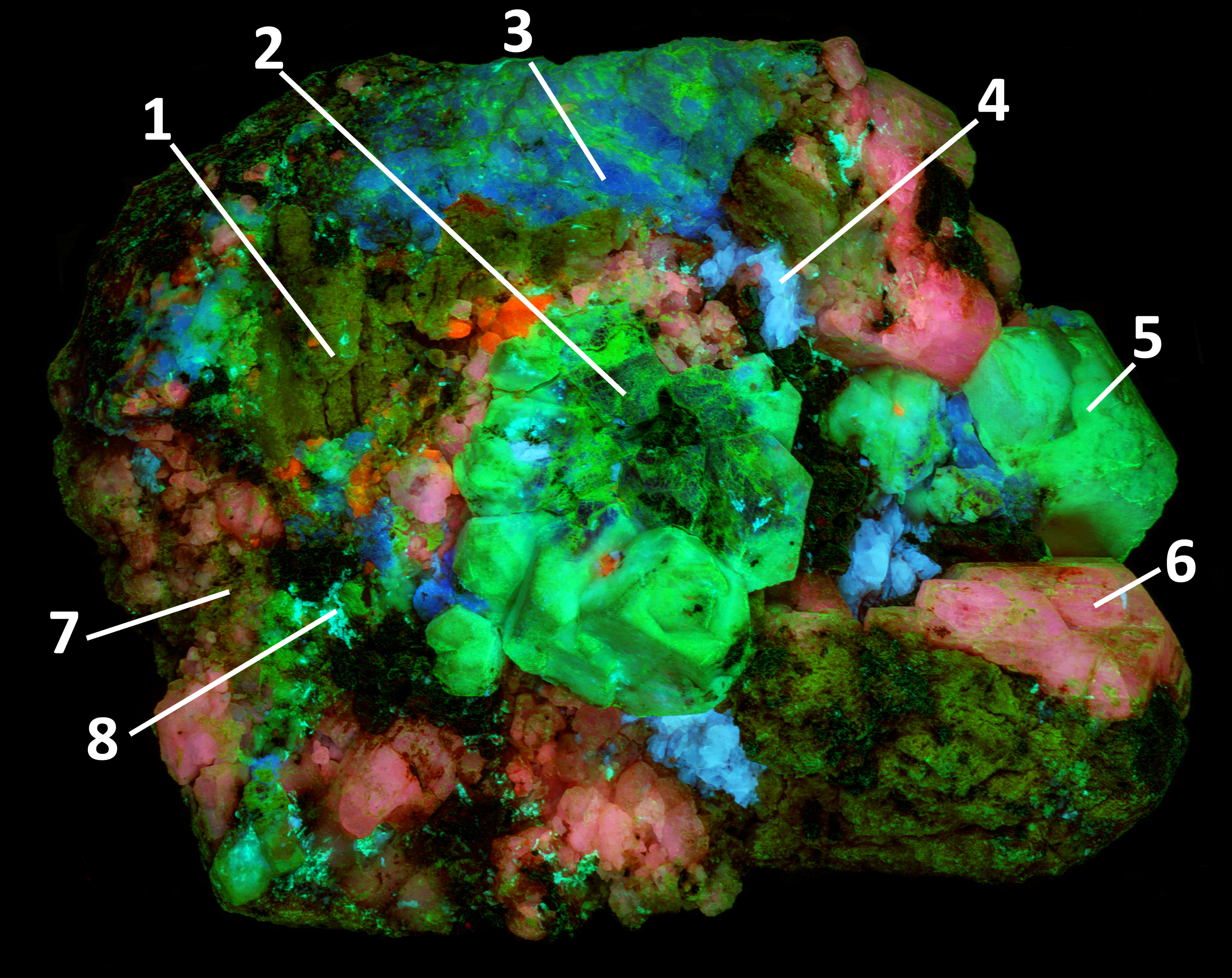
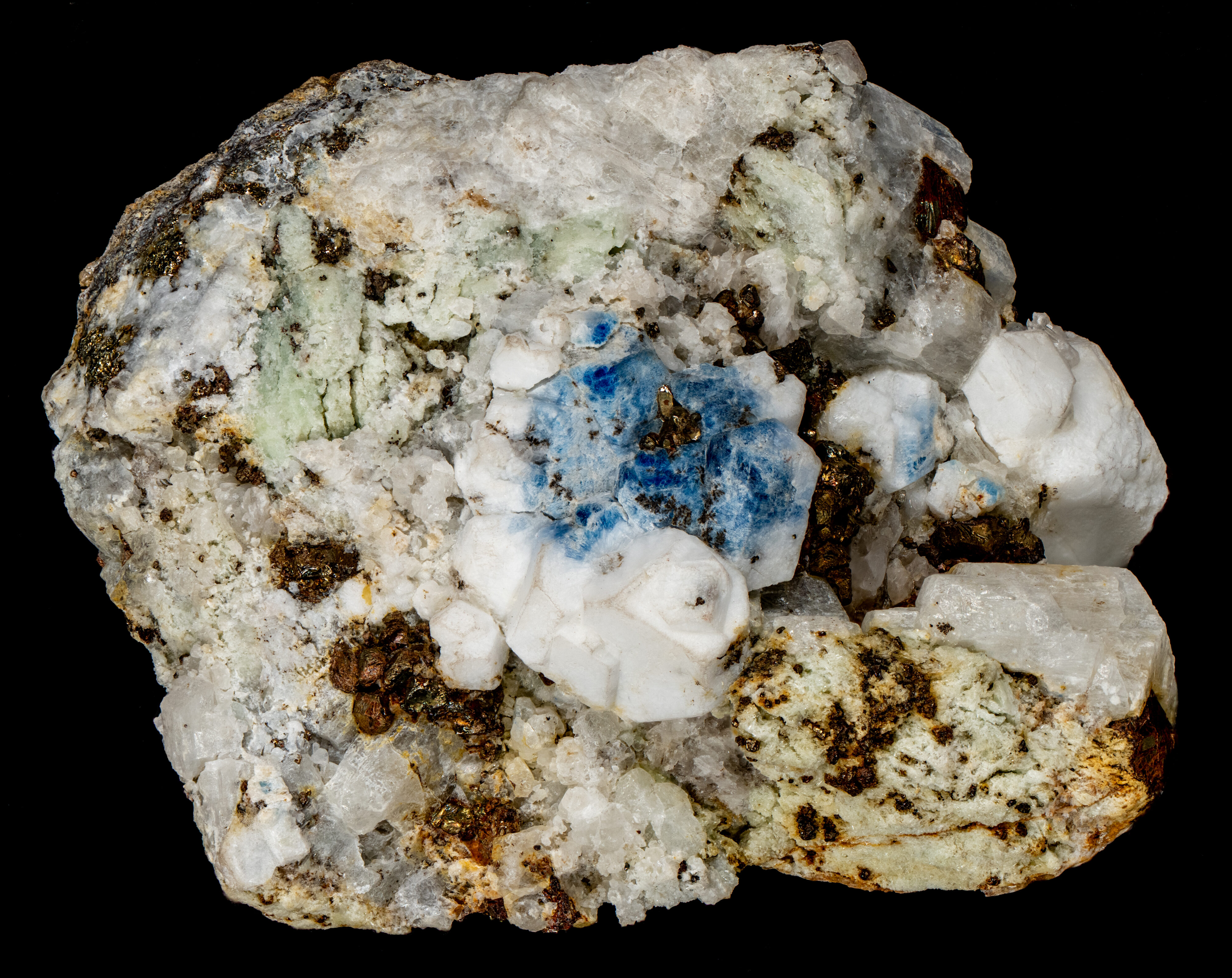
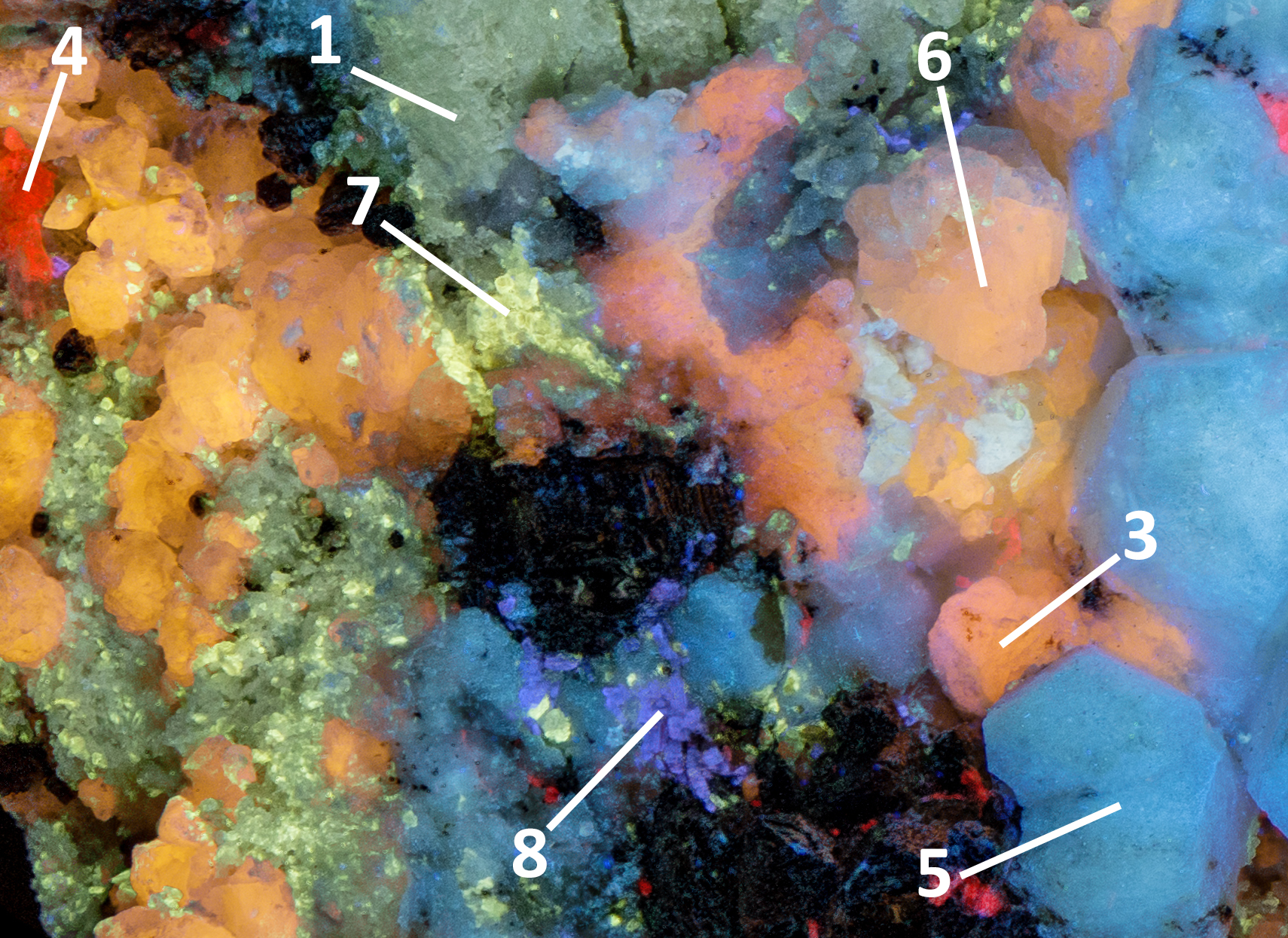
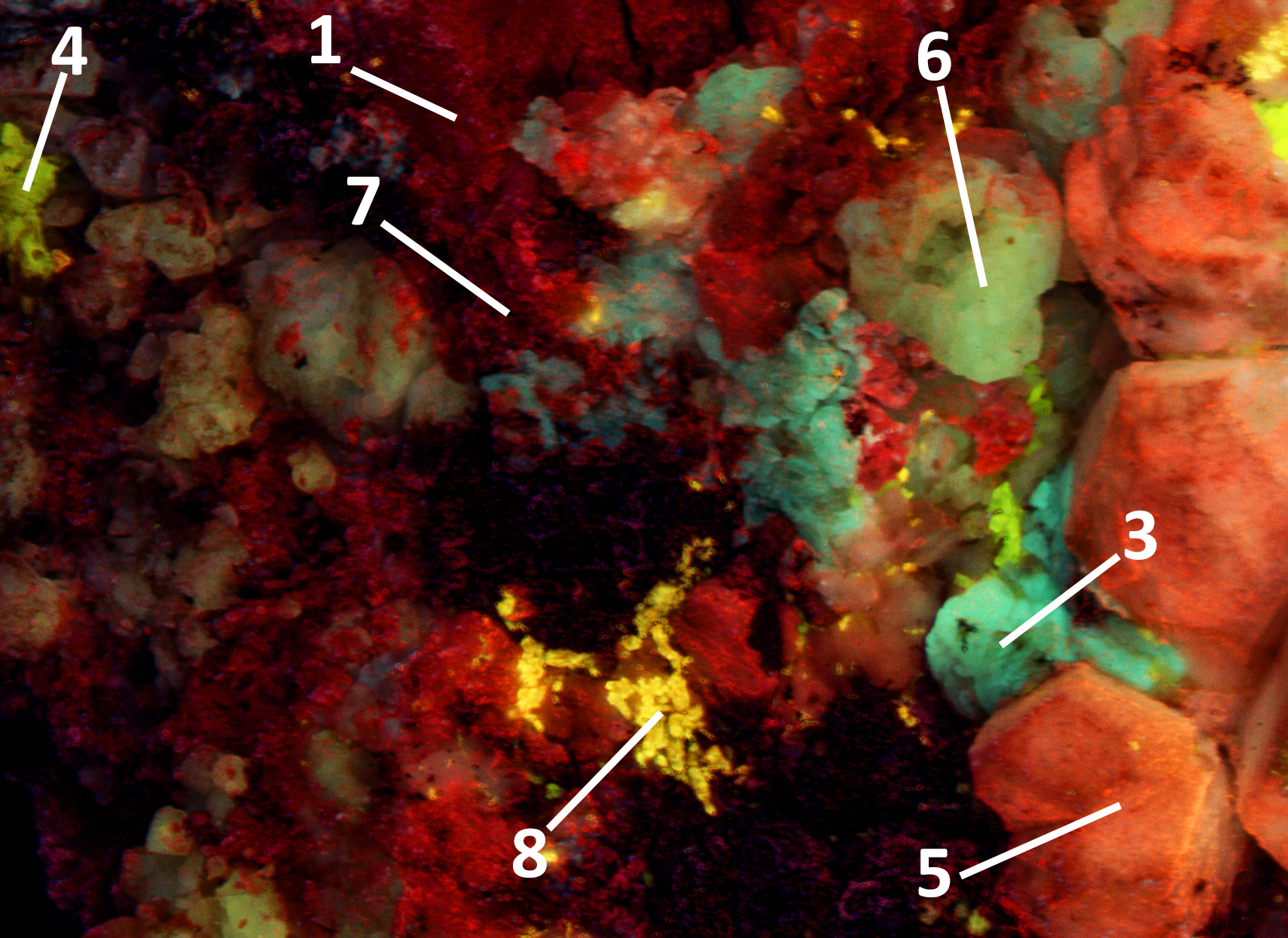
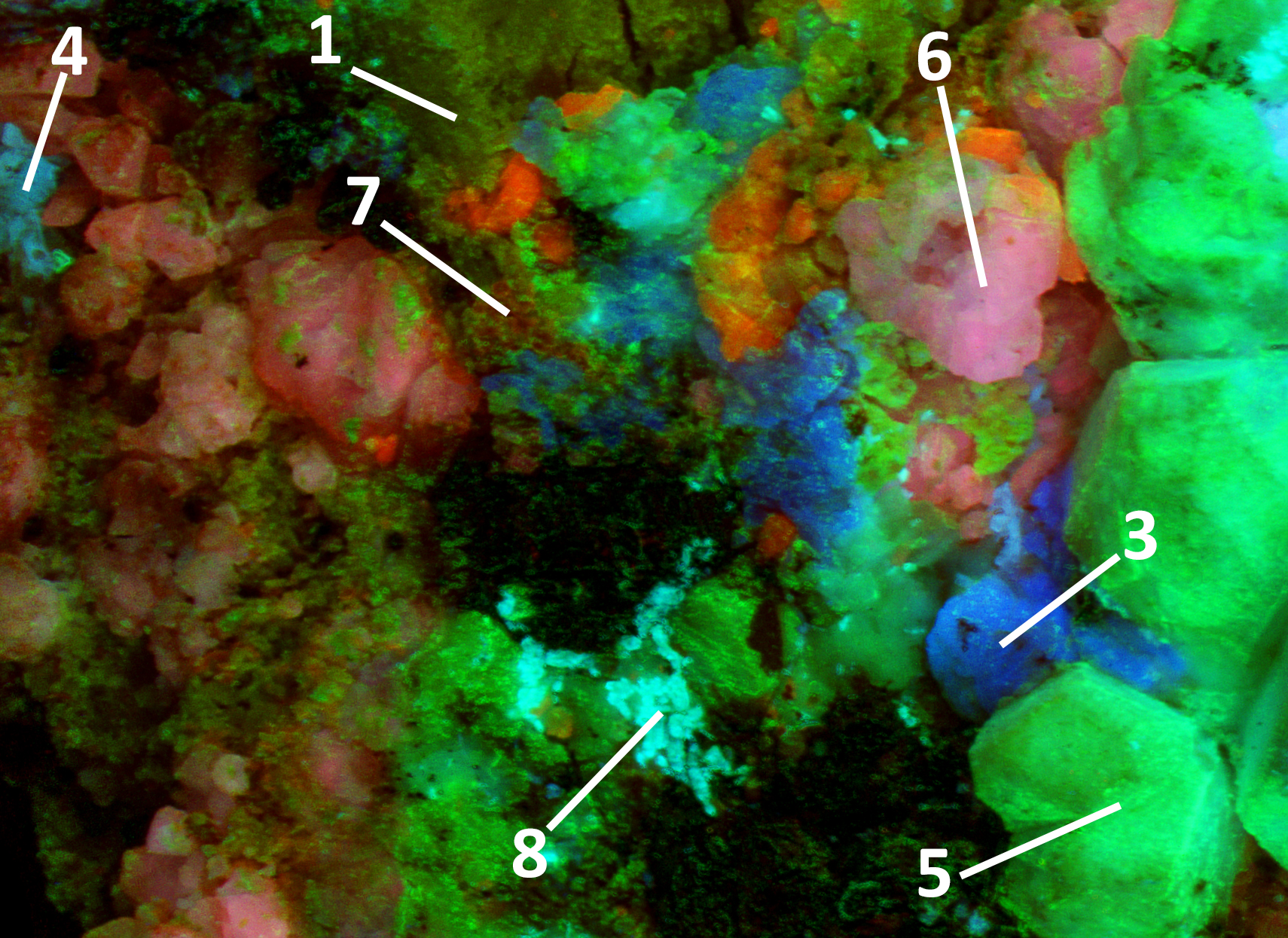
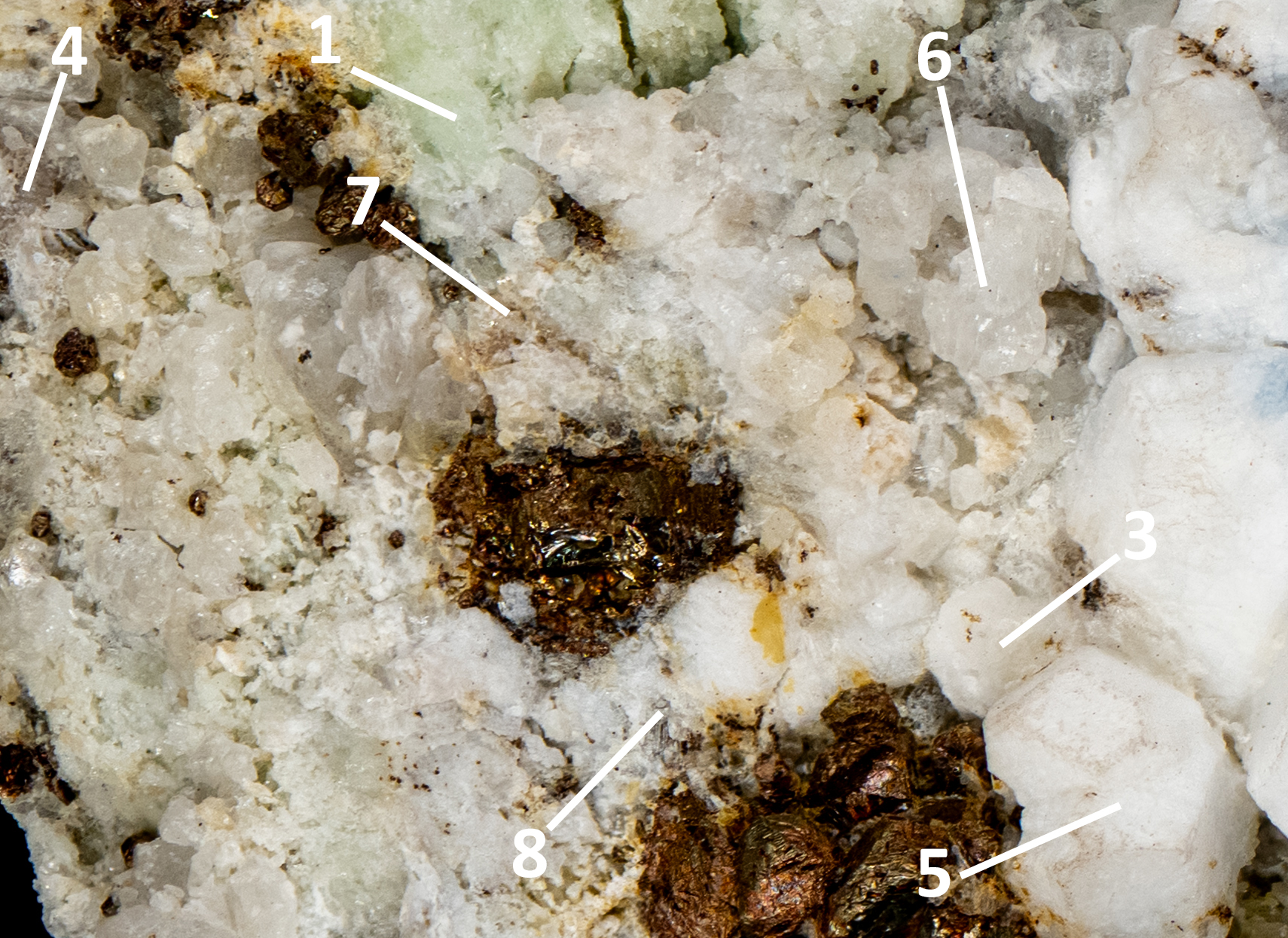
This Sar-e-Sang, Afghanistan specimen contains eight fluorescent minerals:
1. Diopside (CaMgSi2O6) – greenish gray under SW – pale green under white light.
2. Hauyne (Na3Ca(Si3Al3)O12(SO4)) – orange under LW and MW. Non-fluorescent SW. Blue under white light.
3. Afghanite ((Na,K)22Ca10(Si24Al24O96)(SO4)6Cl6) – yellow under LW, MW, and SW
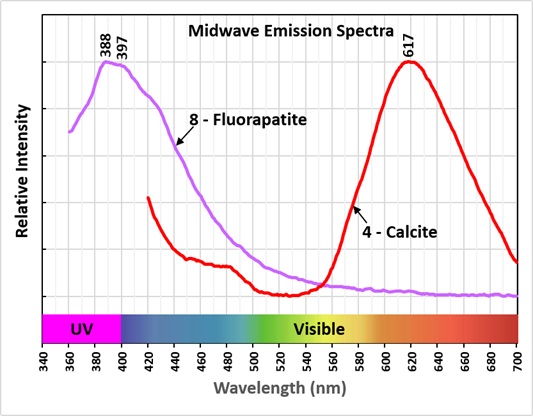
4. Calcite (CaCO3) – red under MW and SW. Non-fluorescent LW.
5. Gonnardite (((Na,Ca)2(Si,Al)5O10·3H2O) – light blue under LW, MW and SW
6. Marialite (Na4Al3Si9O24Cl) – yellow under LW, MW, and SW
7. Phlogopite (KMg3(AlSi3O10)(OH)2) – pale yellow under SW. Non-fluorescent LW and MW.
8. Fluorapatite (Ca5(PO4)3F) – violet under MW and SW. Non-fluorescent LW.
The numbers in this list correspond to labels shown in the images. The specimen also includes non-fluorescent pyrite.
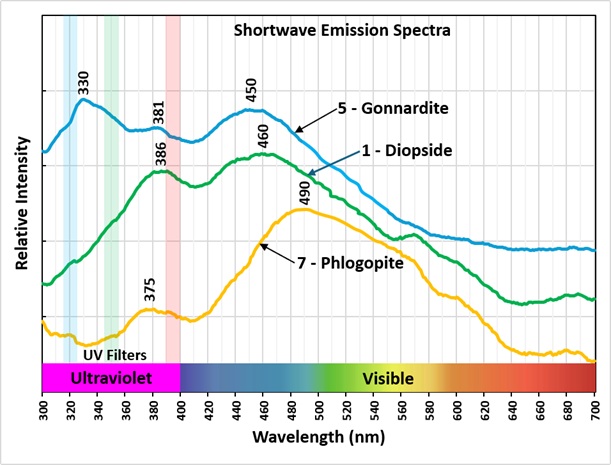
These minerals can be identified by their emission spectra, their visible fluorescence under different UV illumination wavelengths, and their ultraviolet and near-infrared fluorescence under shortwave UV light. Each of the eight fluorescent minerals is brightest at a particular UV wavelength and may be non-fluorescent under other UV wavelengths. Hauyne, marialite, afghanite, and gonnardite are brightest under longwave light; calcite and fluorapatite are brightest under midwave light; and diopside and phlogopite are brightest under shortwave light. A "fullwave" image is the best way to show the strongest fluorescence of all the minerals at once. It is made by illuminating the specimen with longwave, midwave, and shortwave UV light simultaneously, or by creating a digital composite from separate LW, MW, and SW images. The "fullwave" image shown here is a digital composite. For each color channel, it uses the brightest red, green, and blue pixels from the LW, MW, and SW images. In practice, true "fullwave" photography is difficult because LW, MW, and SW lamps often have very different intensities, and the resulting colors depend strongly on the relative strength of each UV source. The digital composite helps balance the fluorescence intensity across the three wavelengths.
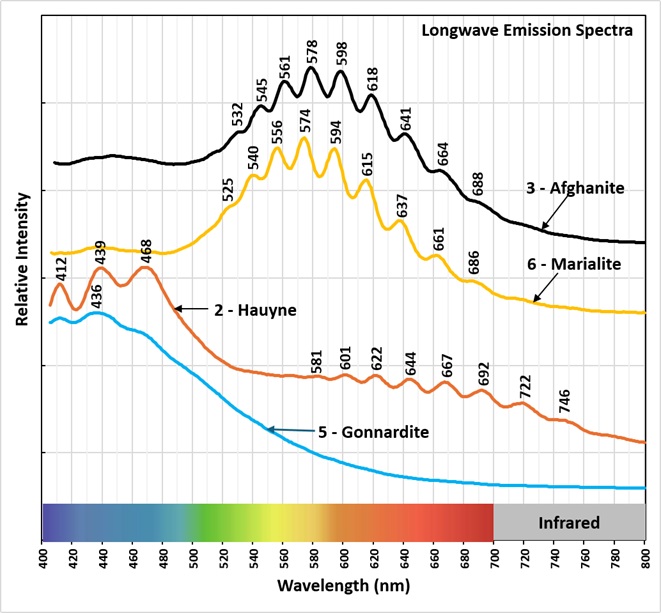
Longwave emission spectra show that the fluorescence of three minerals—hauyne, marialite, and afghanite—is activated by disulfide (S22-. Disulfide replaces some of the sulfate in hauyne, some of the chlorine in marialite and some of the sulfate and chlorine in afghanite. The disulfide ion produces a vibronic signature in each spectrum. Vibronic emission occurs when electronic transitions in the disulfide ion couple with molecular vibrations, creating a series of sharp, semi-regular peaks on a broad emission band. These peaks are spaced about 15 nm to 24 nm apart. The wavelength of the maximum amplitudes of the vibronic peaks is different for each mineral. The vibronic peak signatures differ among the minerals because the disulfide ion is coordinated differently within each mineral's elemental composition and lattice structure. The positions of the vibronic peaks can therefore help identify the minerals.
Hauyne's spectrum shows a vibronic signature from 580 nm to 750 nm. It also includes peaks at 412 nm, 439 nm, and 468 nm from gonnardite mixed with the hauyne. The activator responsible for these gonnardite peaks is unknown; possible causes include lattice defects, rare earth elements, or titanium-oxygen vacancies.
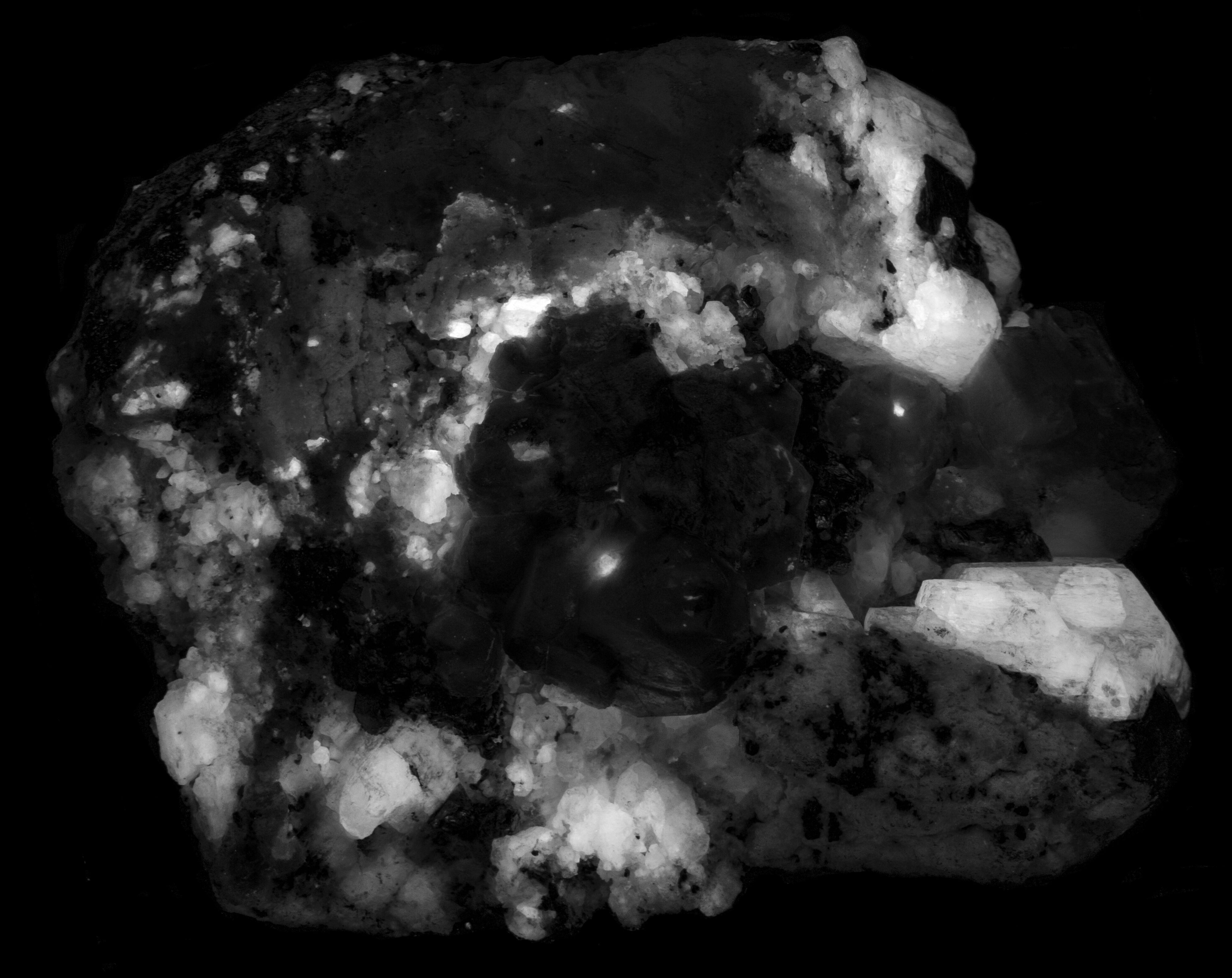
False-color images reveal that several minerals have ultraviolet and near-infrared fluorescence under shortwave illumination. A near-infrared image taken with a 720 nm bandpass filter shows fluorescence only from marialite. When the infrared image is combined with ultraviolet bands, marialite appears pinkish red and can be distinguished from afghanite, which appears blue. These two minerals look similar in the other fluorescent images.
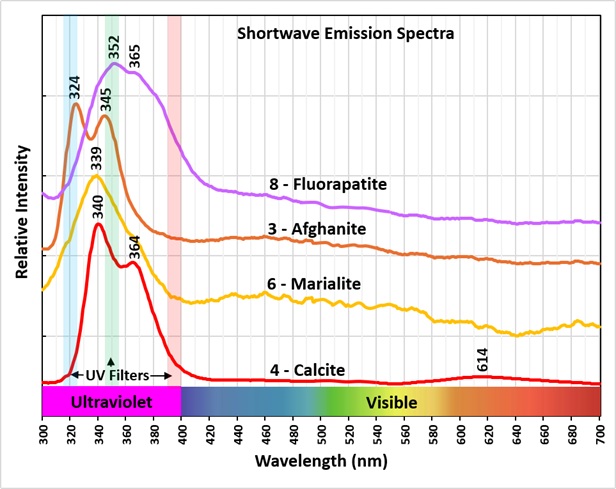
The false-color shortwave ultraviolet image shows color variations among several minerals. Fluorapatite, calcite, marialite, and afghanite all fluoresce in the ultraviolet under shortwave light, and this ultraviolet fluorescence is much brighter than their visible fluorescence. In the false-color image, fluorapatite appears yellow, calcite yellow green, marialite pale greenish gray, and afghanite pale green. Their emission spectra include sharp peaks likely caused by cerium. Calcite's spectrum shows very bright ultraviolet fluorescence—stronger than its red visible fluorescence—with cerium-related peaks at 339 nm and 365 nm. This cerium-activated ultraviolet fluorescence excites the manganese-activated red fluorescence in calcite. It is like an internal UV lamp inside the calcite.
Diopside and gonnardite also fluoresce in the ultraviolet. Their ultraviolet emission peaks are broader, with intensities comparable to their visible fluorescence, but the cause of these peaks is unknown. Diopside also has a broad visible emission peak centered near 460 nm, likely activated by titanium oxide (TiO6). Titanium oxide also activates the pale-yellow fluorescence of phlogopite, whose shortwave emission spectrum is a broad peak centered near 490 nm.
Summary of luminescence responses:
Gonnardite (Mindat) (RRUFF)
- Fluorescence under Longwave (365nm LED) UV light: Blue
- Fluorescence under Midwave (305nm LED) UV light: Blue
- Fluorescence under Shortwave (255nm LED) UV light: Blue
- Fluorescence under Longwave (365nm LED) UV light: Yellow
- Fluorescence under Midwave (305nm LED) UV light: Yellow
- Fluorescence under Shortwave (255nm LED) UV light: Yellow
- Fluorescence under Longwave (365nm LED) UV light: Yellow
- Fluorescence under Midwave (305nm LED) UV light: Red
- Fluorescence under Shortwave (255nm LED) UV light: Red
- Fluorescence under Shortwave (255nm LED) UV light: Green
- Fluorescence under Midwave (305nm LED) UV light: Violet
- Fluorescence under Longwave (365nm LED) UV light: Orange
- Fluorescence under Midwave (305nm LED) UV light: Orange
- Fluorescence under Shortwave (255nm LED) UV light: Yellow