
Radiation Alteration of Hackmanite Fluorescence – Afghanistan
Contributed by: Michael Crawford
Date: Jun 2nd, 2026
Locality: Sar-e-Sang, Kuran wa Munjan District, Badakhshan, Afghanistan (See on Mindat)
Size: 9 x 11.5 cm
Description:
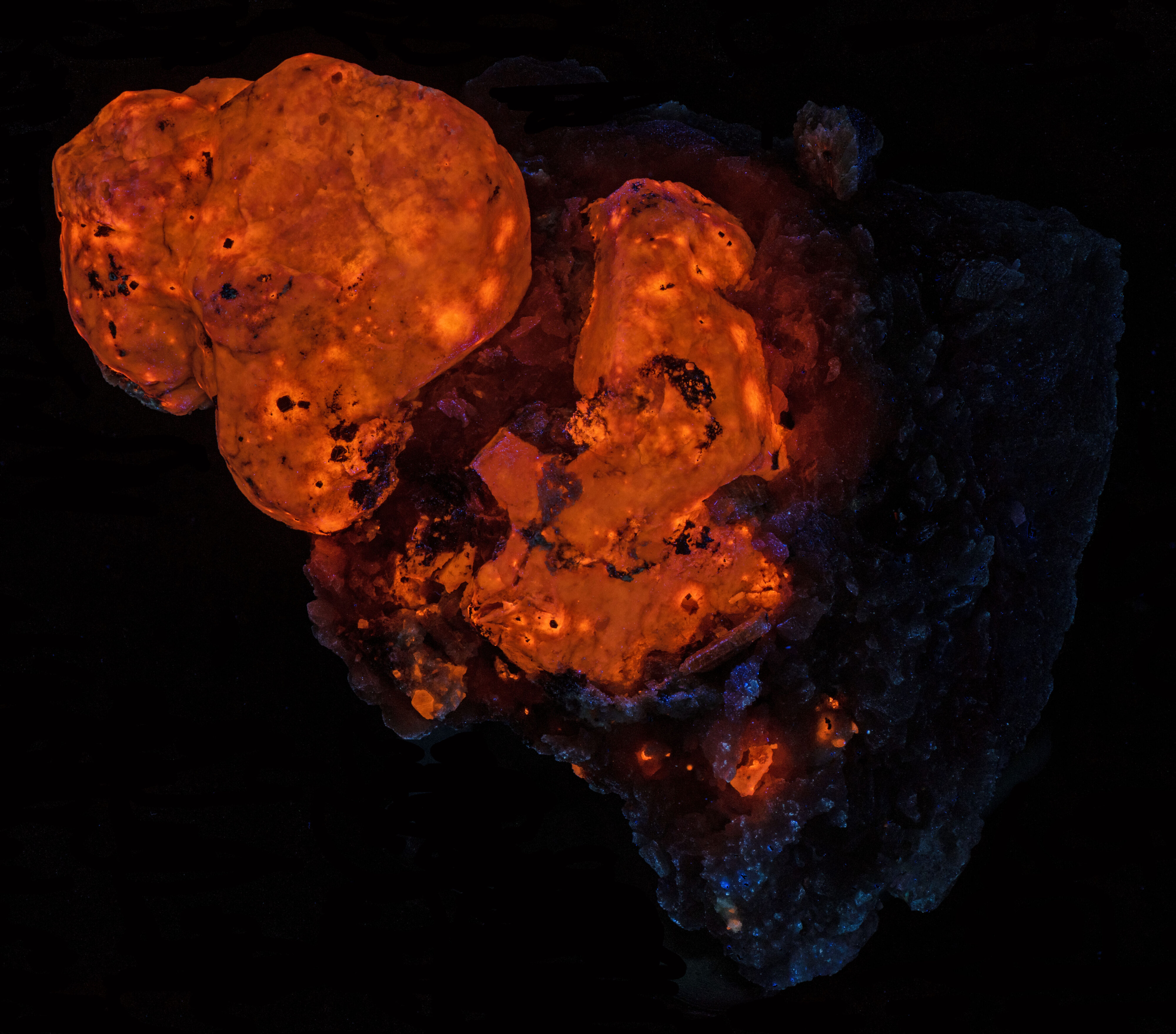
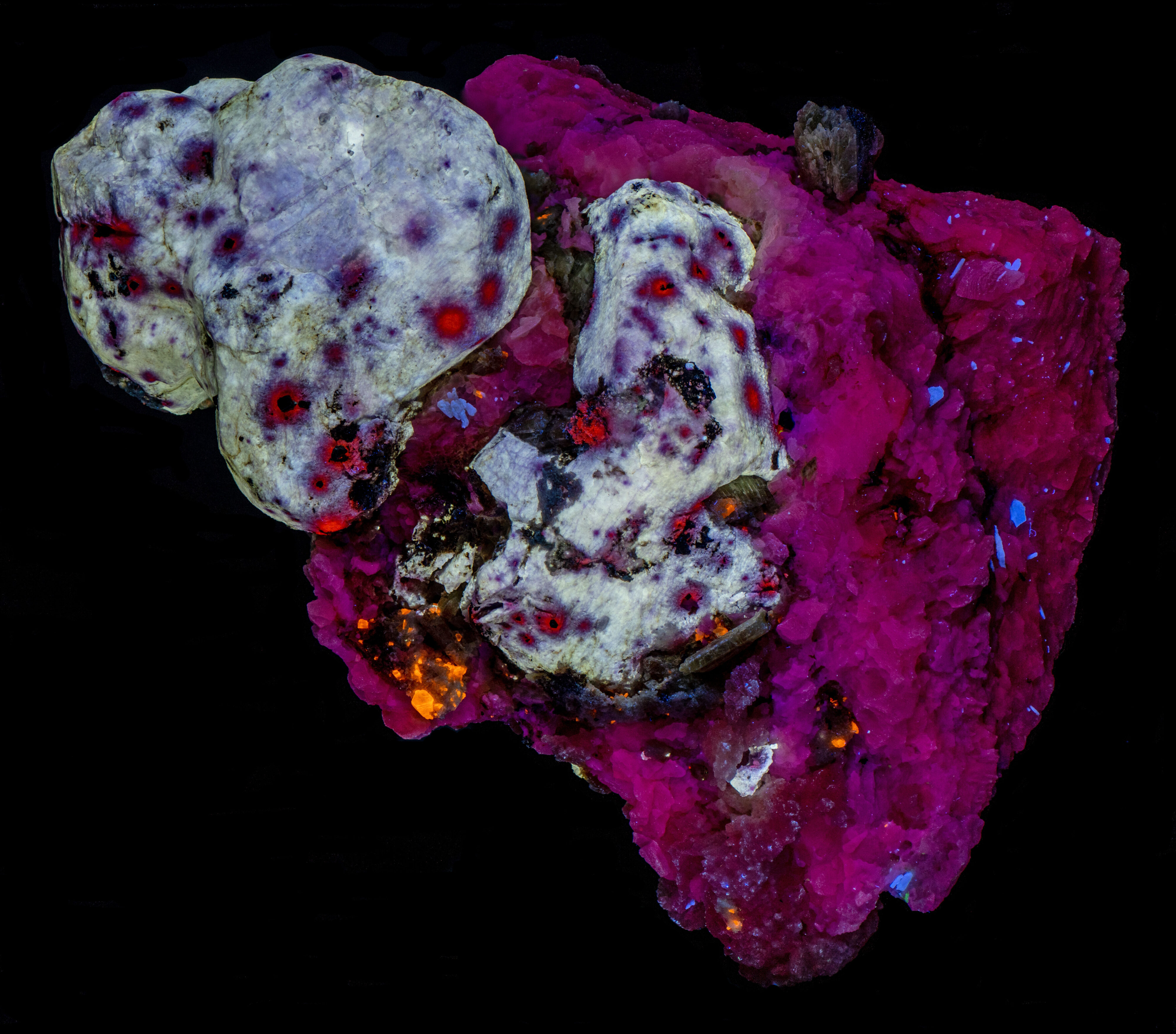
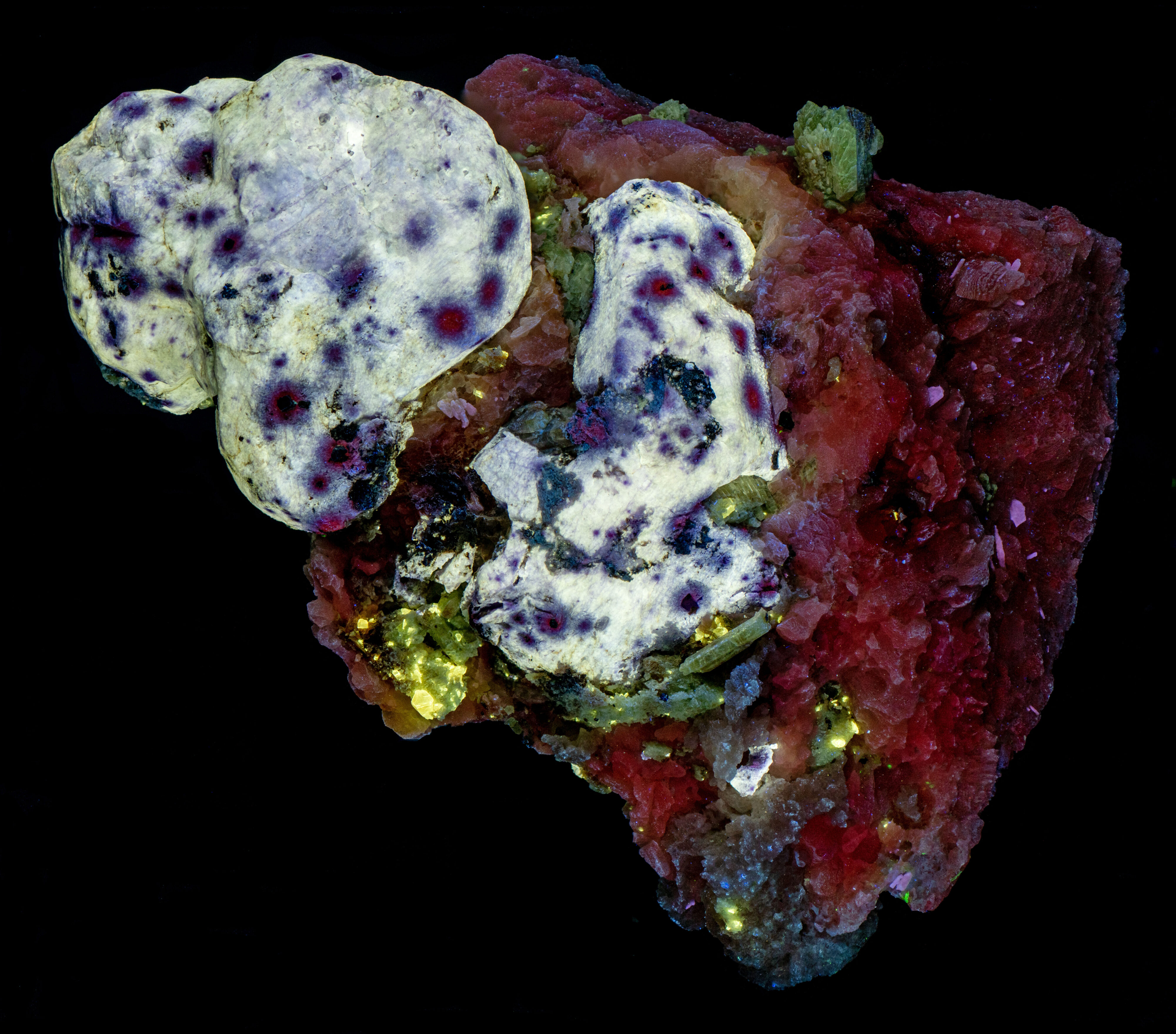
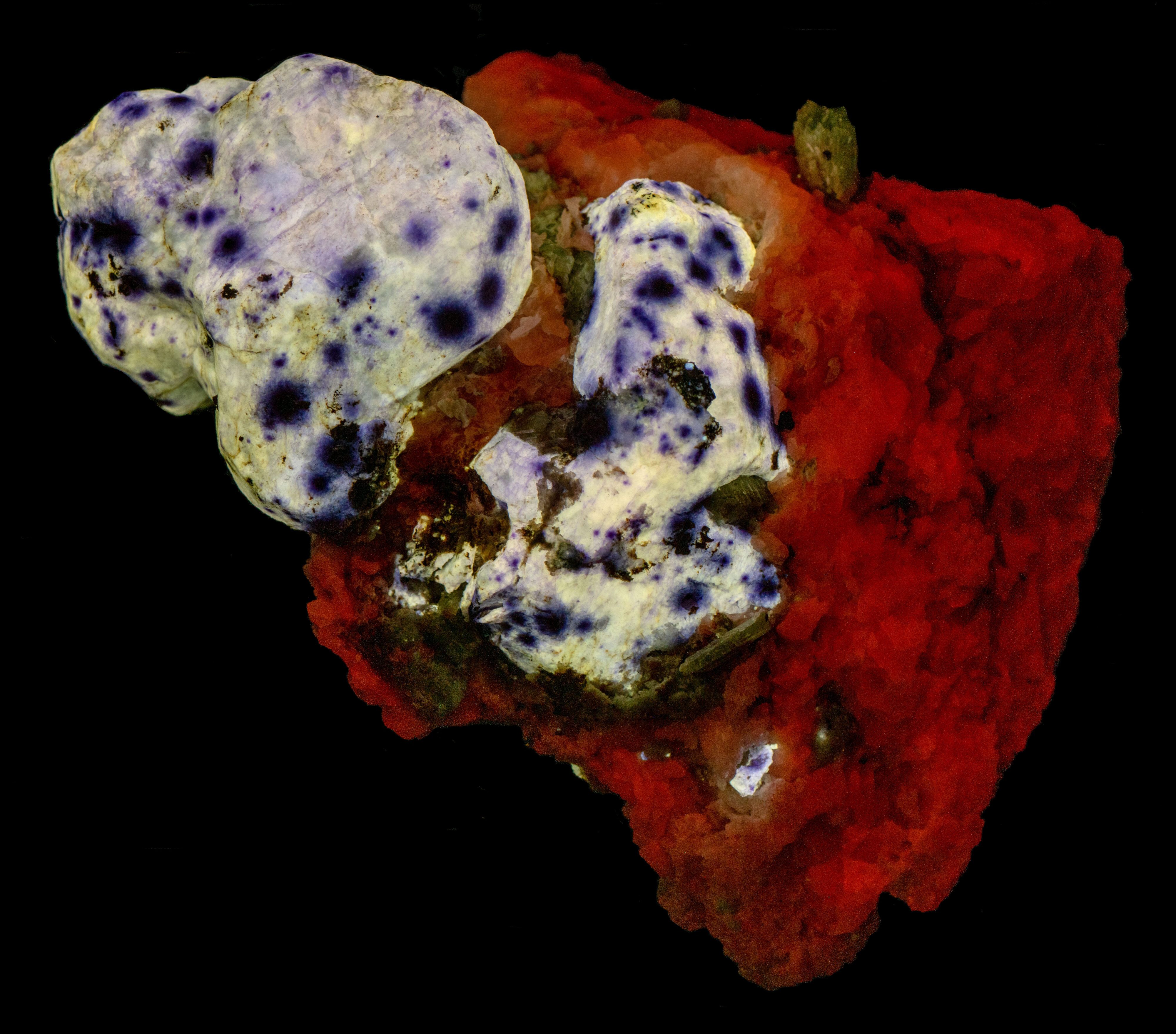
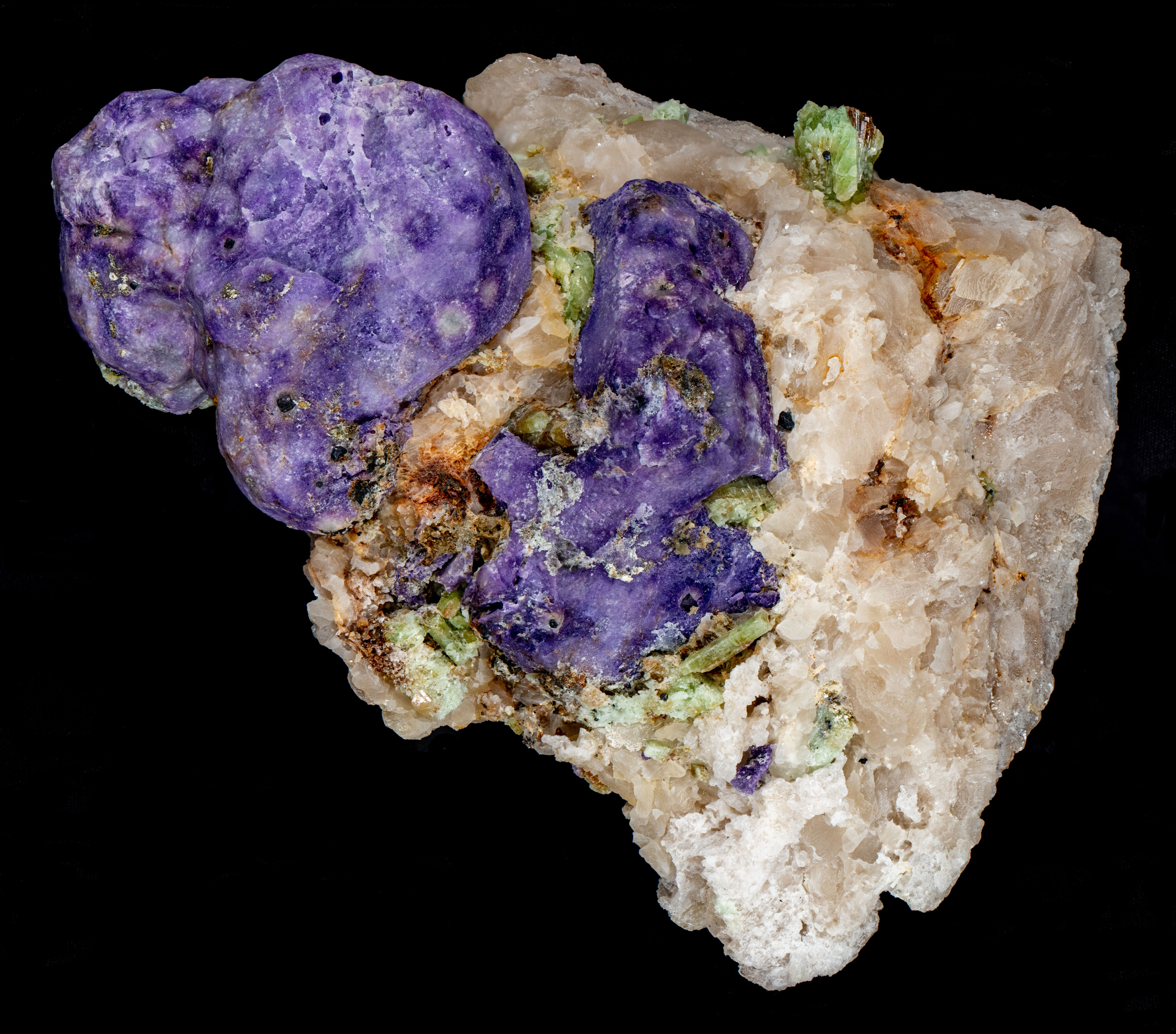
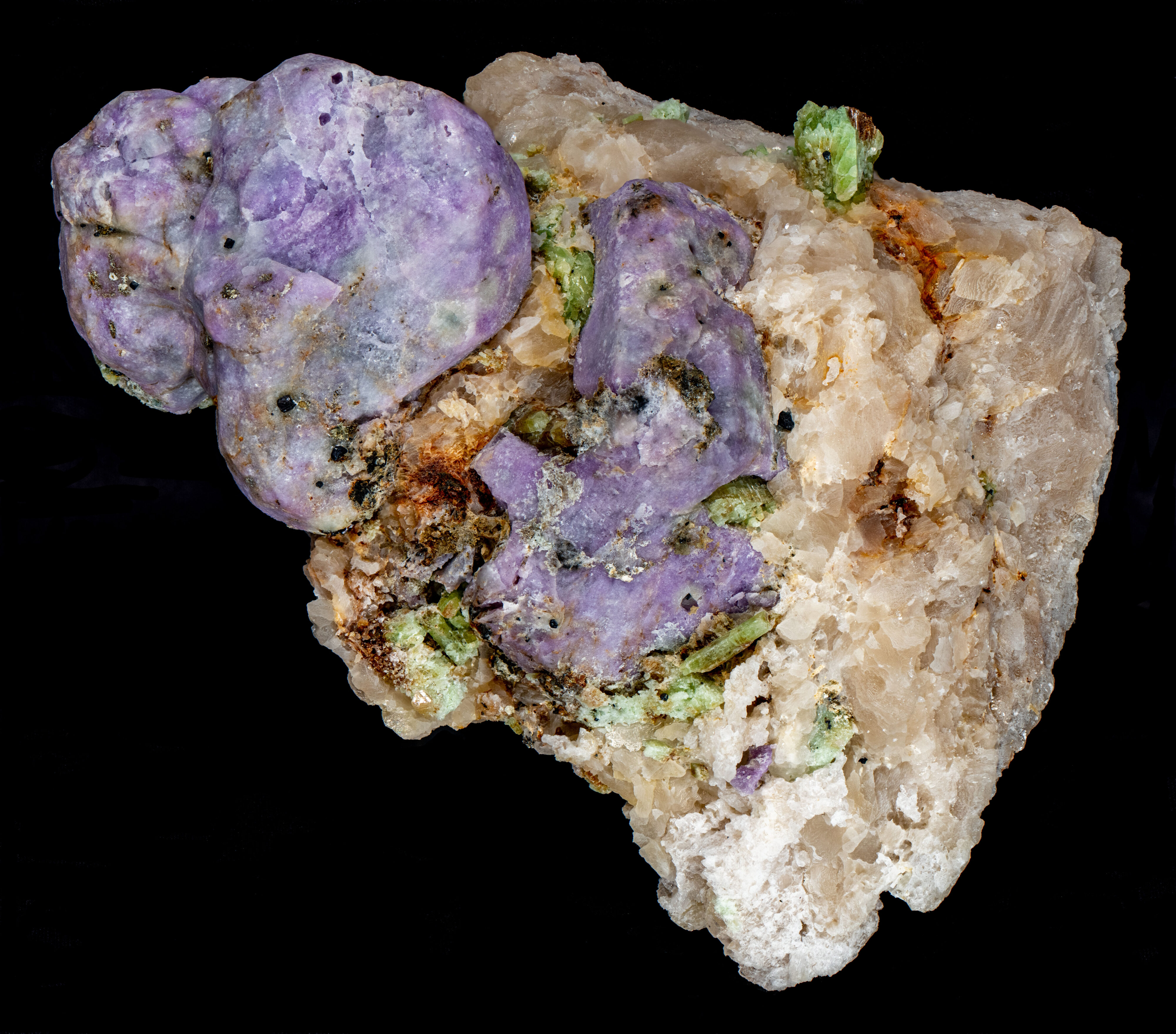
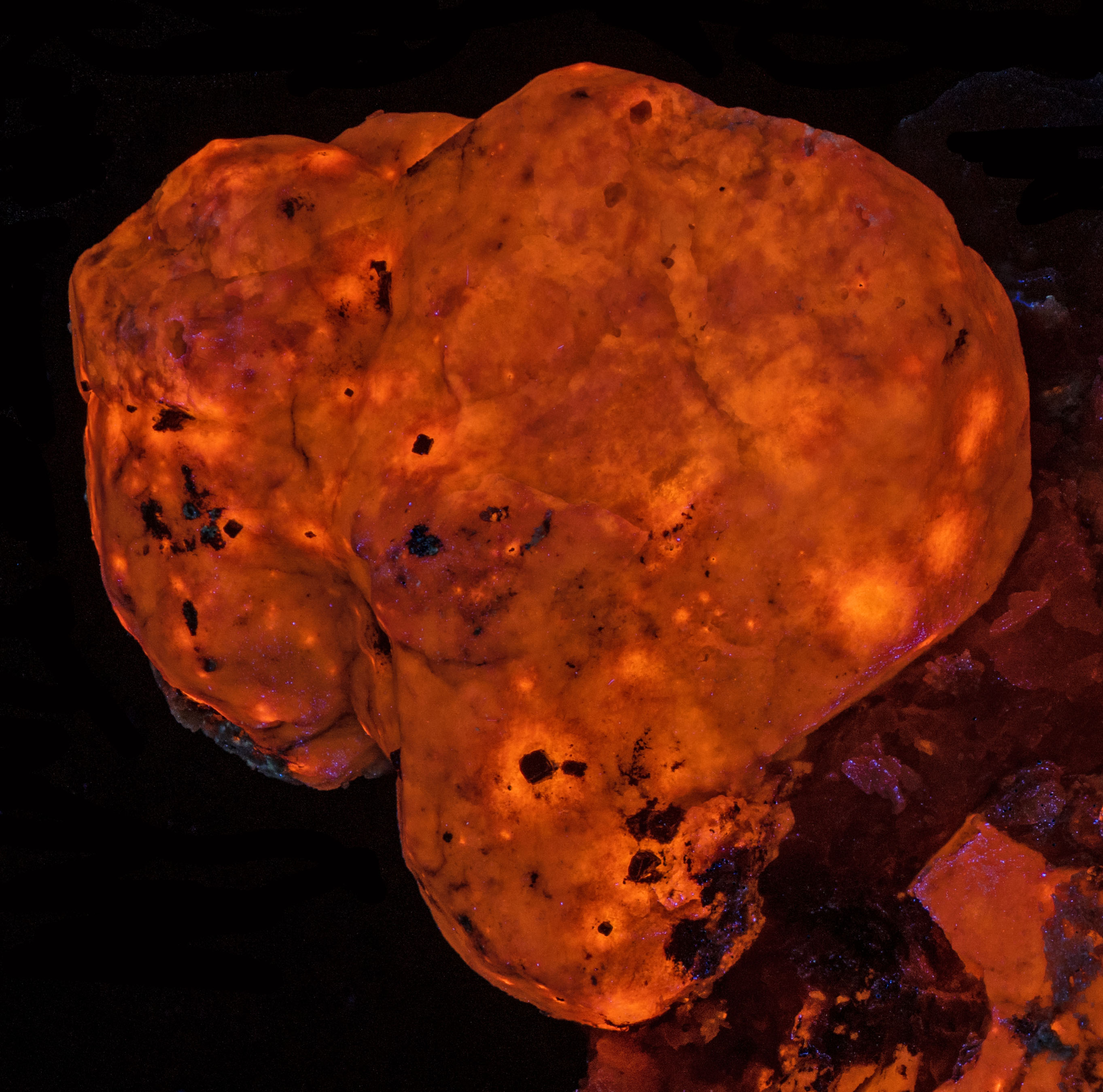
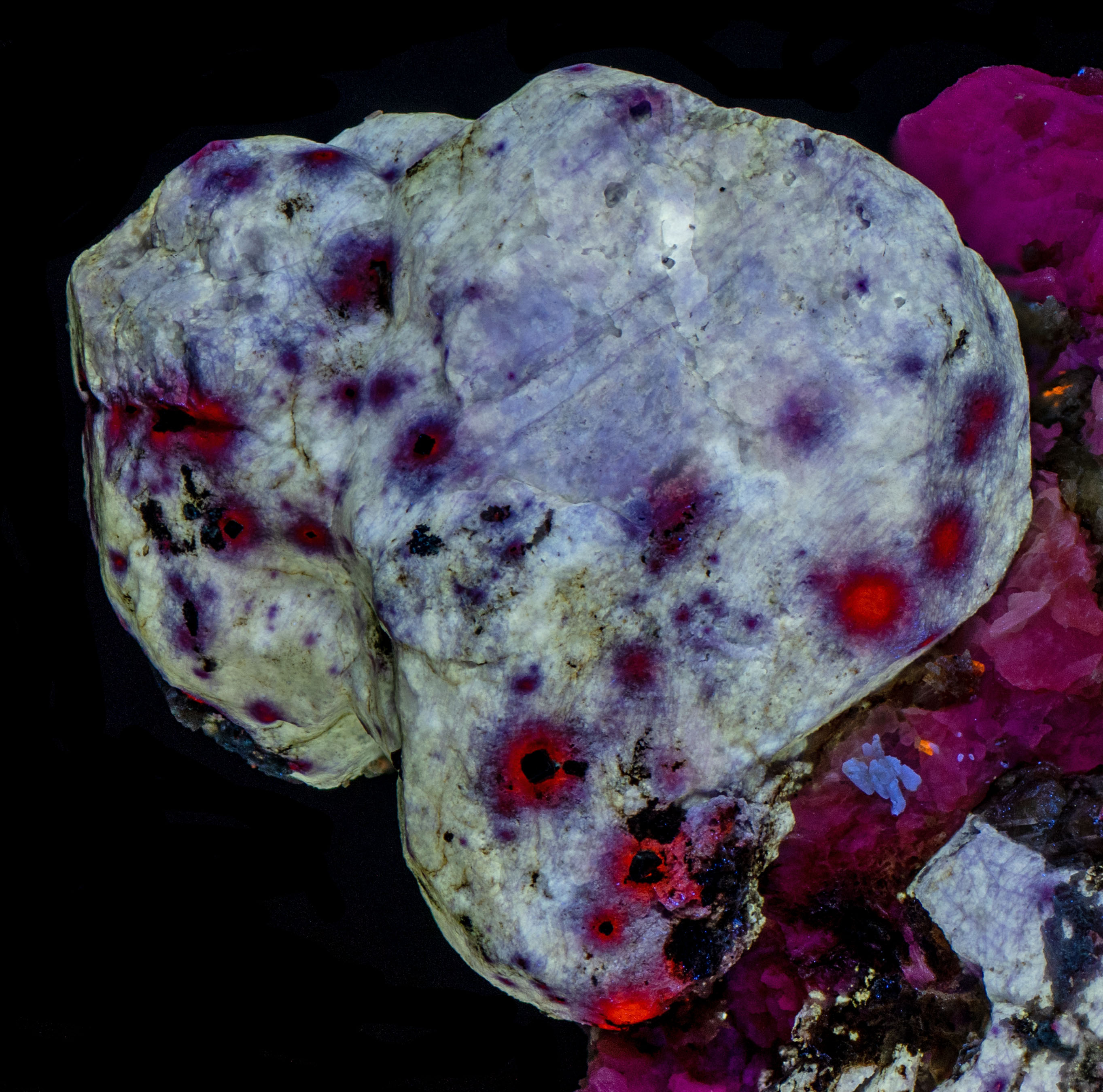
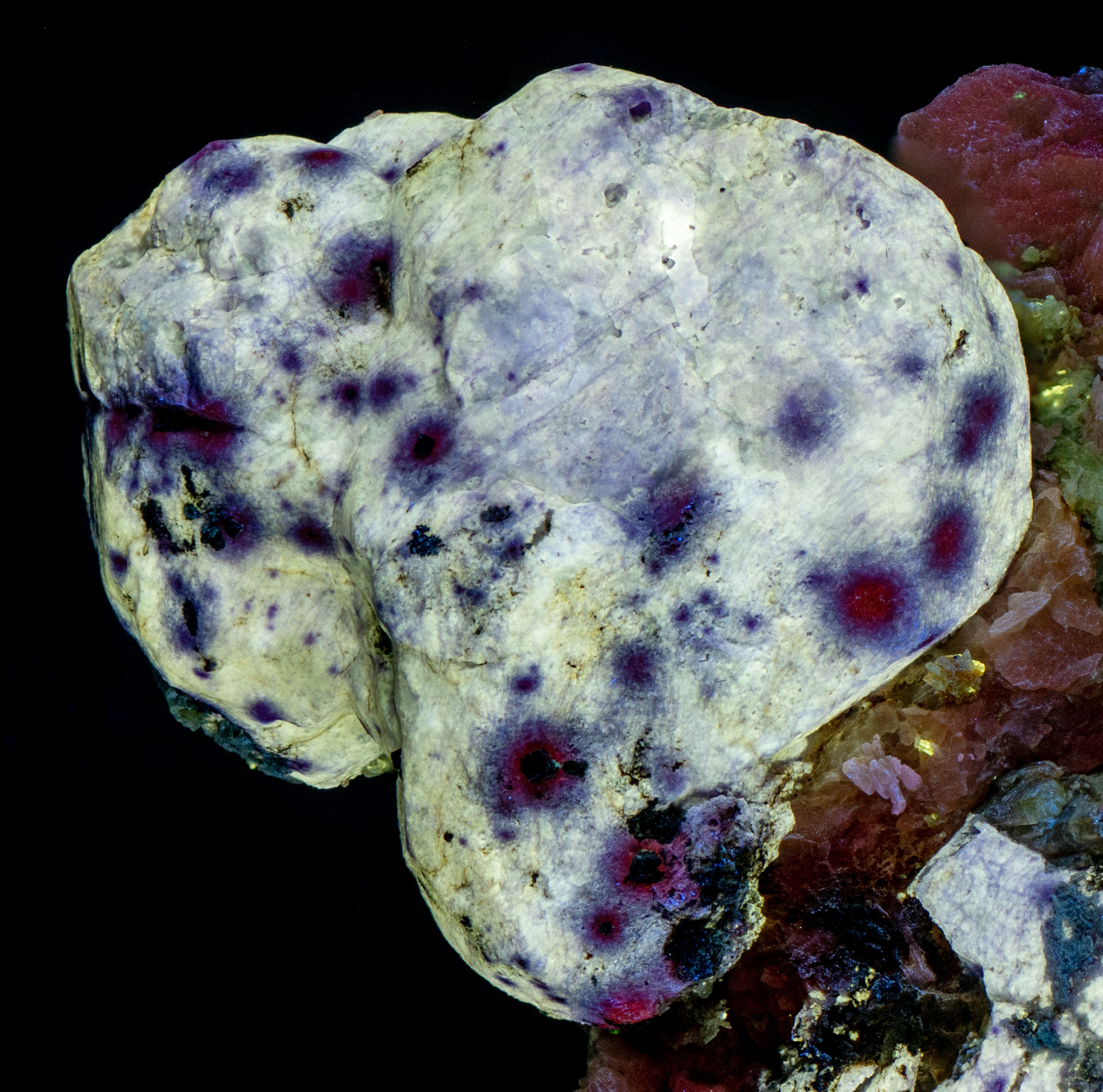
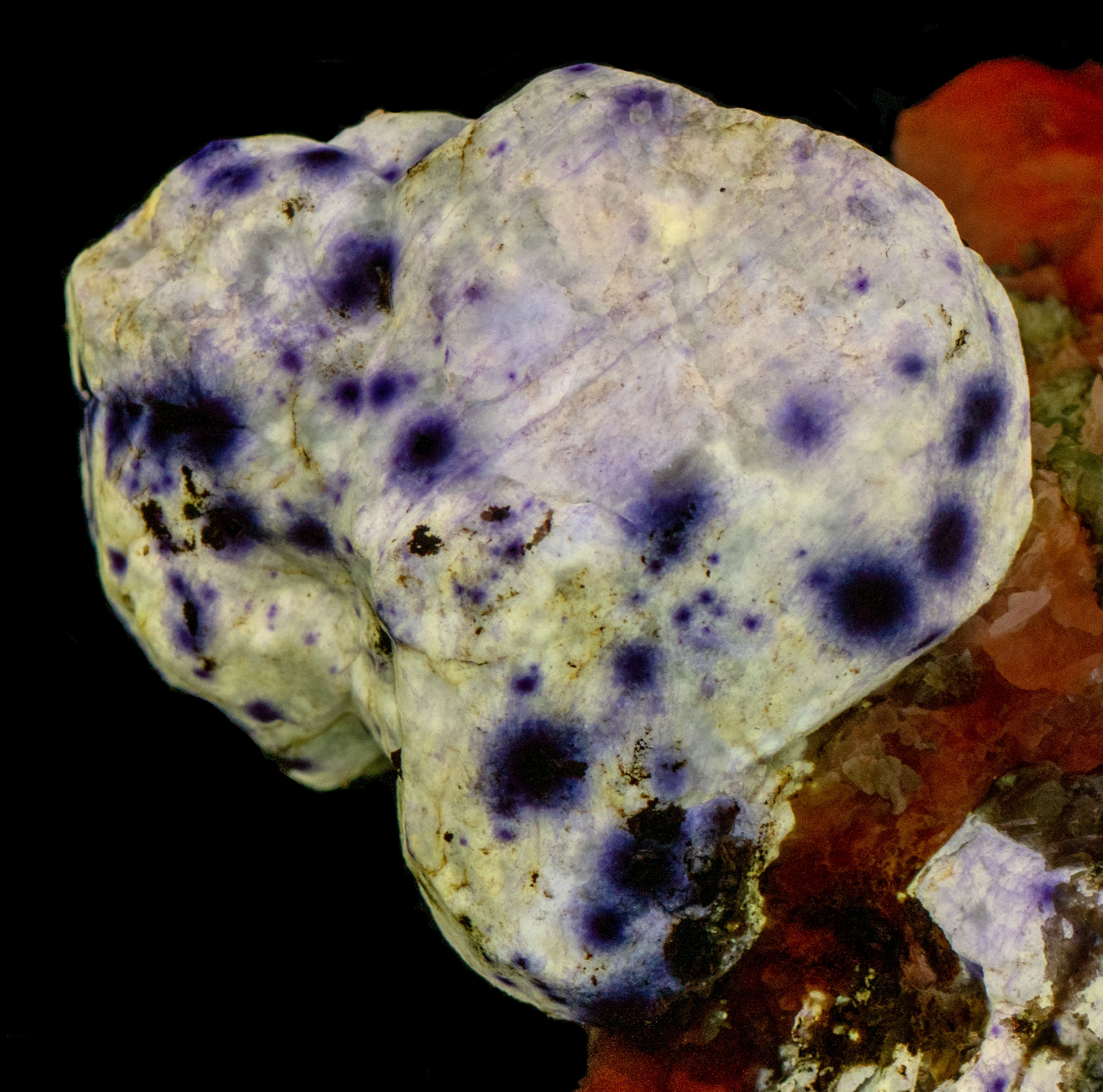
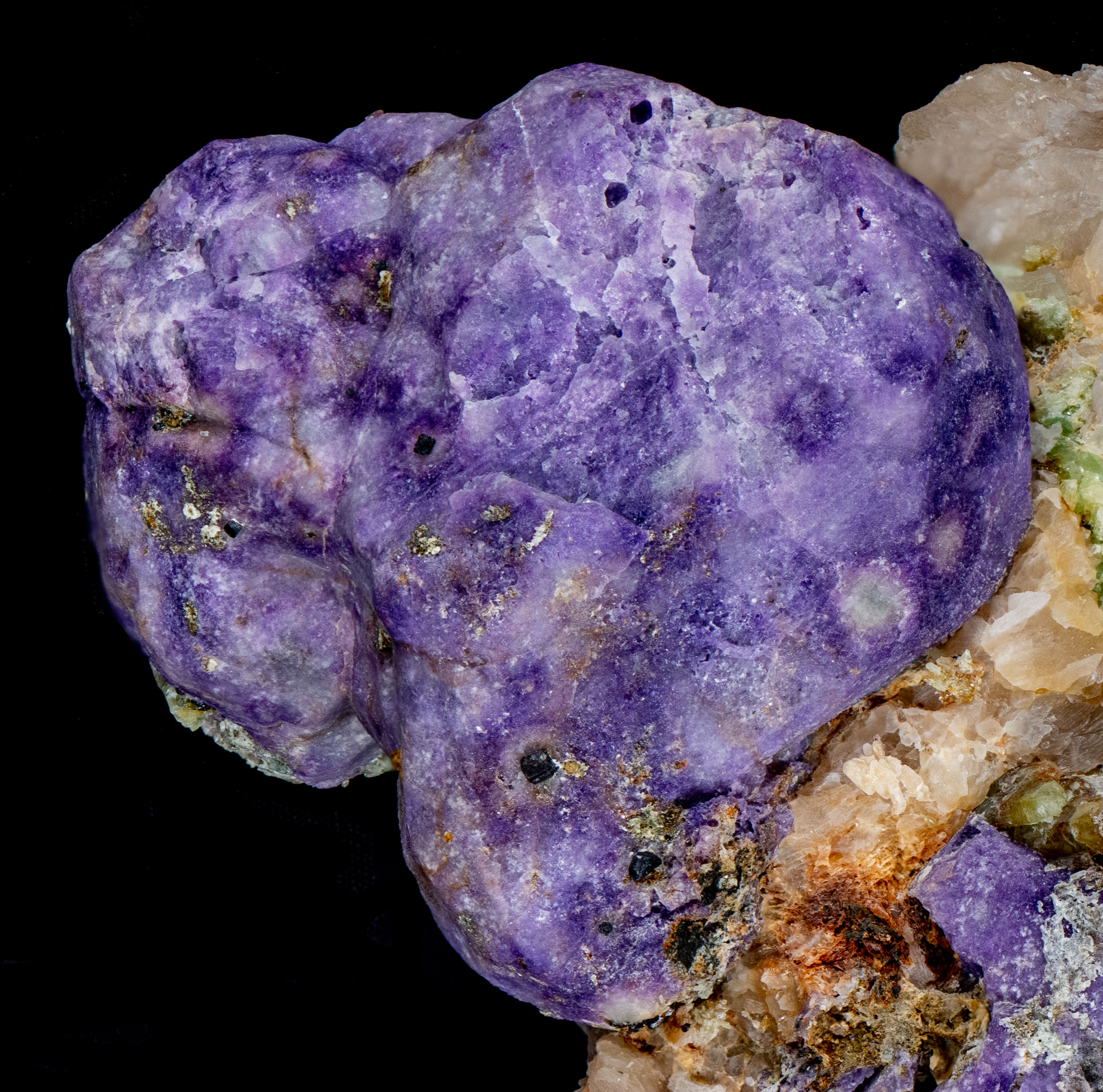
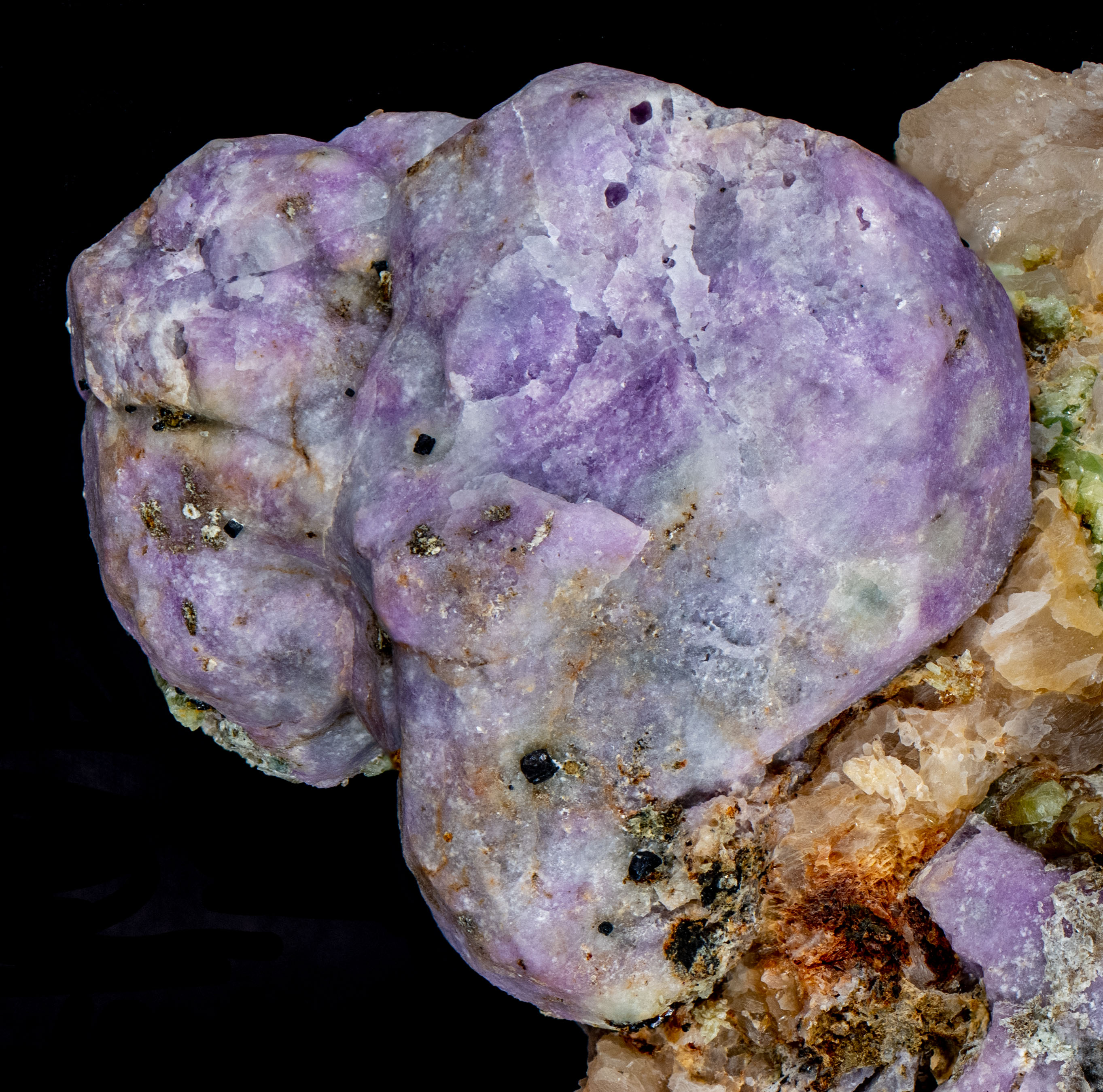
This is a specimen of hackmanite in a matrix of calcite from Sar-e-Sang, Badakhshan, Afghanistan. The matrix also contains pale green crystals of diopside and scattered grains of phlogopite and fluorapatite. The unusual feature of hackmanite in this specimen is that it contains spots of radiation alteration. The spots are 3 mm to 5 mm in diameter. Some of the spots have a cubic grain of uraninite in the center of the spot. The largest grain is 1.5 mm and is shown is the enlarged image of a hackmanite crystal. This crystal is 5.5 cm by 4.5 cm. I measured the radioactivity of the area around this large grain, and I got total count readings between 750cpm to 1000cpm.
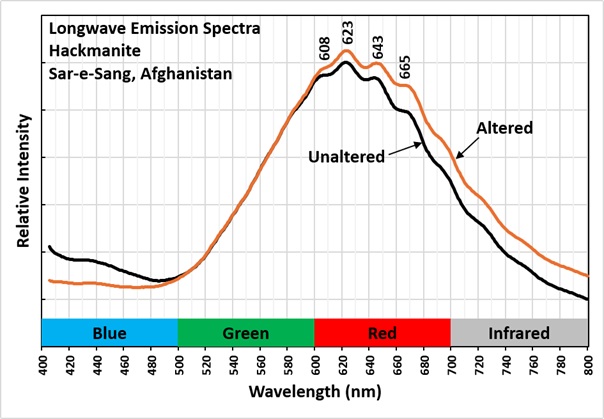
The hackmanite glows yellow orange under longwave UV light and white under MW and SW. The radiation alteration increases the brightness of the LW fluorescence within the spot. Longwave emission spectra of the unaltered and altered hackmanite show the characteristic vibronic signature caused by disulfide activation. The longwave spectrum of the altered hackmanite extends further into the red region.
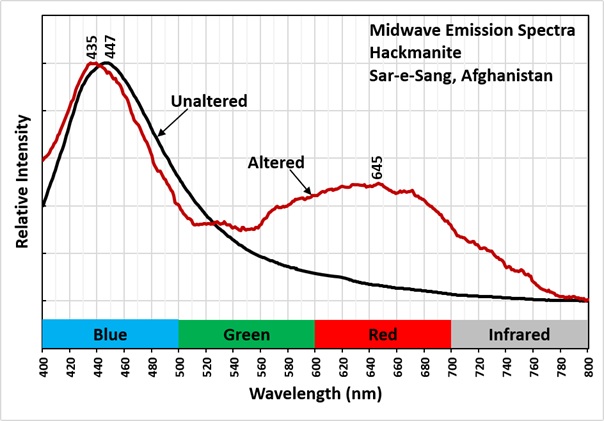
Under MW, the fluorescence changes. The altered spot fluoresces red and the unaltered hackmanite fluoresces bluish white instead of orange. The red fluorescence and the red shift in the LW fluorescence is likely caused by ferric iron (Fe3+) replacing aluminum (Al3+). This creates a broad peak with a maximum around 645 nm. The bluish white midwave fluorescence of hackmanite is activated by titanium (Ti3+) paired with an adjacent oxygen vacancy (Norrbo and others, 2017). This substitution occurs in the aluminum tetrahedra that makes up the hackmanite cage. The titanium-oxygen vacancy is also the activator for the long-lasting afterglow. Afterglow is strongest after exposure to midwave light. There is no afterglow in the altered spot, whereas the rest of the crystal has long lasting afterglow after exposure to LW, MW, and SW illumination.
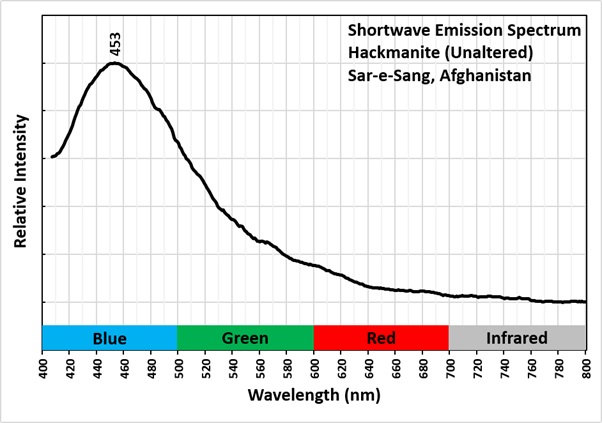
The hackmanite fluorescence under shortwave UV light is like the midwave fluorescence. The unaltered hackmanite glows a bluish white and the spot fluoresces a dull red. The hackmanite tenebrescence is also affected by the radiation. The tenebrescence is a darker purple in a ring around the uraninite grain.
I got this specimen after I wrote a paper about the radiation alteration that was published in the 2021 FMS UVWaves V.51 No.2. That article has more examples of the radiation alteration and more detailed explanation. I was recently involved in the migration of mineral posts from the Nature’s Rainbows website to the FMS website, uvminerals.org. I encountered more examples of radiation alteration from different locations that share the same changes in fluorescence, afterglow and tenebrescence found in this Afghan specimen.
Greenland example
Myanmar example
Another Afghanistan example
The calcite fluoresces red under MW and SW UV light; it is brighter under MW. It has a brief afterglow from exposure to SW light. The phlogopite is orange under LW and MW, and yellowish white under SW. The fluorapatite fluoresces violet blue under MW and pink under SW. The diopside fluoresces a dull greenish white under SW.
Reference
Norrbo, I., Hyppänen, I., and Lastusaari, M. (2017) Up-conversion luminescence– A new property in tenebrescent and persistent luminescent hackmanites, J. of Luminescence, V.191, pp. 28-34.
Summary of luminescence responses:
Calcite (Mindat) (RRUFF)
- Fluorescence under Midwave (305nm LED) UV light: Red
- Afterglow after exposure to Midwave (305nm LED) UV light: Red
- Fluorescence under Shortwave (255nm LED) UV light: Red
- Fluorescence under Longwave (365nm LED) UV light: Orange
- Afterglow after exposure to Longwave (365nm LED) UV light: White
- Tenebrescence after exposure to Longwave (365nm LED) UV light: Purple
- Fluorescence under Midwave (305nm LED) UV light: White
- Afterglow after exposure to Midwave (305nm LED) UV light: White
- Tenebrescence after exposure to Midwave (305nm LED) UV light: Purple
- Fluorescence under Shortwave (255nm LED) UV light: White
- Afterglow after exposure to Shortwave (255nm LED) UV light: White
- Tenebrescence after exposure to Shortwave (255nm LED) UV light: Purple
- Fluorescence under Shortwave (255nm LED) UV light: White
- Fluorescence under Midwave (305nm LED) UV light: Violet
- Fluorescence under Midwave (305nm LED) UV light: Orange
- Fluorescence under Shortwave (255nm LED) UV light: Yellow