
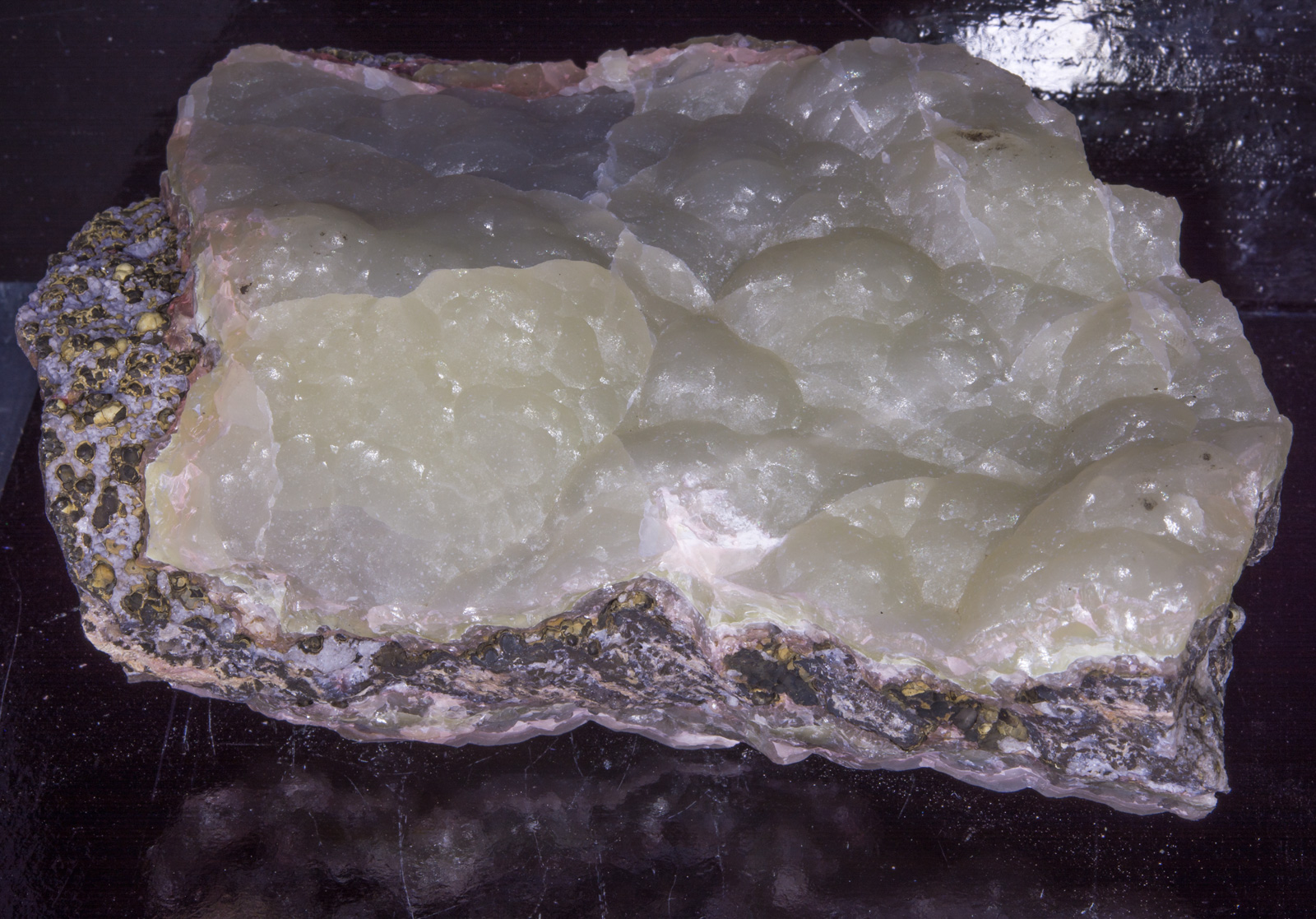
Botryoidal Smithsonite from Mexico
Contributed by: Mark Cole
Date: Apr 7th, 2026
Locality: Buena Tierra Mine, Francisco Portillo, West Camp, Santa Eulalia Mining District, Aquiles Serdán Municipality, Chihuahua, Mexico (See on Mindat)
Size: 4.5 x 2.5 x 7 inches
Weight: 5.34 lb
Description:
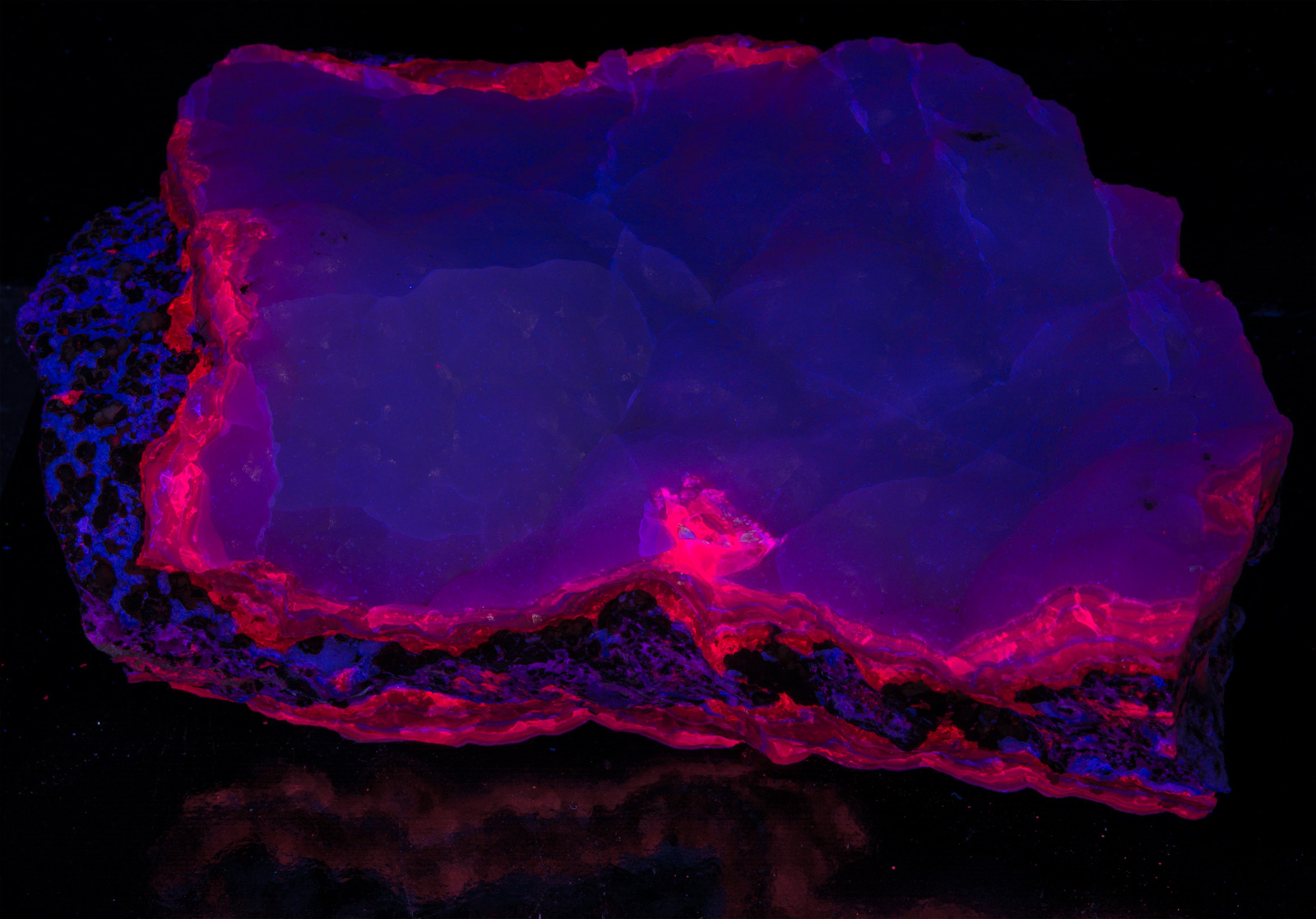
Beautiful red/violet/blue smithsonite sandwiching red fluorescing smithsonite. Also known from the El Potosi Mine and San Antonio Mine, but I think only these have this wonderful dual color fluorescence.
Smithsonite botryoidal mass from the Buena Tierra Mine in Mexico. Very unusual blue fluorescence on top of red fluorescence - both are smithsonite.
Axel Emmermann (from the Fluorescent Mineral Group on Facebook) did an analysis on these pieces, part of which I quote here: "Normally we would think of manganese when we see a red fluorescence in a carbonate mineral, but that is not a sound reflex. Smithsonite fluoresces blue when activated by manganese replacing zinc (Gorobets). That would be seen as a broadband peak with center at 500 nm. That peak is clearly present too and the blue may be partially responsible for the slightly violet tinge of the red fluorescence.
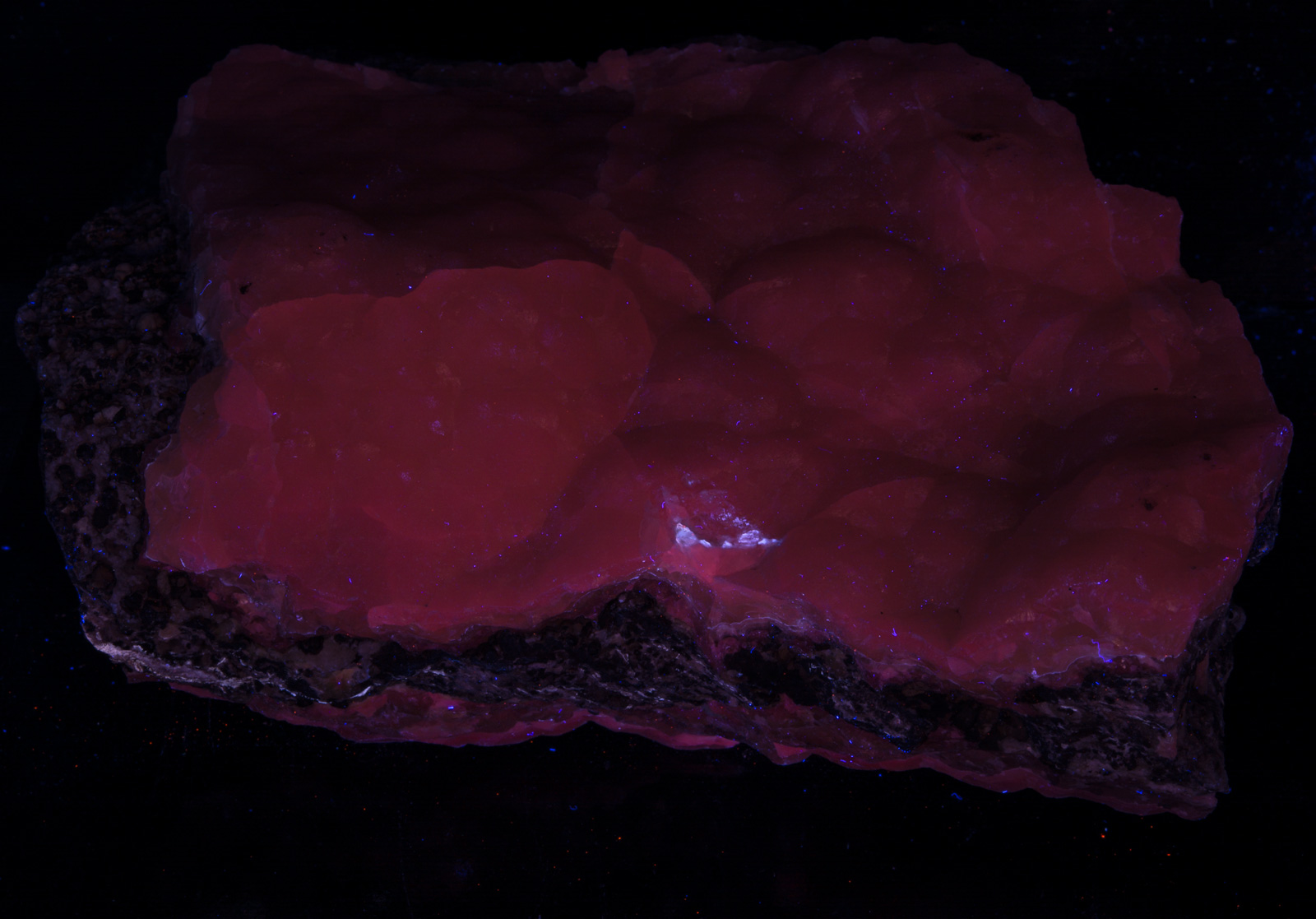
These smithsonite specimens fluoresce very weak orange red in LW. I still need to investigate that… Most certainly not manganese! Under SW, there is a distinct blue to violet fluorescence in the surface of the botryoidal mass. I found a serious peak in the LW UV that I can fit to Pb2+ and Ce3+. Possibly some Eu2+ too but that is not easily proven… I believe that both lead and cerium are co-activators for the main fluorescence: Manganese and some rare earths.
Manganese fluoresces blue but the entire red fluorescence is caused by lanthanoids, probably a combination of Sm3+, Dy3+ and possibly Eu2+. There are diverse thin layers that make up the red fluorescing botryoidal mass. Some of these layers have divergent fluorescence namely blue".
Originally posted by Mark Cole on Nature's Rainbows in 2016.
Summary of luminescence responses:
Smithsonite (Mindat) (RRUFF)
- Fluorescence under Shortwave (254nm Lamp/Mercury) UV light: Blue
- Fluorescence under Shortwave (254nm Lamp/Mercury) UV light: Red
- Fluorescence under Longwave (365nm LED) UV light: Red