
Forsterite from Sar-e-Sang, Badakhshan, Afghanistan
Contributed by: Michael Crawford
Date: Mar 6th, 2026
Locality: Sar-e-Sang, Kuran wa Munjan District, Badakhshan, Afghanistan (See on Mindat)
Size: 9 x 11 cm
Description:
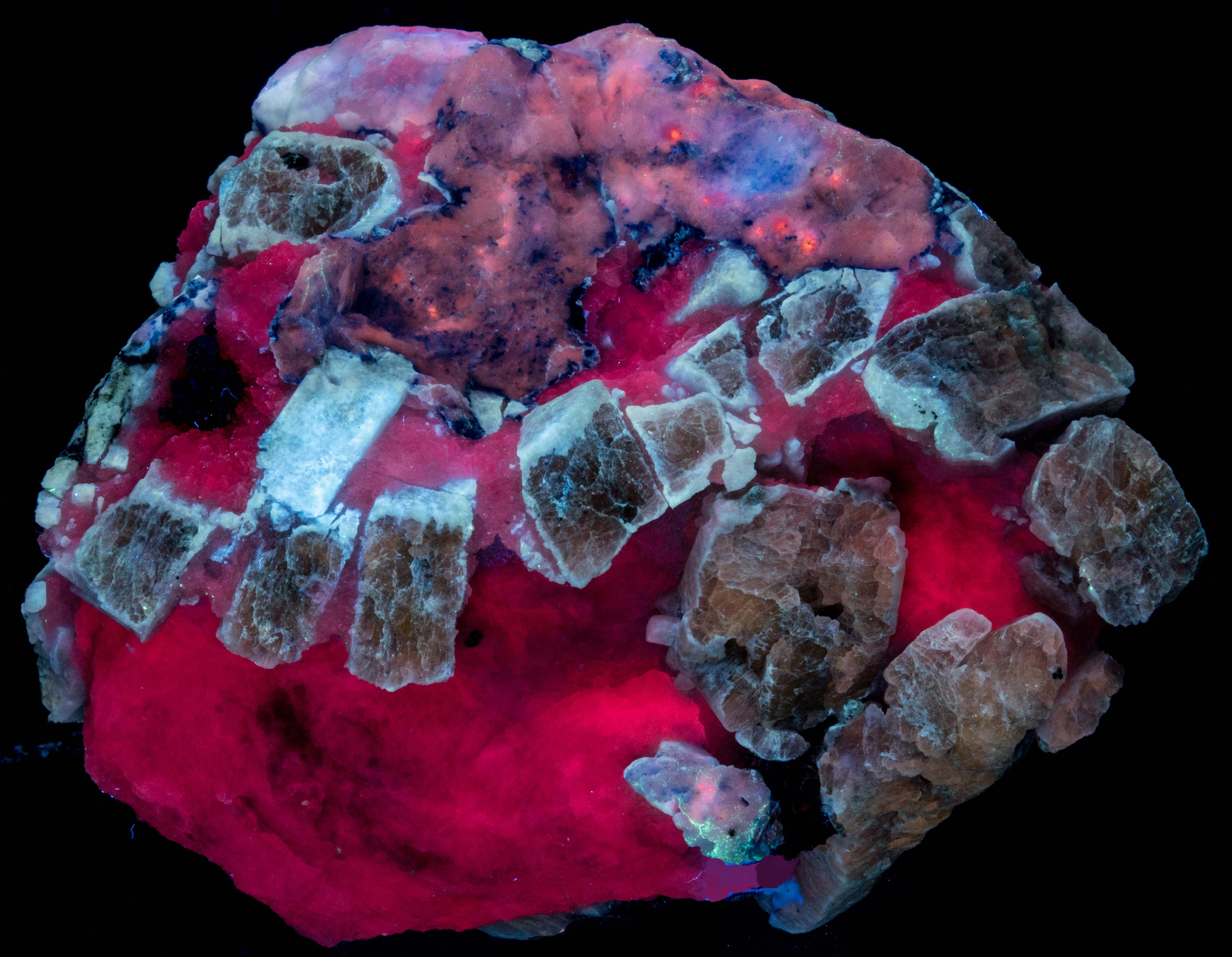
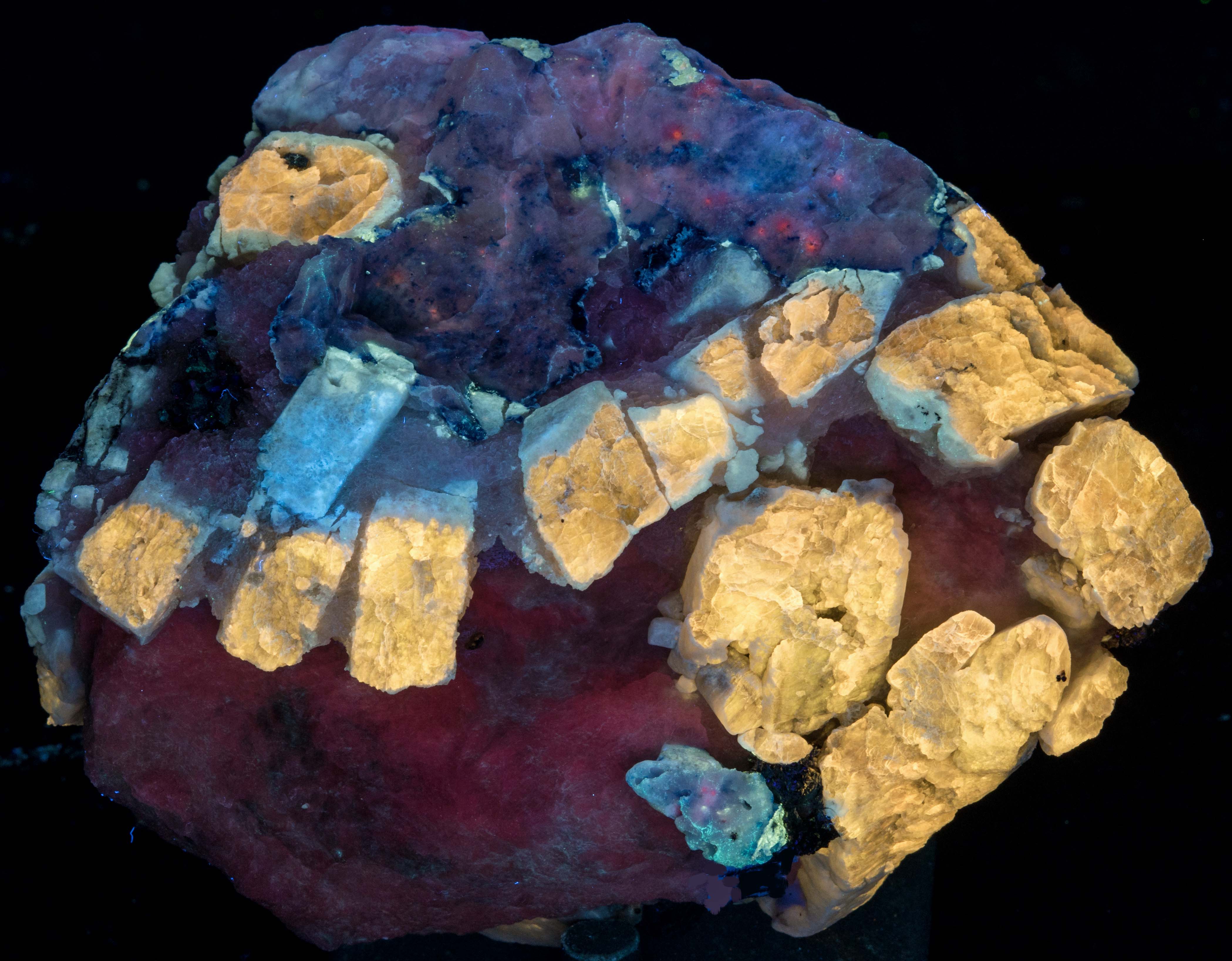
This specimen originates from Sar-e-Sang, Badakhshan Province, Afghanistan and contains forsterite (Mg2(SiO4)) exhibiting an atypical red afterglow, confirmed by XRD analysis.
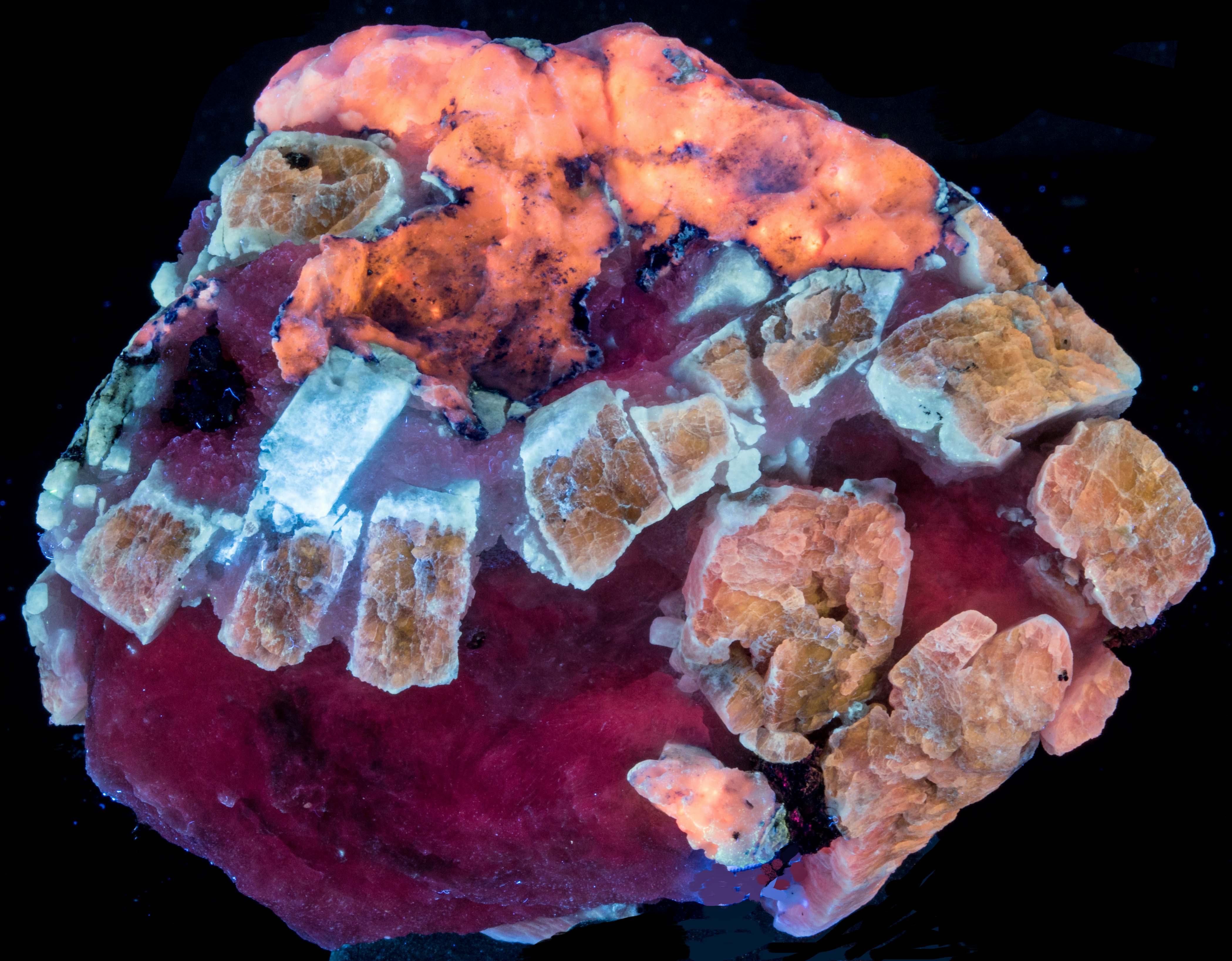
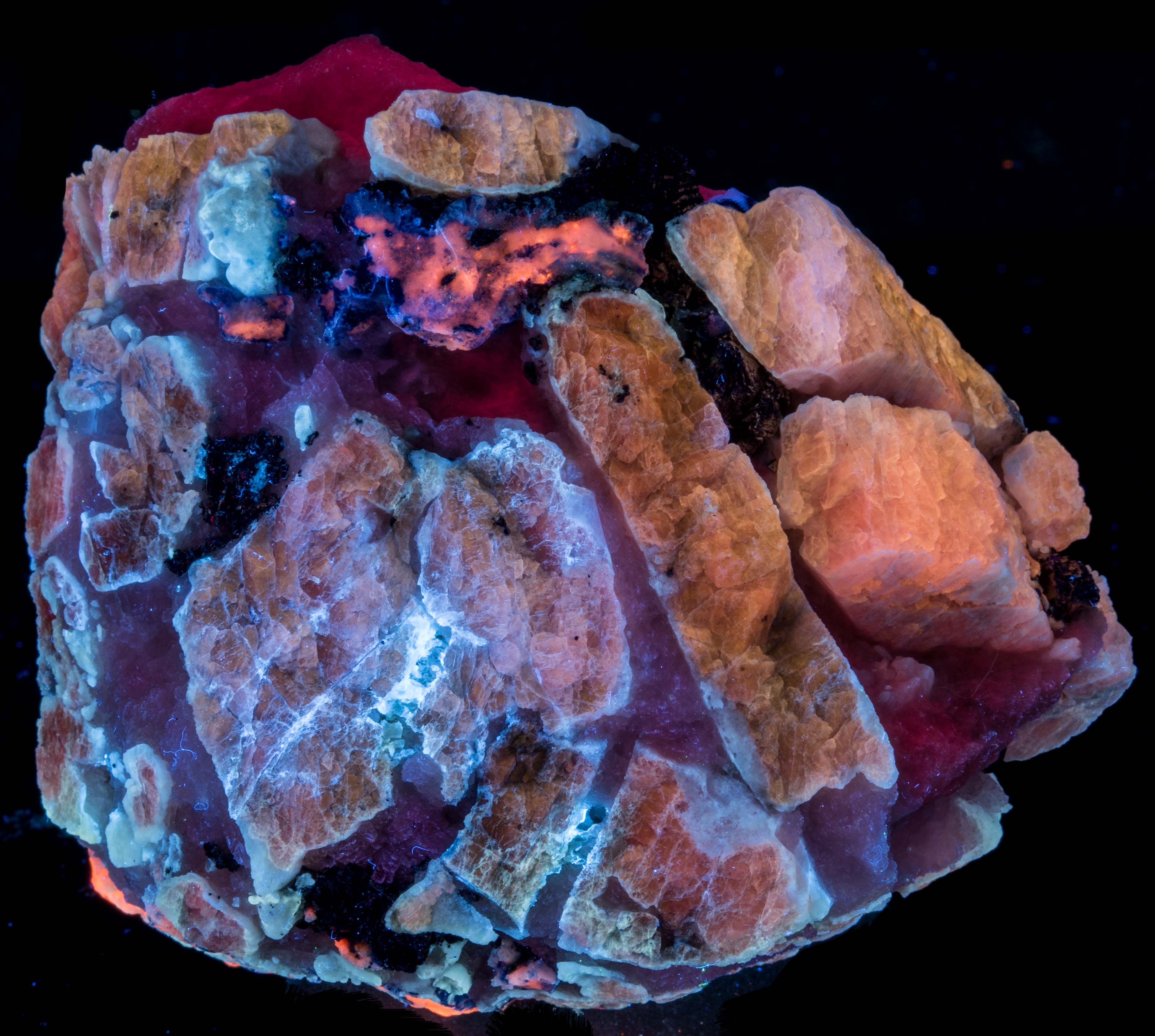
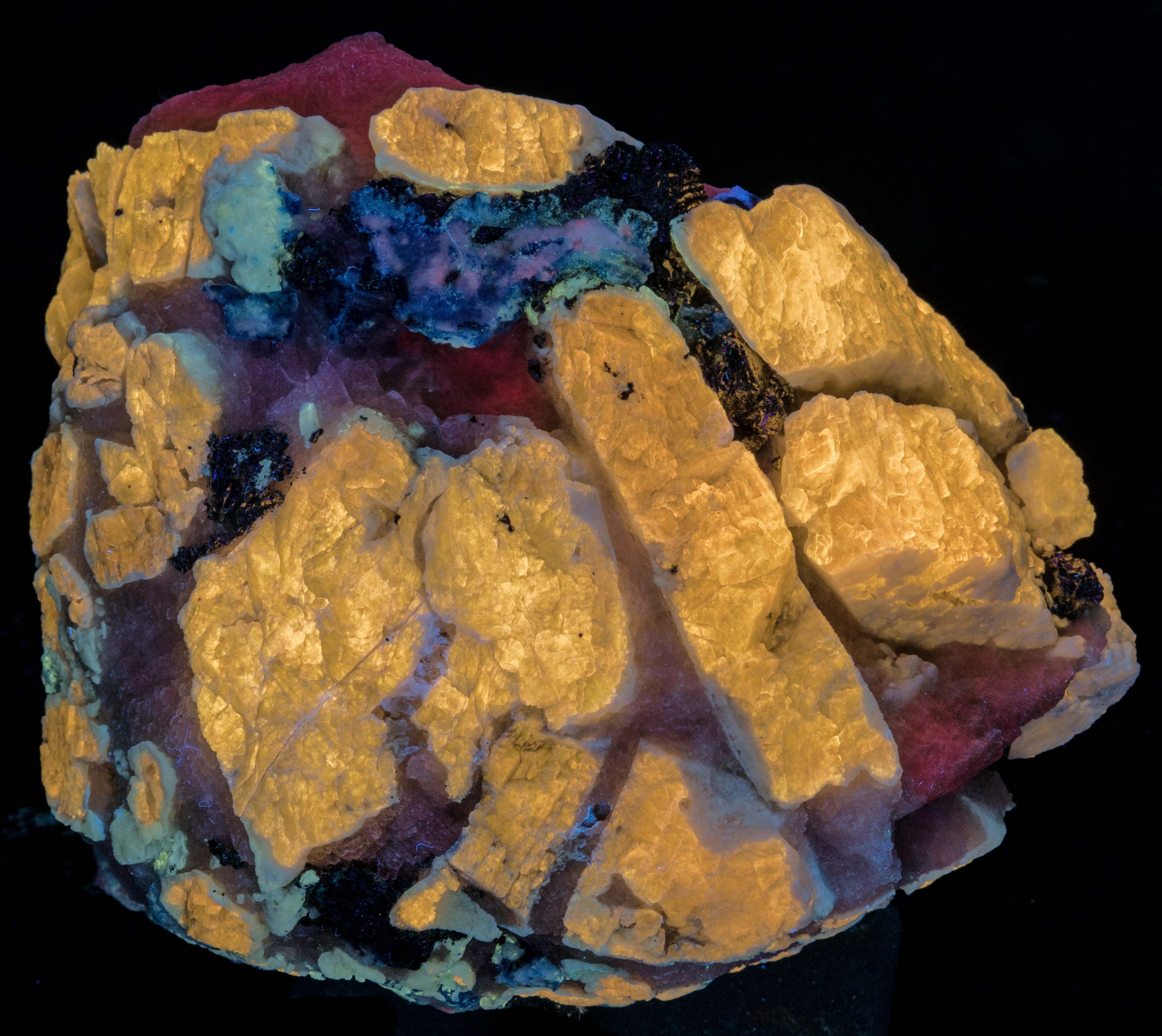
The first image demonstrates fluorescence under "Fullwave" UV illumination, which comprises longwave (LW), midwave (MW), and shortwave (SW) UV lights. Sodalite appears yellow orange in this context, with notable variation in its mass—some portions display afterglow while others do not. Trace titanium substituting for aluminum is responsible for activating the afterglow in sodalite. Certain areas have undergone alteration due to radiation from embedded uraninite grains, resulting in brighter yellow fluorescence under LW and a redder hue under SW light. These spots are tenebrescent and lack afterglow. Additional fluorescent minerals include calcite (red), forsterite (yellow brown), and diopside (bluish white).
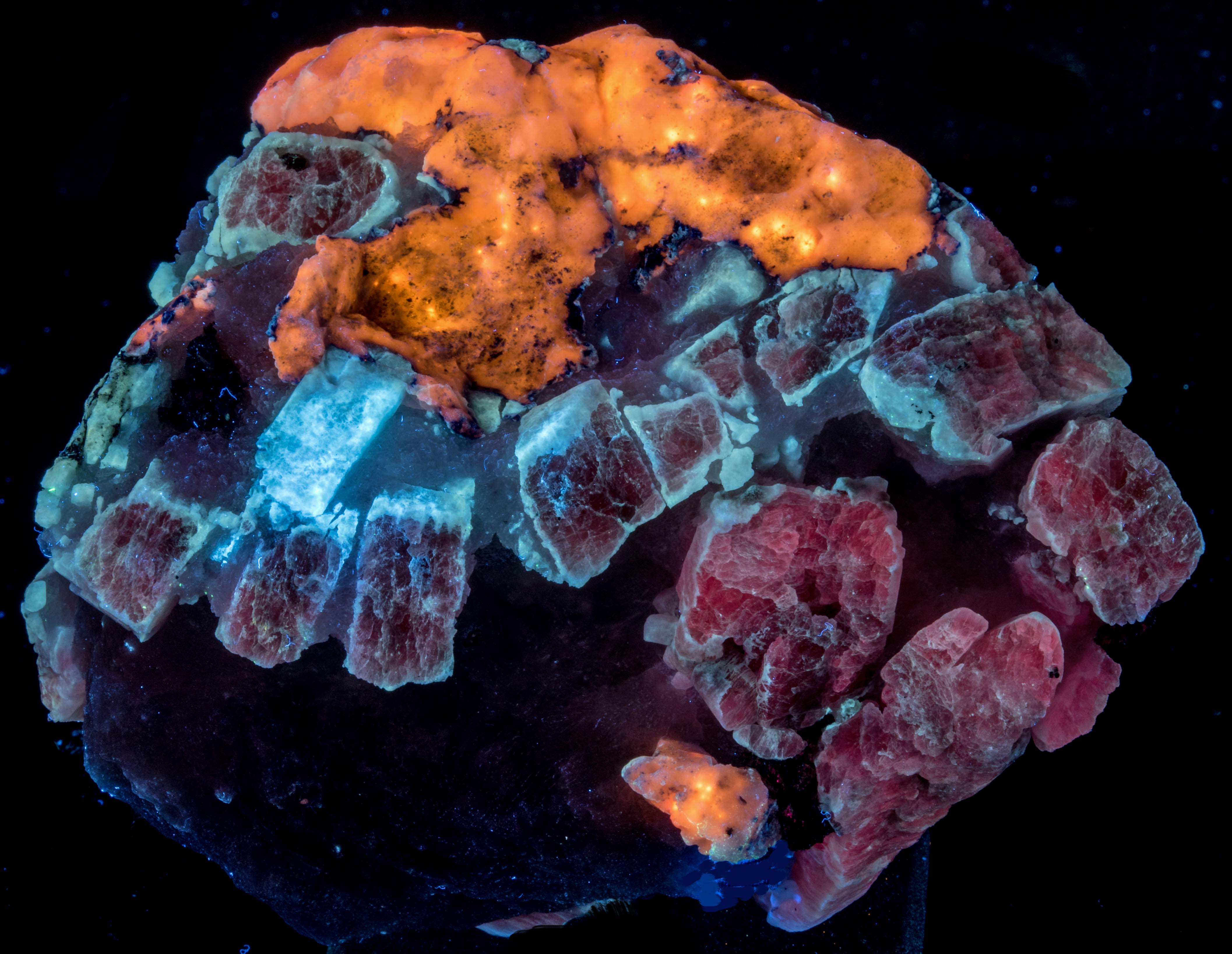
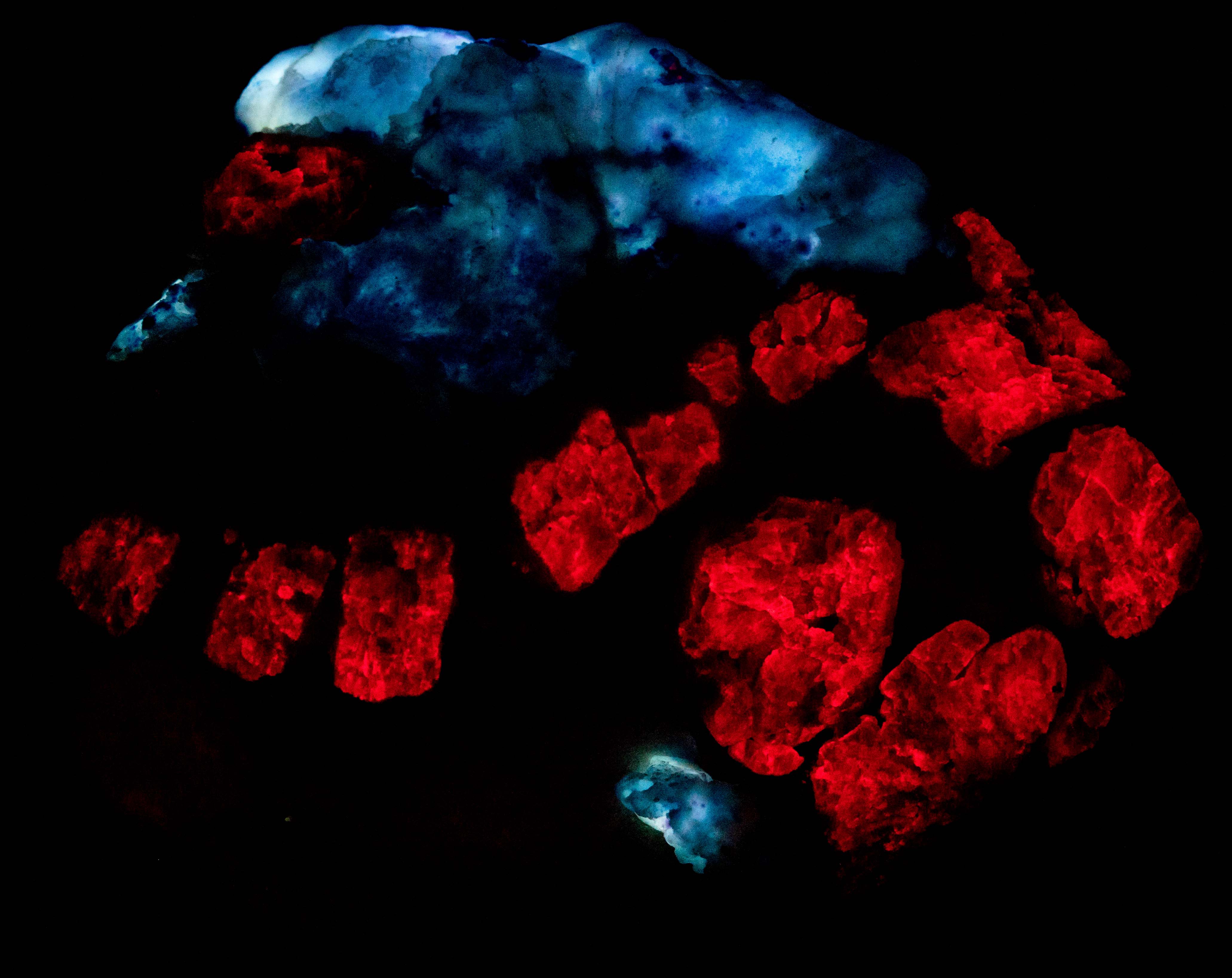
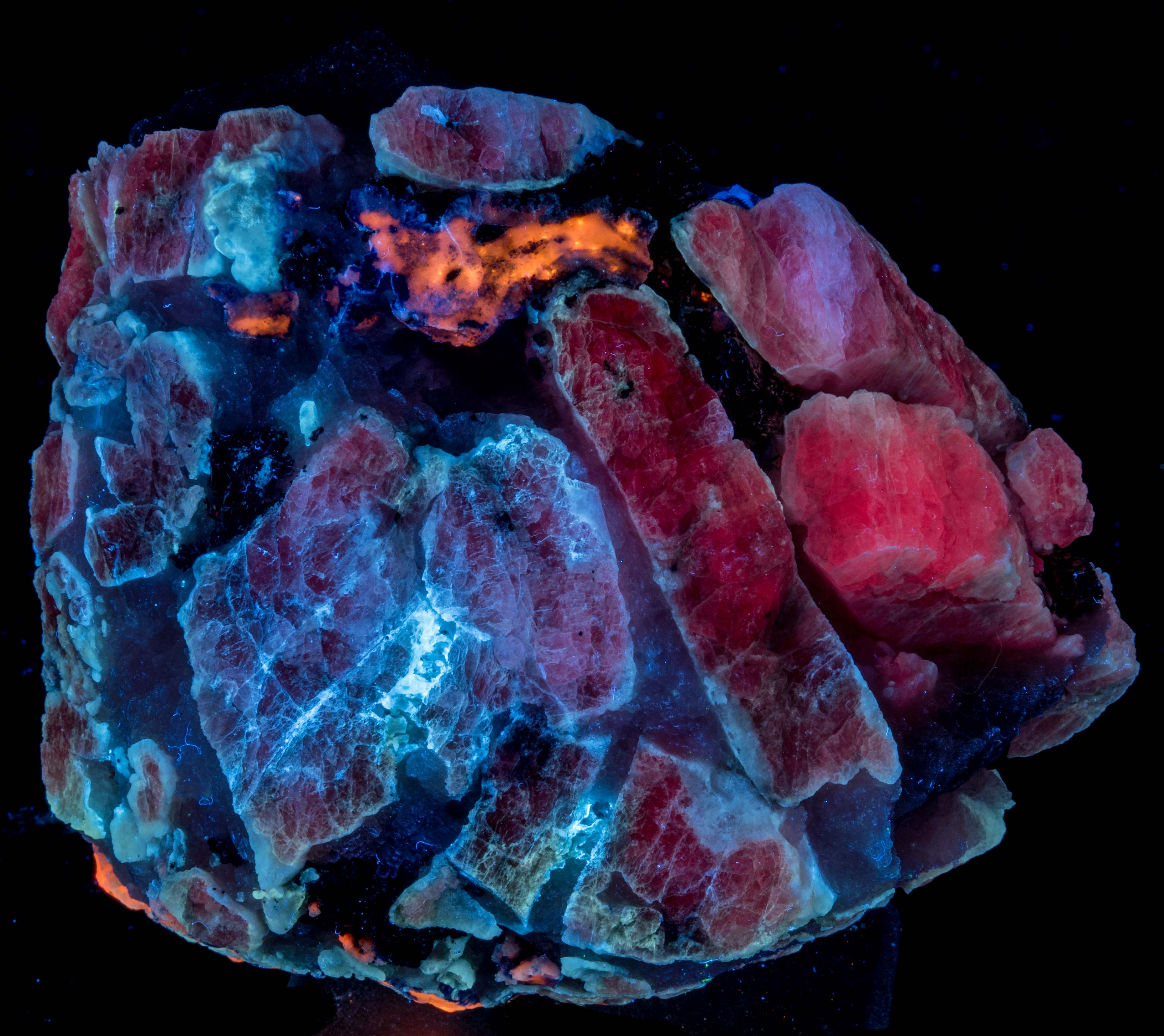
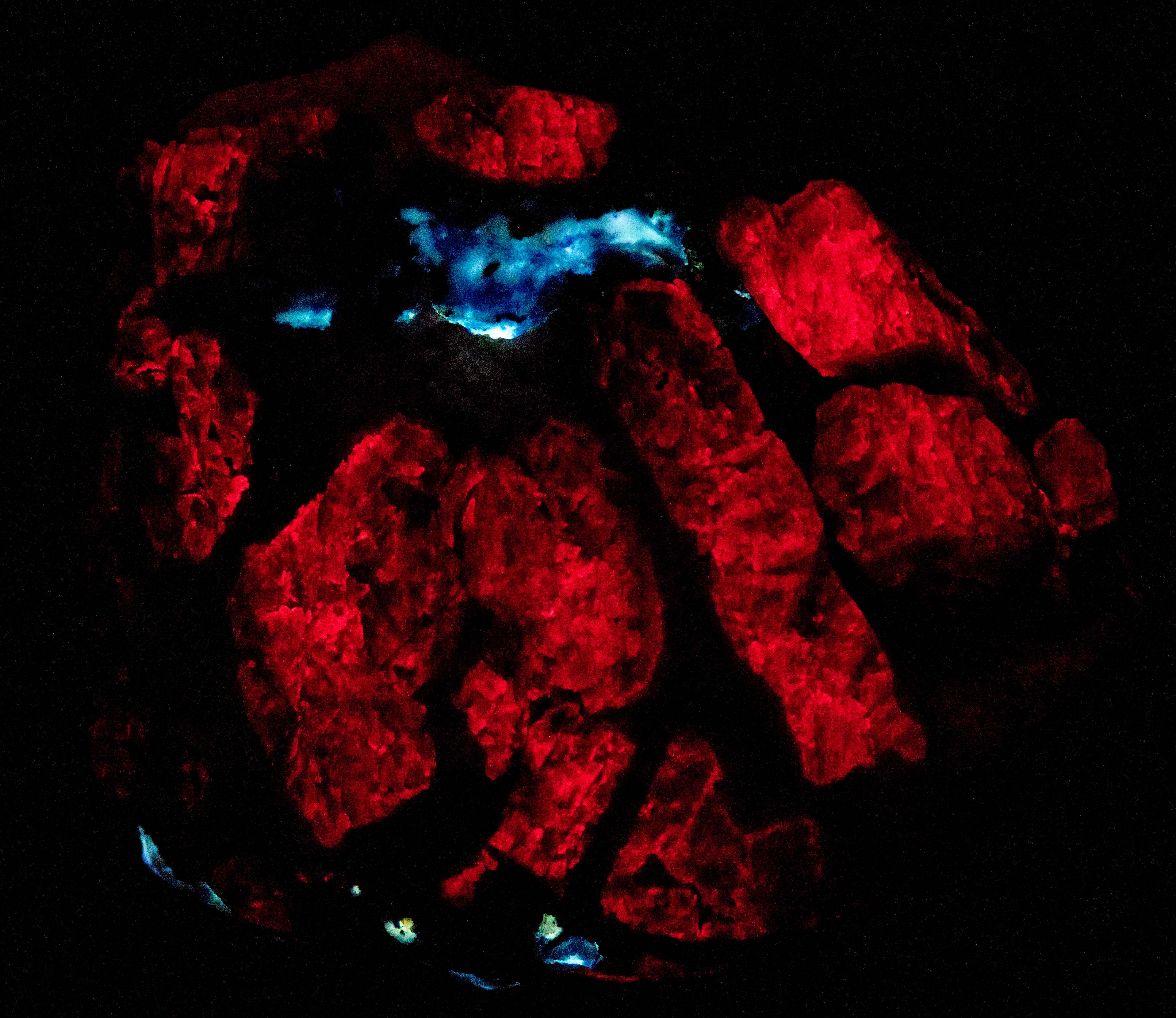
The second image highlights the specimen’s response to longwave UV light: sodalite emits a yellow-orange glow, attributed to disulfide ions. Diopside fluoresces blue, white, likely activated by titanium, while forsterite produces an unusual red fluorescence under LW light, presumably due to manganese. Forsterite also exhibits Brief Intense Phosphorescence (BIP) when exposed to a longwave light swept across the specimen, further suggesting manganese activation. Ordinarily, Afghan forsterite displays weak to moderate white to pinkish fluorescence under LW illumination. A common feature at Sar-e-Sang includes crystals with diopside coatings and forsterite cores.
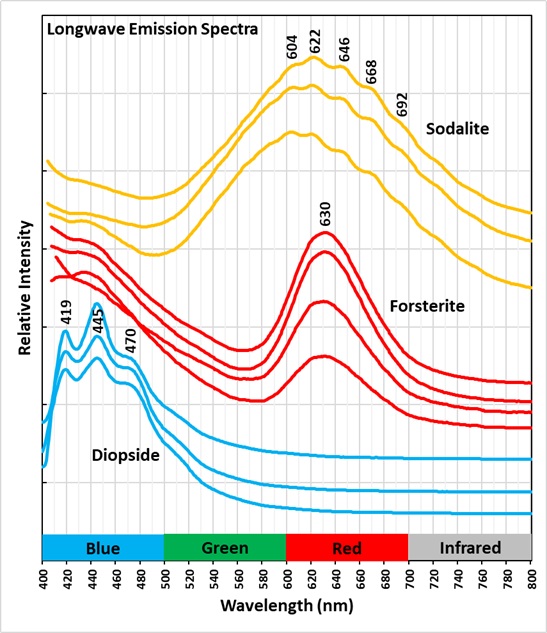
The third image presents longwave emission spectra measured on sodalite, forsterite, and diopside using 365 nm filtered LED flashlights for LW excitation. Sodalite shows a broad peak from 500 nm to 750 nm, with vibronic peaks at 604, 622, 646, 668, and 692 nm, characteristic of disulfide activation. Forsterite\'s spectrum features a broad peak centered at 630 nm, indicating manganese activation. Diopside displays peaks at 419, 445, and 470 nm, consistent with titanium as an activator, though other activators may be involved.
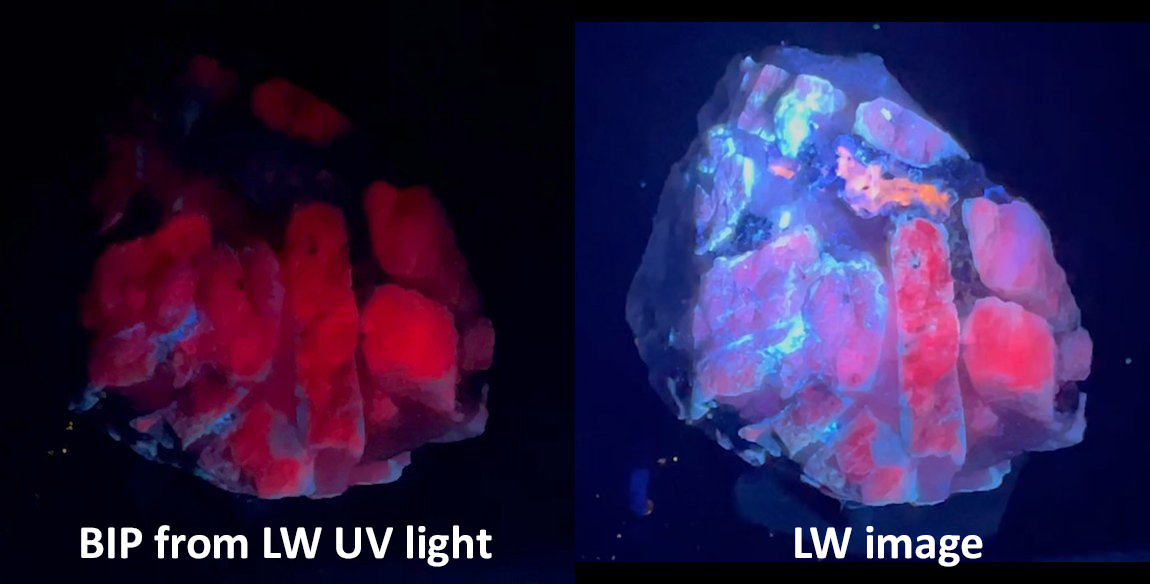
The fourth image shows screen captures from a short video illustrating the red flash or BIP of forsterite—a typical trait of Afghan specimens. Scanning intense LW UV light across the forsterite triggers this red flash.
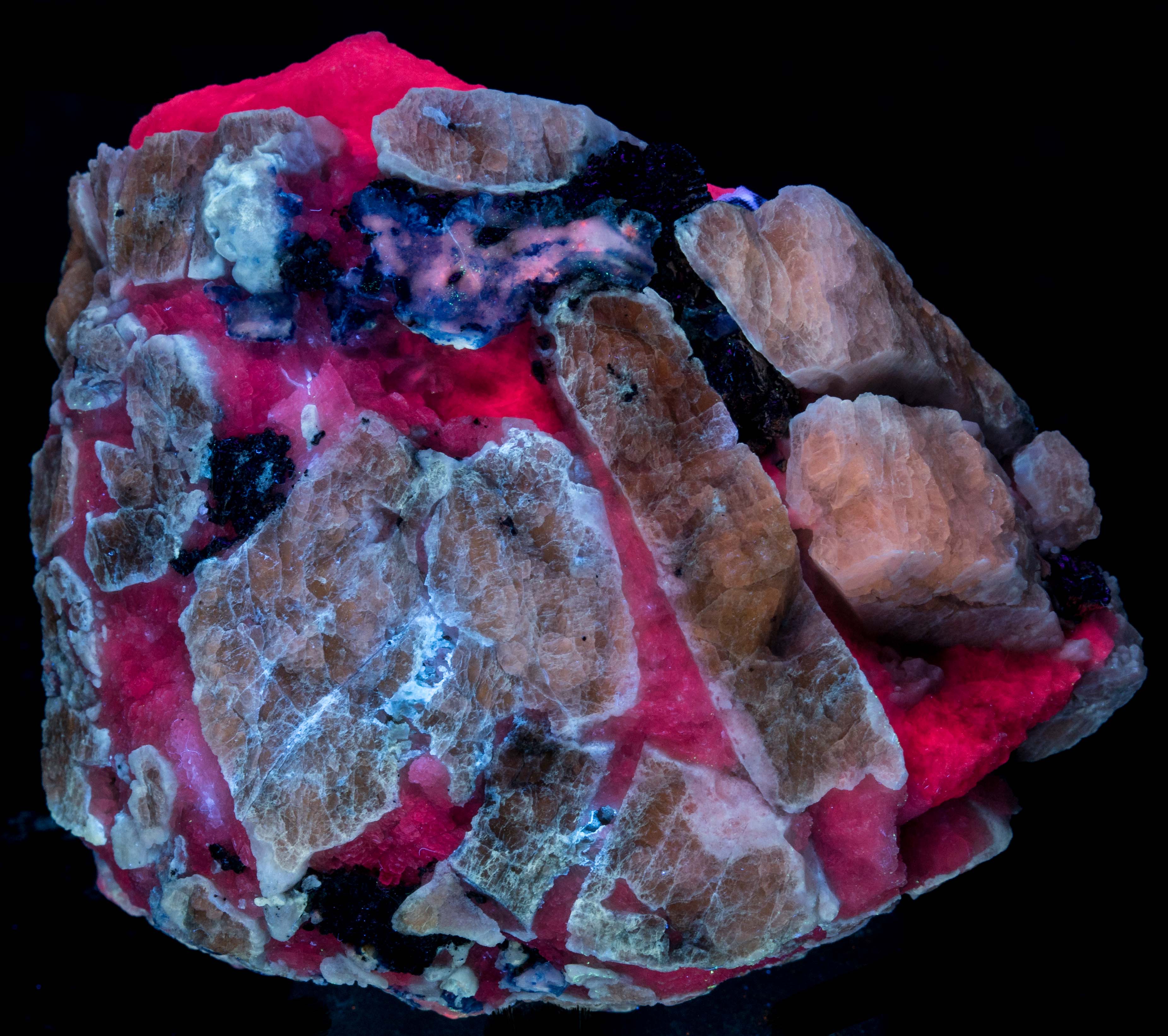
The fifth image depicts the specimen under MW UV illumination, where Afghan calcite achieves its brightest fluorescence.
In the sixth image, SW UV light results in diminished sodalite and calcite fluorescence, with diopside shifting to a bluer tone and forsterite appearing yellow brown. This yellow to yellow-brown SW fluorescence is common for Afghan forsterite, both in massive and crystalline forms.
The seventh image shows afterglow following SW UV exposure. Sodalite’s afterglow is notably bright and long-lasting, occurring after brief SW UV exposure. Forsterite’s red afterglow is less intense but is also long-lasting. The forsterite afterglow requires 30–60 seconds of intense SW exposure; activation often involves a 35W or greater UV light source held close to the specimen.
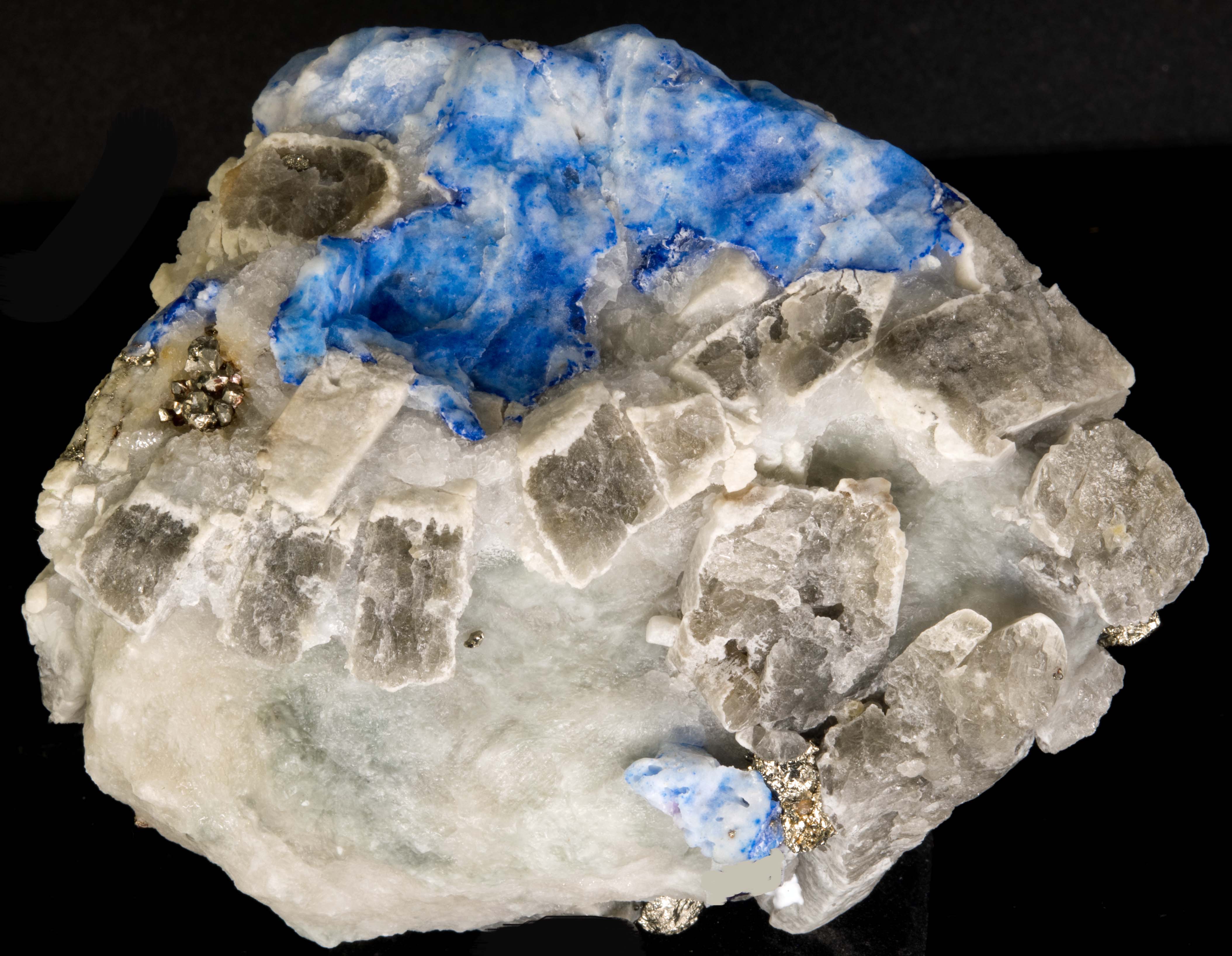
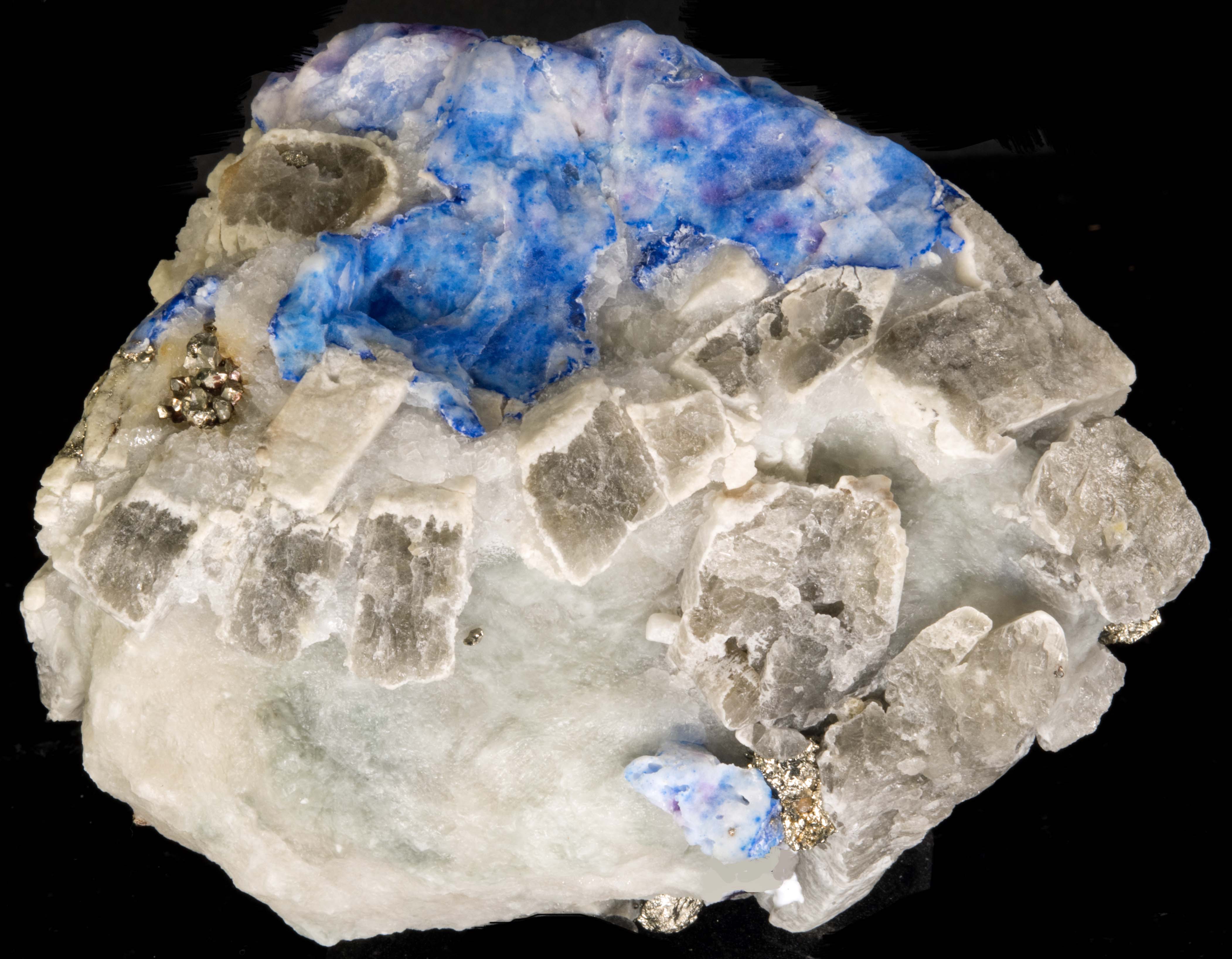
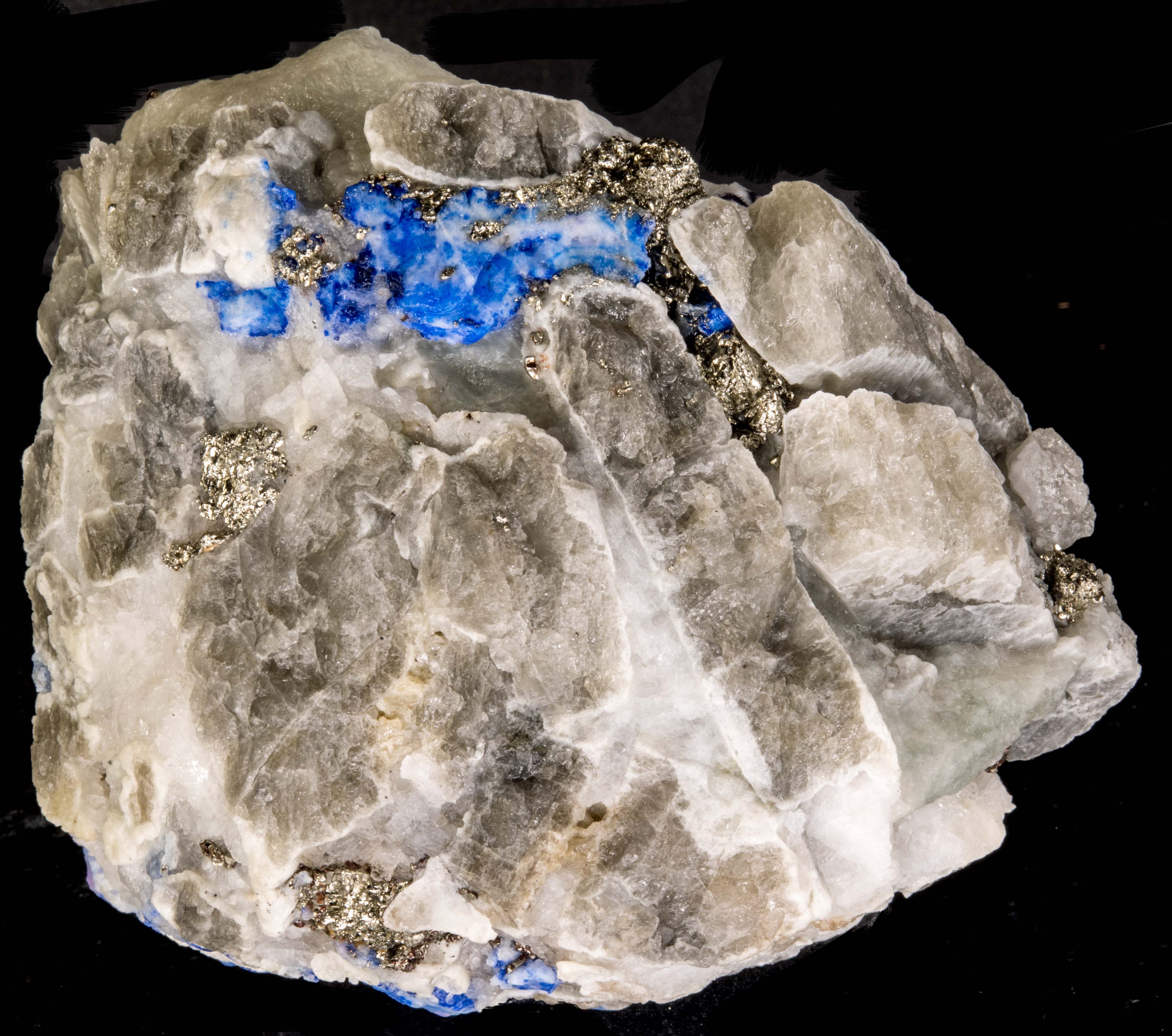
The eighth image provides a white light view of the specimen, while the ninth highlights the tenebrescence (dark purple coloration) of radiation-altered sodalite.
The remaining pictures show the back side of the specimen. Same minerals as the front side. The back side has a couple of large forsterite crystals coated with diopside. The largest crystal is 5 cm long. The crystals rise above the calcite matrix. It is common practice for Pakistani dealers or Afghan miners to etch specimens in acid to remove calcite seeking pristine crystals of lazurite, afghanite, sodalite, etc. In this instance, sufficient calcite remains to support the crystals and enhance the specimen\'s fluorescent aesthetics.
The remaining pictures are full wave, longwave, mid-wave, shortwave, afterglow, and white light.
Summary of luminescence responses:
Calcite (Mindat) (RRUFF)
- Fluorescence under Midwave (305nm LED) UV light: Red
- Fluorescence under Shortwave (255nm LED) UV light: Red
- Fluorescence under Longwave (365nm LED) UV light: Red
- Fluorescence under Midwave (305nm LED) UV light: Red
- Fluorescence under Shortwave (255nm LED) UV light: Yellow
- Fluorescence under Longwave (365nm LED) UV light: Orange
- Fluorescence under Midwave (305nm LED) UV light: Red