
Tsarovite and Scapolite from Merelani Hills, Tanzania
Contributed by: Michael Crawford
Date: Feb 19th, 2026
Locality: Merelani Hills, Lelatema Mountains, Simanjiro District, Manyara Region, Tanzania (See on Mindat)
Size: 6 x 6 cm
Description:
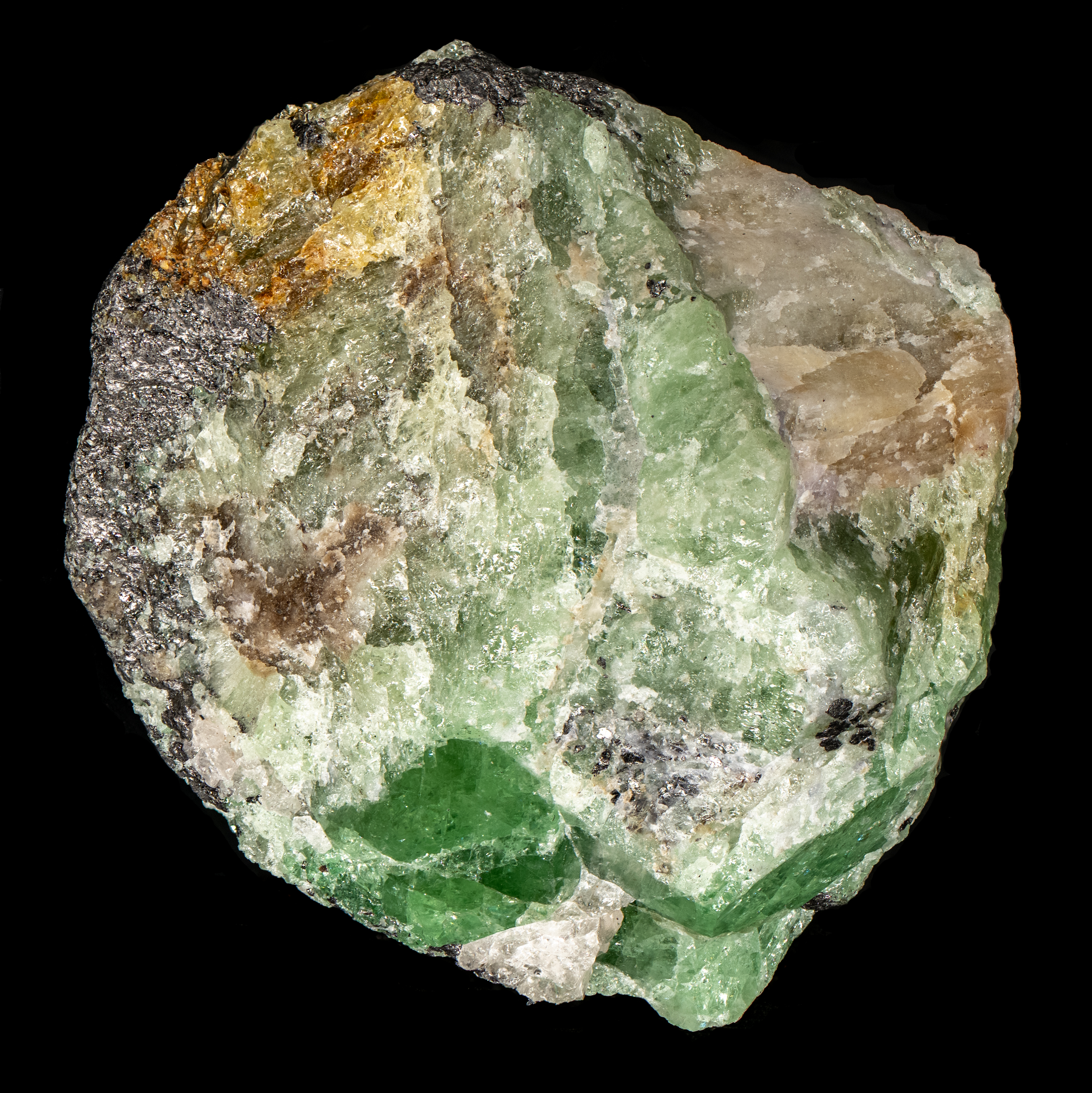
This is a small specimen of green grossular var. tsarovite (Ca3Al2(SiO4)3)) and a yellow fluorescent mineral tentatively identified as scapolite. The specimen comes from the Merelani Hills, Manyara, Tanzania.
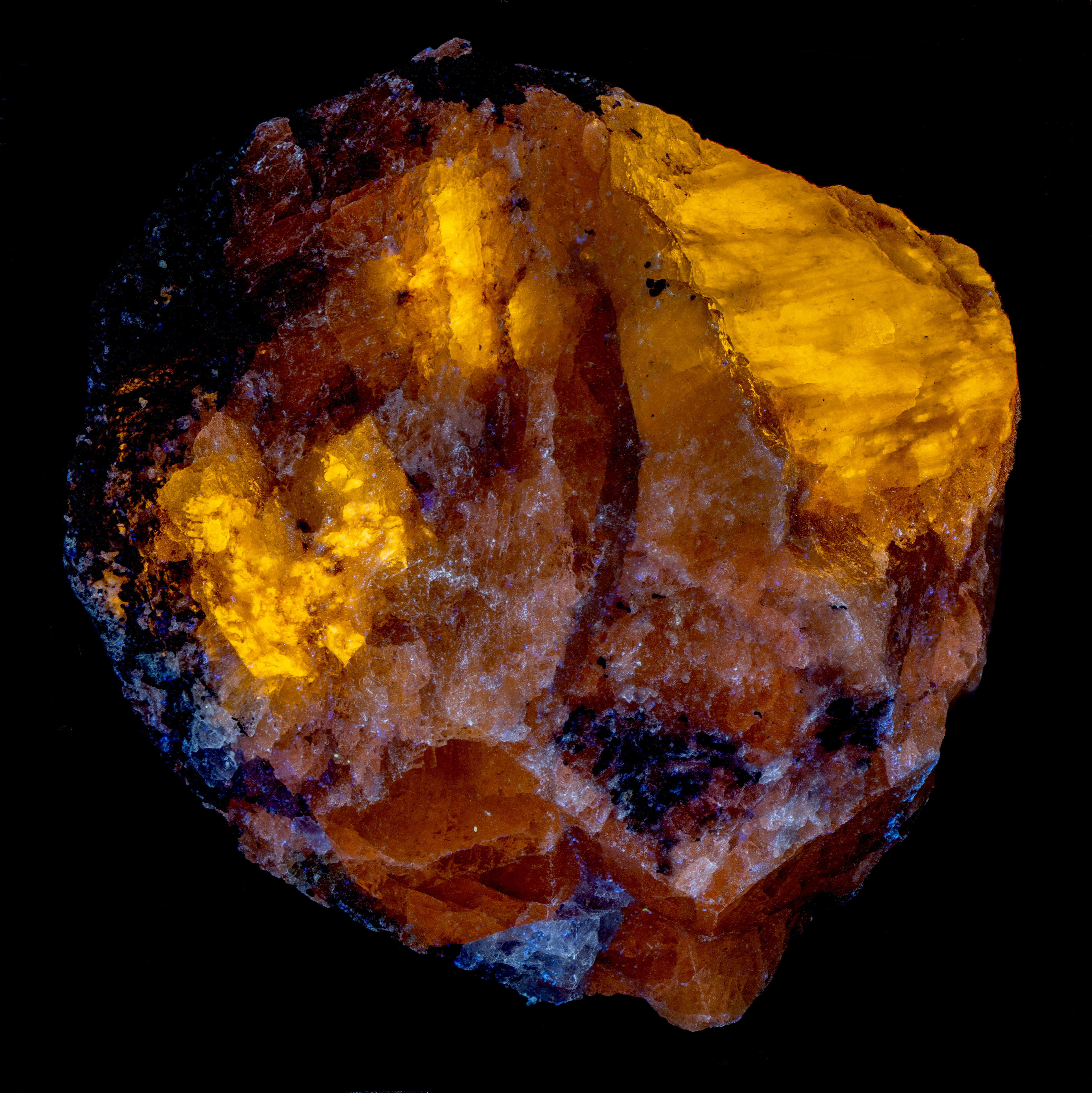
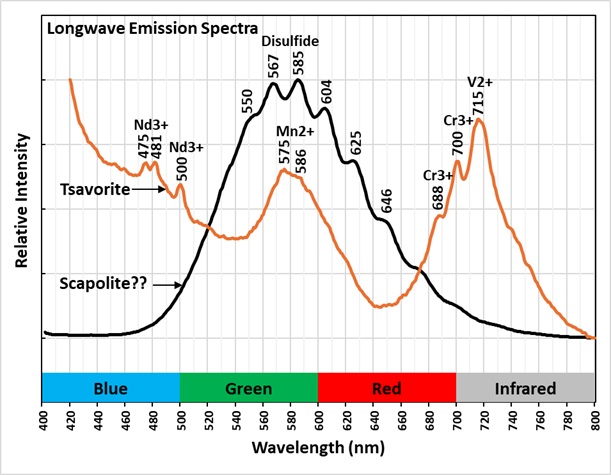
The daylight green color of tsarovite is caused by the presence of vanadium (V2+) and chromium (Cr3+) impurities. Tsarovite has modest orange fluorescence under longwave UV illumination. It has no midwave or shortwave fluorescence. The emission spectrum of tsarovite has a complicated signature. There are sharp peaks at 475 nm, 481 nm and 500 nm that are activated by neodymium (Nd3+) according to fluomin. There is a broad peak around 575 nm to 586 nm that is likely caused by manganese (Mn2+) activation and this peak is responsible for the orange, fluorescent color. Finally, there are sharp peaks in the red and near infrared caused by chromium (Cr3+) and vanadium (V2+).
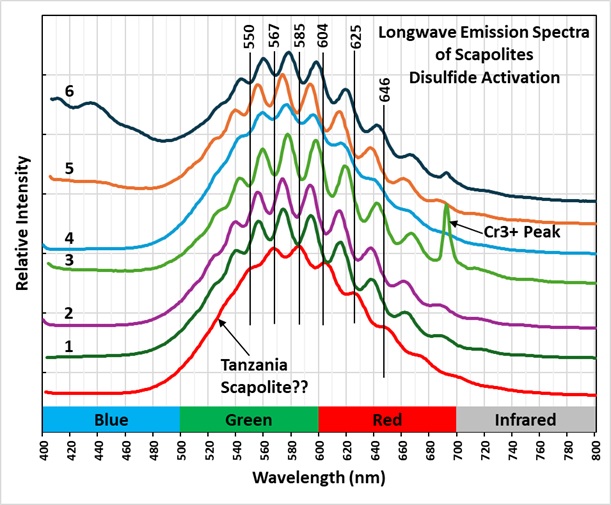
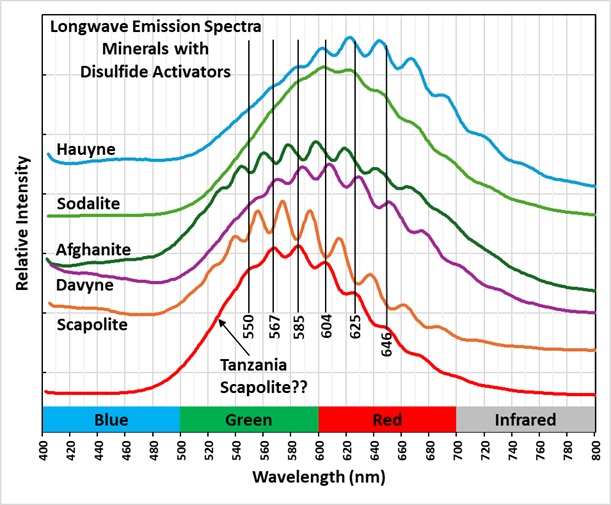
The specimen also has a mineral with bright yellow fluorescence under longwave light. The yellow fluorescence is much dimmer under midwave and shortwave light. The mineral is likely scapolite. The longwave emission spectrum has a vibronic signature characteristic of disulfide activation. However, the vibronic peaks (550 nm, 567 nm, 585 nm, 604 nm, 625 nm and 646 nm) do not match the vibronic peaks of scapolite specimens from other locations. The emission spectra of these six other locations are compared to the Tanzania spectrum in the second plot. The other locations are:
1 – Sar-e-Sang, Badakhshan Province, Afghanistan
2 – Sar-e-Sang, Badakhshan Province, Afghanistan
3 – Rose Road Location, St. Lawrence County, New York
4 – Grenville, Quebec, Canada
5 – Bancroft, Ontario, Canada
6 – Xinjiang Province, China
The third plot compares the Tanzania scapolite spectrum to other minerals that have disulfide activated fluorescence. Again, there are no matches for the vibronic peaks.
These spectral comparisons suggest that the yellow fluorescent mineral may not be scapolite, but another mineral. Scapolite is a solid-solution series between the end members marialite (Na4Al3Si9O24Cl) and meionite (Ca4Al6Si6O24CO3). The different emission spectrum of the Tanzania scapolite may be caused by a mixture of marialite and meionite or the difference may be caused by cation and anion impurities that change coordination with the disulfide ion and therefore change the emission spectrum.
Summary of luminescence responses:
Grossular var. Tsarovite (Mindat) (RRUFF)
- Fluorescence under Longwave (365nm LED) UV light: Orange
- Fluorescence under Longwave (365nm LED) UV light: Yellow