
Sphalerite Specimens from Philipsburg, Montana
Contributed by: Michael Crawford
Date: Feb 16th, 2026
Locality: Algonquin Mine, Philipsburg Mining District (Flint Creek Mining District), Granite County, Montana, USA (See on Mindat)
Description:
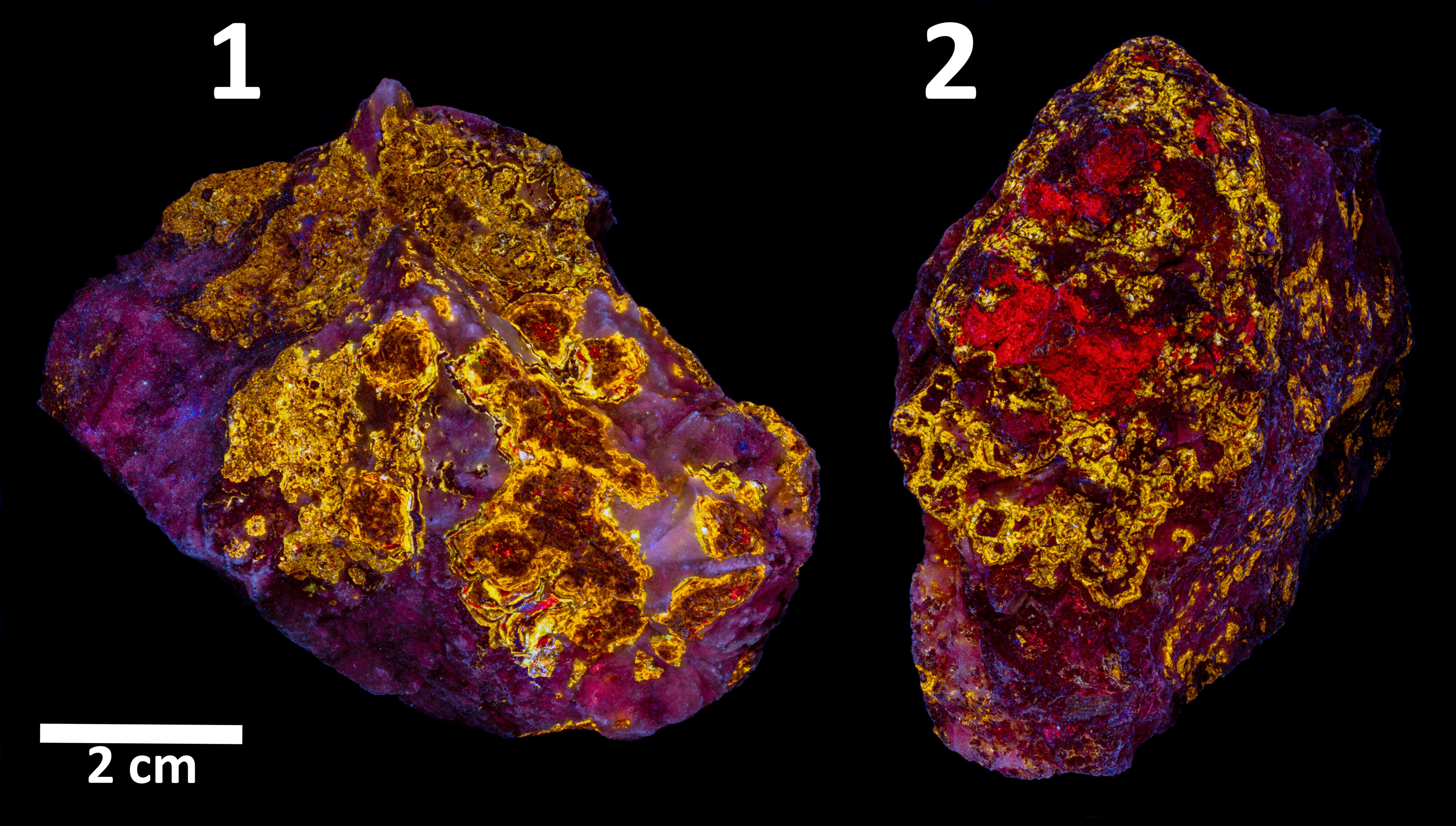
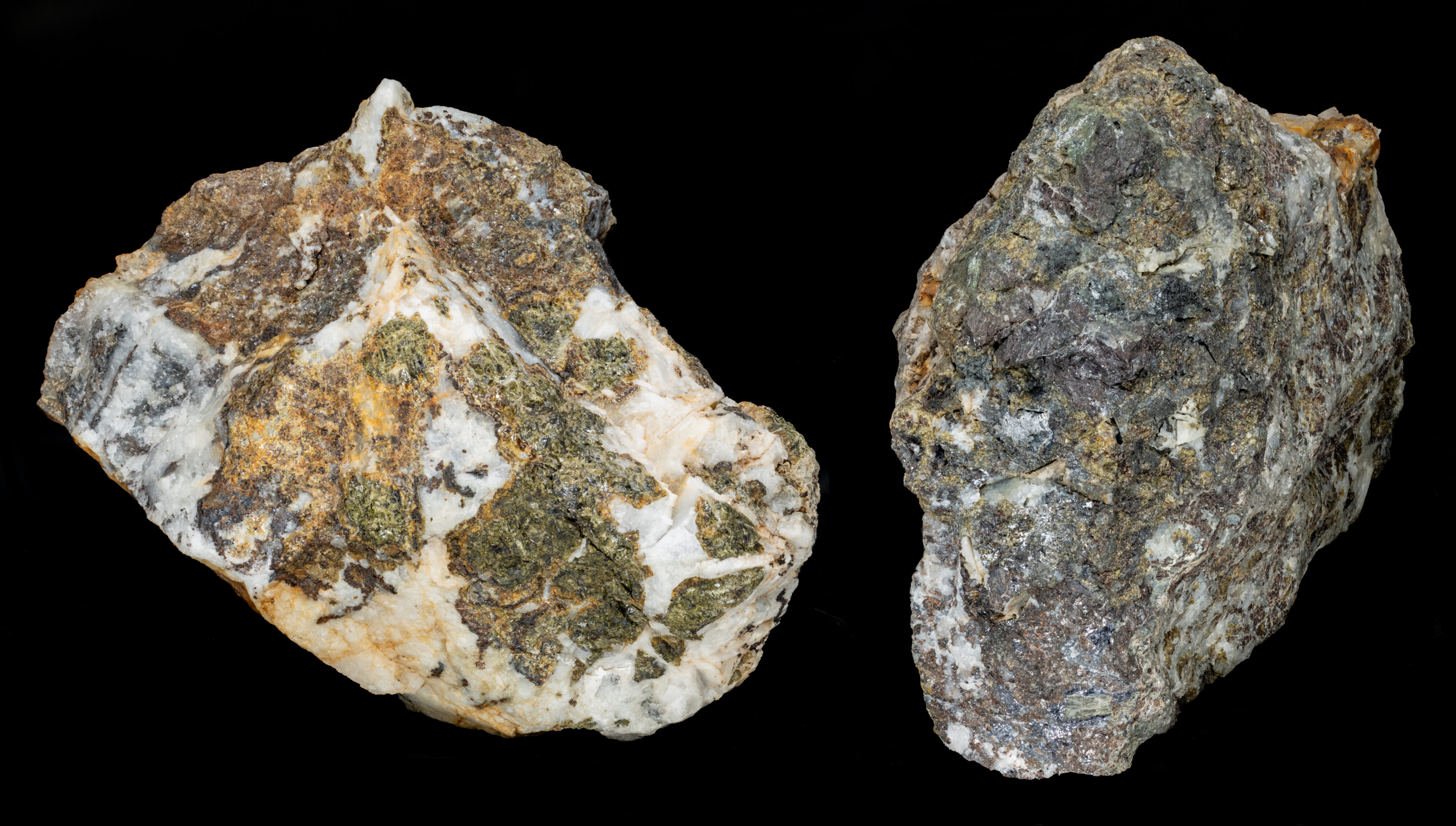
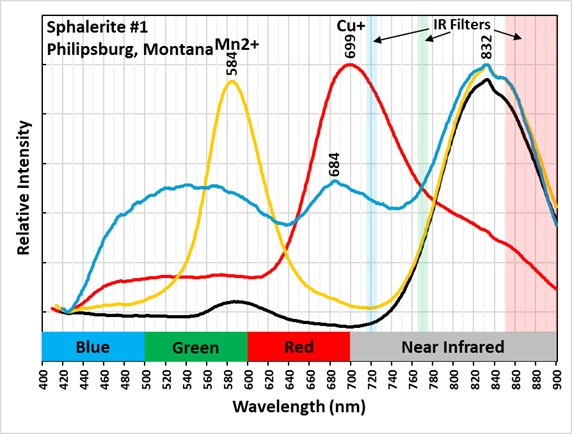
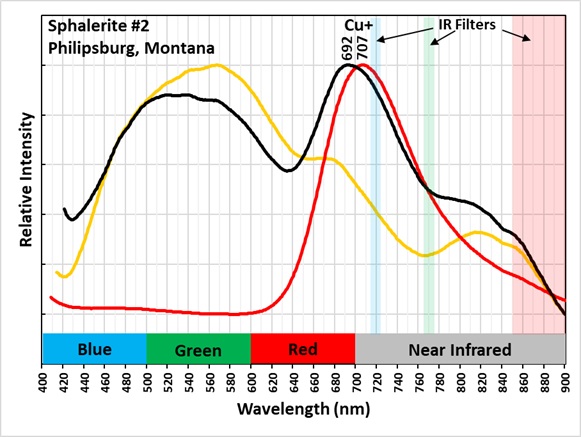
These are two sphalerite (ZnS) specimens from the Algonquin Mine, Philipsburg Mining District, Granite County, Montana. These specimens have multiple colors of visible fluorescence and infrared fluorescence. The longwave emission spectra for these specimens have peaks that correspond to known activators of sphalerite fluorescence as well as several peaks with no reference material available to identify the activator. The peak at 584 nm in specimen #1 corresponds to yellow fluorescence activated by manganese (Mn2+). The red fluorescence represented by emission peaks around 700 nm are activated by copper (Cu+) and a tungsten (W6+) co-activator. According to Beaucamp and others (2024) study of the red fluorescence of sphalerite from Philipsburg, copper and tungsten enter the sphalerite lattice as a tungsten atom and four copper atoms that replace five zinc atoms. This substitution maintains charge balance as W6+ + 4Cu+ = 5Zn2+.
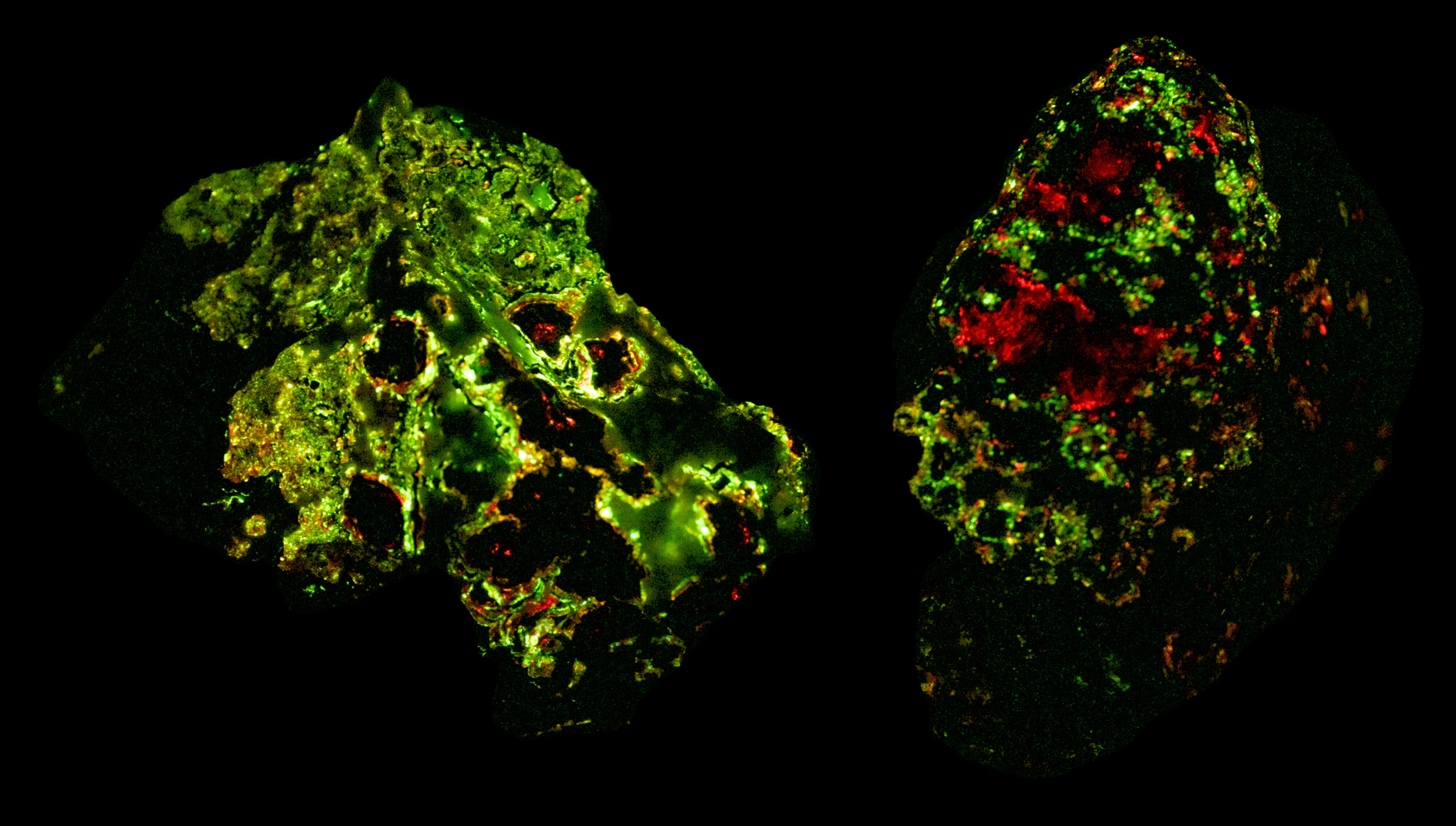
The broad emission peaks in the visible blue and green are likely caused by multiple activators, but there are no references available to determine what those activators might be. There are also strong emission peaks in the infrared with maximum at 832 nm where the activators are unknown. The study done by Beaucamp and others (2024) found that Philipsburg sphalerite with yellow fluorescence had high values of gallium and low values of tungsten. Germanium was also found in the sphalerite specimens. Gallium and germanium are potential activators of the infrared and visible fluorescence.
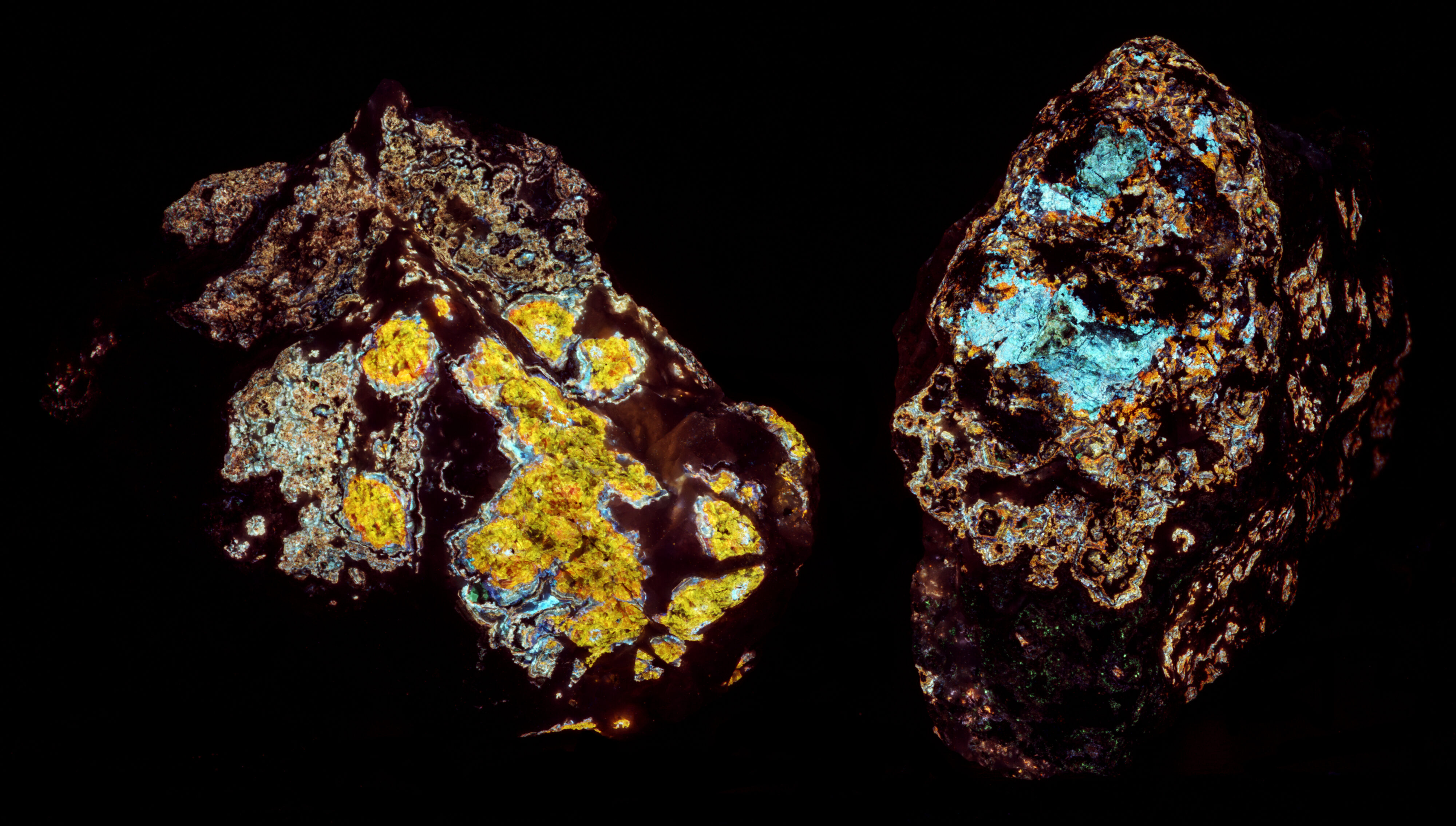
The false color image of the infrared fluorescence is composed of two narrow bandpass images centered at 720 nm (blue) and 770 nm (green), and an 850 nm cutoff filter (red). The infrared filters are shown on the spectral plots. The copper-tungsten activated fluorescence appears light blue in the false color image. The yellow areas represent the bright infrared fluorescence with the emission peaks at 852 nm.
Reference
Beaucamp, C.M.E, Gammons, C.H., Thompson, J.M, Lowers, H.A., 2024, Fluorescent sphalerite rich in tungsten, copper, gallium, silver, and other elements from the Cordilleran-style, polymetallic veins of Philipsburg, Montana, Ore Geology Reviews, V. 173,
Summary of luminescence responses:
Sphalerite (Mindat) (RRUFF)
- Fluorescence under Longwave (365nm LED) UV light: Red
- Fluorescence under Longwave (365nm LED) UV light: Yellow