
Sphalerite from the Phillipsburg District, Granite County, Montana
Contributed by: Michael Crawford
Date: Dec 9th, 2025
Locality: Granite County, Montana, USA (See on Mindat)
Size: 5 x 6 cm
Description:
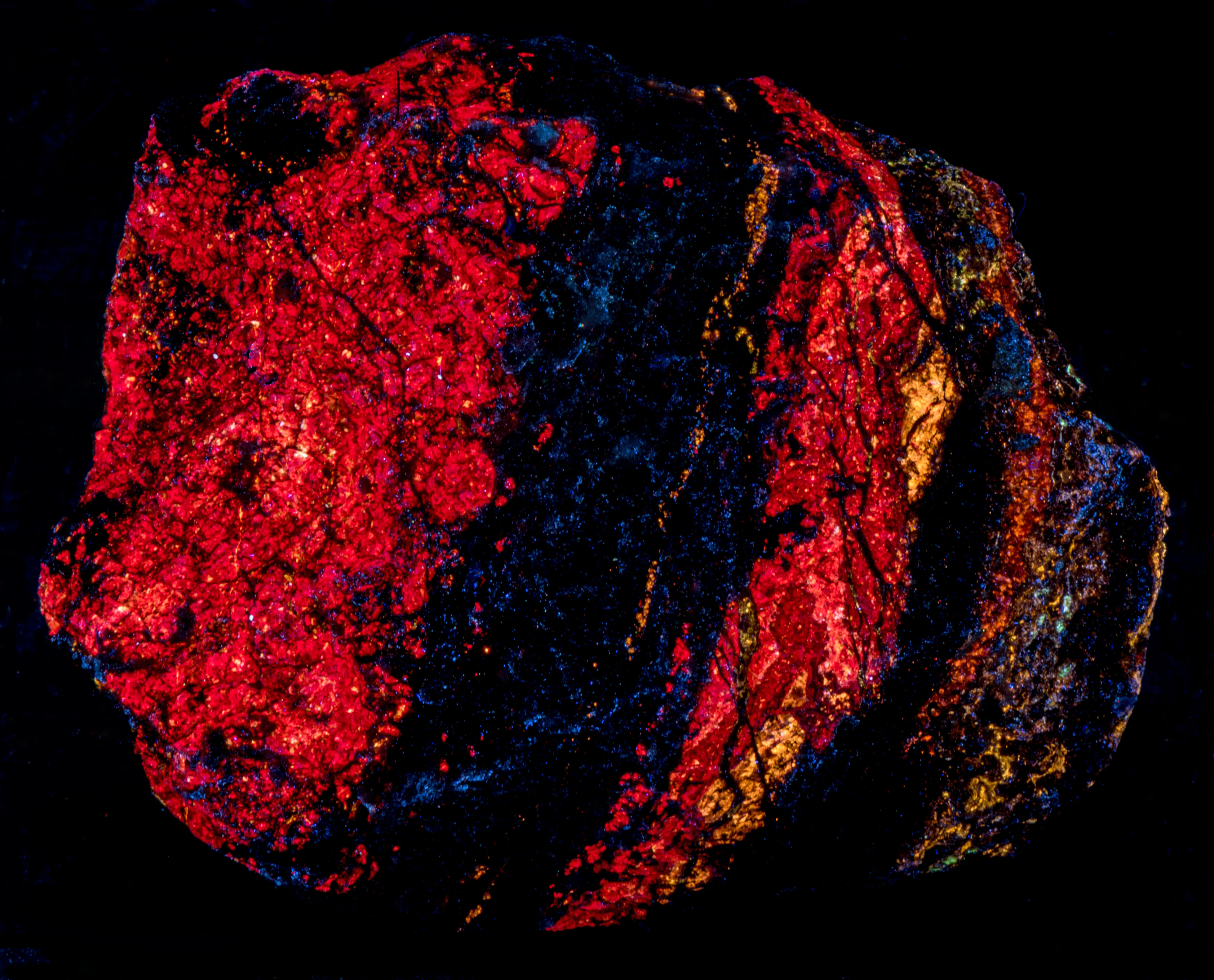
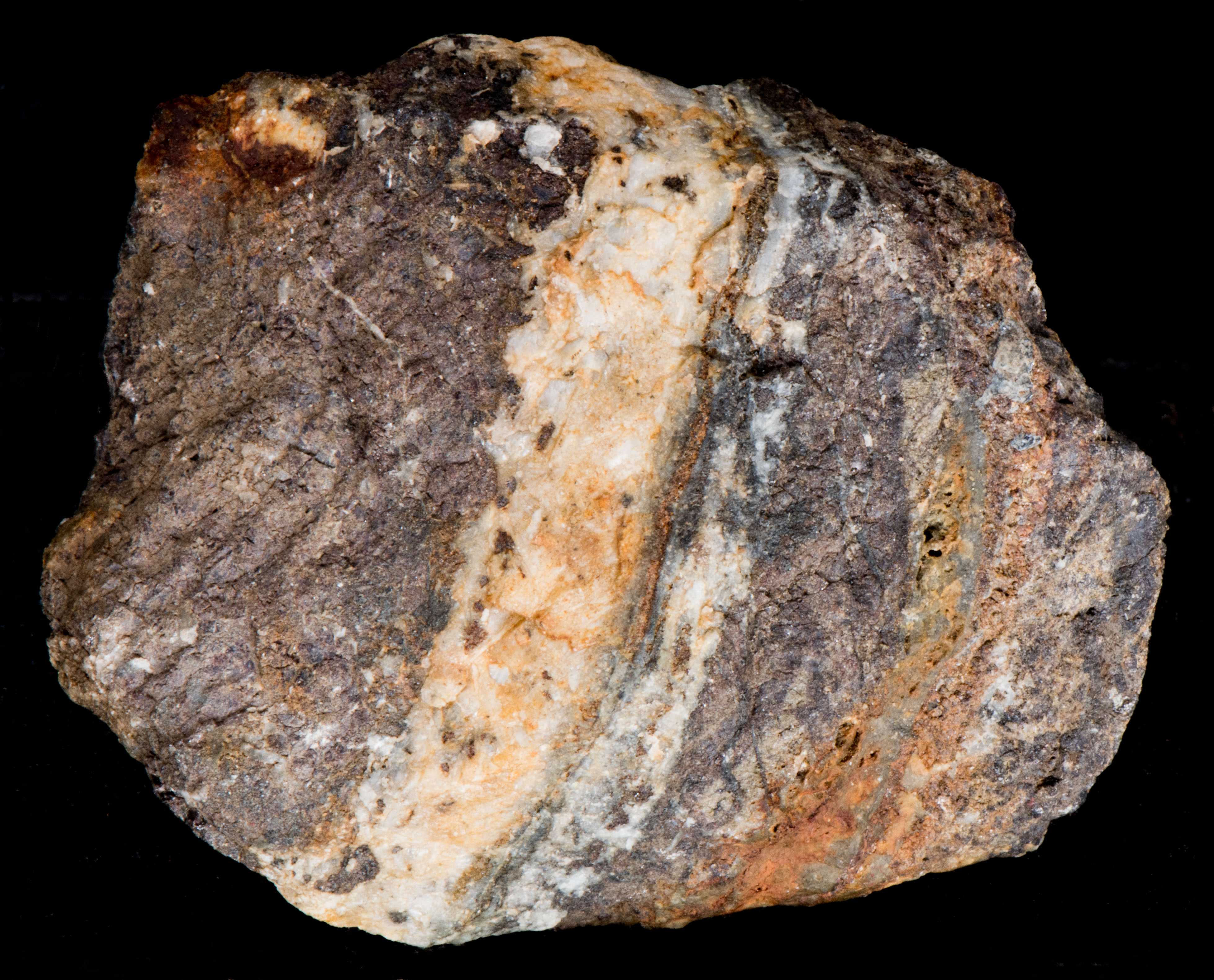
A sphalerite specimen from the Phillipsburg District, Granite County, Montana. The specimen contains bands of sphalerite that fluoresce red and yellow orange under longwave UV light. The red fluorescence of sphalerite is uncommon. A recent study of the red fluorescence of the sphalerite from this area found that fluorescence is activated by copper and tungsten (Beaucamp and others, 2024). They proposed that copper and tungsten enter the sphalerite lattice as a tungsten atom and four copper atoms that replace five zinc atoms. This substitution maintains charge balance as W6+ + 4Cu+ = 5Zn2+. This substitution also creates strain in the sphalerite lattice. The study also found that sphalerite with high copper and gallium but lacking tungsten fluoresces yellow.
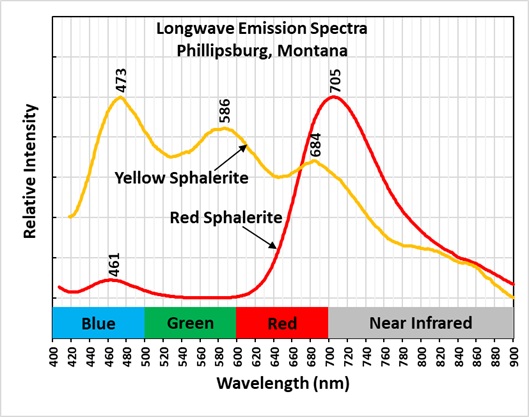
The longwave emission spectrum of the yellow orange, fluorescent sphalerite is unusual. It has three peaks, one at 473 nm, another at 586 nm and the third one at 705 nm. Yellow sphalerite fluorescence usually indicates a manganese activator, but that activation creates a single peak around 580 nm to 605 nm. The paper by Beaucamp and others (2024) cited copper and gallium as activators for the yellow fluorescence of sphalerite from the Phillipsburg District. The multiple peaks are likely from multiple activators such as manganese, copper and gallium.
The spectrum for the red fluorescent sphalerite is a broad peak with a maximum in the near infrared at 705 nm. According to the previously mentioned research, this red and near infrared emission is activated by copper along with tungsten.
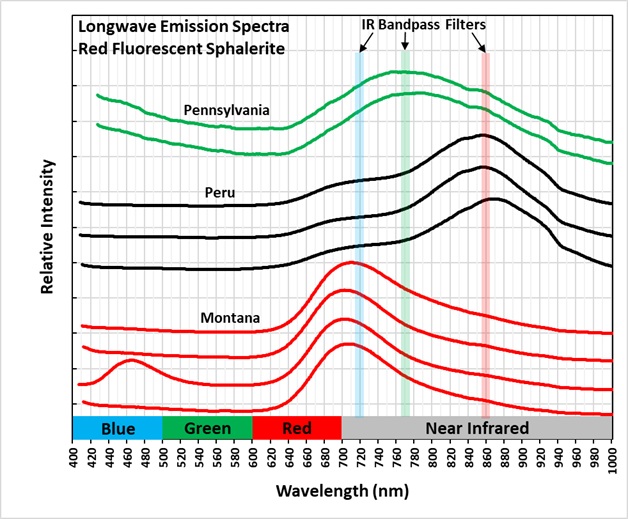
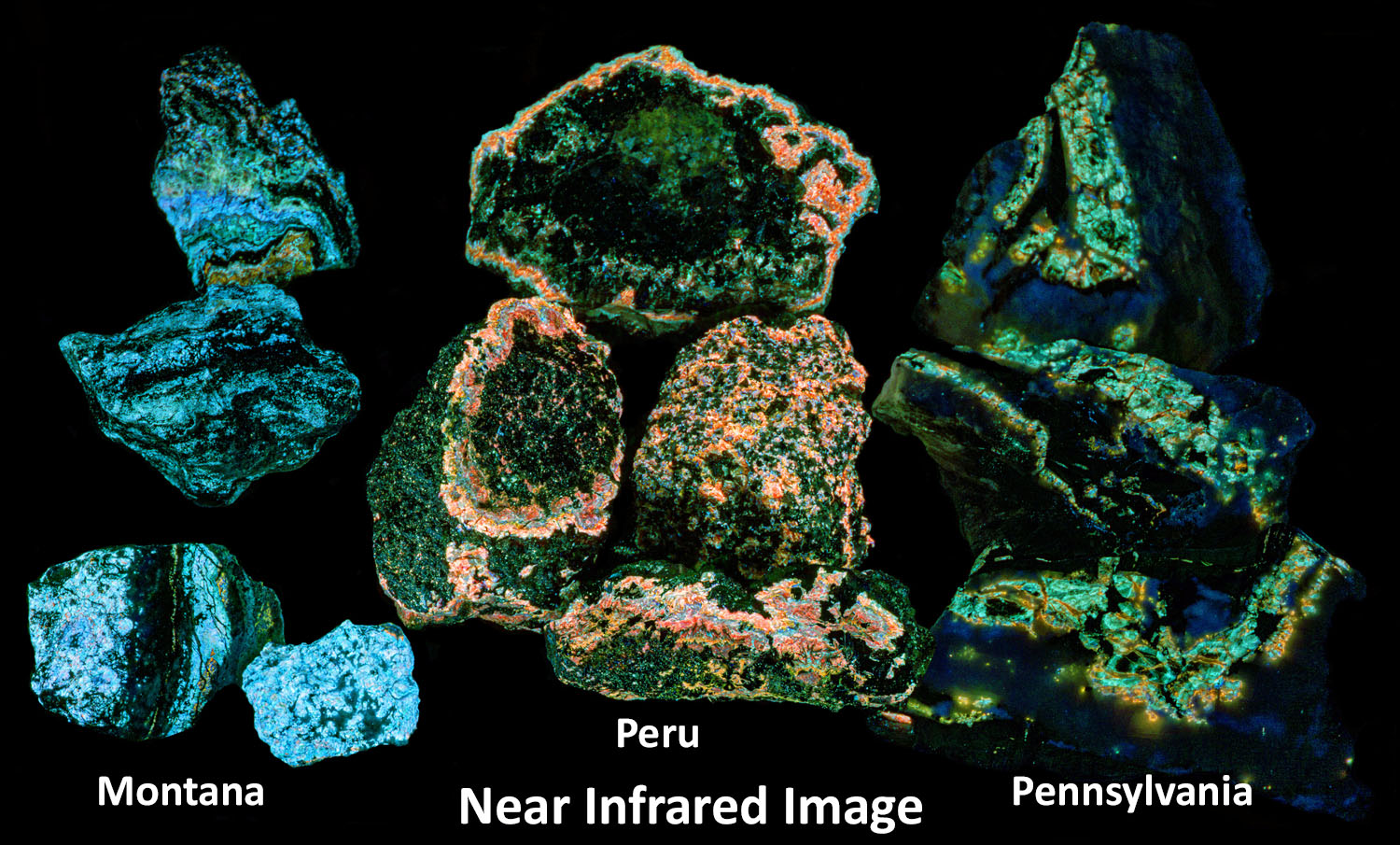
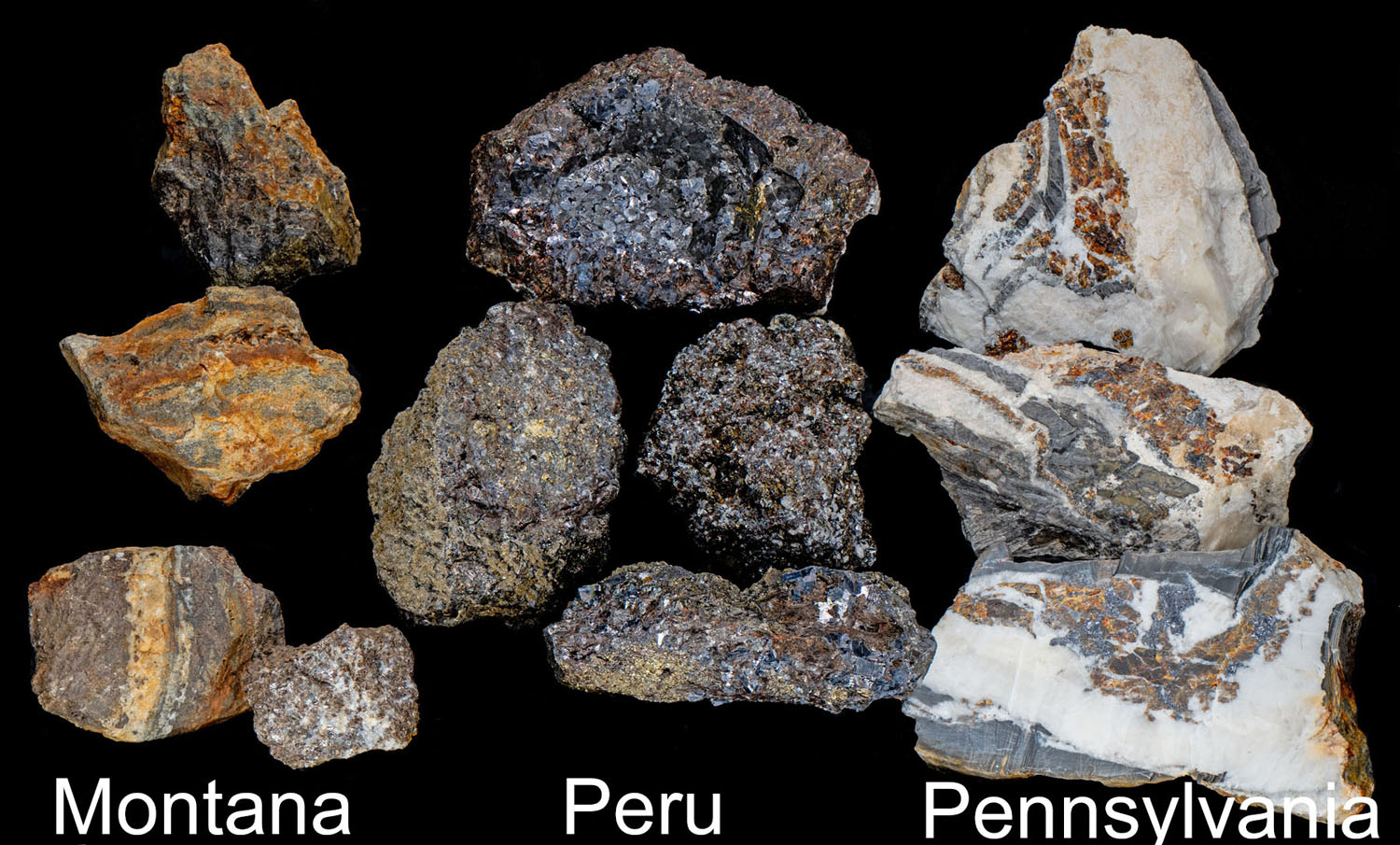
A second set of images compare red fluorescent sphalerites from Montana, from two locations in Peru (Huanzala Mine, Huallanca District, Bolognesi Province, Ancash, Peru and Huaron Mine, Huayllay District, Pasco Province, Pasco, Peru), and from the Almedia Mine, Columbia County, Pennsylvania. All specimens appear red in the image of visible fluorescence. The false color image of the near infrared fluorescence shows differences in the fluorescent response for the three locations. The false color image is created from three images taken with 10 nm wide bandpass filters centered at 720 nm, 770 nm and 860 nm. The three images are combined by assigning the 860 nm image to red, assigning the 770 nm image to green, and assigning the 720 nm image to blue. The false color image shows that the sphalerite has a different color for each location. The Montana sphalerite is a light blue color. It is brightest in 720 nm image (blue). The Peru sphalerite has a pinkish red color. It is brightest in the 860 nm image (red). The Pennsylvania sphalerite has a blue-green color. It is brightest in the 770 nm image (green).
The color differences in the false color images are explained by the longwave emission spectra. The narrow bandpass filters used to create false color images are shown on the spectral plots. Longwave emission spectra shows that the red fluorescent sphalerites have different spectral signatures in the near infrared. Differences in the longwave emission spectra of these specimens suggest three different activators for the near infrared fluorescence. Copper along with different co-activators appears to be the cause of red fluorescence and different infrared emission signatures. Glenn Waychunas described in the 2020 FMS Journal that the red fluorescence of the sphalerite is activated by copper along with nearby vacancies of sulfur atoms in the ZnS crystal lattice. Manual Robbins book describes iron or copper with coactivators as possible activators for red fluorescence. Fluomin lists Cu+-Ga3+ and Cu+-In3+ replacing Zn2+ activating red fluorescence.
References
Beaucamp, C.M.E, Gammons, C.H., Thompson, J.M, Lowers, H.A., 2024, Fluorescent sphalerite rich in tungsten, copper, gallium, silver, and other elements from the Cordilleran-style, polymetallic veins of Philipsburg, Montana, Ore Geology Reviews, V. 173, https://doi.org/10.1016/j.oregeorev.2024.106267
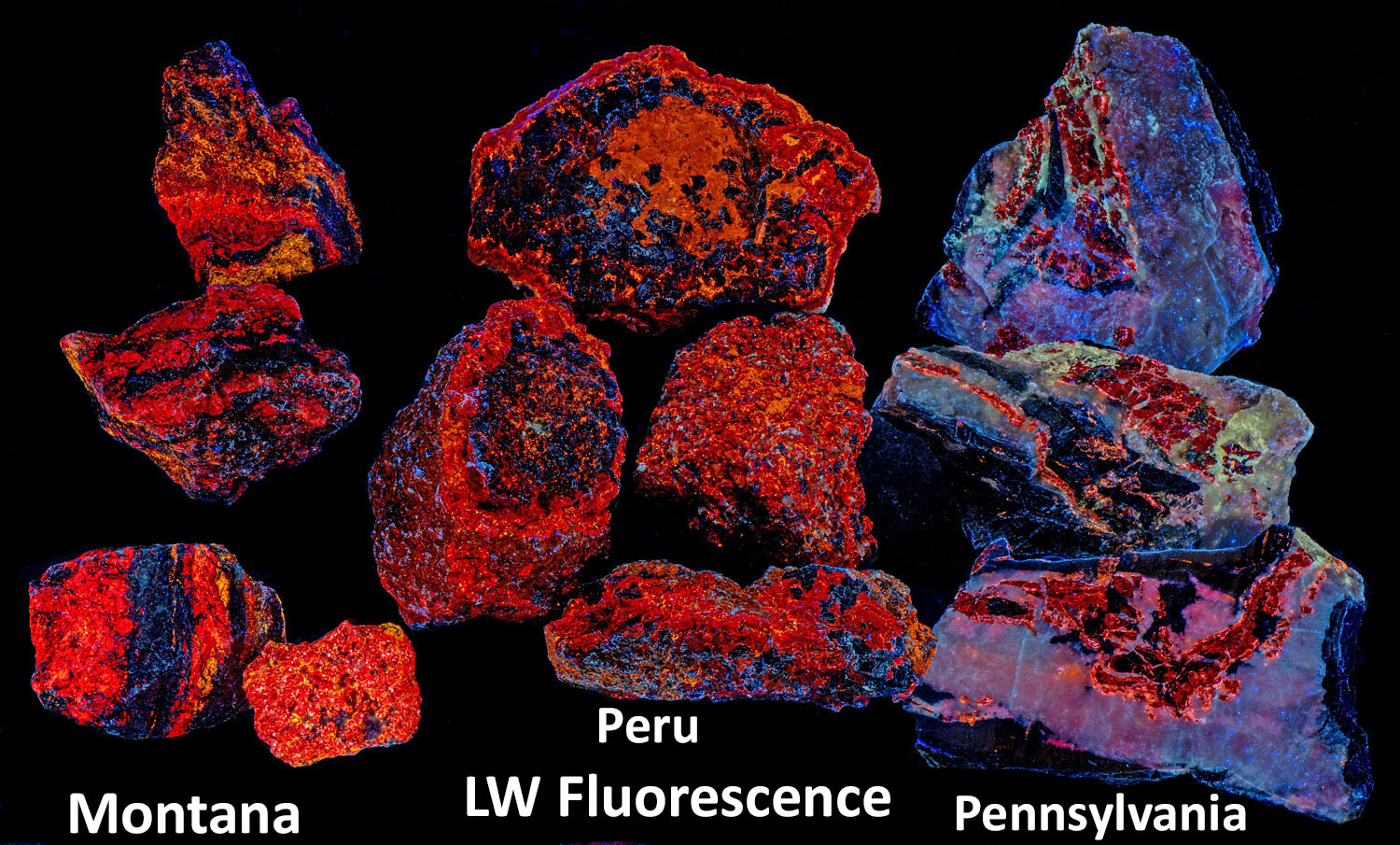
Summary of luminescence responses:
Sphalerite (Mindat) (RRUFF)
- Fluorescence under Longwave (365nm LED) UV light: Red
- Fluorescence under Longwave (365nm LED) UV light: Yellow