
Terlingua-Type Calcite – Boquillas Del Carmen, Mexico
Contributed by: Michael Crawford
Date: Sep 7th, 2026
Locality: San Vicente Mine, Boquillas Del Carmen, Ocampo Municipality, Coahuila, Mexico (See on Mindat)
Size: 5.5 x 9 cm
Description:
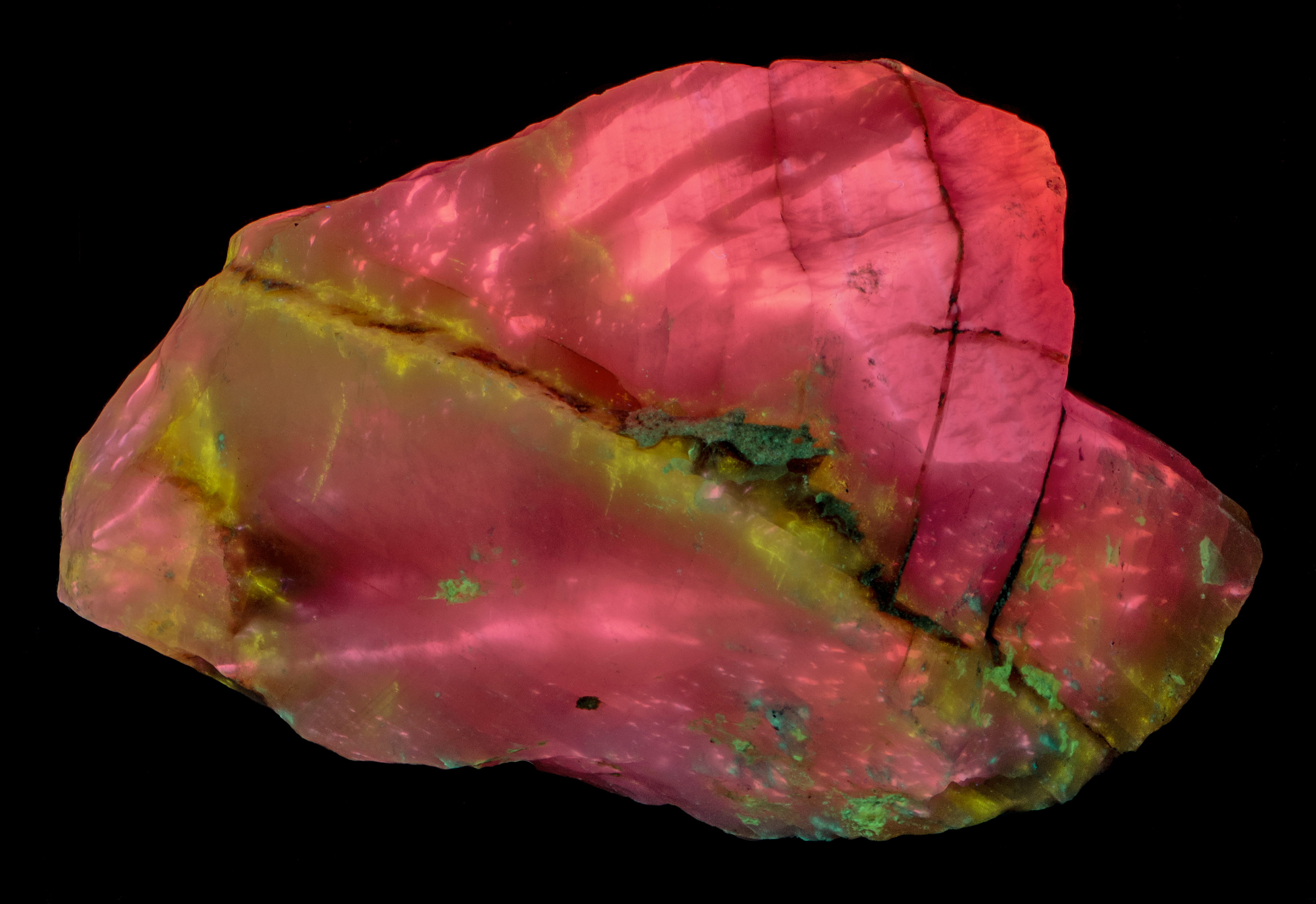
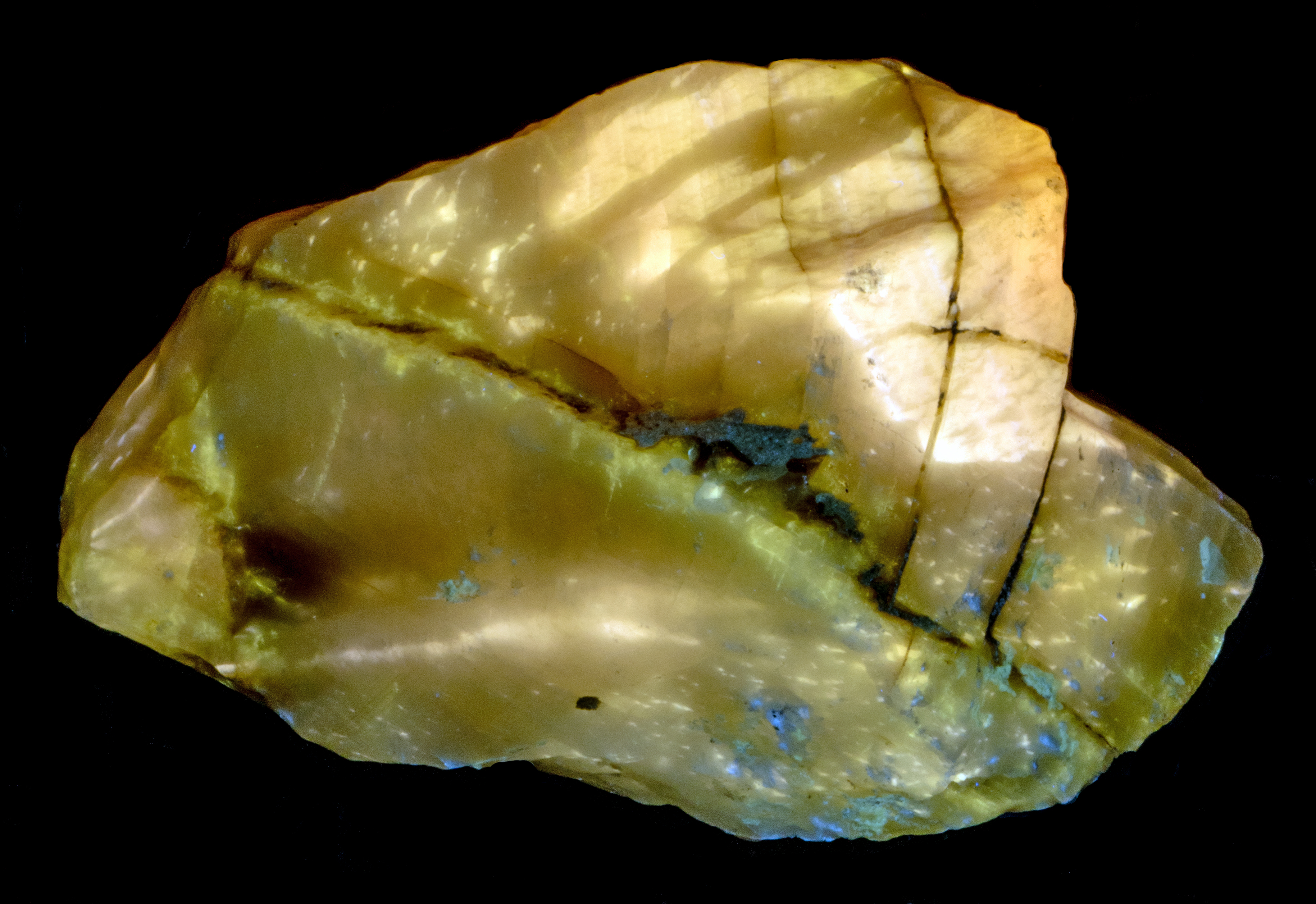
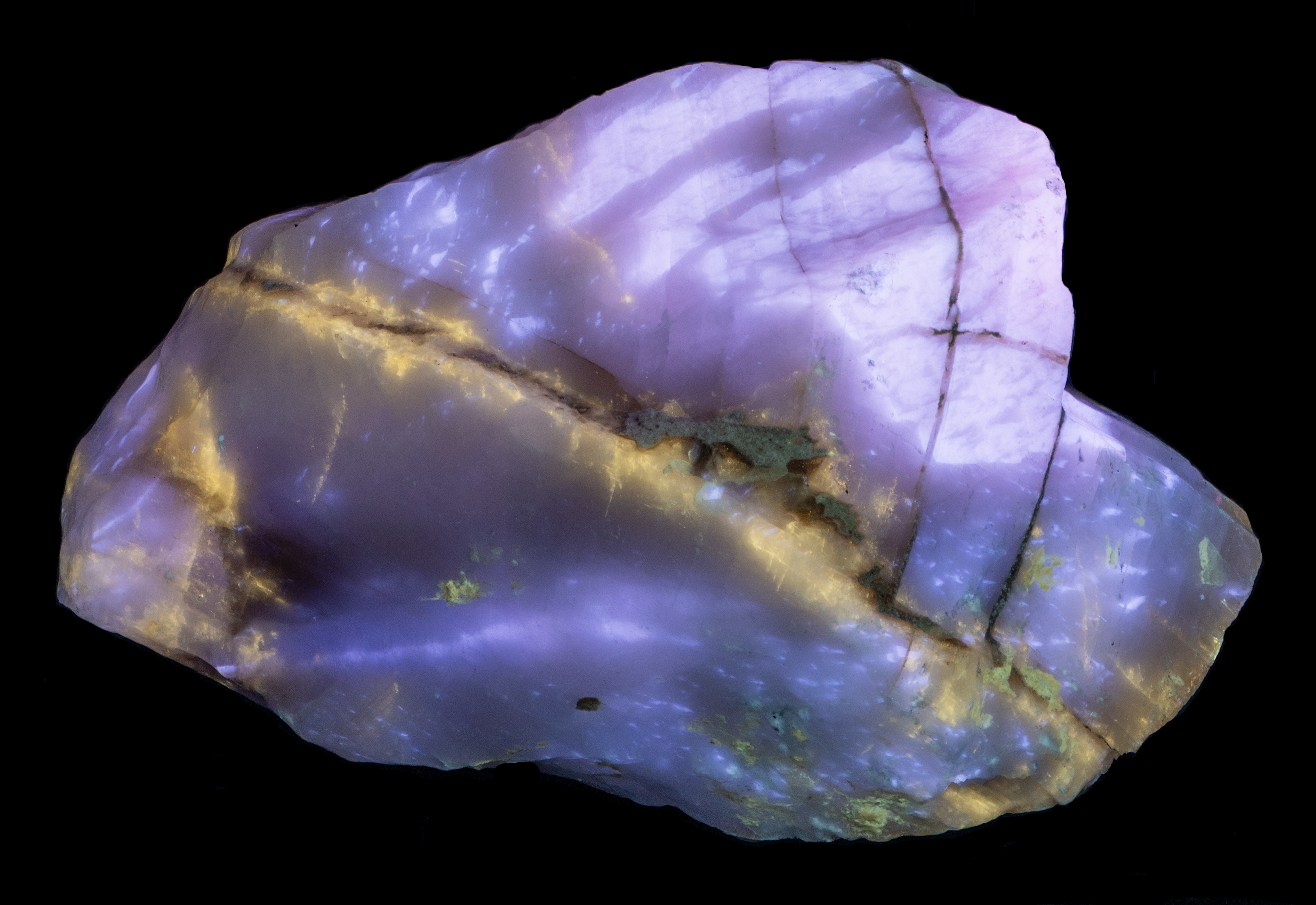
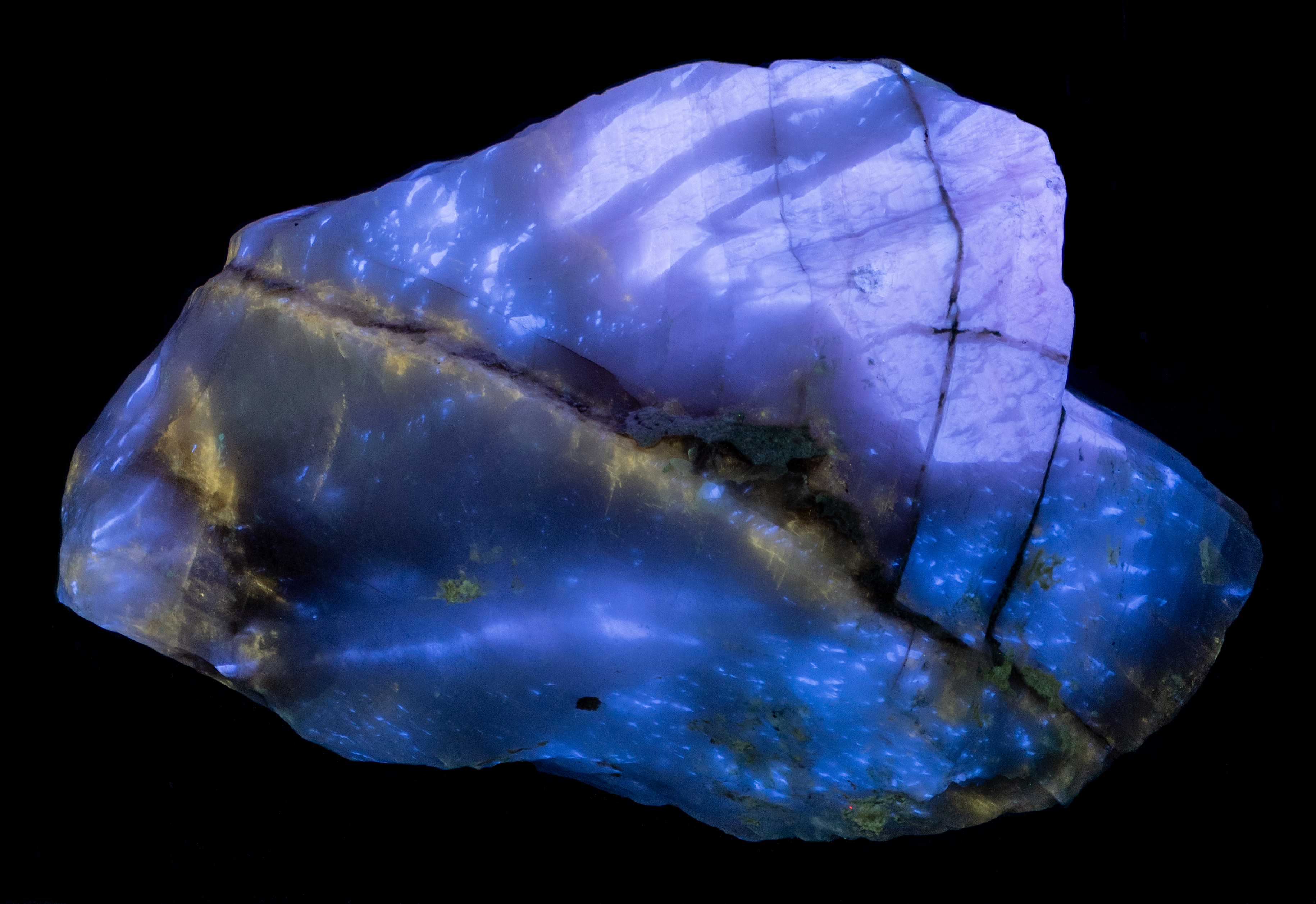
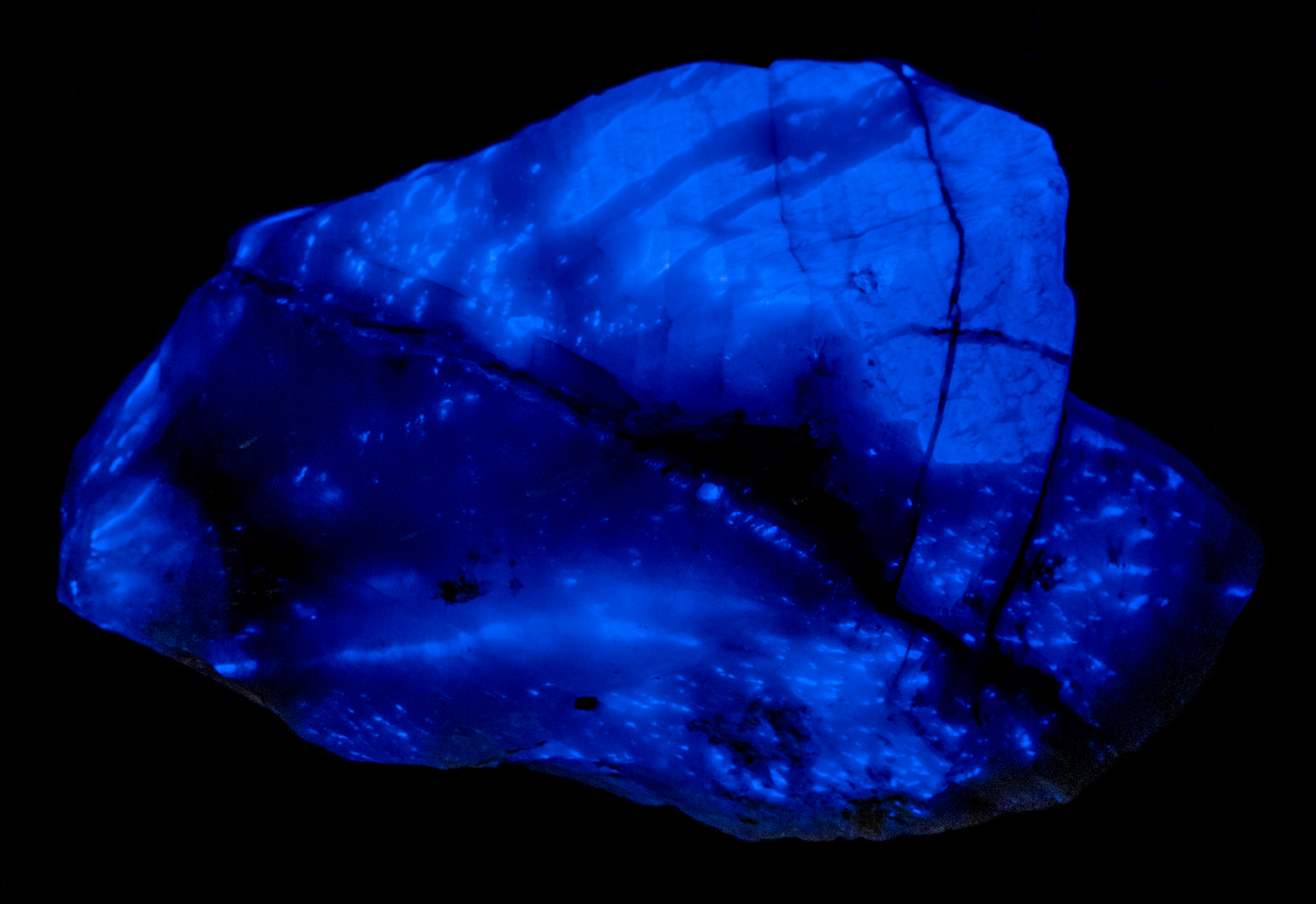
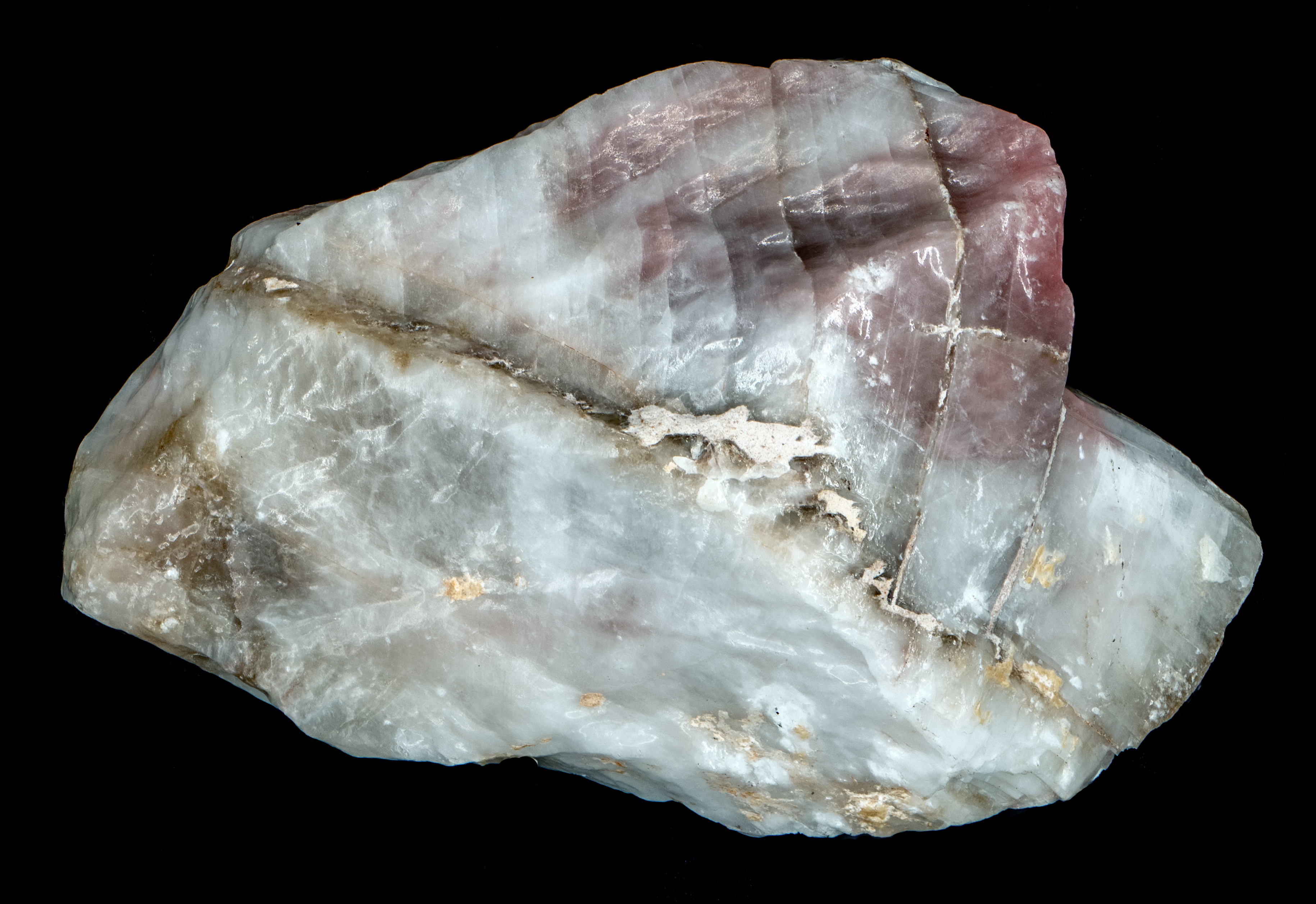
This Terlingua-type calcite specimen comes from the San Vicente Mine in Boquillas Del Carmen, Coahuila, Mexico. It exhibits the typical fluorescence of Terlingua-type calcite, along with several additional fluorescent responses. Typical specimens show bright blue-white fluorescence under shortwave UV, a strong and long-lasting blue afterglow, and bright pinkish-orange fluorescence under longwave UV. This specimen also displays violet shortwave fluorescence and pale-yellow fluorescence under 340 nm LED illumination. Across all wavelengths, the brightest fluorescence is associated with daylight-pink areas of the specimen. Waychunas (2012) found that these areas contain higher concentrations of rare earth minerals.
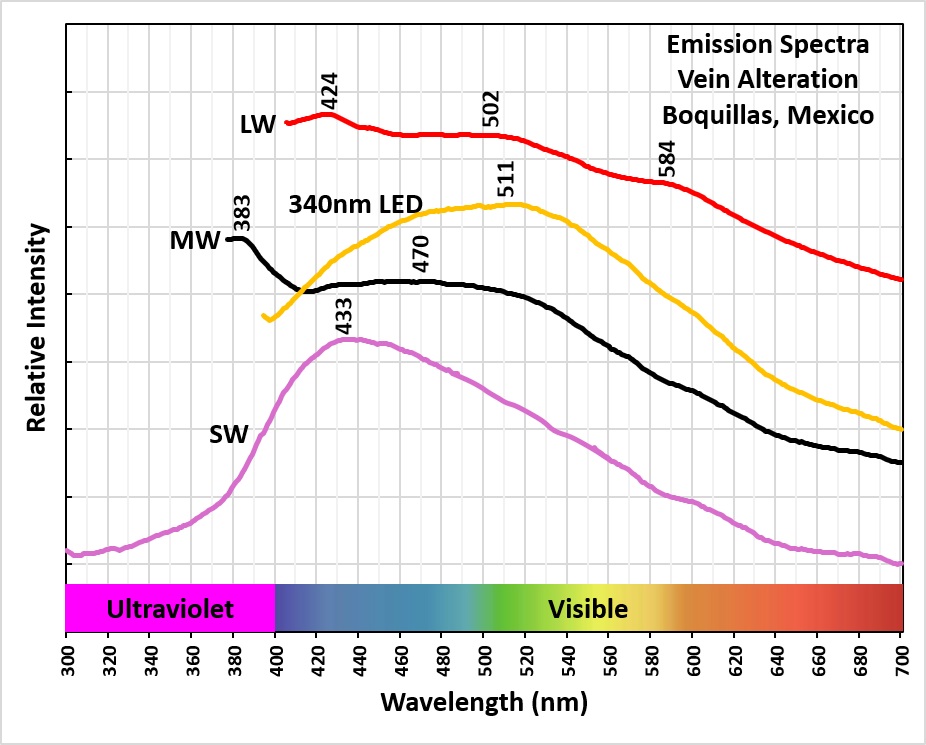
A vein also crosses the center of the specimen. The vein minerals are non-fluorescent, but an adjacent alteration zone fluoresces yellow under all UV wavelengths. The emission spectra from this yellow alteration zone differs from the pale-yellow fluorescence produced under 340 nm UV light. The alteration spectra have very broad peaks, with maxima at 433 nm (SW), 470 nm (MW), 511 nm (340 nm LED), and 502 nm (LW). These spectra do not identify a specific activator. Organic material is a possible activator for the pale-yellow fluorescence in the vein alteration zone.
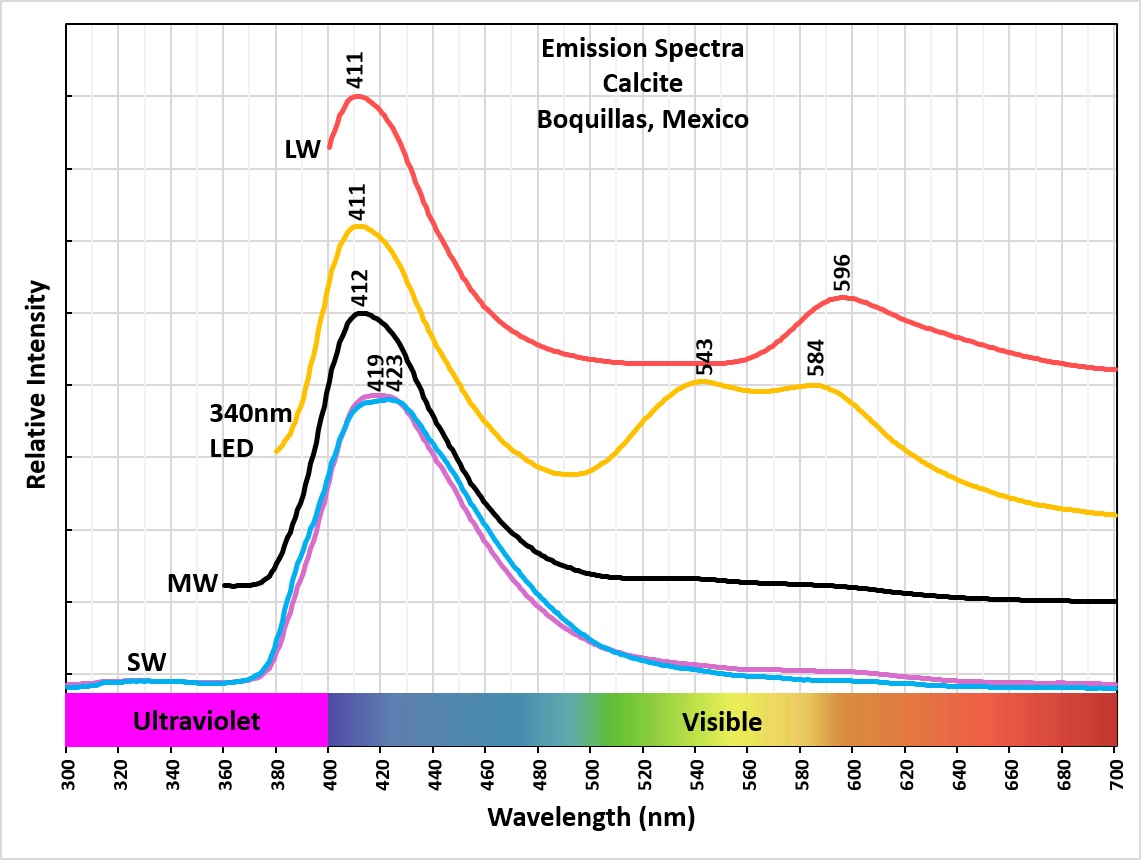
Pinkish-orange longwave fluorescence is common in Terlingua calcite. Its emission spectrum has peaks at 411 nm (violet) and 596 nm (orange), which combine to produce the pinkish-orange color. In Terlingua-type calcite, this violet and orange fluorescence is activated by radiation-induced lattice defects. These defects are likely associated with different rare earth elements responsible for the 411 nm and 596 nm peaks (Waychunas, 2012), although the specific elements have not been identified. The nature of the lattice defect is also unknown. Missing carbonate ions are one possible explanation, but this hypothesis remains unproven.
The pale-yellow fluorescence has three emission peaks: 411 nm, 543 nm, and 584 nm. These peaks are likely produced by different rare earth elements coupled with lattice defects. As with the other emissions, the responsible, rare earth elements have not been identified, and the lattice defect remains unknown.
The calcite also shows two shortwave fluorescent colors: light blue and violet. Their shortwave emission spectra have strong peaks at 419 nm and 423 nm. The violet fluorescence results from a slight increase in orange emission near 600 nm. The blue emission is also activated by radiation-induced lattice defects associated with a rare earth element. The blue and violet calcite share the same intense blue afterglow after shortwave exposure, indicating electron traps just below the conduction band. Shortwave light excites electrons into these traps. Thermal energy then gradually releases the electrons into the conduction band, where they lose some energy and drop to an excited state. As each electron returns from that excited state to the valence band, it emits a photon of violet-blue light. Temperature controls how quickly electrons leave the traps and therefore how long the afterglow lasts; cooler temperatures slow the release and extend the afterglow.
References:
Gaft, M., Nagli, L., Panczer, G., Waychunas,G., Porat,N., 2008, The nature of unusual luminescence in natural calcite CaCO3, American Mineralogist, V.93, pp.158–167
Waychunas, G.A., 2012, Investigation of the causes of Luminescence in Terlingua-Type (TT) calcite: a case for rare earth activation coupled with electronic defects, FMS Journal, V.32, pp.5-14
Summary of luminescence responses:
Calcite (Mindat) (RRUFF)
- Fluorescence under Longwave (365nm LED) UV light: Red
- Fluorescence under Longwave (365nm LED) UV light: Yellow
- Fluorescence under Midwave (305nm LED) UV light: Violet
- Fluorescence under Midwave (305nm LED) UV light: Yellow
- Fluorescence under Shortwave (255nm LED) UV light: Blue
- Fluorescence under Shortwave (255nm LED) UV light: Violet
- Fluorescence under Shortwave (255nm LED) UV light: Violet
- Afterglow after exposure to Shortwave (255nm LED) UV light: Blue
- Fluorescence under 340nm LED UV light: Yellow