
Terlingua Type Calcite from Challenger Cave, Mexico
Contributed by: Michael Crawford
Date: Aug 30th, 2026
Locality: Challenger Cave System, Monterrey Municipality, Nuevo León, Mexico (See on Mindat)
Description:
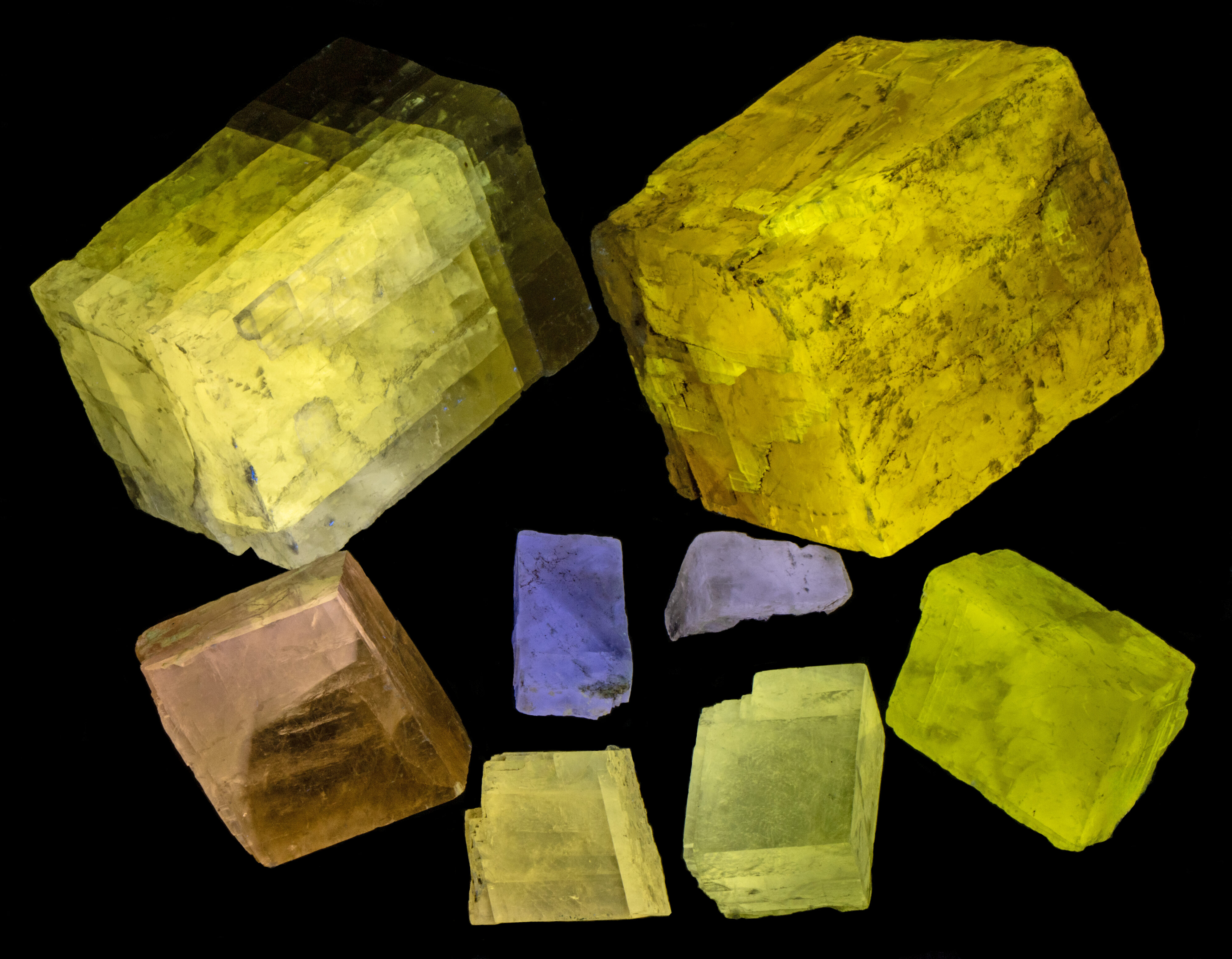
David Doyle sent me two calcite (CaCO3) specimens from Challenger Cave, Nuevo Leon, Mexico, that differ from the typical fluorescence for that locality. The most notable difference is the absence of bright yellow fluorescence under a 340 nm LED UV light. To compare these variations, I examined other Challenger Cave specimens in my collection. These specimens are Terlingua-type calcites. A Terlingua-type calcite is defined by bright blue-white fluorescence under shortwave UV, a bright and long-lasting blue afterglow, and bright pinkish-orange fluorescence under longwave UV. The standard Terlingua-type material comes from the Little 38 Mine in Terlingua, Texas. Some Challenger Cave calcites match this definition, but others show clear deviations.
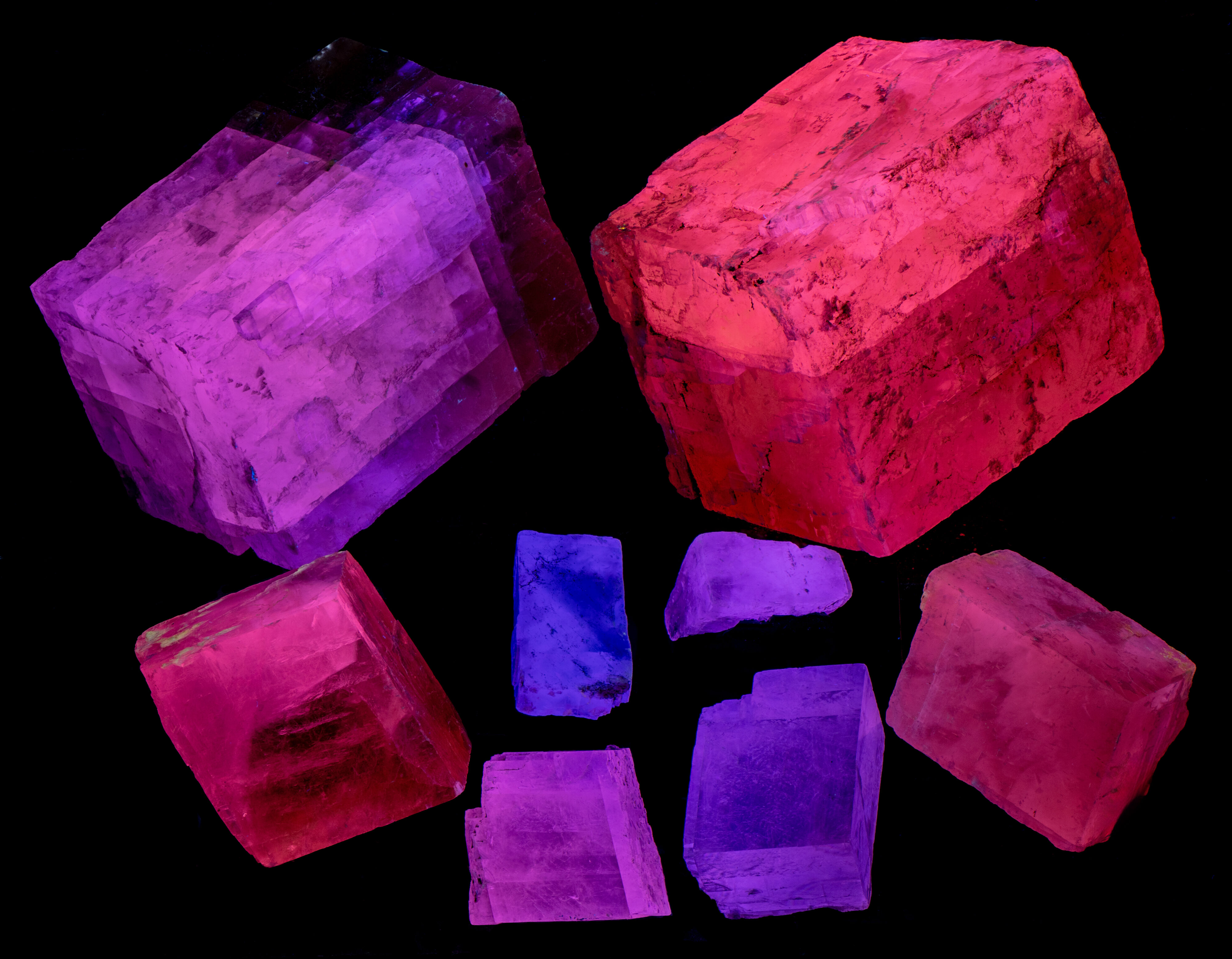
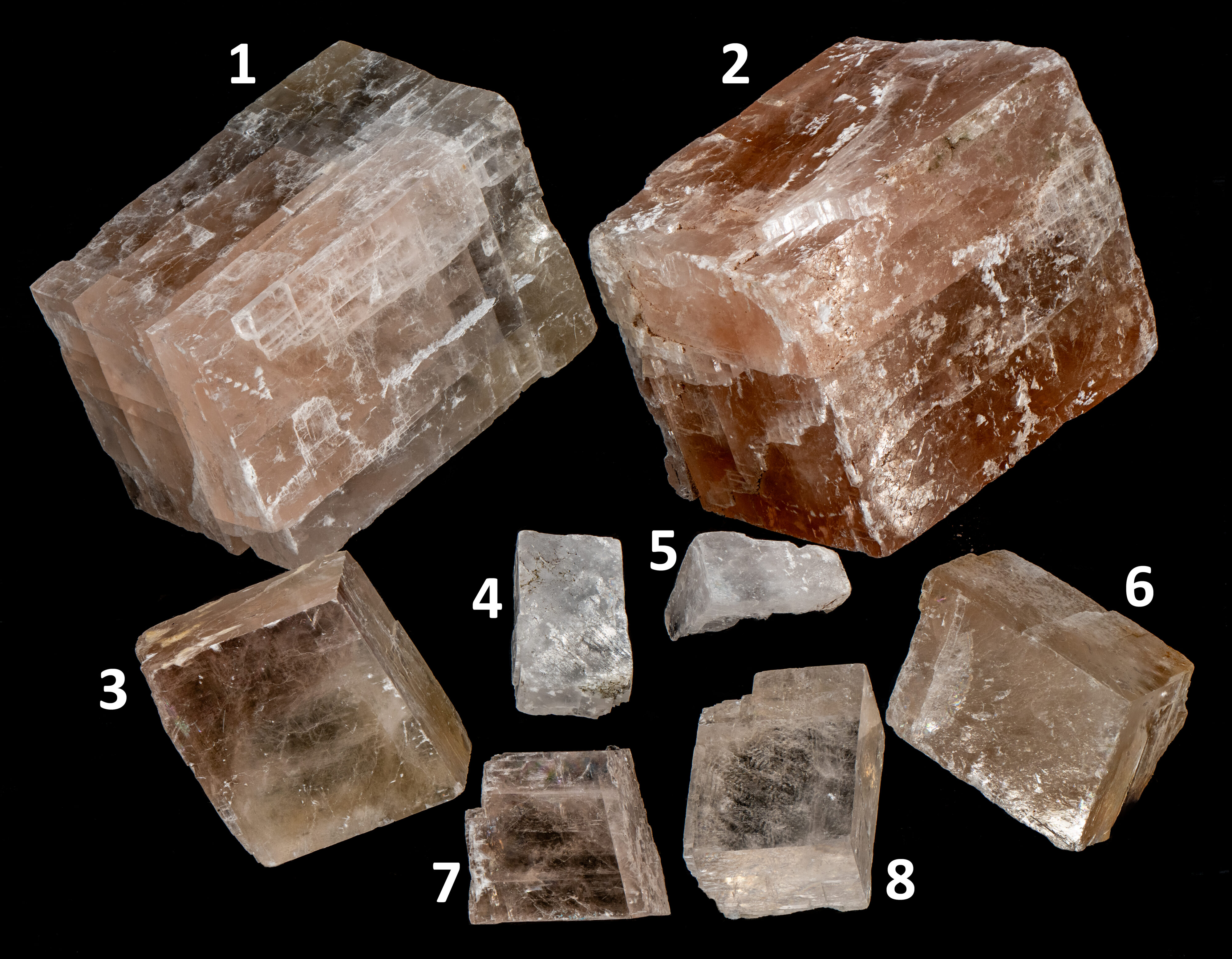
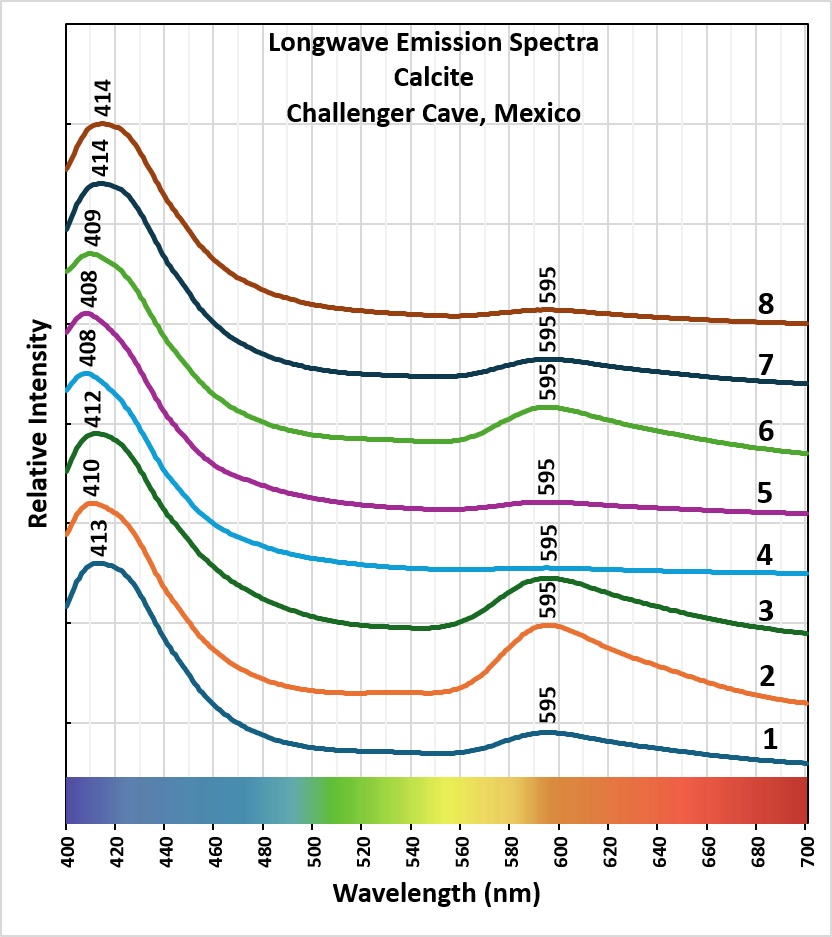
Under longwave light, the specimens fluoresce violet, blue, pink, and pinkish orange. David’s two specimens are the blue- and violet-fluorescing rhombs near the center of the display (Specimens 4 and 5). The longwave emission spectra help explain these color differences. All specimens show a strong violet peak at around 408–414 nm, while some also have a broad orange-red peak centered near 595 nm. The observed longwave colors result from the combination of violet and orange-red fluorescence. Differences in color are mainly controlled by the relative brightness of the orange-red emission compared with the violet emission; pink and pinkish-orange specimens have stronger orange fluorescence.
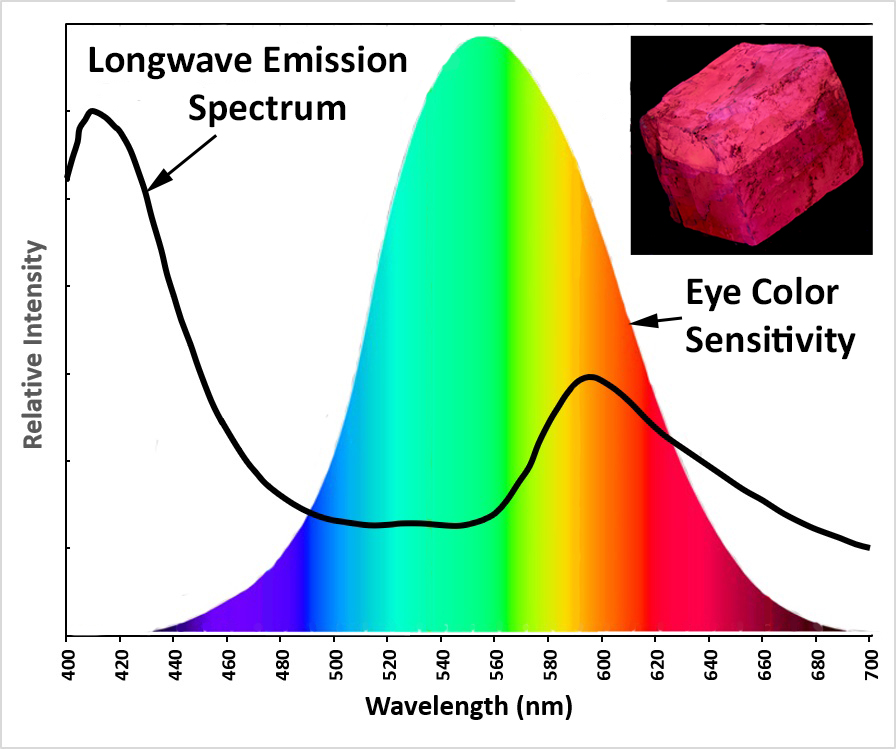
In all longwave emission spectra, violet fluorescence is much stronger than orange-red fluorescence, even in specimens with the brightest orange-red response. However, the spectrometer and the human eye perceive fluorescence differently. A color-vision sensitivity plot from Wikipedia ()), reproduced with the longwave spectrum of a bright pinkish-orange calcite specimen (2), illustrates this difference. The human eye is far more sensitive to red light near 595 nm than to violet light near 412 nm. This is partially caused by red-sensitive cone cells making up about 64% of retinal cones in the eye, compared with about 2% for blue-sensitive cones and 32% for green-sensitive cones. As a result, the spectrometer records a stronger violet response, while the human eye sees a stronger orange response.
The violet and orange-red fluorescence in Terlingua-type calcite is activated by radiation-induced lattice defects. These defects are likely associated with different rare earth elements that produce the two emission peaks at 412 nm and 595 nm (Waychunas, 2012). The specific elements associated with the defects have not been identified. Longwave color variations may reflect differences in rare earth concentrations, the number of lattice defects, or heating history. Orange fluorescence is thermally unstable and disappears after heating at temperatures ranging from 230 to 500oC (Gaft and others, 2008; McCann, 1995). Violet fluorescence is more stable.
Challenger Cave calcite also differs from Terlingua, Texas calcite in crystal habit. Terlingua calcite occurs as euhedral crystals (scalenohedral or modified scalenohedral) or as anhedral masses (Gossien, 2005), whereas Challenger Cave calcite occurs as translucent rhombs. These rhombs likely formed from low-temperature hydrothermal fluids in stable cavities or fractures that allowed slow crystal growth. These calcites do not show layering that is the typical habit formed in limestone caves from precipitating calcium carbonate that forms stalagmites, stalactites, flowstone and other cave formations.
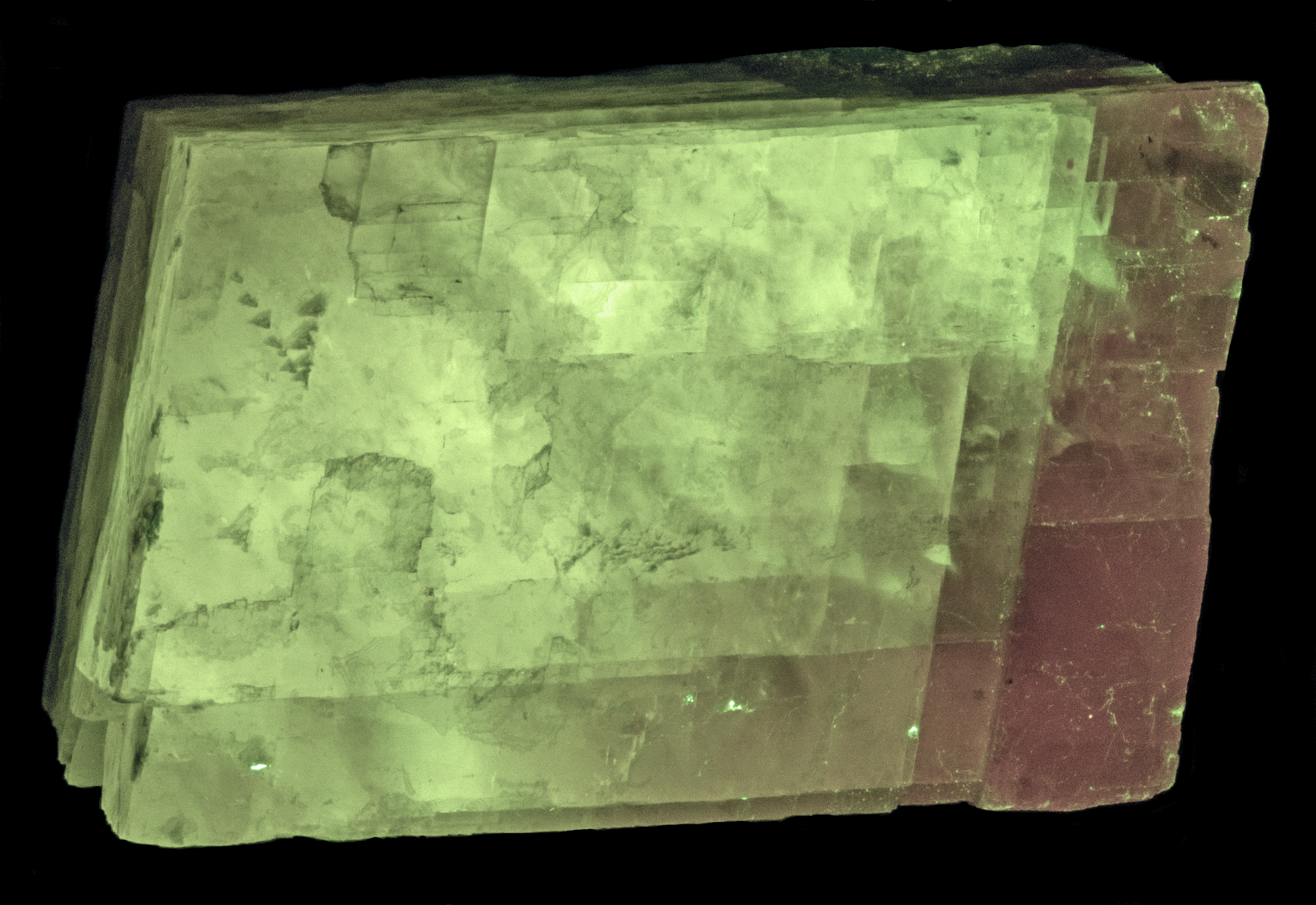
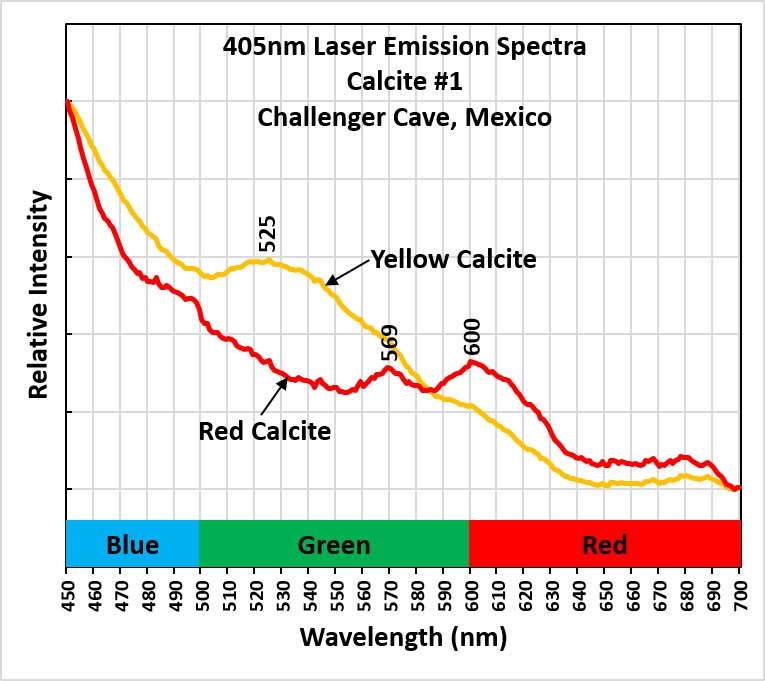
Fluorescence in these rhombs sometimes shows unusual zoning. Cleavage faces define rhombohedral fluorescent zones, which occur in Specimens 1, 2, 3, 7, and 8. Robbins (1994, p. 175) described this zoning in Challenger Cave calcite, but its formation remains unexplained. In Specimen 1, two zones are clearly visible under 405 nm laser illumination: one pale yellow and the other orange red. The orange red fluorescence is not visible at other wavelengths and is dim even under the intense laser illumination. Its emission spectrum is noisy, and peaks at 569 nm and 600 nm are not diagnostic of a specific activator.
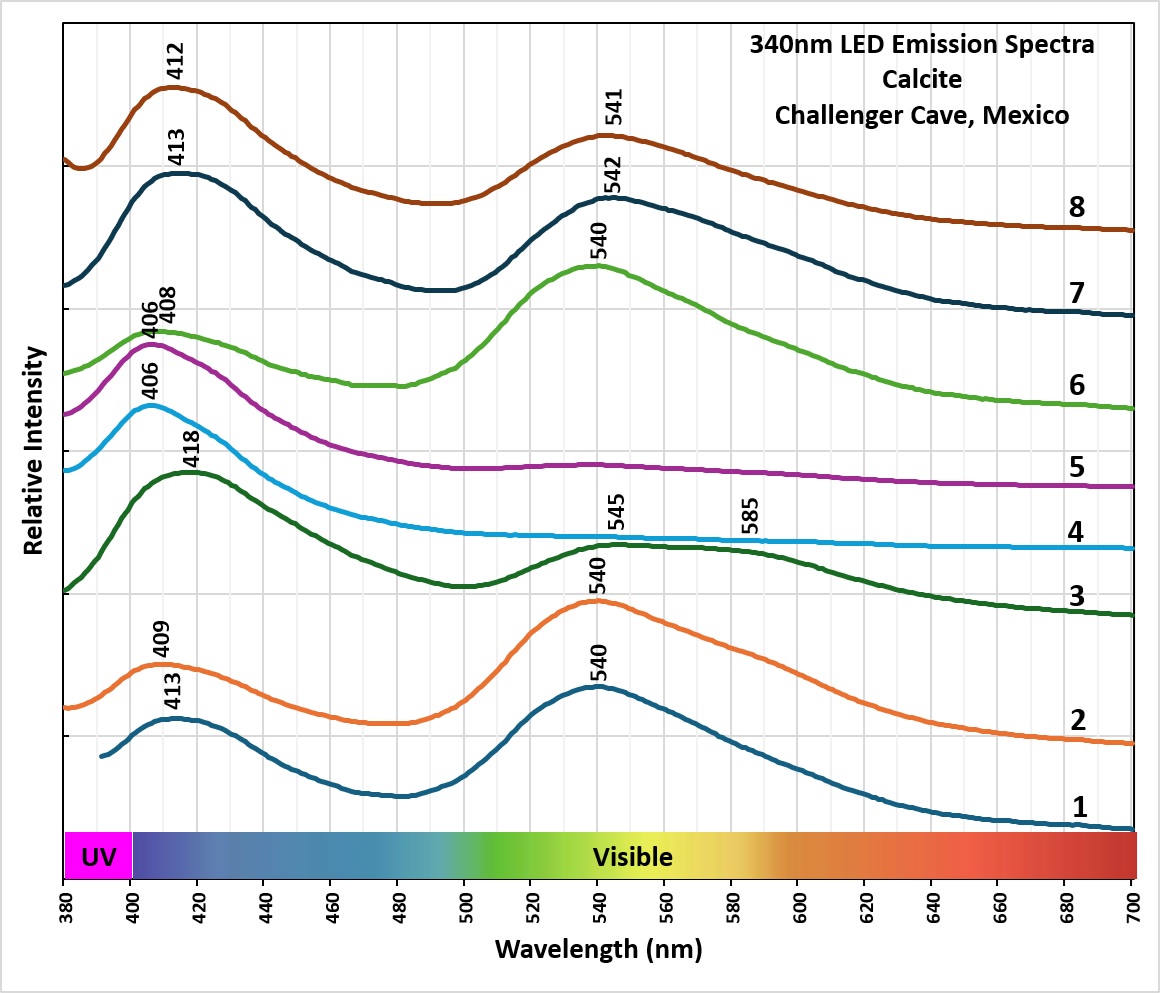
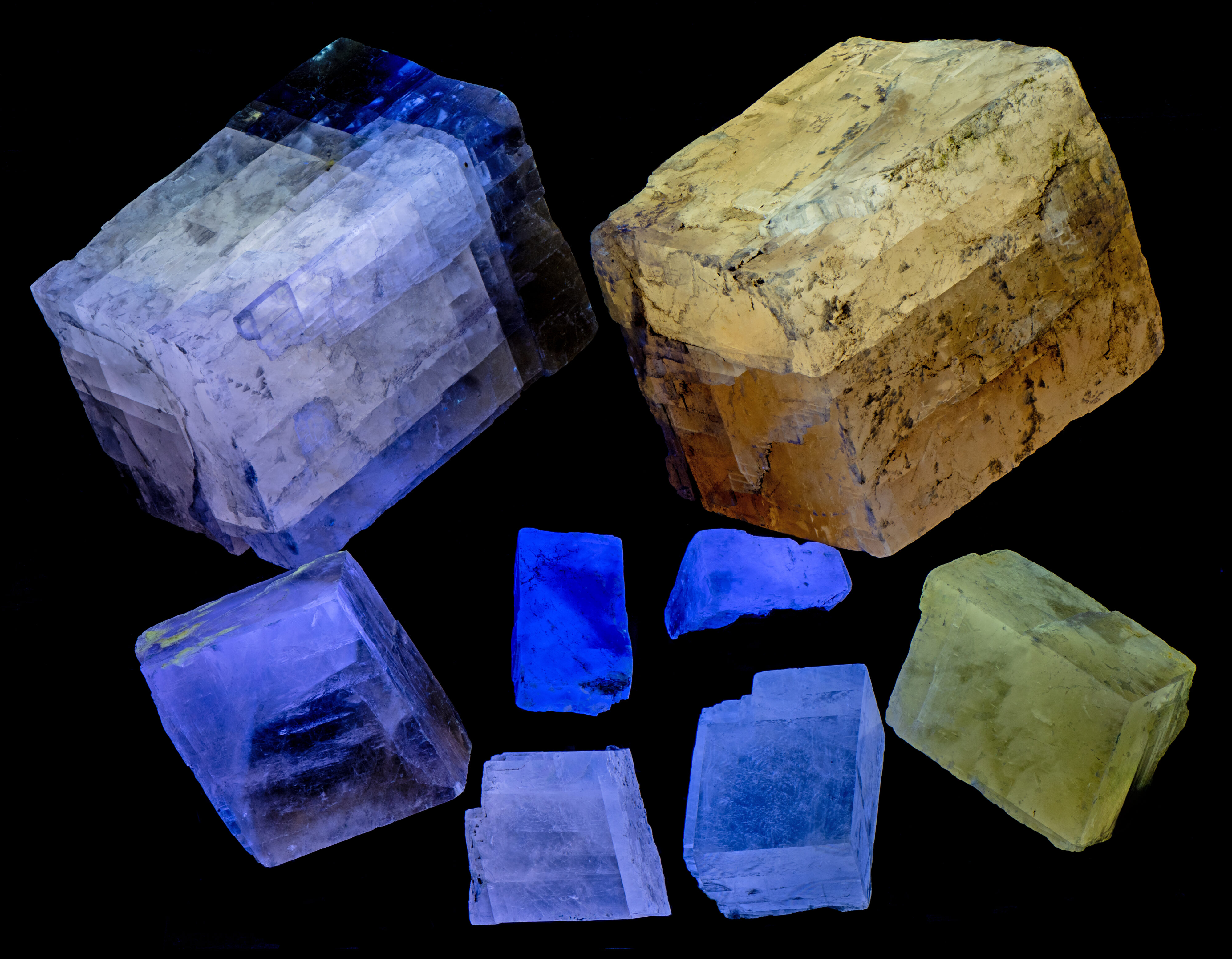
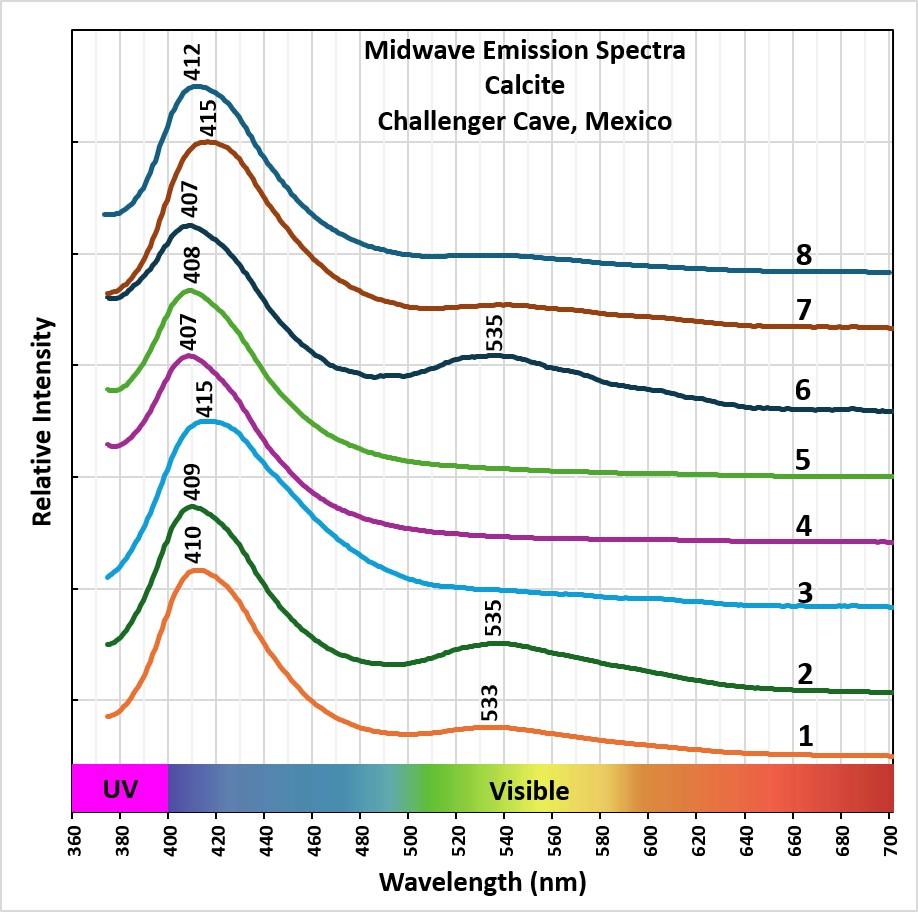
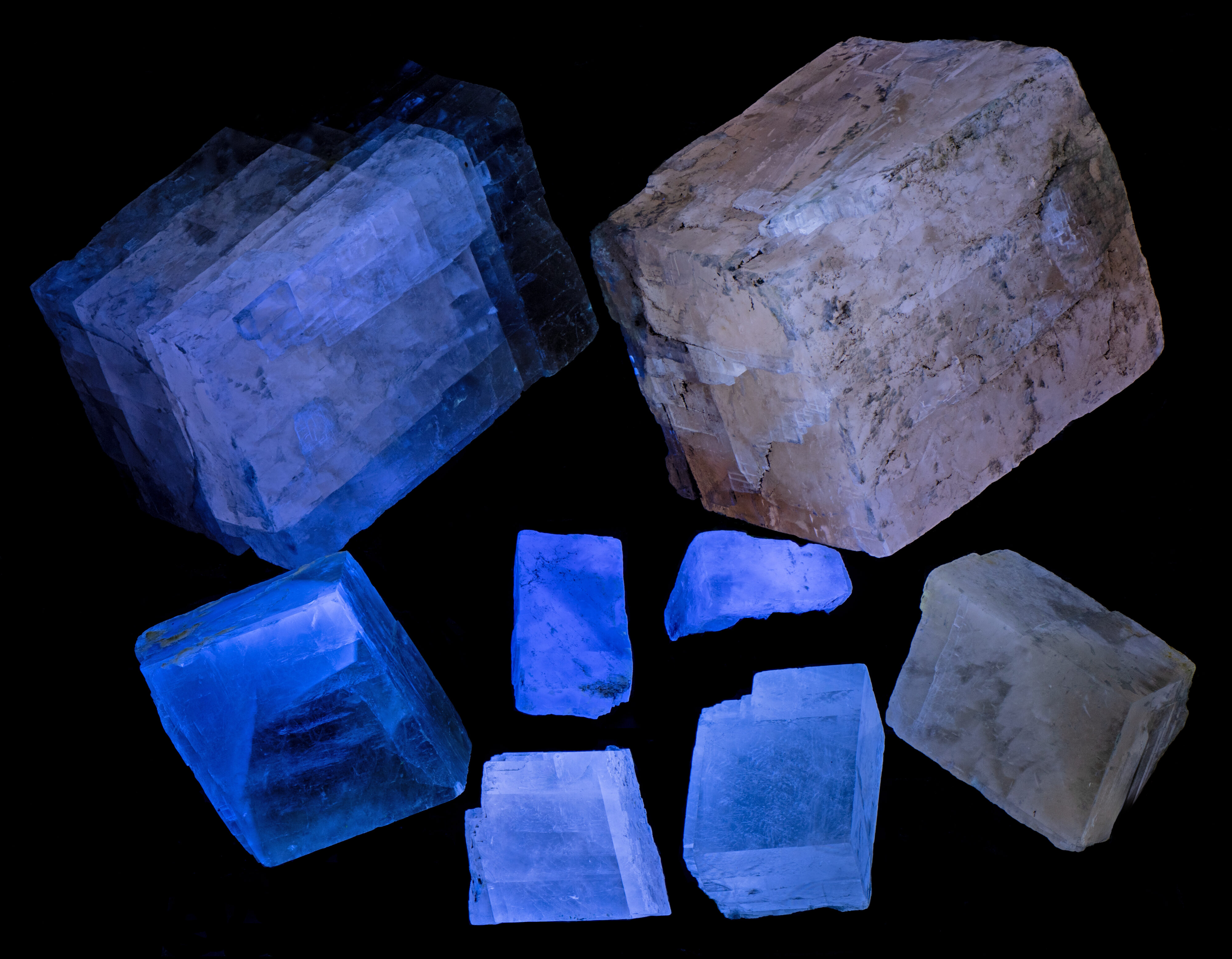
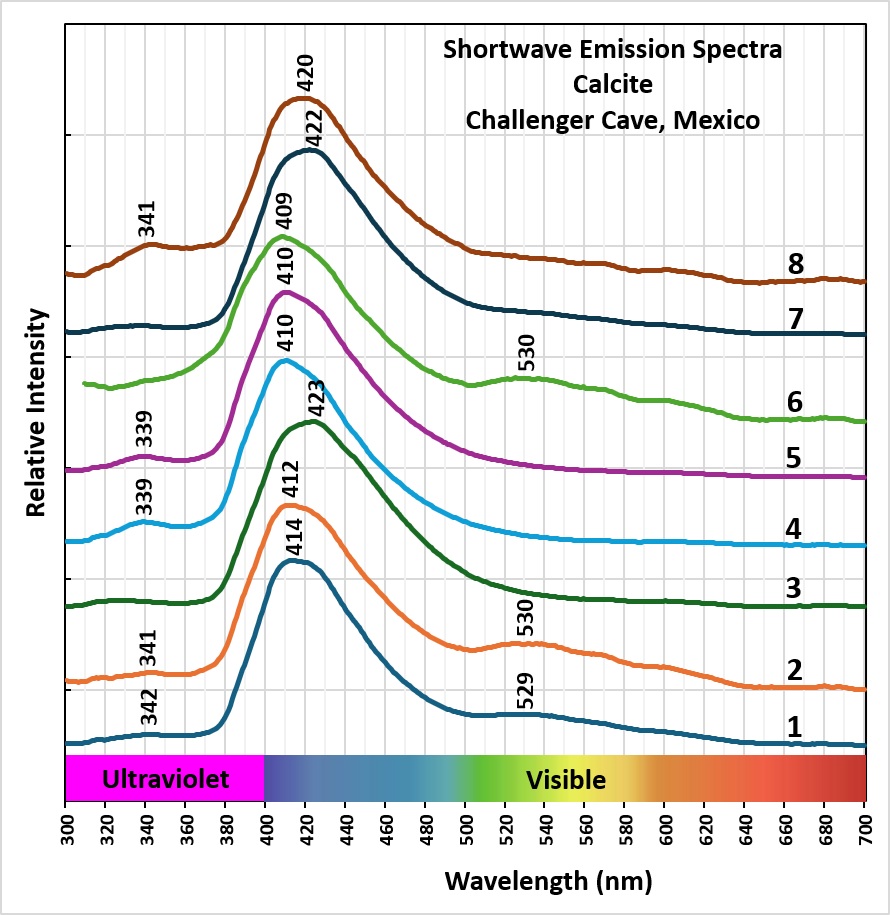
Another distinctive feature of Challenger Cave calcite is its bright, saturated yellow fluorescence under 340 nm LED light. At present, Challenger Cave is the only known locality where Terlingua-type calcite shows this response. McCann (1995) also observed yellow fluorescence only in Challenger Cave calcite. Some Challenger Cave calcites such as David Doyle’s specimens (4 and 5) do not fluoresce yellow. The emission spectra of the yellow specimens is a broad peak centered near 540 nm. This fluorescence likely has a similar origin to the violet and orange emissions: a lattice defect associated with a rare earth element, but the rare earth element is different from those responsible for the violet and orange responses. In two specimens, the yellow fluorescence persists under midwave and shortwave UV, but it is paler. The emission peak shifts from 540 nm under 340 nm excitation to 535 nm under midwave (305 nm) and 530 nm under shortwave (255 nm). Under both midwave and shortwave UV, the afterglow color of the yellow specimens matches the blue color of the other specimens.
The shortwave emission spectra show a bright peak near 410 nm, and several spectra also include a small ultraviolet peak at 340 nm. The shortwave emission is activated by radiation-induced lattice defects associated with a rare earth element. The 340 nm peak may be activated by cerium, which may also be the rare earth associated with the lattice defects responsible for the 410 nm emission. The strong violet-blue afterglow after shortwave excitation indicates the presence of electron traps just below the conduction band. Shortwave light excites electrons into these traps; thermal energy then gradually releases them into the conduction band. As the electrons lose energy and return through the excited state to the valence band, they emit violet-blue photons. Temperature controls how quickly electrons leave the traps and, therefore, the duration of the afterglow: cooler temperatures slow release and extend the afterglow. Midwave excitation produces a similar afterglow through the same mechanism, but it is dimmer and shorter than the shortwave afterglow.
References:
Gaft, M., Nagli, L., Panczer, G., Waychunas,G., Porat,N., 2008, The nature of unusual luminescence in natural calcite CaCO3, American Mineralogist, V.93, pp.158–167
Gossien, F., 2005, More About Terlingua, UV Waves, V.35, No.4
McCann, M., 1995, Luminescence in Terlingua and Terlingua-Type Calcites, UV Waves, V.25, No.3
Robbins, M., 1994, Fluorescence: gems and minerals under ultraviolet light, Geoscience Press, Inc, 374p.
Waychunas, G.A., 2012, Investigation of the causes of Luminescence in Terlingua-Type (TT) calcite: a case for rare earth activation coupled with electronic defects, FMS Journal, V.32, pp.5-14
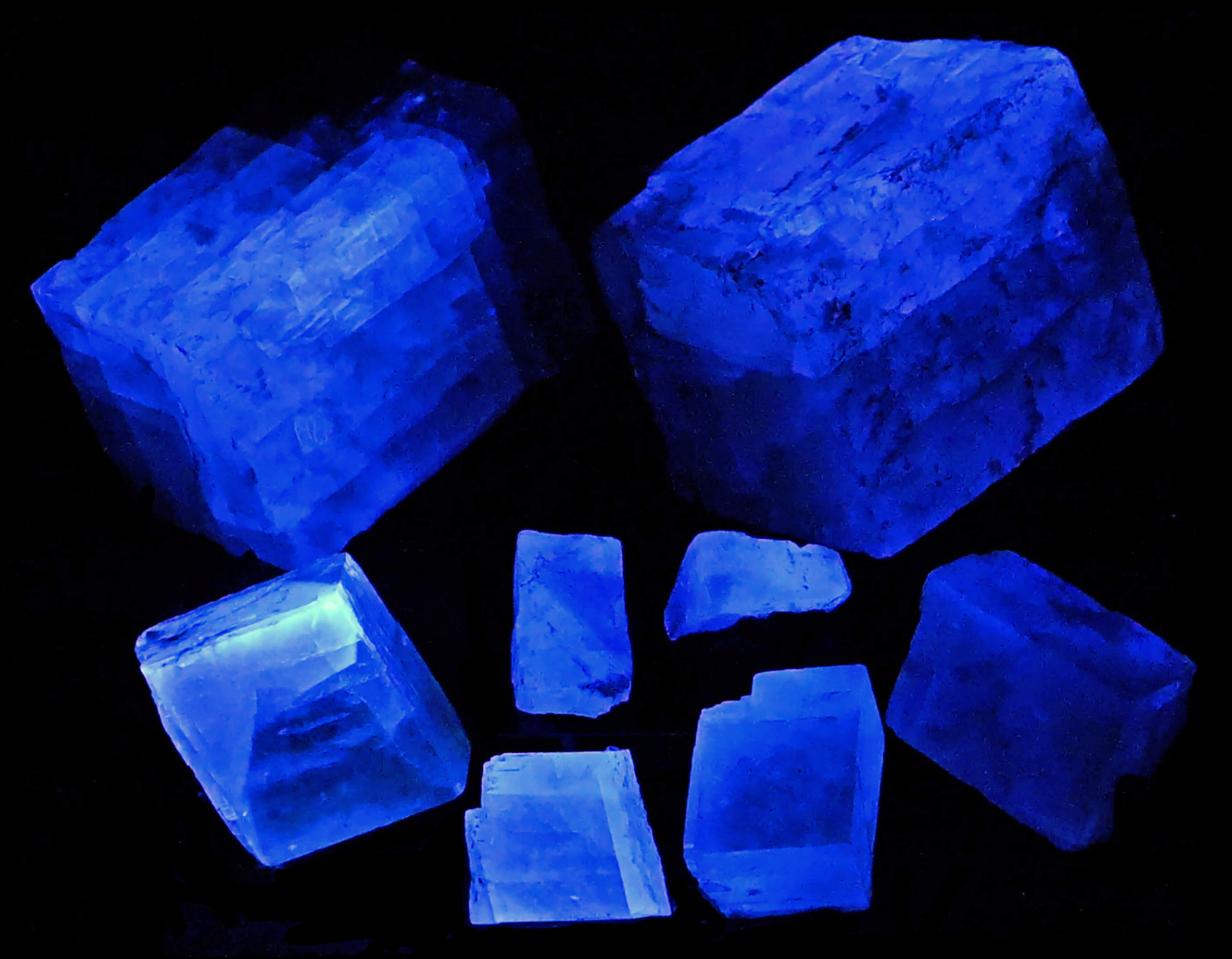
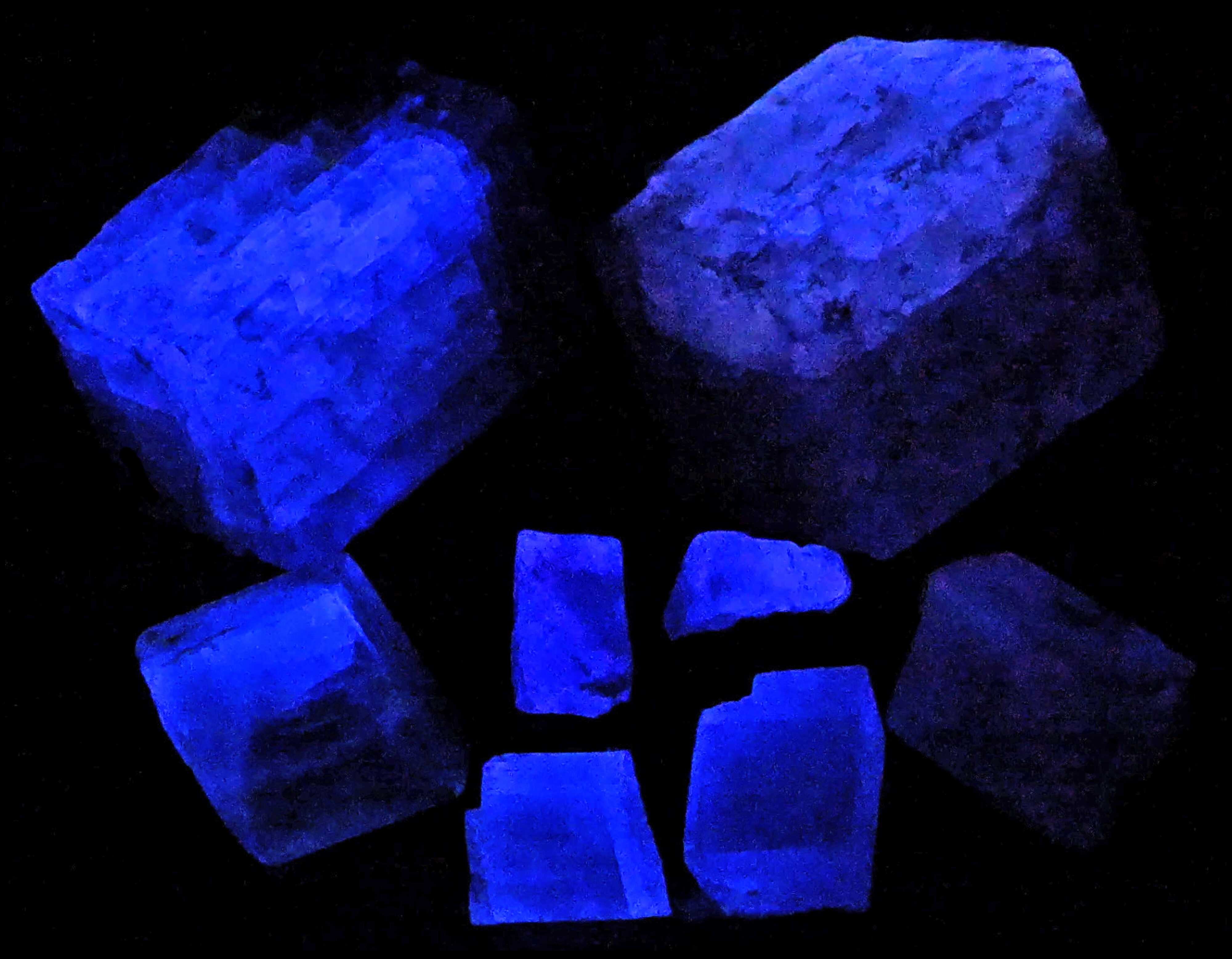
Summary of luminescence responses:
Calcite (Mindat) (RRUFF)
- Fluorescence under Longwave (365nm LED) UV light: Pink
- Fluorescence under Midwave (305nm LED) UV light: Yellow
- Afterglow after exposure to Midwave (305nm LED) UV light: Blue
- Fluorescence under Midwave (305nm LED) UV light: Blue
- Fluorescence under Shortwave (255nm LED) UV light: Blue
- Afterglow after exposure to Shortwave (255nm LED) UV light: Blue
- Fluorescence under 340nm LED UV light: Yellow