
Gonnardite and Hauyne – Sar-e-Sang, Afghanistan
Contributed by: Michael Crawford
Date: Aug 11th, 2026
Locality: Sar-e-Sang River, Sar-e-Sang, Kuran wa Munjan District, Badakhshan, Afghanistan (See on Mindat)
Size: 6 x 10 cm
Description:
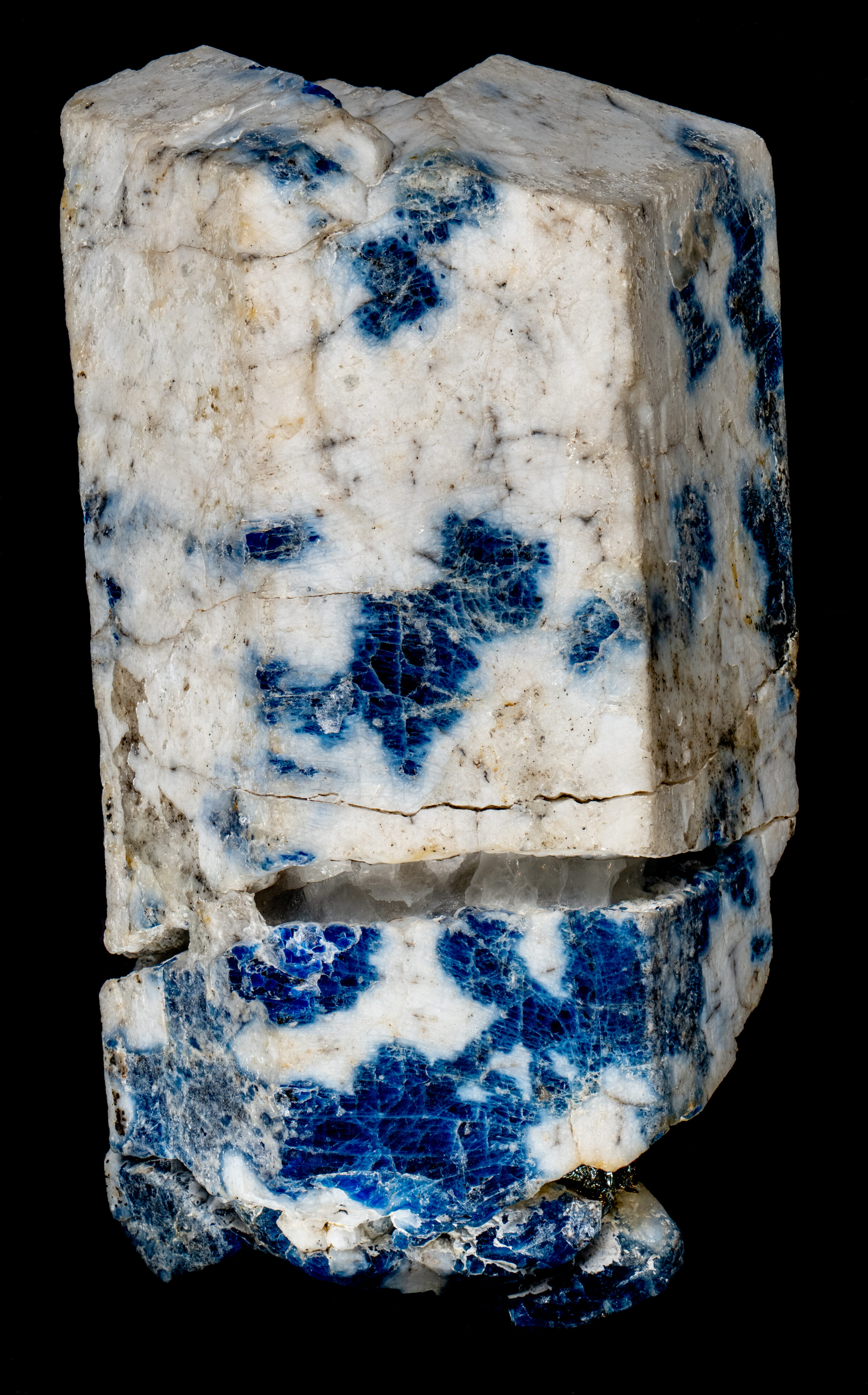
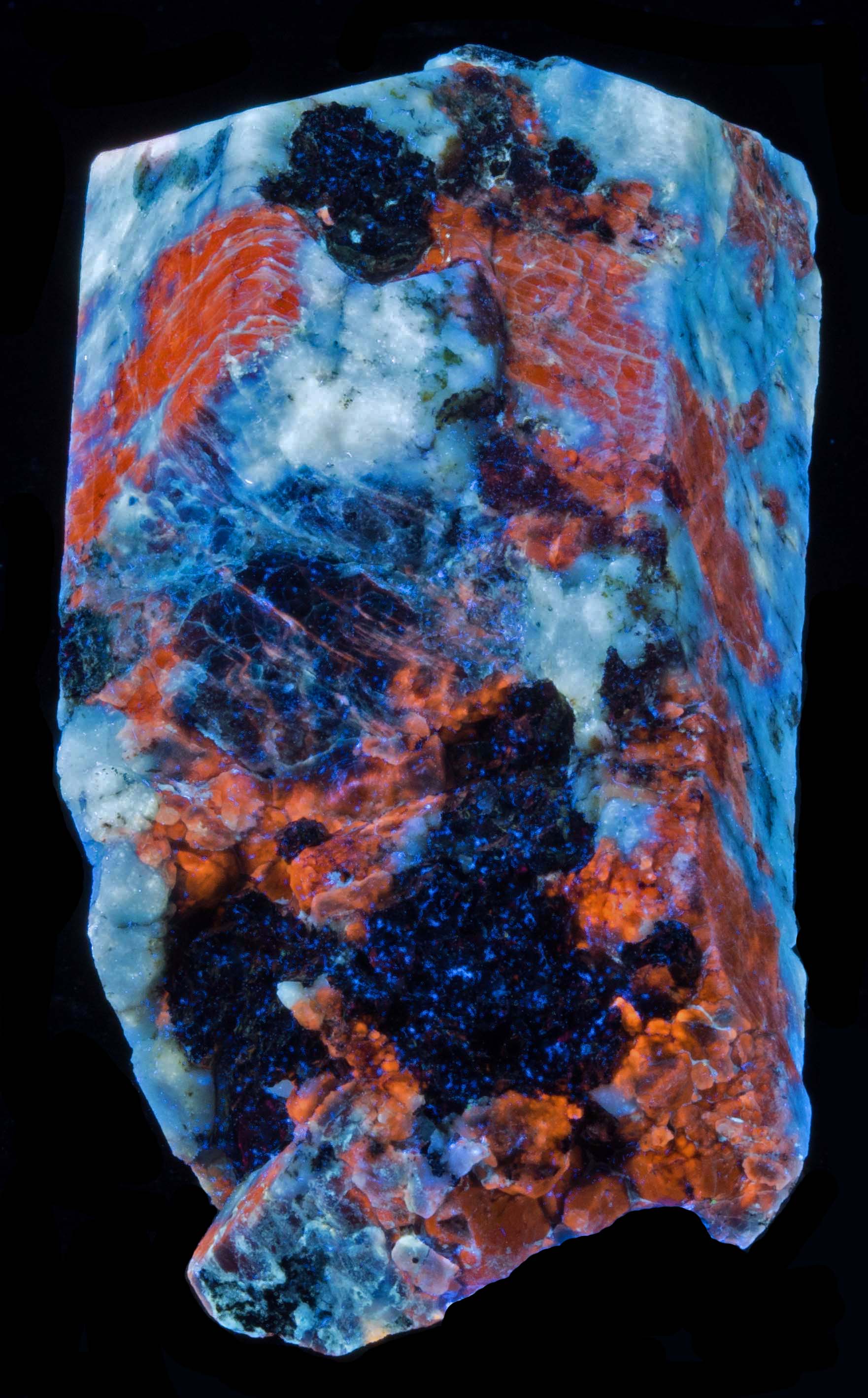
This specimen is a pseudomorph in which the zeolite gonnardite ((Na,Ca)2(Si,Al)5O10·3H2O) has replaced a very large blue hauyne (Na3Ca(Si3Al3)O12(SO4)) crystal from Sar-e-Sang, Badakhshan Province, Afghanistan. Hauyne replacement by gonnardite is very common at Sar-e-Sang. This crystal was fractured and later cemented with calcite, which fluoresces bright red under midwave UV light and a dimmer red under shortwave UV. Calcite-filled fractures are another common feature of crystal specimens from this locality.
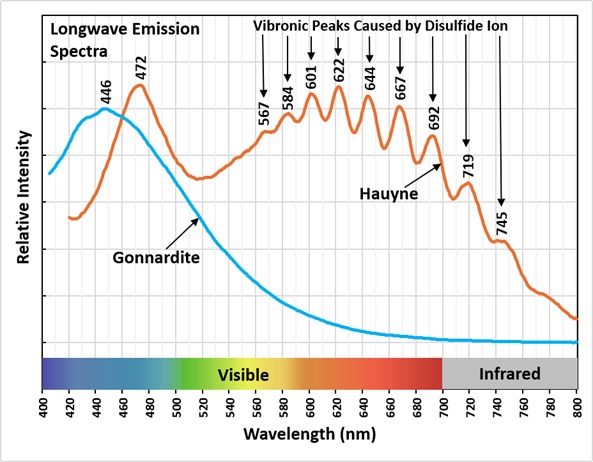
Gonnardite fluoresces bright blue, white under longwave UV and somewhat dimmer under midwave and shortwave UV. Its emission spectrum forms a broad peak centered near 446 nm. The activator responsible for this fluorescence has not yet been identified.
Hauyne belongs to the sodalite group and shares sodaliteapos;s crystal structure: an ordered framework of linked AlO4 and SiO4 tetrahedra, with silicon and aluminum alternating in the tetrahedral sites. These linked (Al,Si)O4 tetrahedra form cage-like cubo-octahedral cavities. Each cavity contains a central anion tetrahedrally coordinated to four cations. In hauyne, the central anion is sulfate (SO4) while in sodalite it is chlorine (Cl). The surrounding cations are sodium and calcium in hauyne, but only sodium in sodalite.
Fluorescence in hauyne and sodalite is activated when disulfide (S22-) replaces some sulfate or chlorine as the central anion in the cubo-octahedral cage. Because disulfide is linear, UV light causes it to vibrate inside the cage, producing an emission spectrum with nine sharp peaks superimposed on a broader peak. This pattern is known as a vibronic signature. The signature is much stronger in hauyne than in sodalite because the hauyne cage is slightly larger due to the larger calcium cation. In hauyne, disulfide activation produces orange fluorescence under longwave UV, weaker fluorescence under midwave UV, and no shortwave fluorescence.
The longwave emission spectrum of hauyne also includes a broad peak centered at 472 nm, although not all hauyne specimens show this feature. Its cause is unknown. Possible explanations include a lattice defect, such as an oxygen vacancy in the aluminosilicate tetrahedra, or substitution by a rare earth element, titanium, or another element within the tetrahedra.
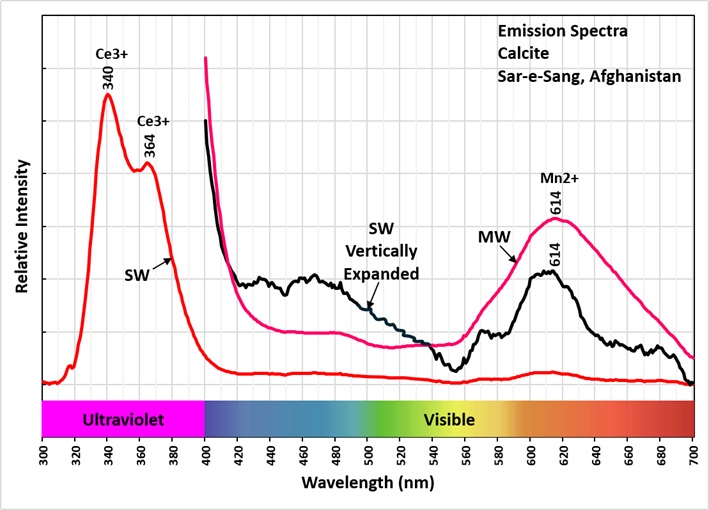
The red fluorescence in the calcite is activated by manganese substituting for calcium and is brightest under midwave UV, with an emission peak at 614 nm. Under shortwave UV, this calcite also produces very bright ultraviolet fluorescence that is much stronger than the visible red emission. The shortwave spectrum has two sharp peaks at 340 nm and 364 nm, a signature caused by cerium (Ce3+) replacing calcium.
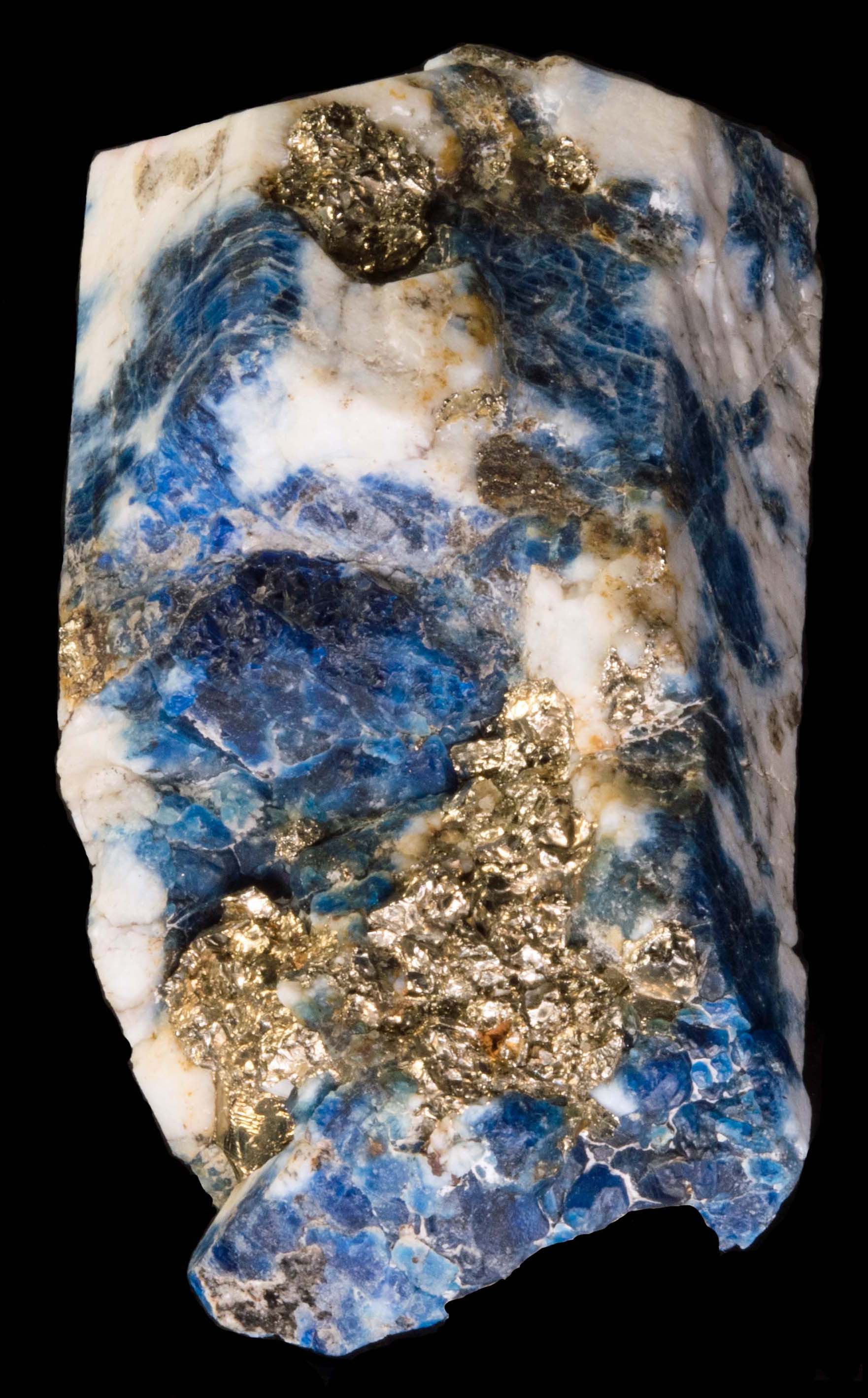
Images of the crystal's reverse side show where it was attached to the matrix and reveal the crystal core. The core contains non-fluorescent dark blue lazurite, pyrite, and longwave UV-fluorescent gonnardite and hauyne. As sulfide replaces sulfate in hauyne, the mineral loses its fluorescence, turns dark blue, and becomes lazurite, a variety of hauyne.
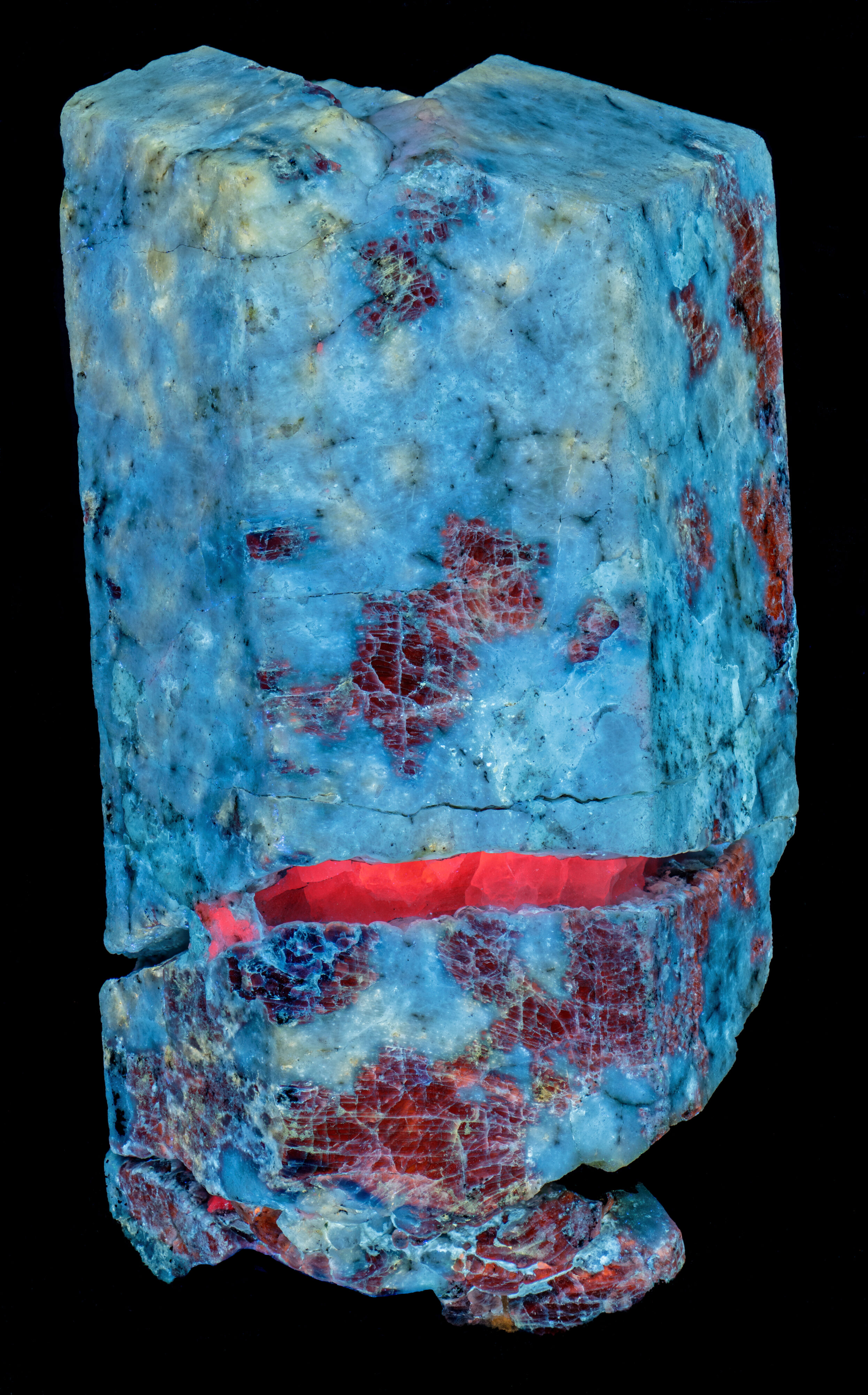
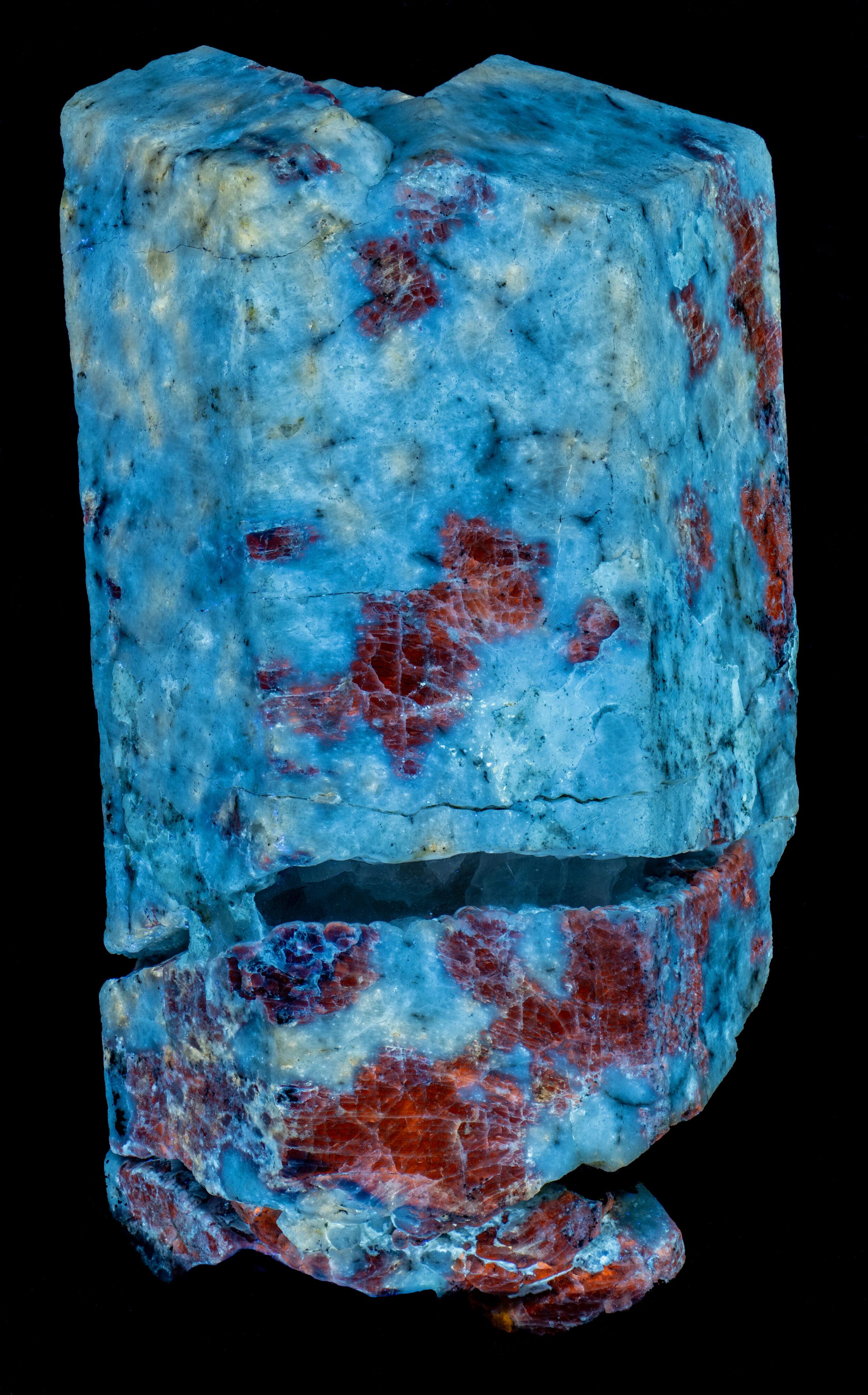
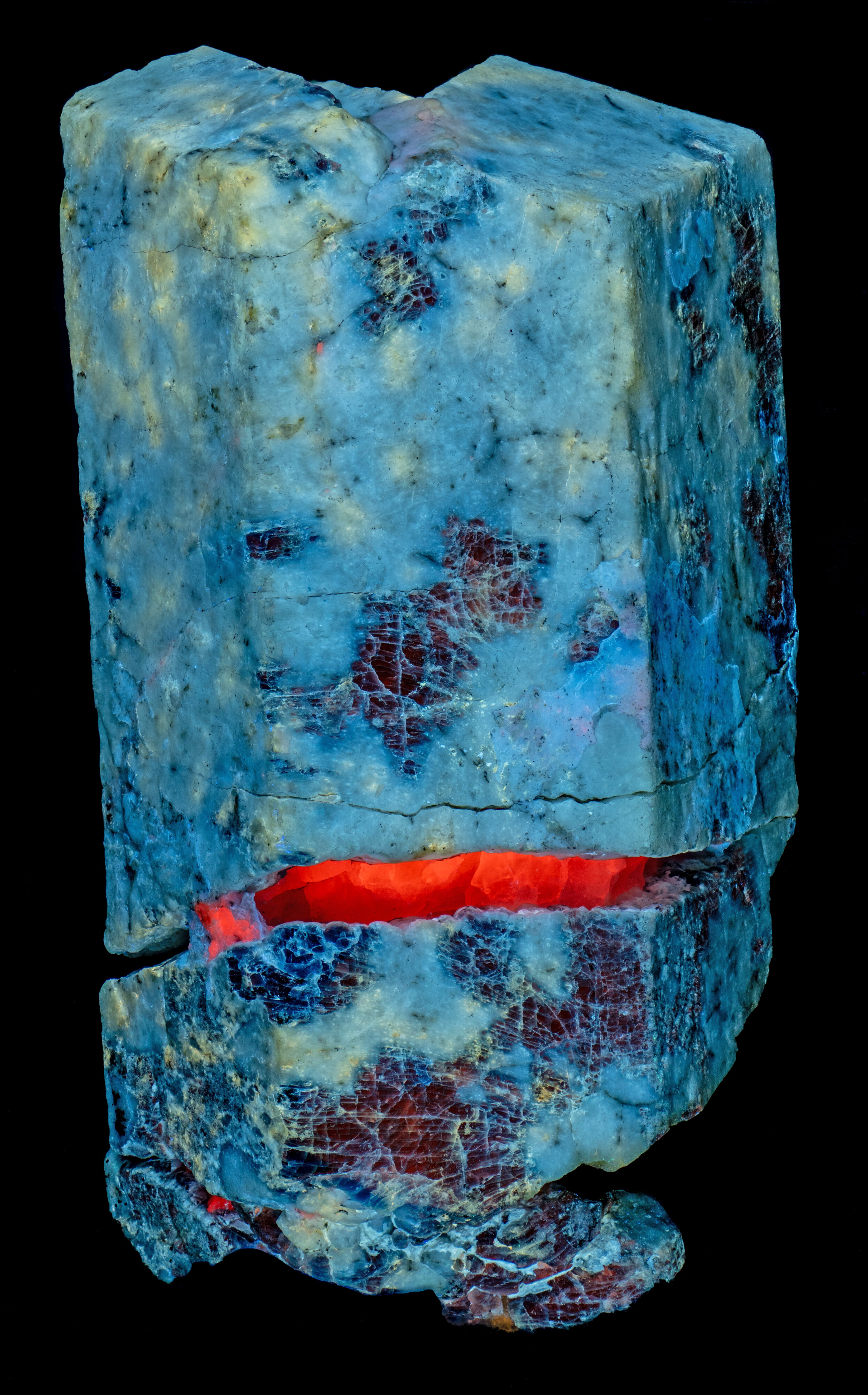
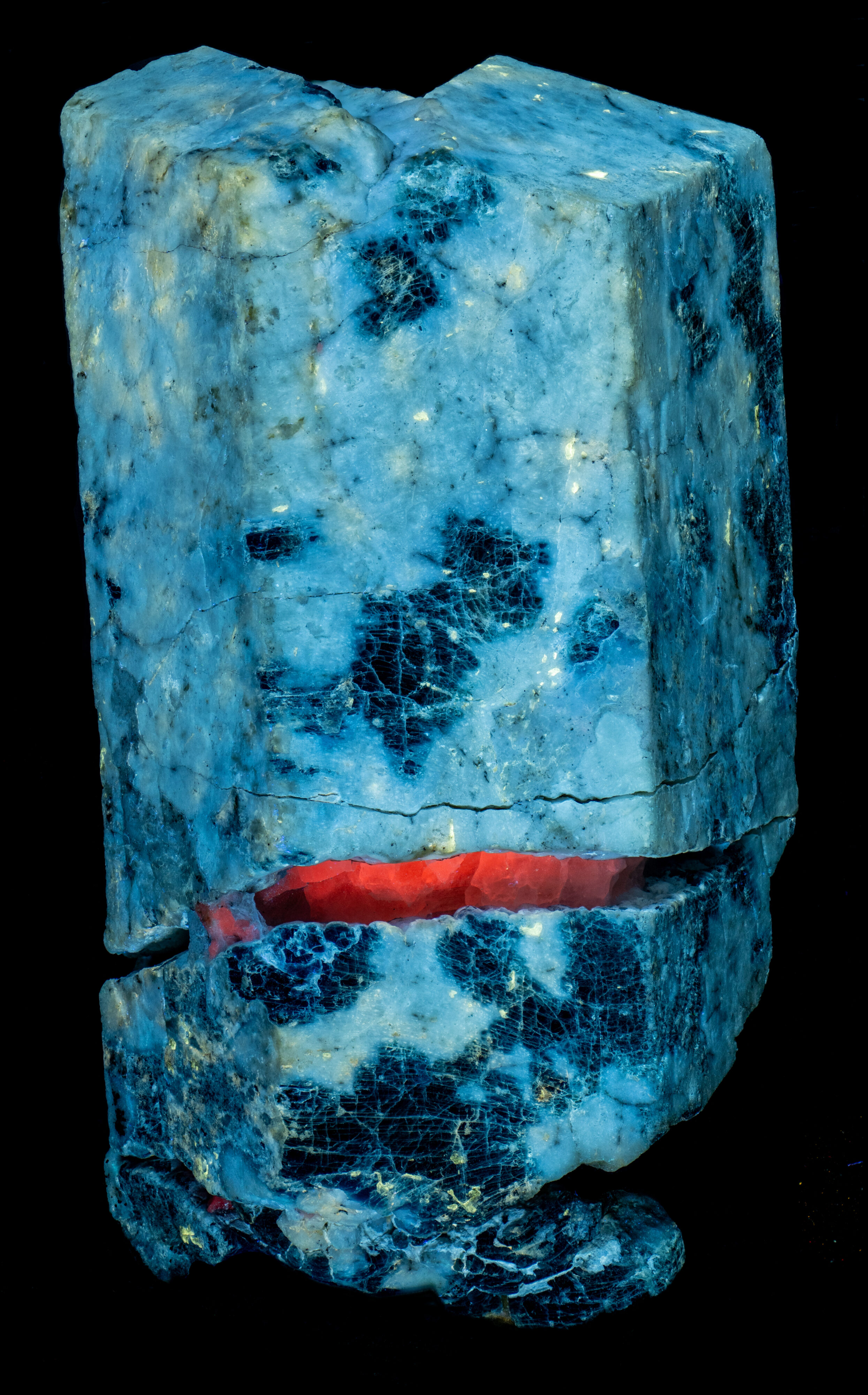
Summary of luminescence responses:
Gonnardite (Mindat) (RRUFF)
- Fluorescence under Longwave (365nm LED) UV light: Blue
- Fluorescence under Midwave (305nm LED) UV light: Blue
- Fluorescence under Shortwave (255nm LED) UV light: Blue
- Fluorescence under Longwave (365nm LED) UV light: Orange
- Fluorescence under Midwave (305nm LED) UV light: Orange
- Fluorescence under Midwave (305nm LED) UV light: Red