
Zektzerite, Sogdianite and Microcline – Dara-i-Pioz, Tajikistan
Contributed by: Michael Crawford
Date: Aug 3rd, 2026
Locality: Dara-i-Pioz Massif, Districts of Republican Subordination, Tajikistan (See on Mindat)
Size: 5.5 x 8.5 cm
Description:
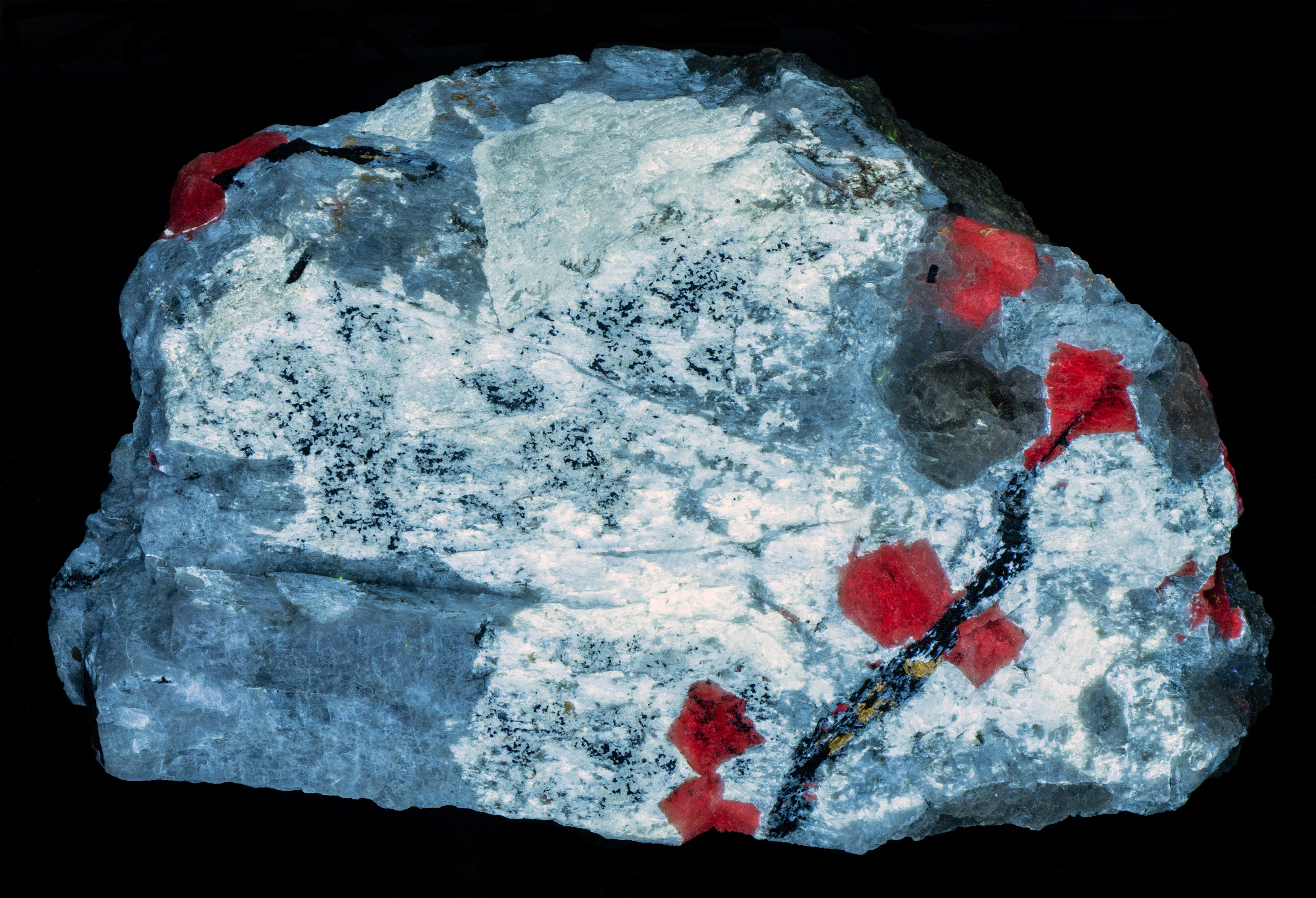
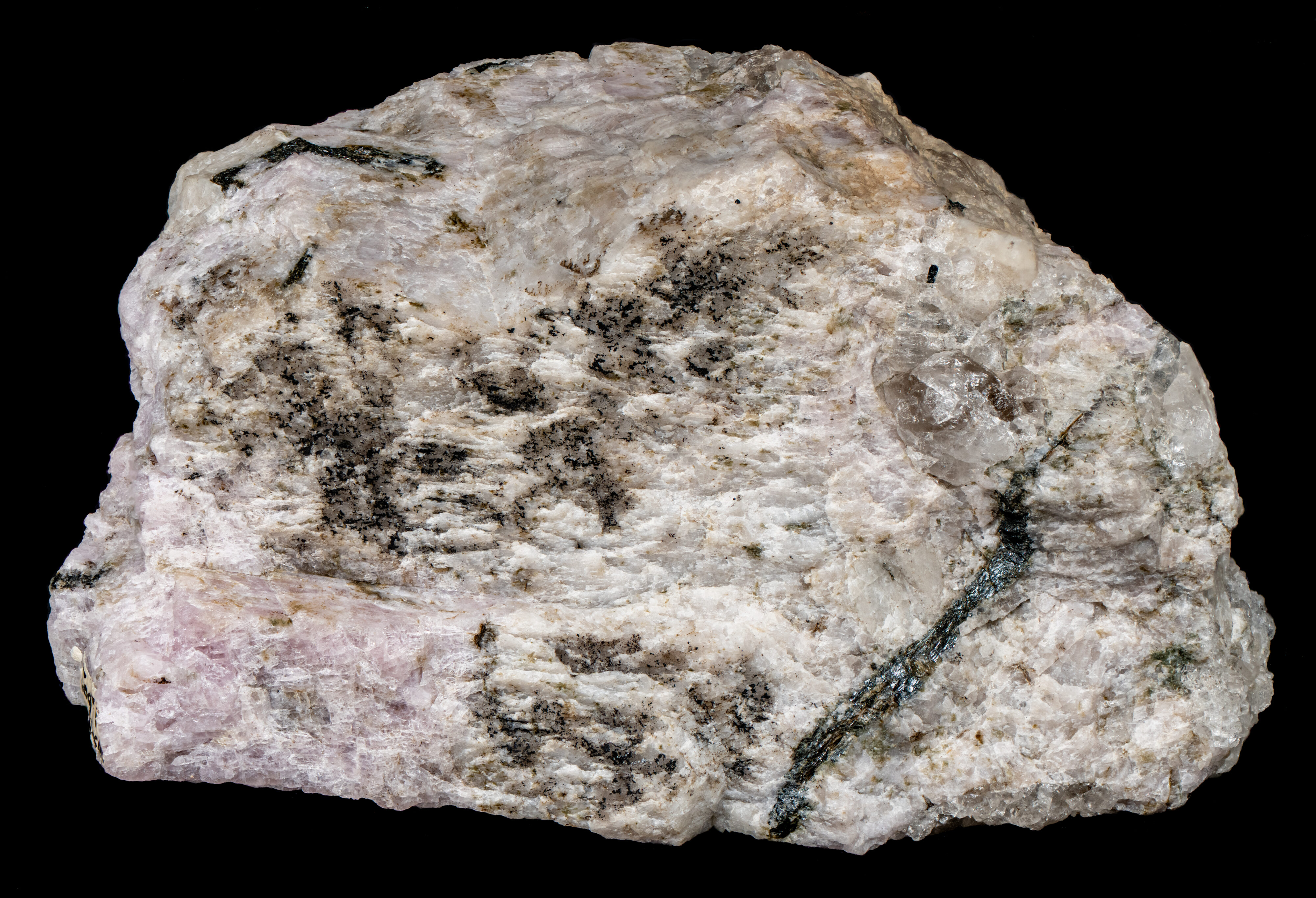
The primary mineral in this specimen is zektzerite (LiNaZrSi6O15), which fluoresces bright white under shortwave UV light. According to Belakovskiy (2020), the zektzerite is a pseudomorph after sogdianite (KZr2Li3Si12O30). In white light, the sogdianite is slightly pink; under shortwave UV, it fluoresces bluish gray, but more dimly than zektzerite. Both minerals are zirconium-lithium silicates, but sogdianite contains potassium while zektzerite contains sodium. Their crystal structures also differ: sogdianite is hexagonal, whereas zektzerite is orthorhombic.
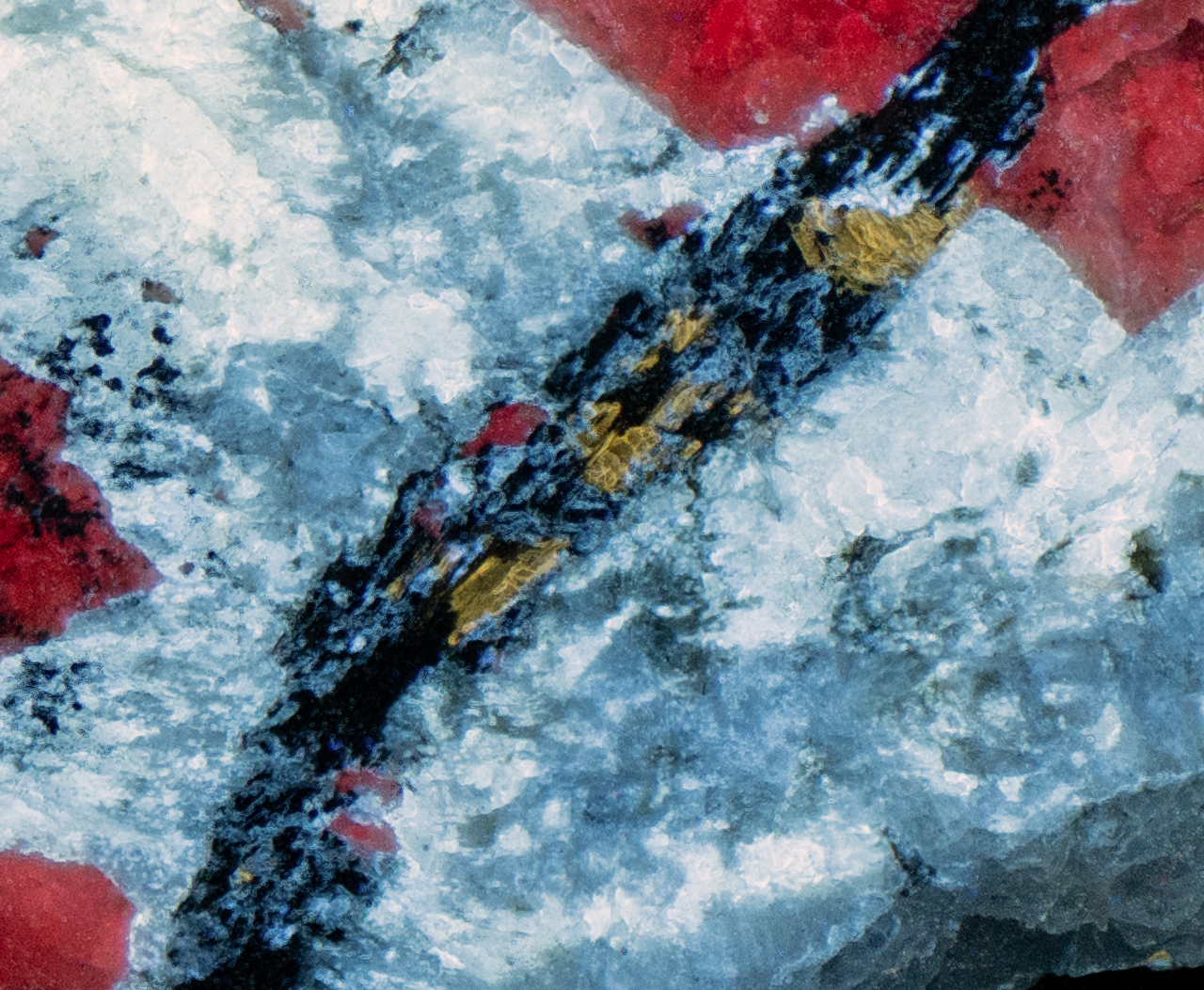
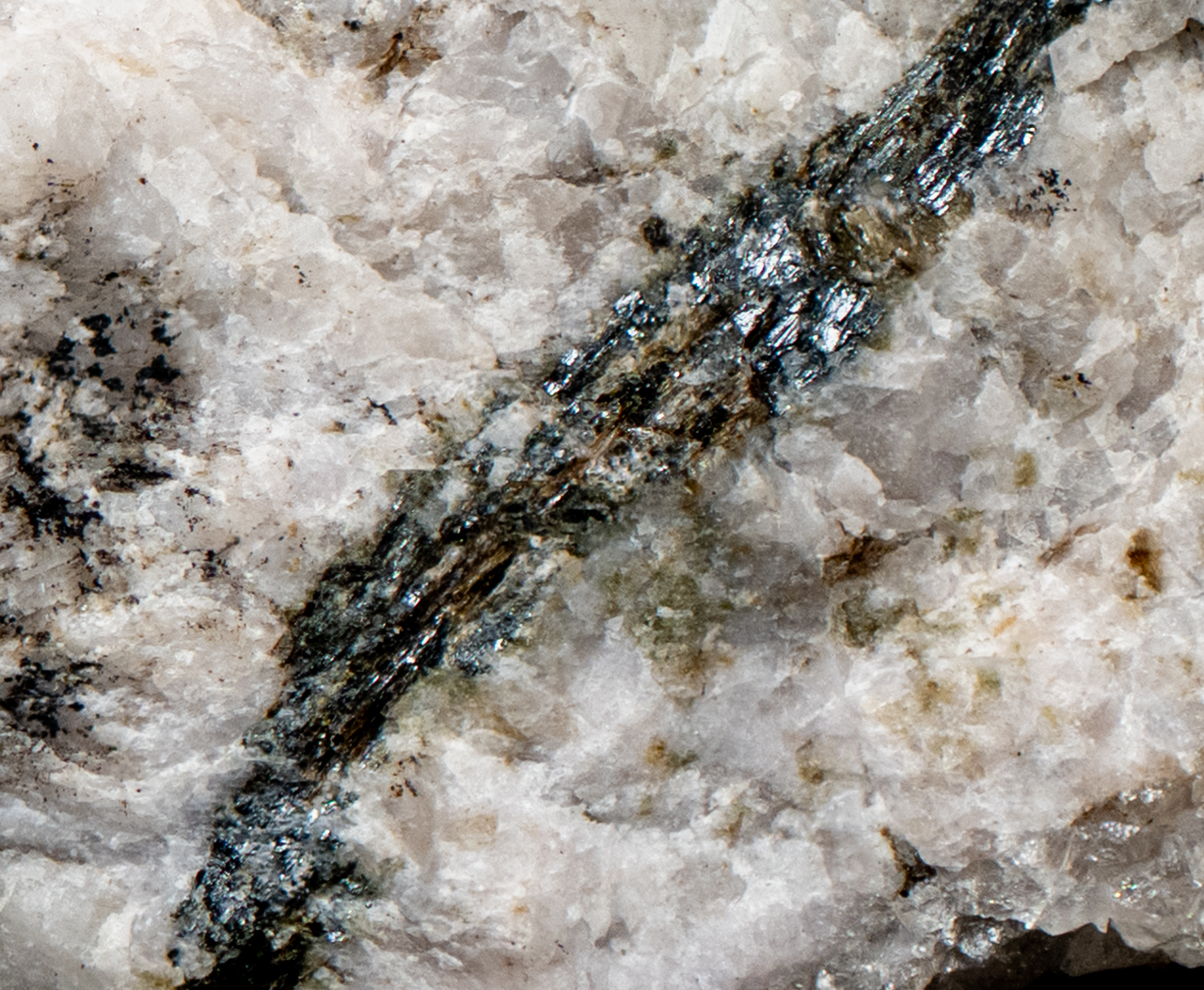
The specimen also contains two feldspars—microcline (K(AlSi3O8)) and albite (Na(AlSi3O8))—that fluoresce red under shortwave UV light. A few grains of polylithionite (KLi2Al(Si4O10)(F,OH)2) are also present and fluoresce yellowish brown. The specimen includes a black, non-fluorescent mineral that may be neptunite. No fluorescence is observed under longwave or midwave UV light.
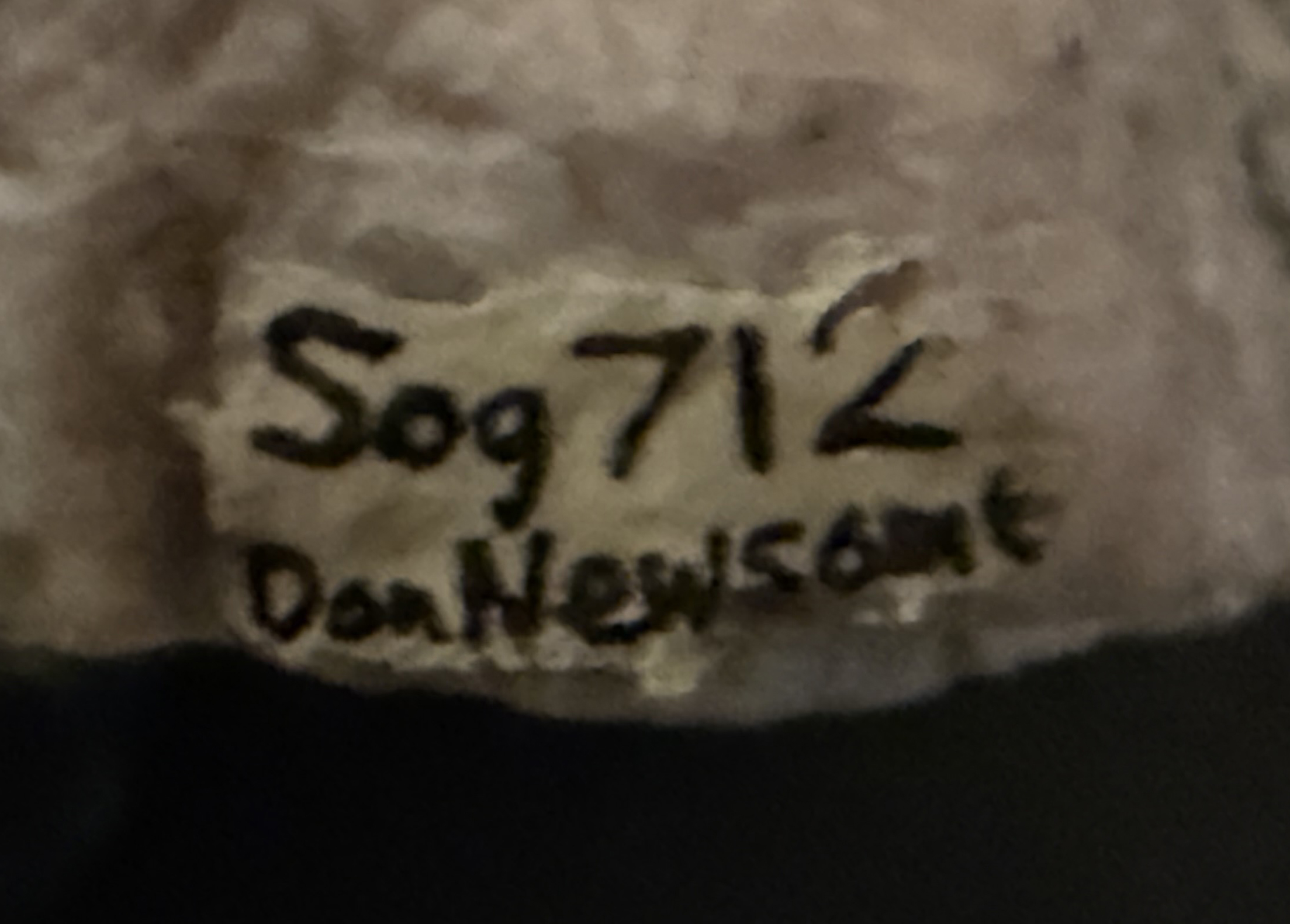
This specimen comes from the Dara-i-Pioz Massif in Tajikistan, an unusual granitoid intrusion enriched in boron, lithium, and many cesium-bearing minerals. It was previously in the collection of Don Newsome, one of the founding members of the Fluorescent Mineral Society. His painted label on the specimen is remarkable: the lettering is only 1 mm tall, yet the penmanship is exceptionally neat.
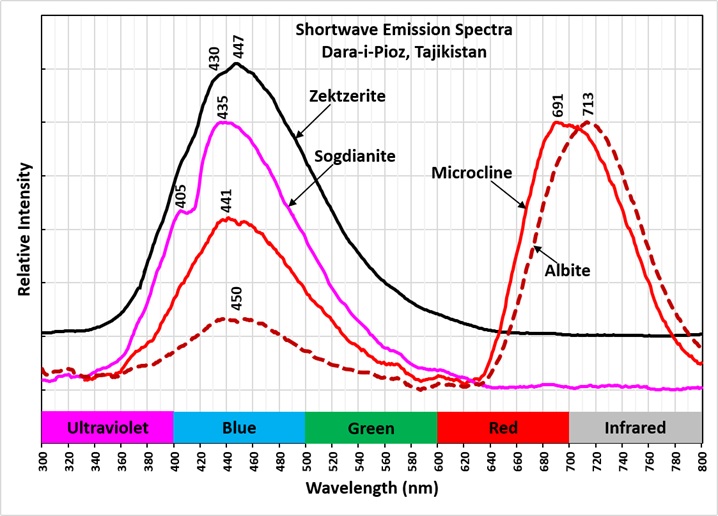
The shortwave emission spectrum of zektzerite shows a broad peak with a maximum at 447 nm and a secondary inflection at 430 nm, along with a sharp peak at 447 nm. The sogdianite spectrum also has a broad peak, with a maximum at 435 nm, plus a sharp peak at 405 nm. References identify titanium-oxygen (Ti-O) substituting for zirconium-oxygen (Zr-O) as the activator in both sogdianite and zektzerite. The sharp peaks in both minerals suggest a second activator, possibly a rare earth element.
The red fluorescence of the feldspars is activated by ferric iron (Fe3+) substituting for aluminum (Al3+). The microcline emission spectrum peaks at 691 nm, while the albite spectrum peaks at 713 nm. These red fluorescence spectra help indicate feldspar composition: peaks below 700 nm, near 690 nm, suggest potassium feldspar such as microcline or orthoclase, whereas peaks above 700 nm, near 720 nm, indicate sodium feldspar such as albite. The feldspar spectra in this specimen also show a broad peak around 440–450 nm, which may result from missing oxygen atoms in the alumina tetrahedra.
REFERENCE
Belakovskiy, D.I, 2020, Zektzerite from the Darai-Pioz Massif, Pamir-Alay Mts, Tajikistan, FMS UV Waves, V.50, No.3
Summary of luminescence responses:
Feldspar (Mindat) (RRUFF)
- Fluorescence under Shortwave (255nm LED) UV light: Red
- Fluorescence under Shortwave (255nm LED) UV light: Blue
- Fluorescence under Shortwave (255nm LED) UV light: White
- Fluorescence under Shortwave (255nm LED) UV light: Yellow