
Roeblingite – Franklin, New Jersey
Contributed by: Michael Crawford
Date: Jul 20th, 2026
Locality: Parker shaft, Franklin Mine, Franklin, Sussex County, New Jersey, USA (See on Mindat)
Size: 15 x 20 mm
Description:
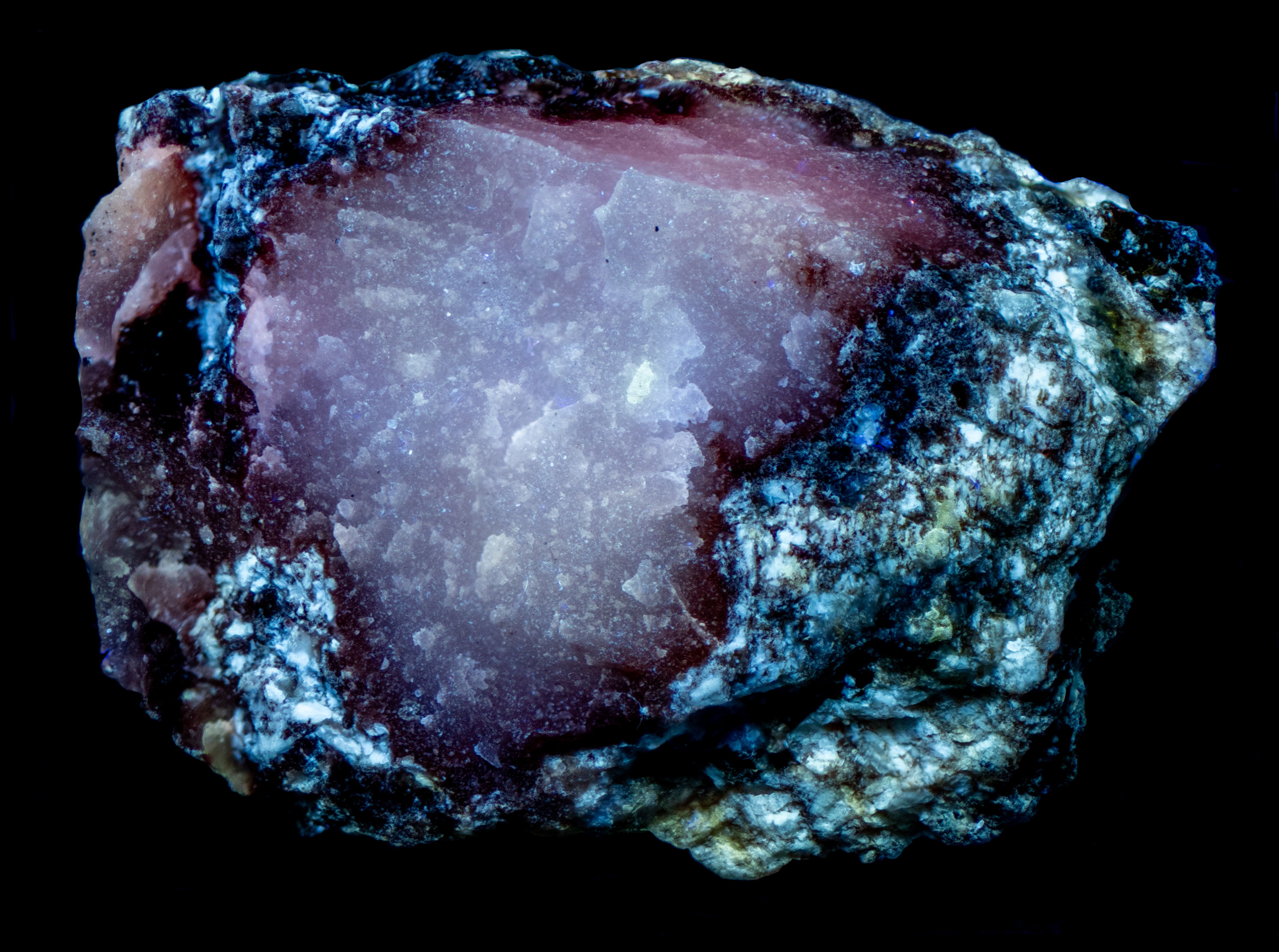
This is a small roeblingite nodule (Pb2Ca6Mn2+(Si3O9)2(SO4)2(OH)2 · 4H2O) is from the Parker Shaft in Franklin, New Jersey which is the type locality for roeblingite. Its nodular morphology is typical of roeblingite specimens. Under visible light, the specimen exhibits a white, porcelaneous appearance sometimes referred to as a "coconut meat" appearance. The nodule is enclosed by a brick-red, non-fluorescent hancockite ((CaPb)(AlAlFe3+)O[Si2O7][SiO4](OH)) rind. The Parker Shaft is also the type locality for hancockite. The specimen also contains additional non-fluorescent black patches attributed to hendricksite (KZn3(Si3Al)O10(OH)2). Roeblingite is a rare mineral of the Parker Shaft assemblage that is prized by collectors and small specimens like this one occasionally appear on the market from old collections.
The specimen contains two additional fluorescent minerals. One mineral fluoresces white under longwave and midwave ultraviolet radiation and blue to bluish white under shortwave ultraviolet radiation. The accompanying label identifies charlesite (Ca6(Al,Si)2(SO4)2[B(OH)4](OH,O)12 · 26H2O), which may correspond to this fluorescent mineral. Published descriptions report blue to light blue shortwave ultraviolet fluorescence for charlesite, but do not document its longwave or midwave ultraviolet response. Associated gypsum possibly altered from charlesite may account for the white longwave and midwave ultraviolet fluorescence. The second fluorescent mineral fluoresces light brown under shortwave ultraviolet radiation and may be prehnite.
Roeblingite exhibits orange-red fluorescence under shortwave ultraviolet radiation, pale red fluorescence under longwave ultraviolet radiation, and very weak pinkish-white fluorescence under midwave ultraviolet radiation. This specimen also displays red Brief Intense Phosphorescence (BIP) when exposed to a moving longwave ultraviolet flashlight across the specimen. BIP is most noticeable from longwave exposure as the roeblingite goes from pale red to bright red. Midwave exposure produces a fainter BIP and shortwave BIP is a quick fading of the bright red fluorescence.
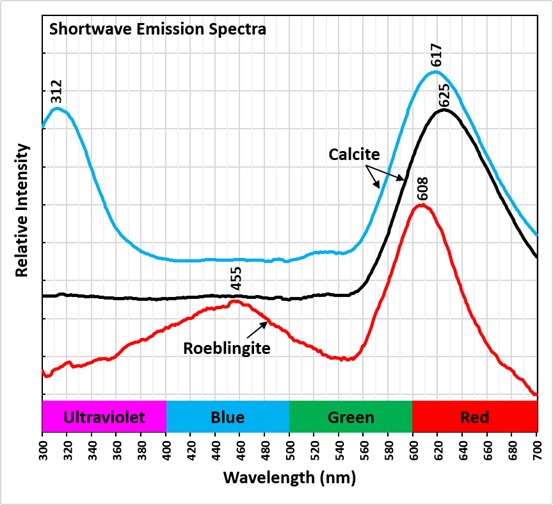
Roeblingite's shortwave fluorescence is visually similar to that of manganese-activated calcite, which historically led to attribution of roeblingite fluorescence to "admixed calcite", particularly because dilute HCl treatment eliminated the red fluorescence. However, dilute HCl acid decomposes roeblingite without the effervescence associated with calcite dissolution and carbon dioxide (CO2) release from calcite's carbonate (CO32-) anion. The red fluorescence of roeblingite is therefore interpreted as intrinsic and associated with structural manganese (Mn2+), whereas red fluorescence in calcite is extrinsic and results from manganese impurities substituting for calcium.
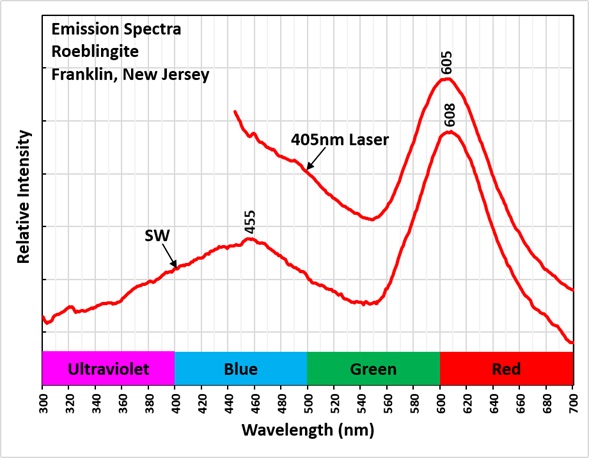
The shortwave ultraviolet emission spectrum of roeblingite is distinct from those of Franklin calcite. Franklin calcite occurs as both a lead-activated ultraviolet-fluorescent variety with an emission maximum near 312 nm and a variety lacking ultraviolet fluorescence. Both calcite types display a broad red emission band between approximately 617 and 625 nm. In contrast, roeblingite exhibits a red emission maximum near 608 nm, shifting to approximately 605 nm under 405 nm laser excitation. Roeblingite also shows a broad blue emission band near 455 nm and lacks the ultraviolet fluorescence commonly associated with red-fluorescent calcite. The blue emission in roeblingite may be related to lead in its crystal structure.
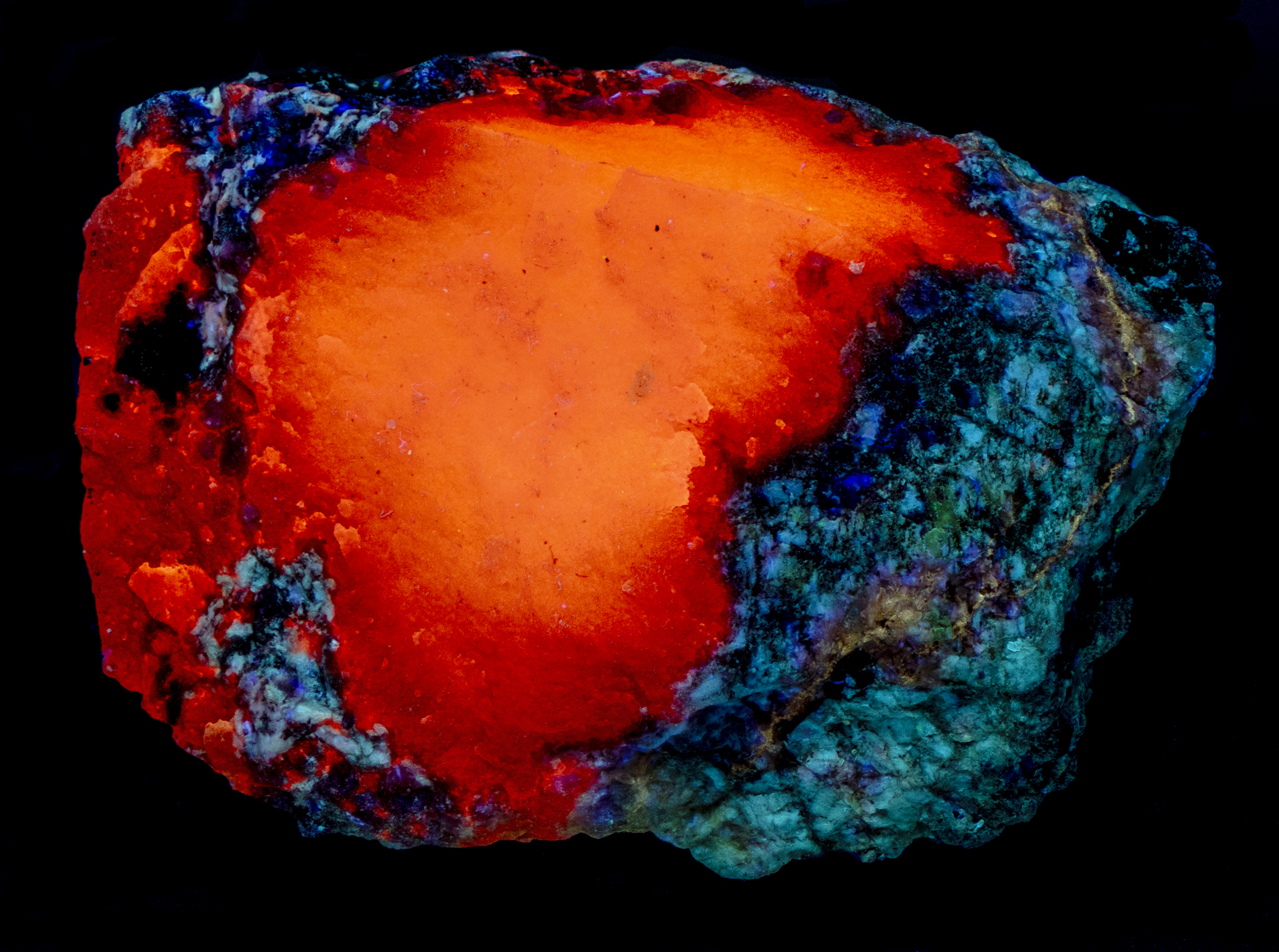
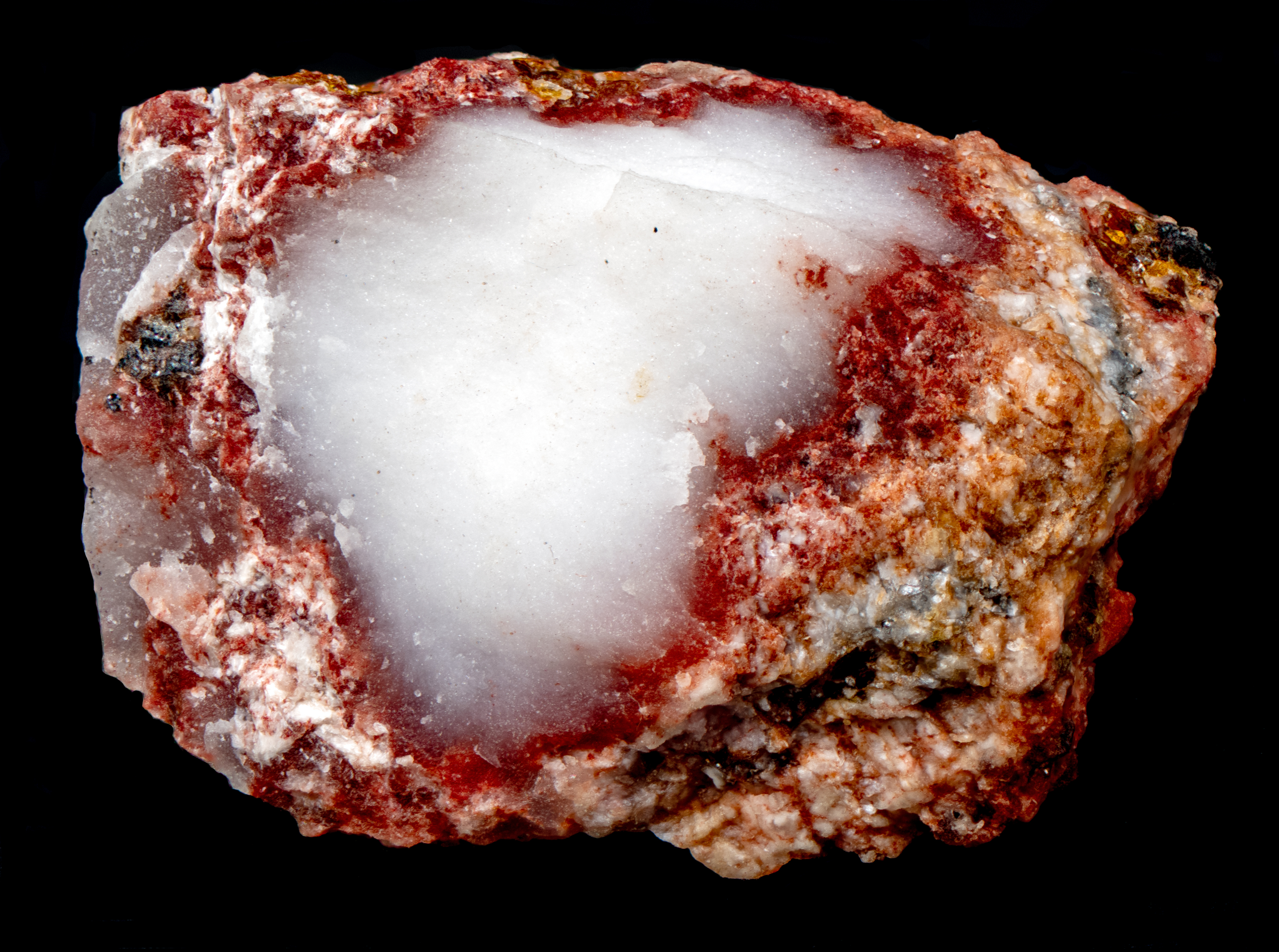
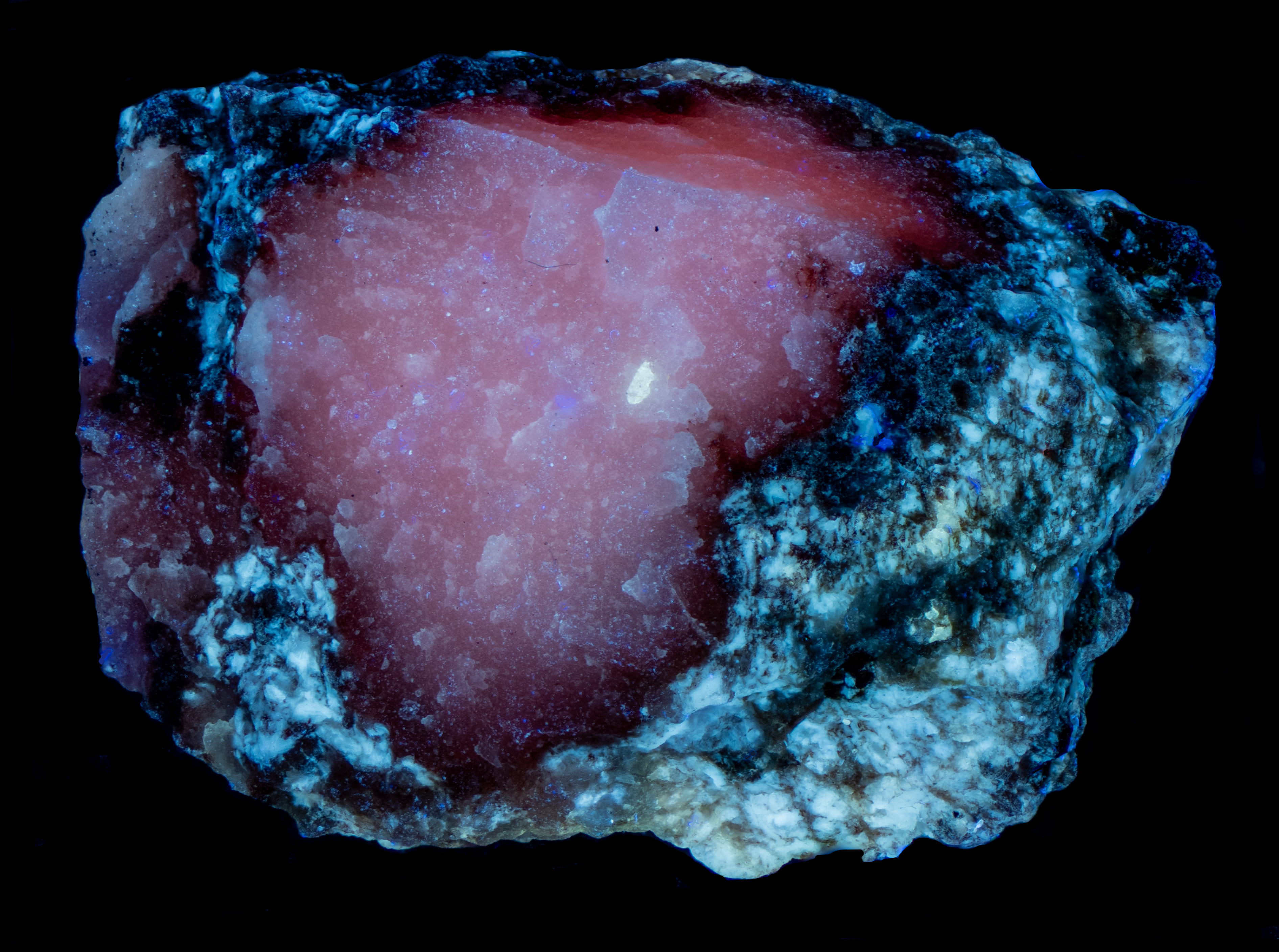
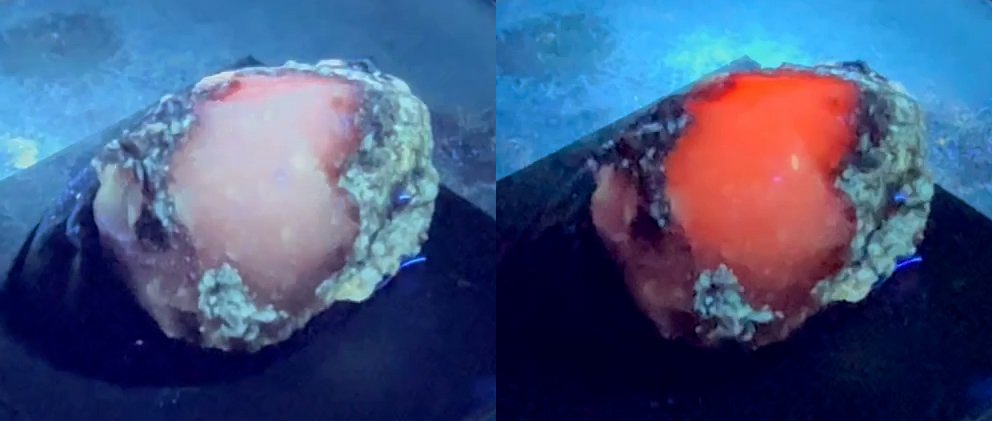
Summary of luminescence responses:
Roeblingite (Mindat) (RRUFF)
- Fluorescence under Shortwave (255nm LED) UV light: Red
- Fluorescence under Longwave (365nm LED) UV light: Pink
- Afterglow after exposure to Longwave (365nm LED) UV light: Red