
Leucophanite, Zircon, Calcite – Norway
Contributed by: Michael Crawford
Date: Jul 14th, 2026
Locality: A/S Granit Quarry, Tuften, Tvedalen, Larvik Commune, Vestfold, Norway (See on Mindat)
Size: 7 x 11 cm
Description:
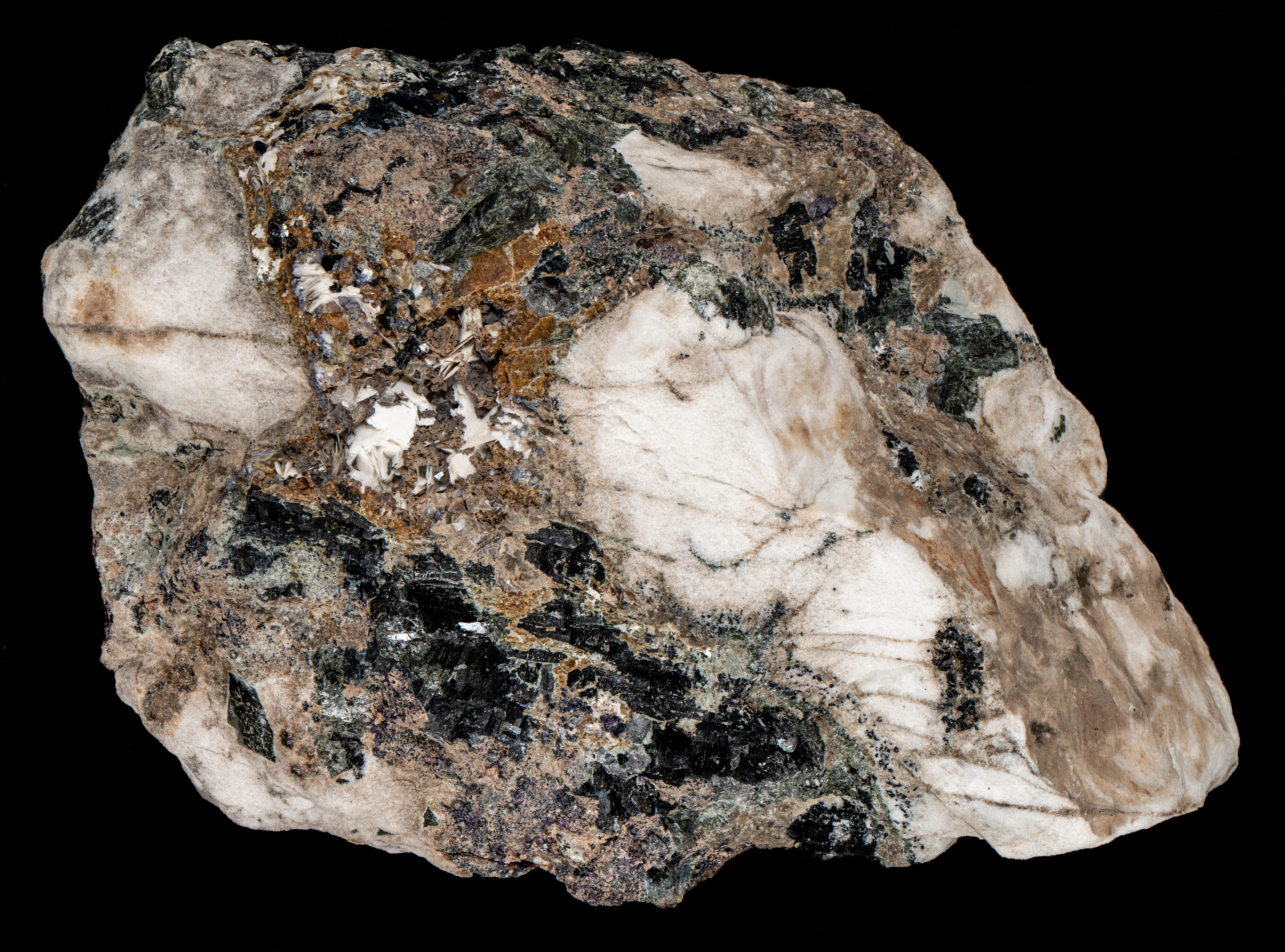
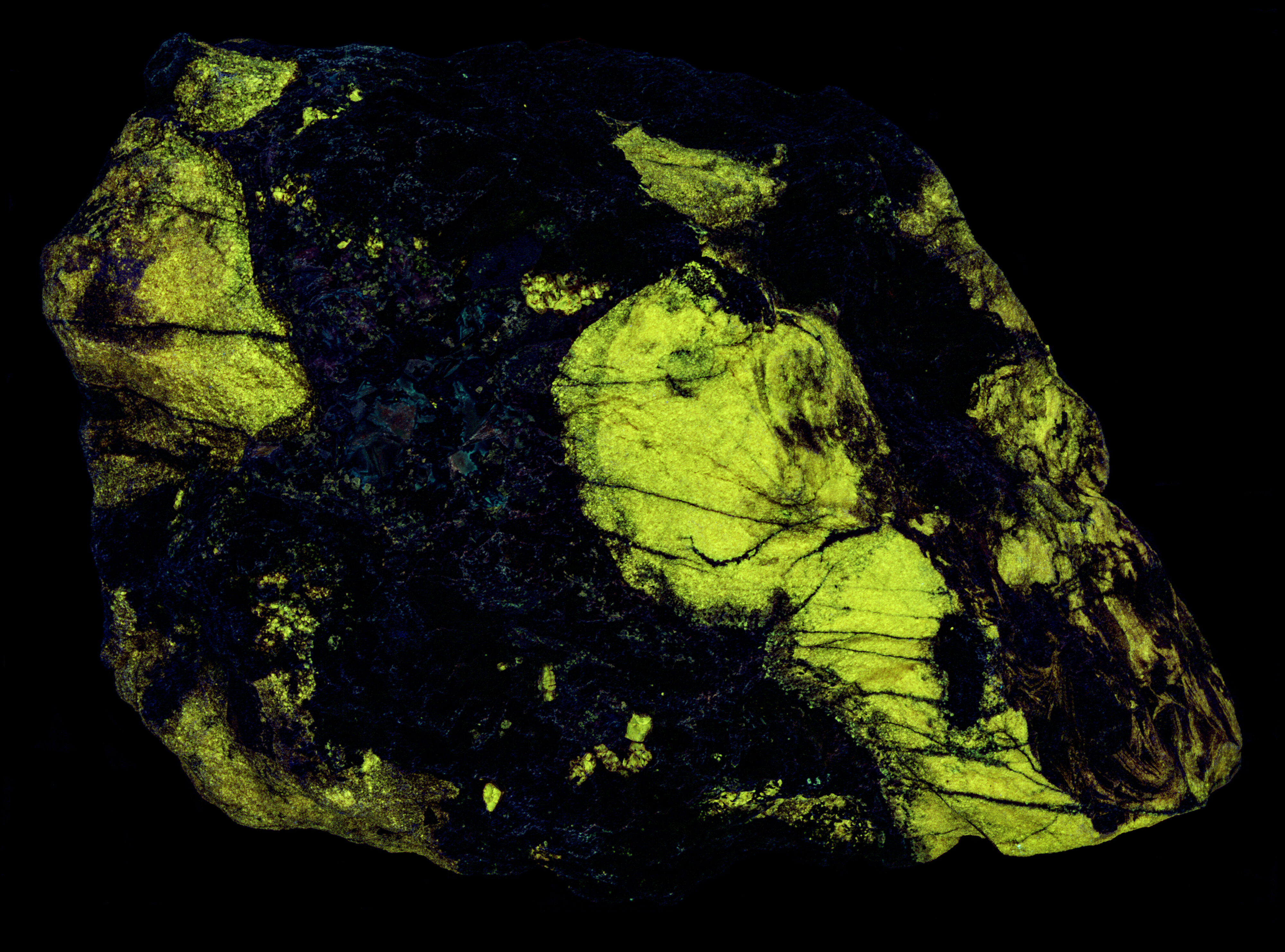
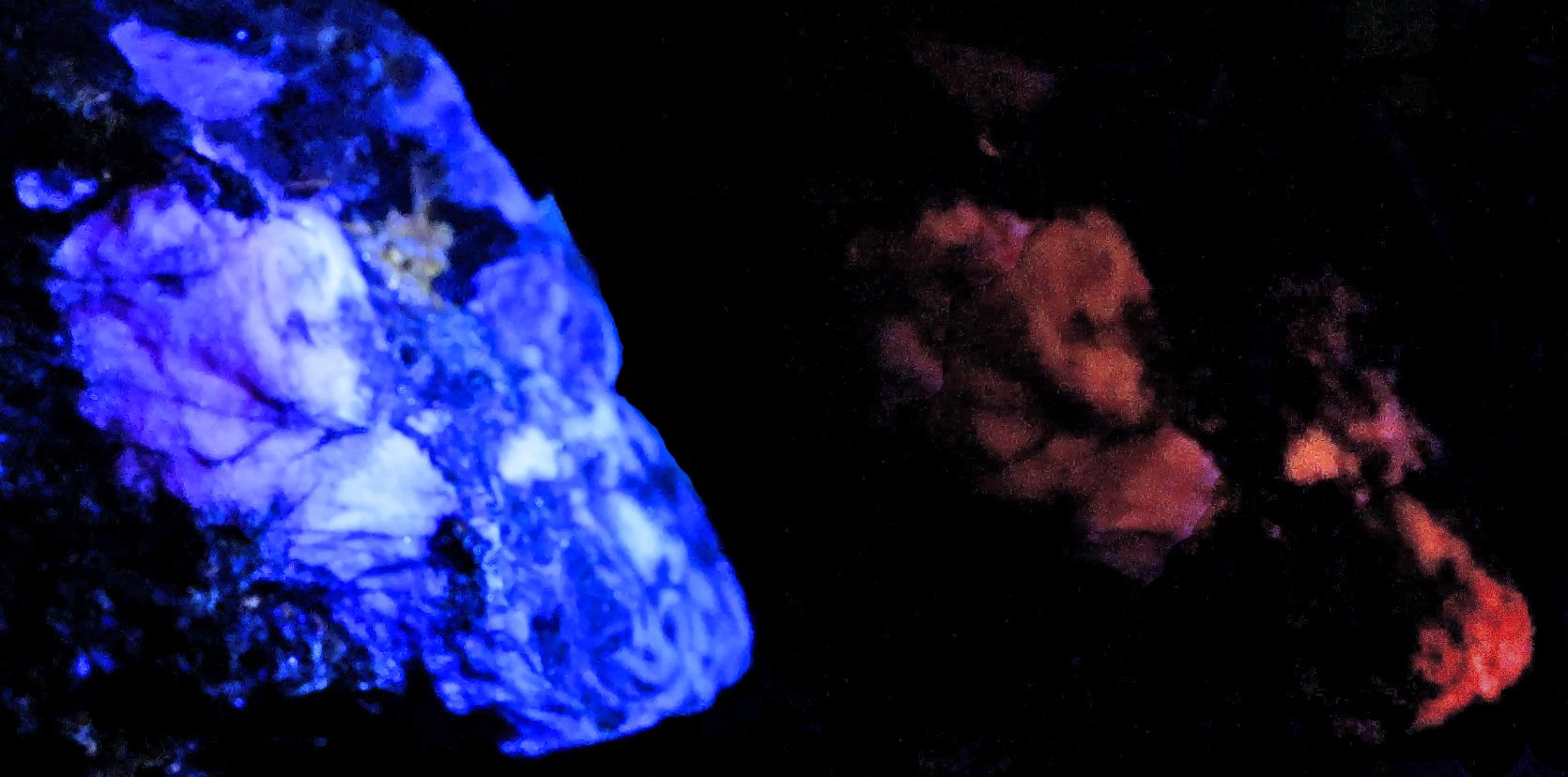
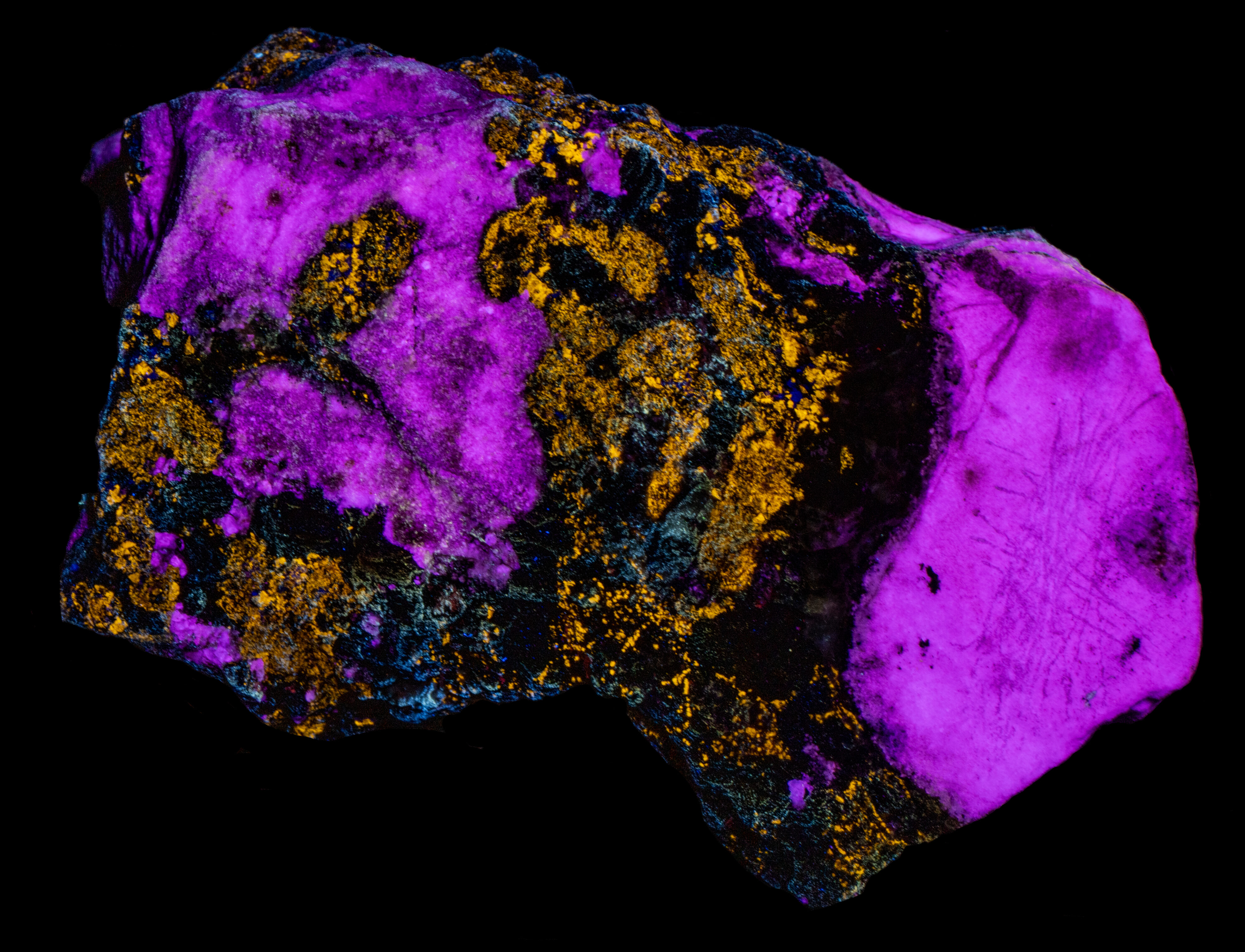
This is another mineral I found that has a unique fluorescent response under 340nm LED illumination compared to other UV wavelengths. The leucophanite in this specimen is brightest under 340nm LED and has a bright pink color. This specimen of leucophanite (NaCaBeSi2O6F) also displays many luminescent properties. It changes fluorescent color under different wavelengths of UV illumination. It shows brief intense phosphorescence (BIP) after exposure to LW (365nm LED) light. It is also triboluminescent and thermoluminescent. The specimen comes from the A/S Granit Quarry, Tuften, Tvedalen, Larvik Commune, Vestfold, Norway. The specimen also contains fluorescent zircon (Zr(SiO4)) and calcite (CaCO3). These three minerals create a very attractive fluorescent specimen.
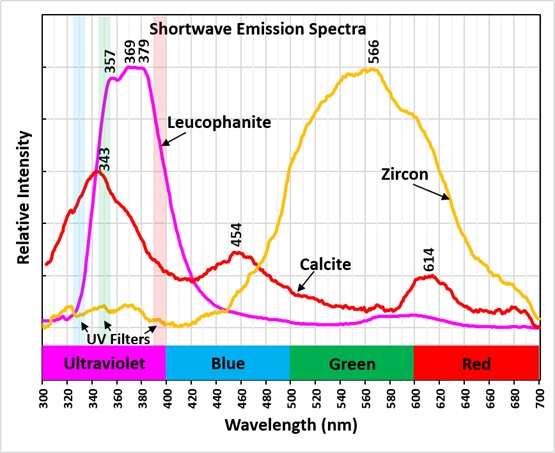
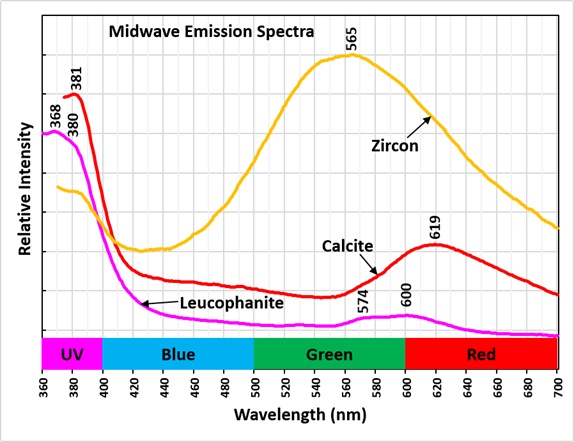
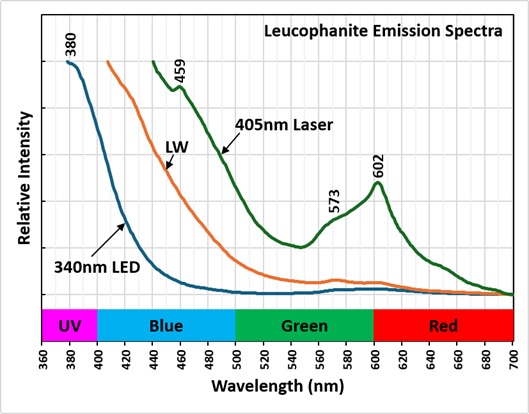
The leucophanite is brightest under 340 nm LED illumination. It is a bright pink under this wavelength. It is lavender under LW (365 nm LED) light. It is medium pink under midwave (305 nm LED) light and pinkish orange under shortwave (255 nm LED) light. The emission spectra at different excitation wavelengths show that leucophanite fluorescence is caused by a combination of violet-blue fluorescence activated by cerium and possibly other rare earths and orange-red fluorescence activated by manganese, dysprosium and samarium. The shortwave, midwave and 340nm emission spectra show the brightest emission occurs in the ultraviolet region with a shoulder that extends into the violet-blue region. The ultraviolet fluorescence is much brighter than the visible orange-red fluorescence. The shortwave emission spectrum has several small peaks in the ultraviolet at 357 nm, 369 nm and 379 nm suggesting cerium is not the lone activator, other rare earths (i.e. europium) or lattice defects may cause the additional peaks.
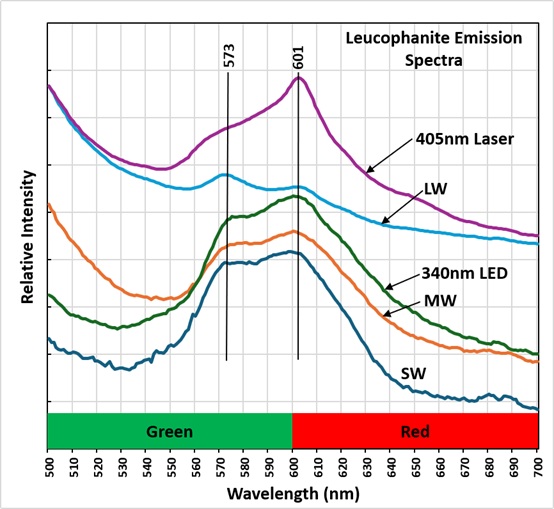
The orange-red part of leucophanite’s fluorescence is caused by manganese and rare earths. A vertically expanded view of emission spectra excited by various UV wavelengths show a broad peak with two smaller superimposed peaks at 573 nm and 601 nm. The broad peak is activated by manganese replacing calcium. The peak at 573 nm may be activated by dysprosium and the 601 nm peak activated by samarium. The manganese that activates fluorescence also causes the brief intense phosphorescence (BIP) after exposure to longwave UV light. Leucophanite BIP is orange-red compared to the red BIP of calcite.
Zircon fluoresces orange under longwave and yellow under the other UV wavelengths. The yellow fluorescence is brightest under shortwave light. The SW and MW emission spectra of zircon have a broad peak with maximum around 565 nm. The broad emission is activated by radiation damage of the zircon crystal structure. Sharper peaks superimposed on the broad emission peak are likely caused by rare earth activators such as dysprosium.
Calcite fluoresces brightest under midwave light. Its midwave emission spectrum is a broad peak with a maximum at 619 nm. This spectral signature is typical for manganese activation of red calcite fluorescence. The shortwave emission spectrum has a peak in the ultraviolet region with a maximum at 343 nm. This peak is activated by cerium which is a co-activator for the red manganese fluorescence. The ultraviolet fluorescence of calcite is considerably dimmer compared to the leucophanite ultraviolet fluorescence. Calcite is barely discernable in the false color image of ultraviolet fluorescence compared to the bright yellow color of the leucophanite.
Triboluminescence is a property where scratching a mineral with a hard object causes a flash of light. Scratching leucophanite with a knife point causes a flash of orange light. Triboluminescence is caused by the mechanical breaking of chemical bonds and electrical charge separation. Light flashes are produced by the recombination of electrical charges. The exact mechanism for producing the flash of orange light from leucophanite is unknown. One classic example of triboluminescence is the blue flash of light produced when a Wint-O-Green Life Savor is crushed. Crushing the crystals of the chemicals in the Life Savor creates a separation of positive and negative electrical charges. When the charges recombine, electrons collide with nitrogen gas molecules and produce blue and ultraviolet light (micro lightning). The UV light causes the oil of wintergreen in the Life Saver to fluoresce bright blue, white. In the case of leucophanite, it is unknown if a similar mechanism occurs where blue and UV emission from charge recombination causes manganese activated orange fluorescence. Alternatively, the mechanical breaking of bonds in leucophanite excites electrons to a higher energy level. The return of the electrons to the ground state emits orange photons. No UV light is involved in producing orange light.
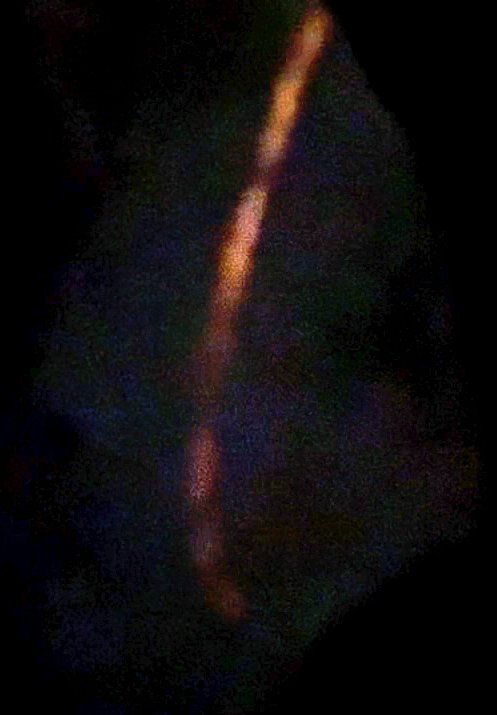
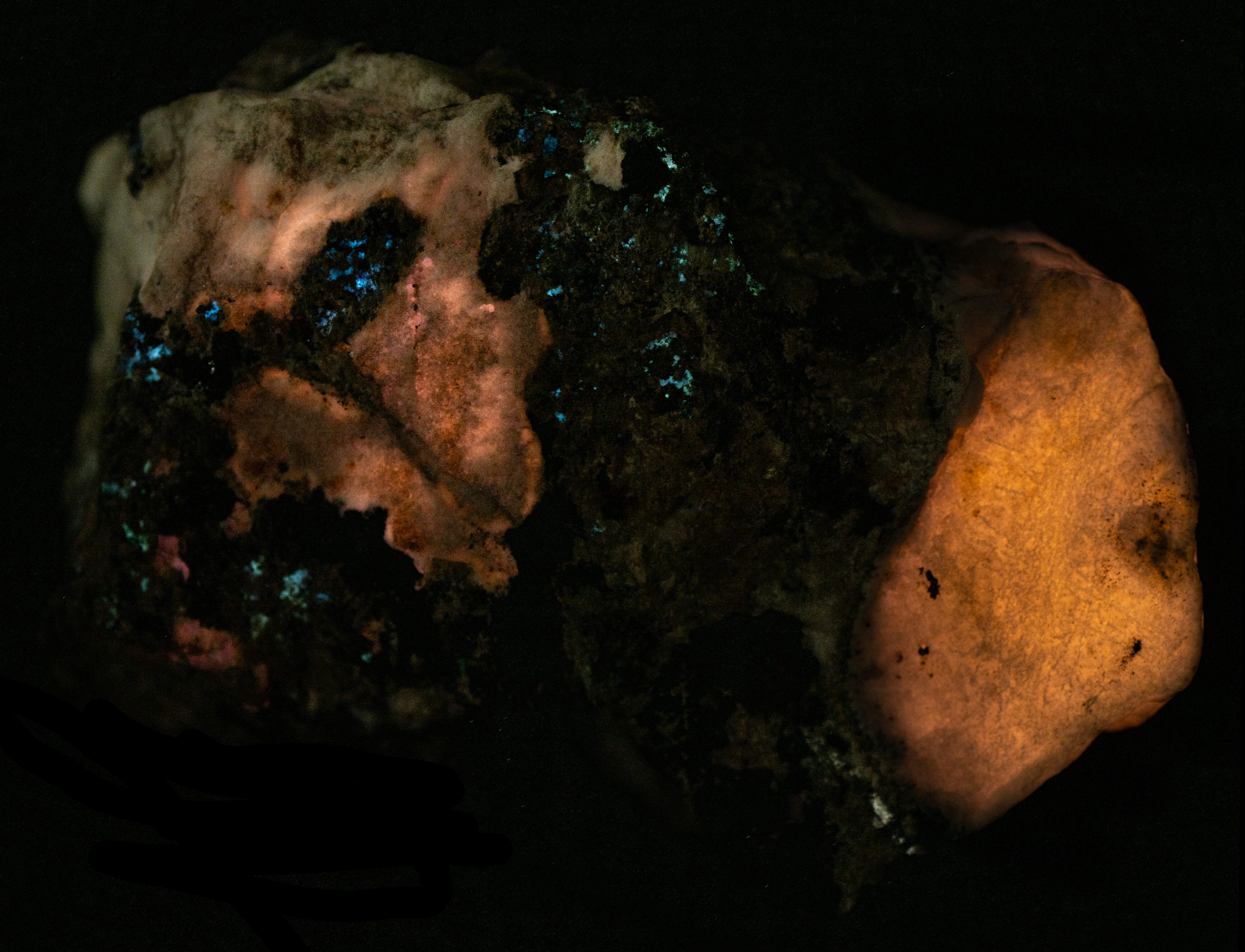
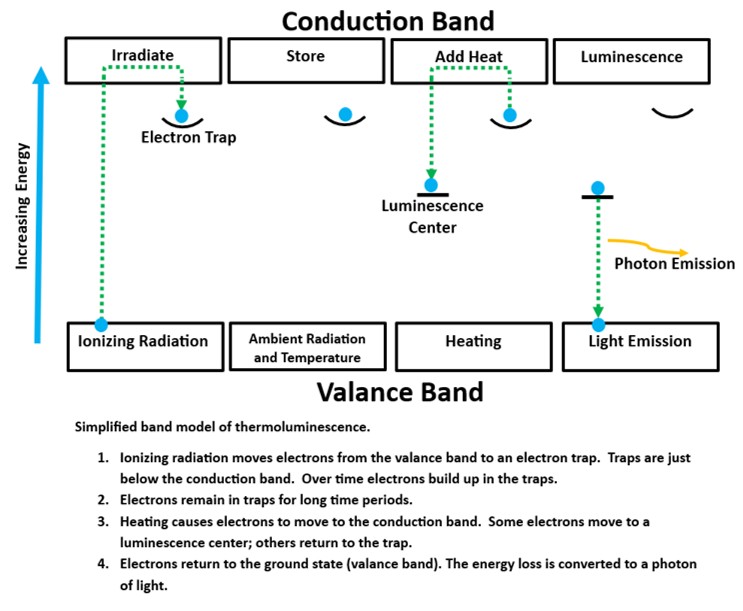
Heating the specimen with a heat gun causes the leucophanite to glow orange. This property is called thermoluminescence. Thermoluminescence requires the presence of an electron "trap". A trap is an electronic state caused by an impurity or lattice defect that can hold electrons for long periods of time. The energy level of the trap is just below the conduction band in the band theory model. Electrons are moved into the trap from the valance band by ionizing radiation. Heat moves electrons from the trap to the slightly higher energy level in the conduction band. Some electrons then return to the ground state (valence band) through luminescence centers by releasing energy as a photon of light. Intense and/or prolonged heating can completely empty the electron traps to prevent thermoluminescence from reoccurring until ionizing radiation refills the traps.
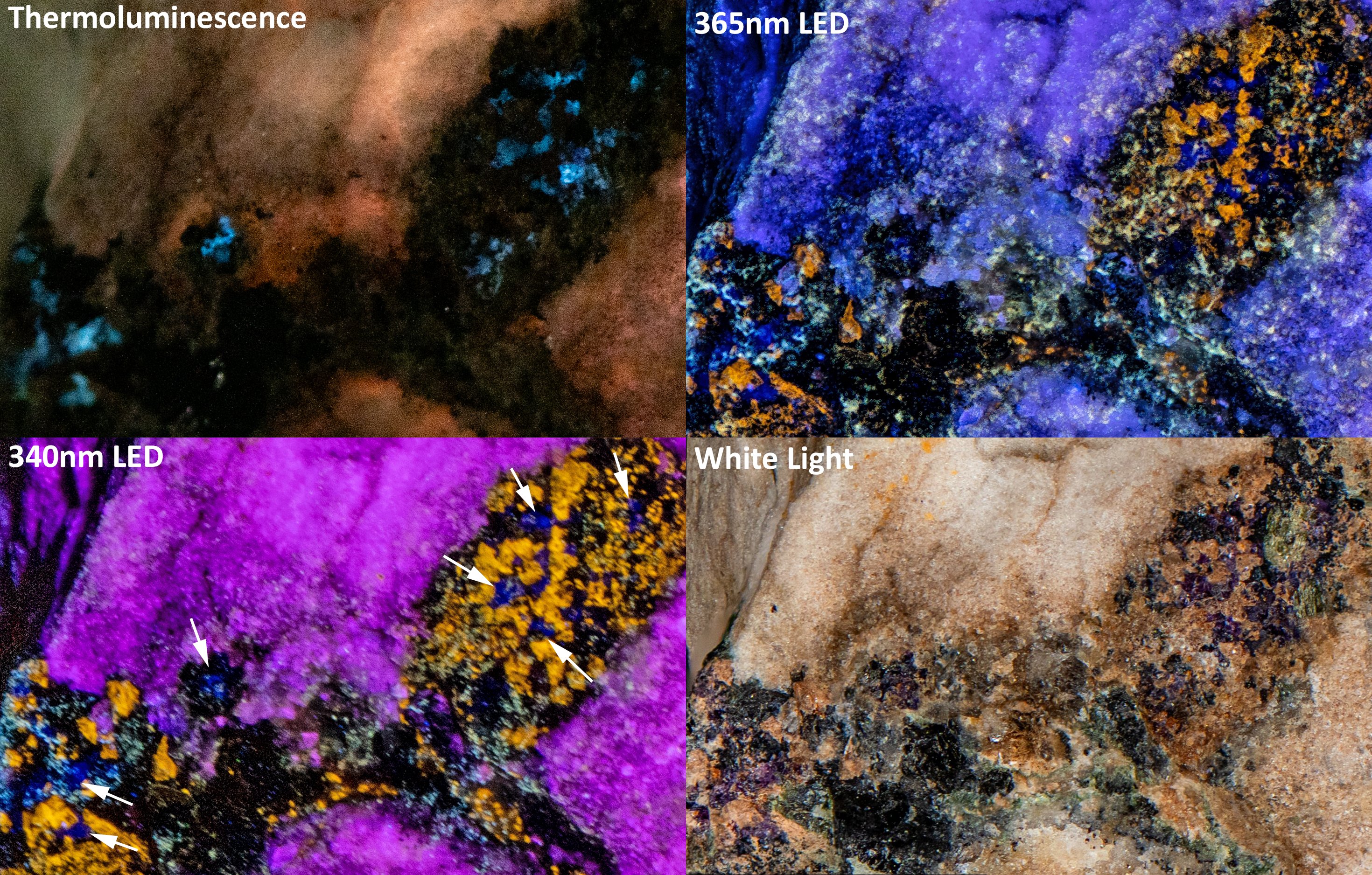
The thermoluminescent image shows areas of greenish gray grains in addition to the orange areas of the leucophanite. Comparison of enlarged thermoluminescent image to LW and 340nm enlarged images show dark blue grains corresponding to the greenish gray thermoluminescence. These grains are likely fluorite.
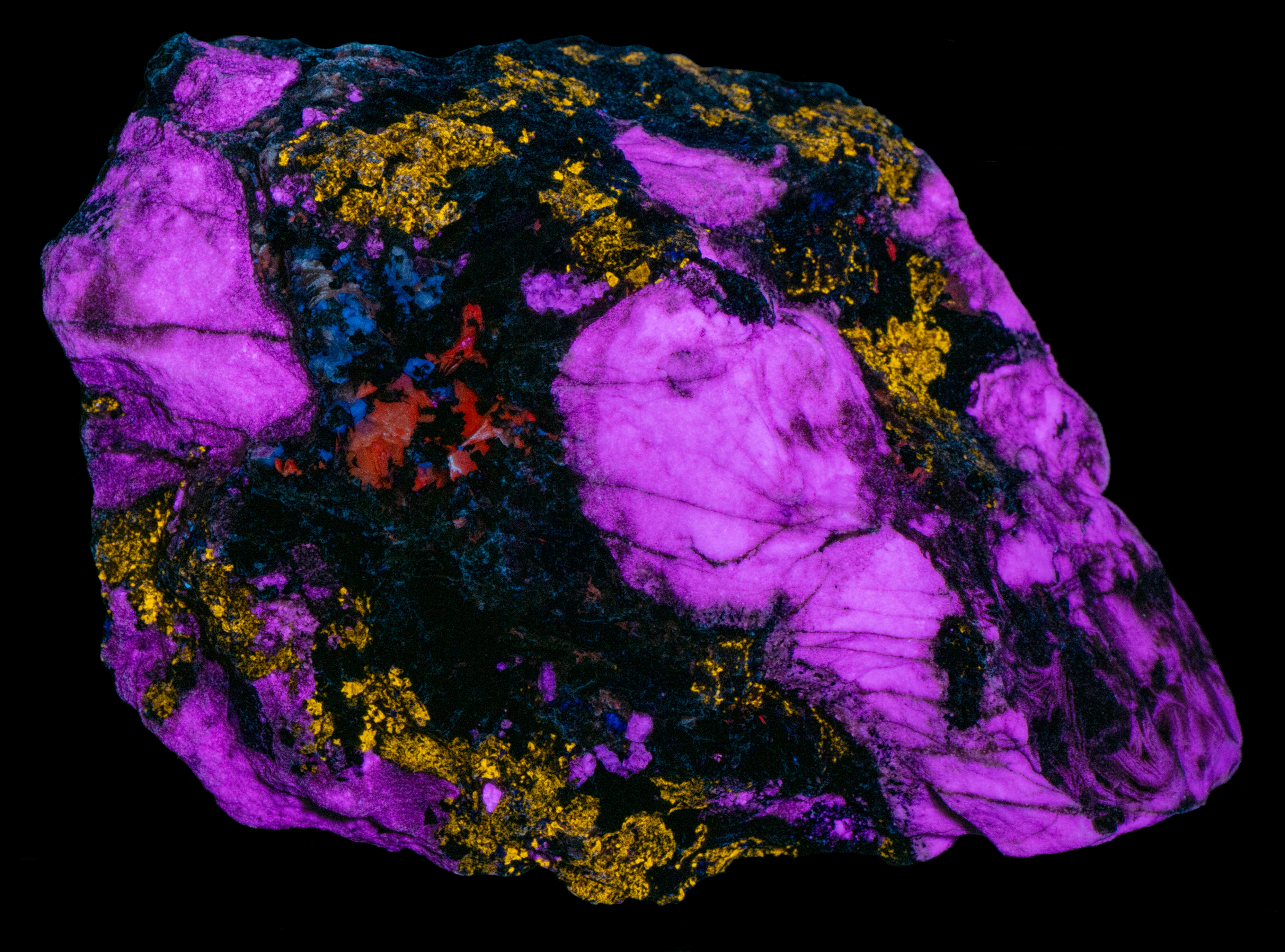
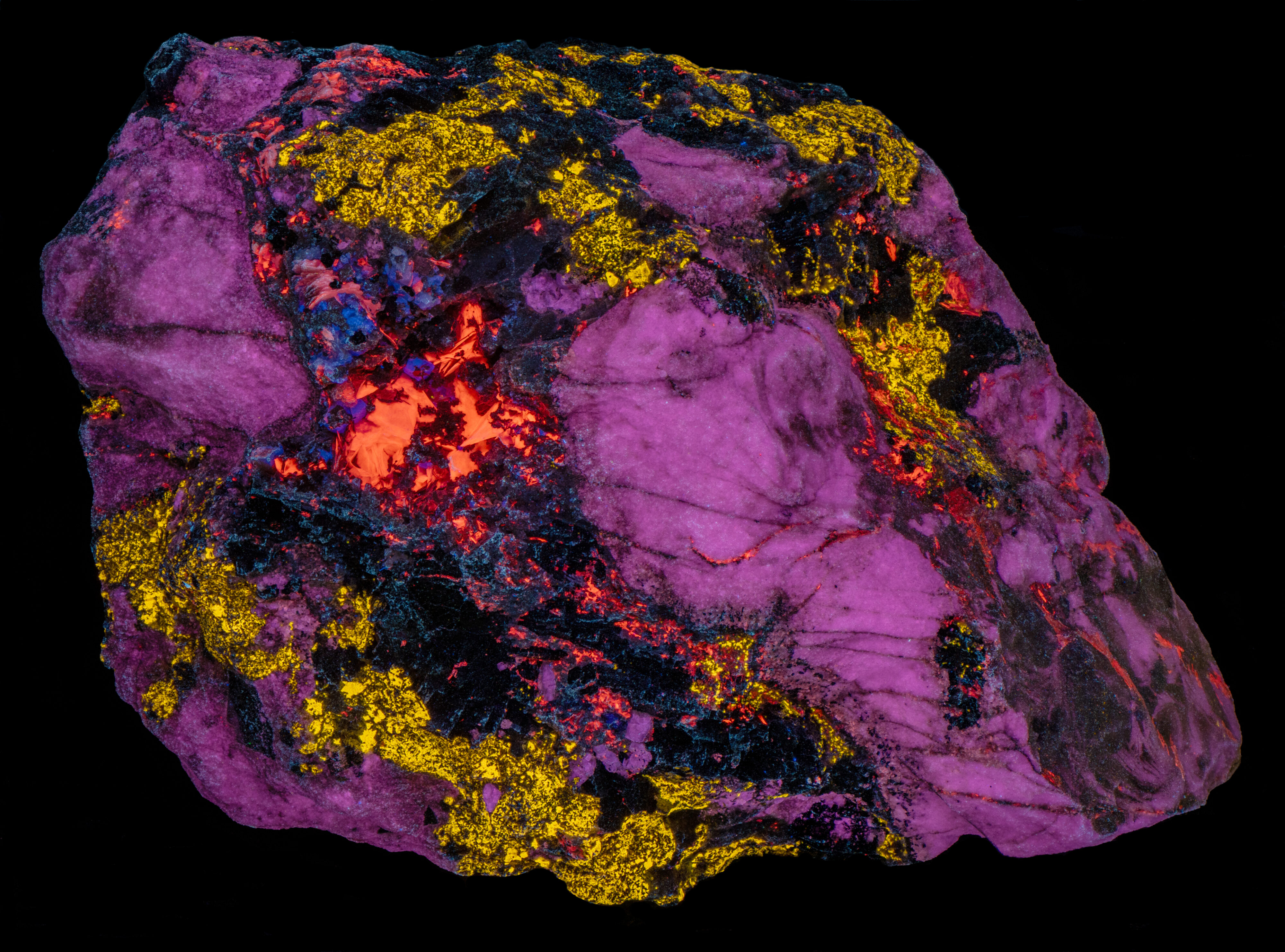
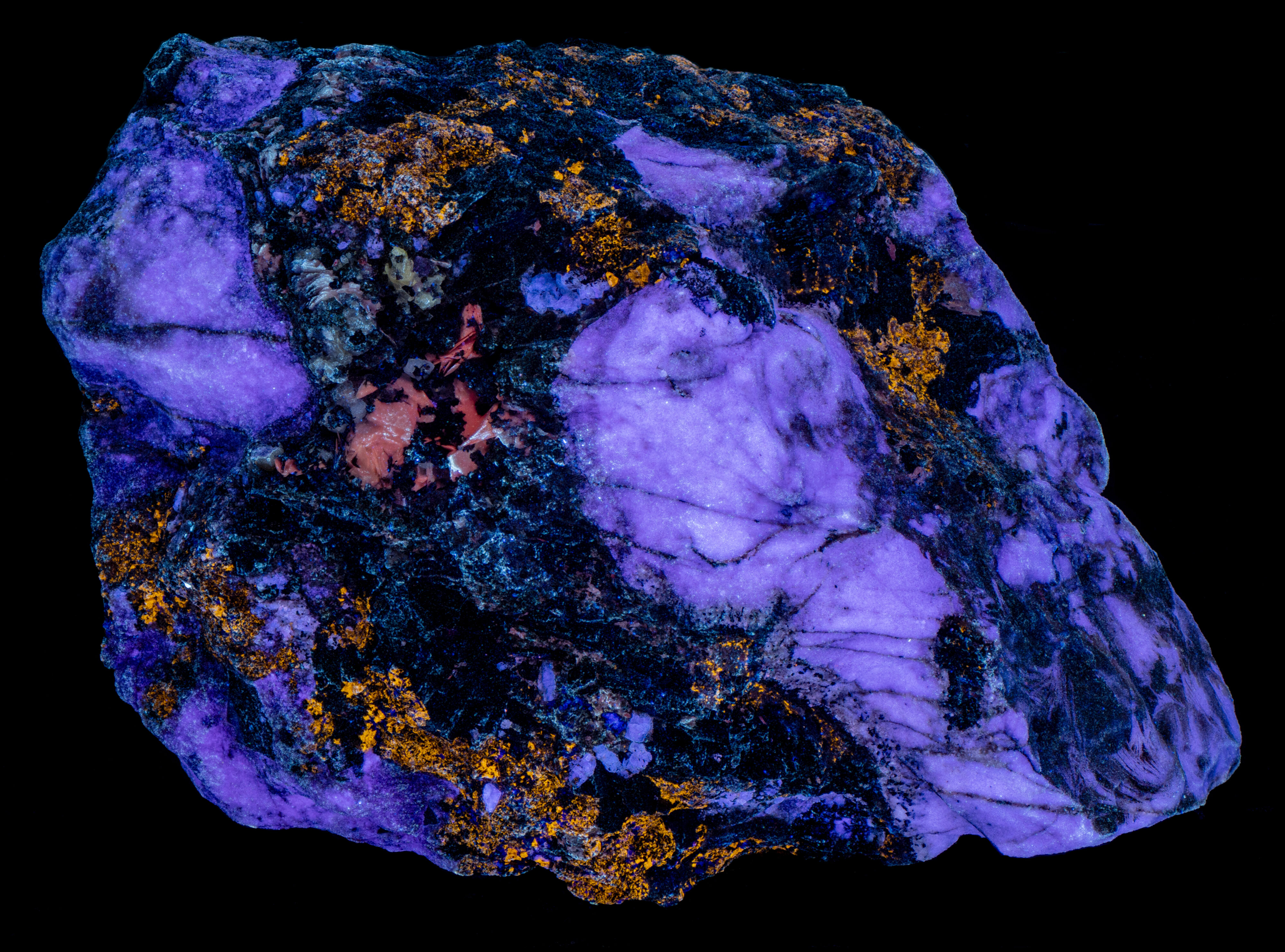
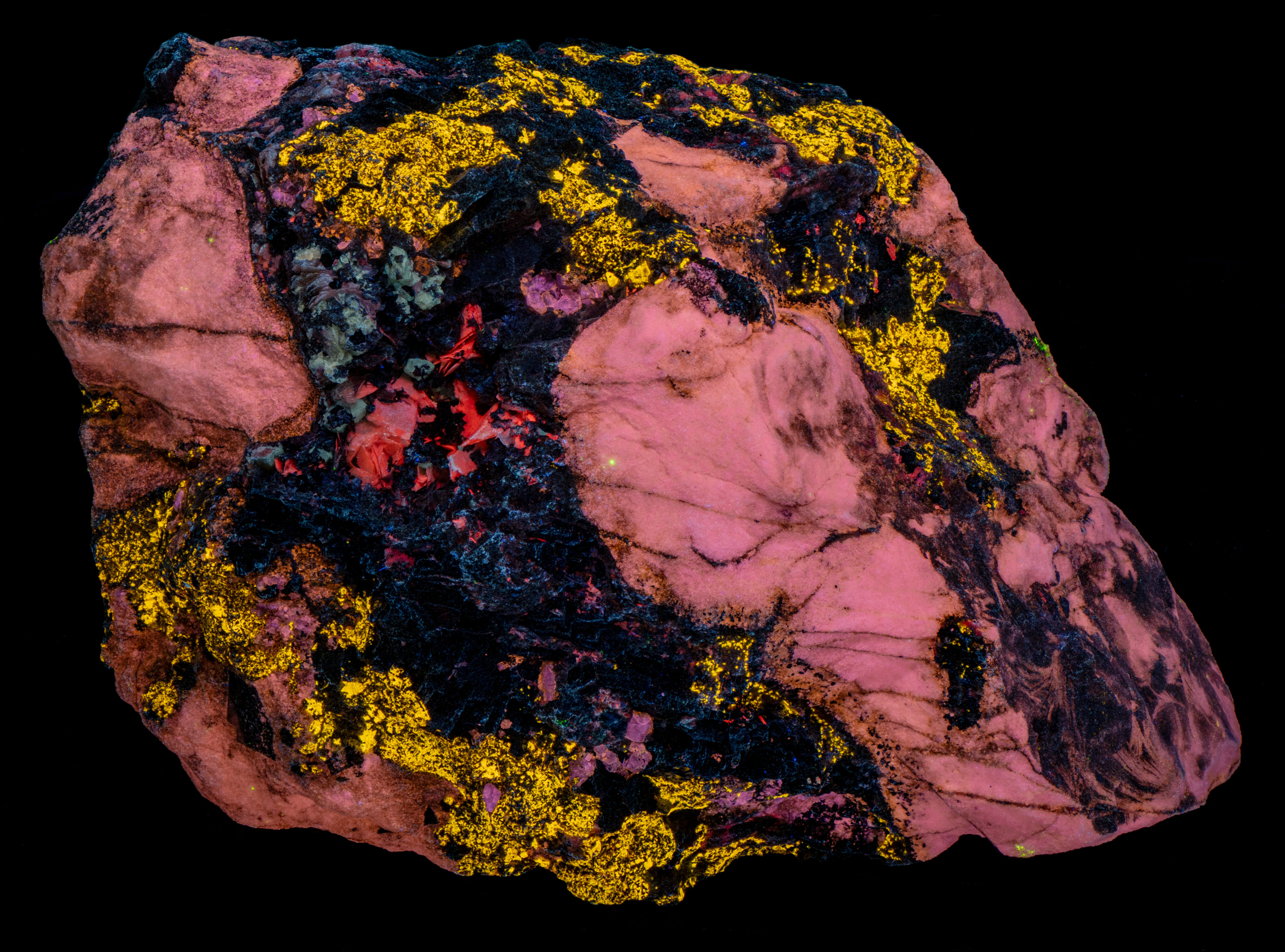
Summary of luminescence responses:
Leucophanite (Mindat) (RRUFF)
- Fluorescence under Longwave (365nm LED) UV light: Violet
- Fluorescence under Midwave (305nm LED) UV light: Pink
- Fluorescence under Shortwave (255nm LED) UV light: Pink
- Triboluminescence under Other: Orange
- Thermoluminescence under Other: Orange
- Afterglow after exposure to Longwave (365nm LED) UV light: Red
- Fluorescence under Midwave (305nm LED) UV light: Yellow
- Fluorescence under Shortwave (255nm LED) UV light: Yellow
- Fluorescence under Midwave (305nm LED) UV light: Red
- Fluorescence under Shortwave (255nm LED) UV light: Red