
Pyromorphite and Plumbogummite – Laohuan Mine, Guangxi, China
Contributed by: Michael Crawford
Date: Jul 5th, 2026
Locality: Laohuan Mine, Gongcheng Co., Guilin, Guangxi, China (See on Mindat)
Size: 7 x 7 cm
Description:
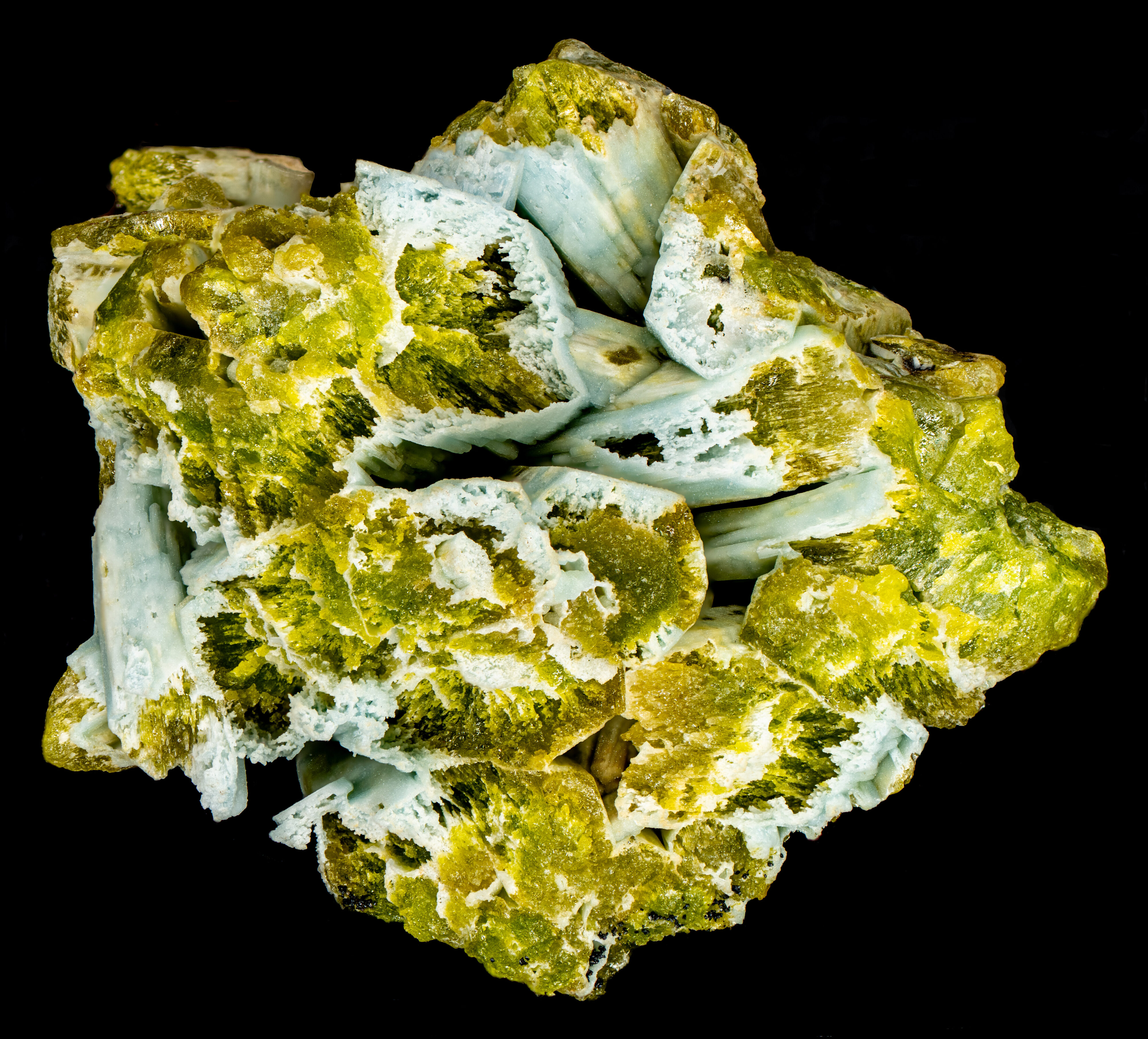
This is a specimen of pyromorphite (Pb5(PO4)3Cl) and plumbogummite (PbAl3(PO4)(PO3OH)(OH)6) from the Laohuan Mine, Guangxi, China. Many similar specimens described their location from either the Daoping Mine or Yangshuo Mine, but the November-December 2022 issue of The Mineralogical Record has an article describing these specimens and giving the correct location for these specimens as the Laohuan Mine, Gongcheng County, Zhuang Autonomous Region, Guangxi, China that is 10km north of Yangshuo-Daoping Mines.
The plumbogummite and pyromorphite form in the oxidized zone of a lead deposit. The pyromorphite formed first and then the blue gray plumbogummite coated and replaced the yellow pyromorphite. Several crystals have a core of pyromorphite with a coating of plumbogummite.
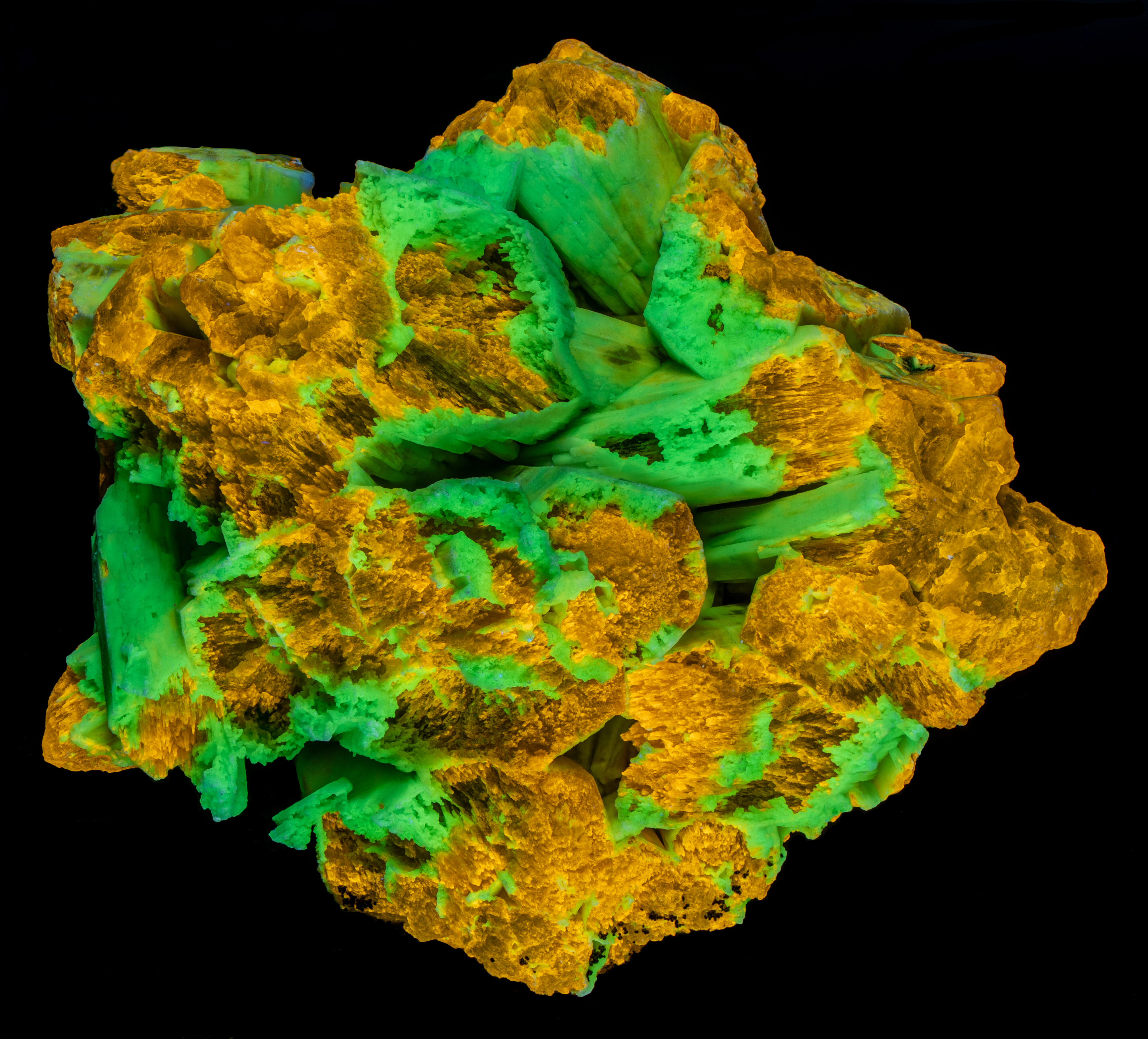
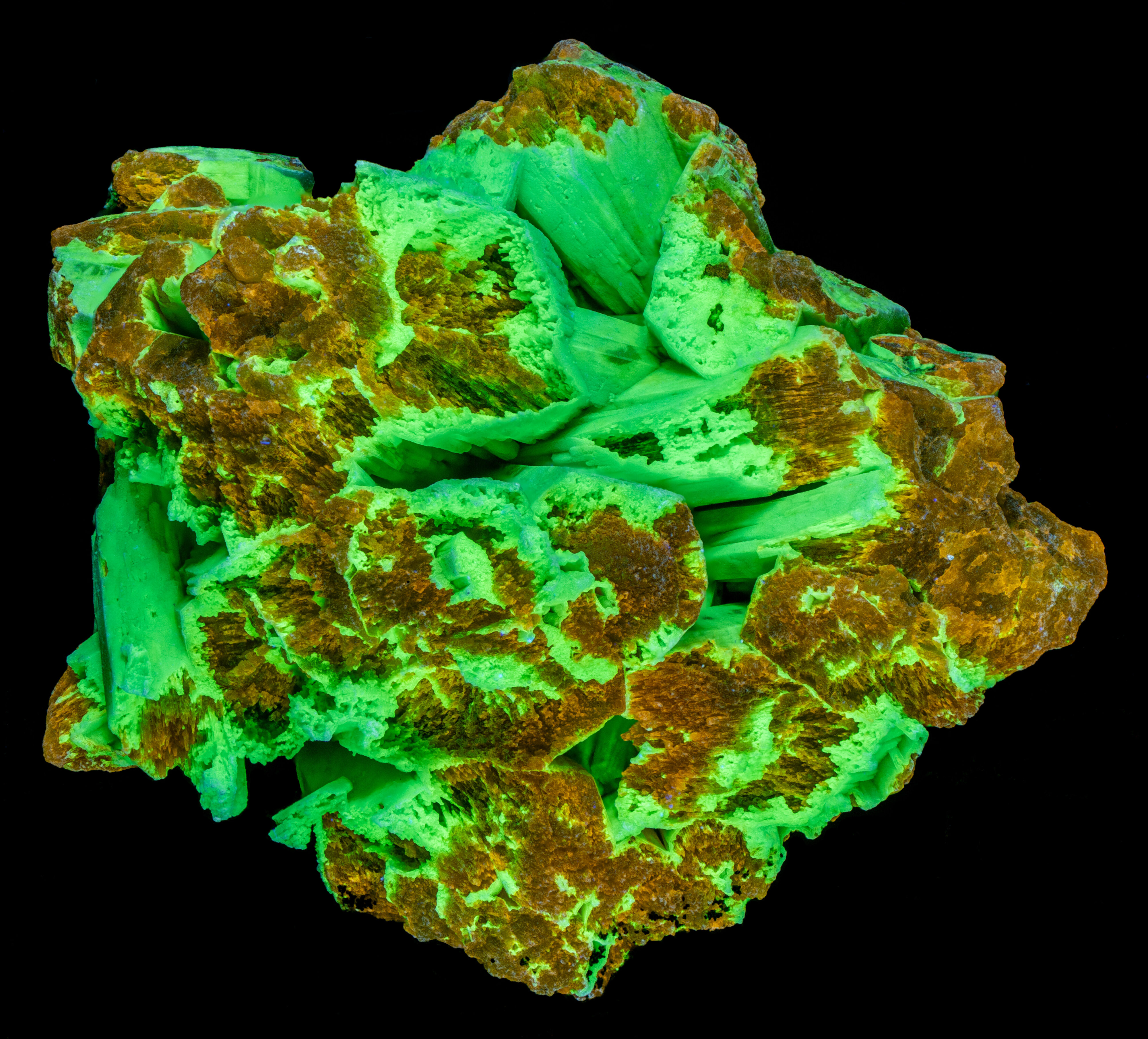
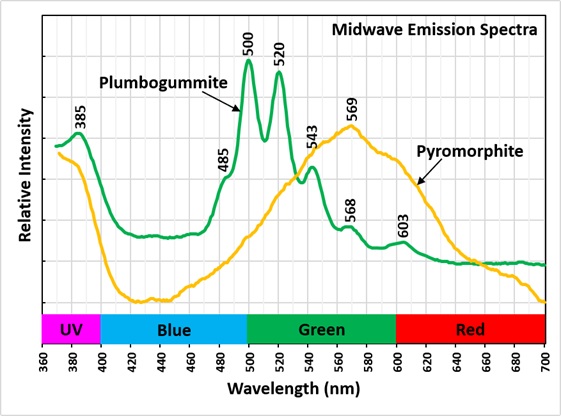
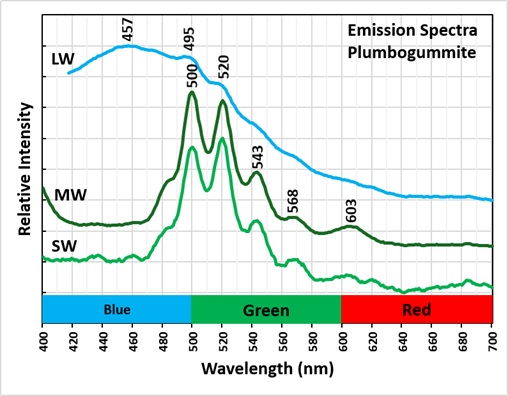
The specimen has the brightest fluorescence under midwave UV illumination. The plumbogummite fluoresces green due to uranyl (UO22+) activation. The uranyl activation is clearly shown in the MW and SW emission spectra with the sharp peaks in the green region at 500 nm, 520 nm, 543 nm, 568 nm and 603 nm. The MW spectrum also has a peak in the ultraviolet at 385 nm. The activator for this ultraviolet peak is unknown and may be a rare earth such as cerium or europium.
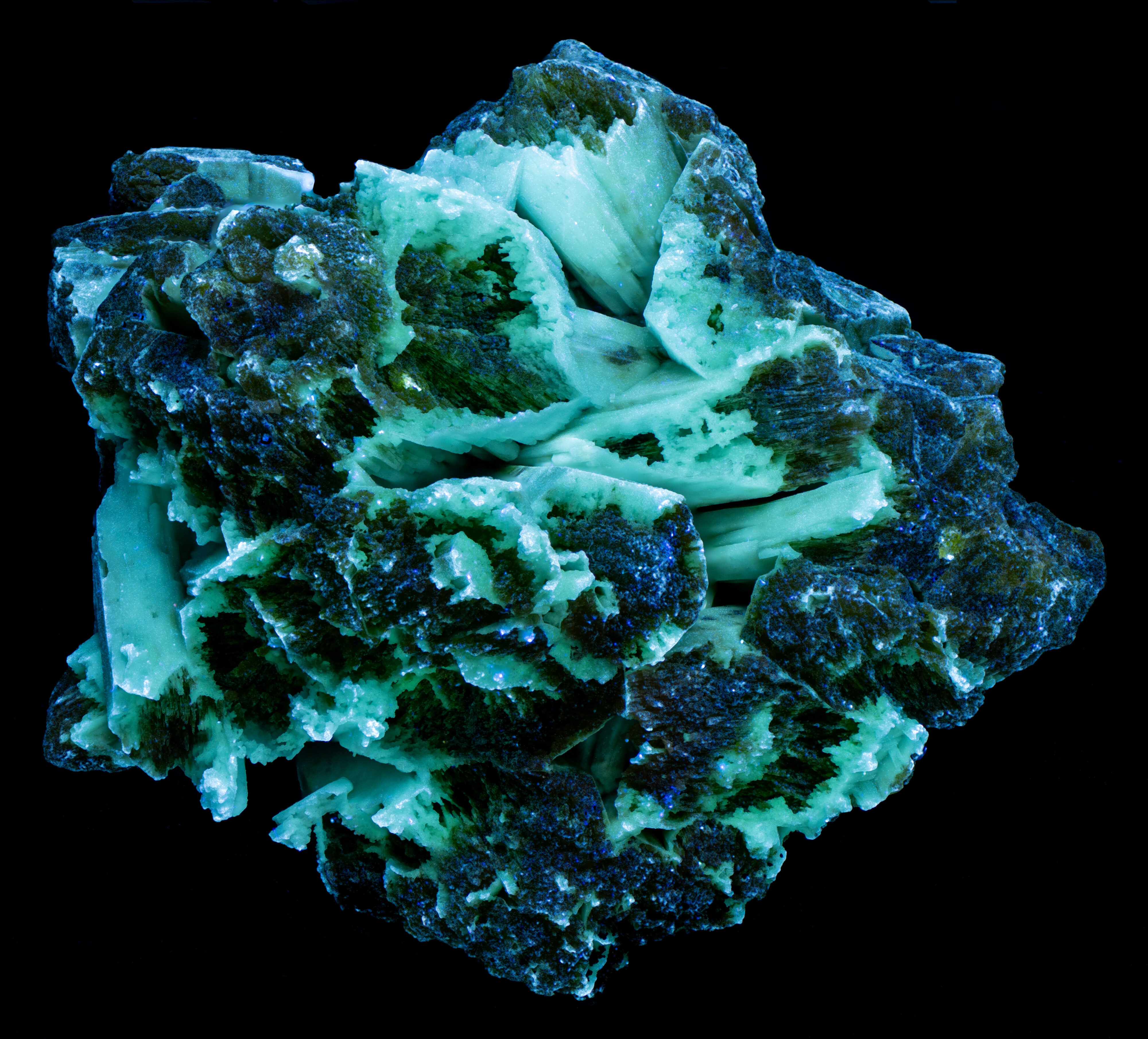
The longwave spectrum of plumbogummite has a broad peak centered at 457 nm and ripples on the flank of broad peak caused uranyl activation. The activator for the broad peak may be lead, possibly titanium substituting for aluminum, or some other element. The longwave image shows the blue gray plumbogummite fluorescence related to this broad peak. The color of the plumbogummite fluorescence changes to pale green under MW and SW illumination where the uranyl activated fluorescence dominates.
The midwave emission spectrum of pyromorphite shows a broad peak with a maximum at 569 nm that corresponds to its yellow fluorescence. The yellow fluorescence of pyromorphite is activated by europium according to fluomin.org, but a rare earth would produce a sharper peak. Lead (Pb2+) or manganese (Mn2+) are also potential candidates for fluorescent activation. The MW spectrum also has a peak in the ultraviolet similar to the plumbogummite peak. The ultraviolet peak may be activated by europium, cerium or some other rare earth.
The SW image of the pyromorphite fluorescence appears more orange compared to the MW image. The SW fluorescence is not bright enough to acquire a spectrum, so I cannot speculate on why the fluorescent color shifts to a longer wavelength.
Summary of luminescence responses:
Plumbogummite (Mindat) (RRUFF)
- Fluorescence under Longwave (365nm LED) UV light: Blue
- Fluorescence under Midwave (305nm LED) UV light: Green
- Fluorescence under Shortwave (255nm LED) UV light: Green
- Fluorescence under Midwave (305nm LED) UV light: Yellow
- Fluorescence under Shortwave (255nm LED) UV light: Orange