
Banded Calcite – Hungary
Contributed by: Michael Crawford
Date: Jun 15th, 2026
Locality: Cserhát Mountains, Nógrád County, Hungary (See on Mindat)
Size: 11 x 1 x 18 cm
Description:
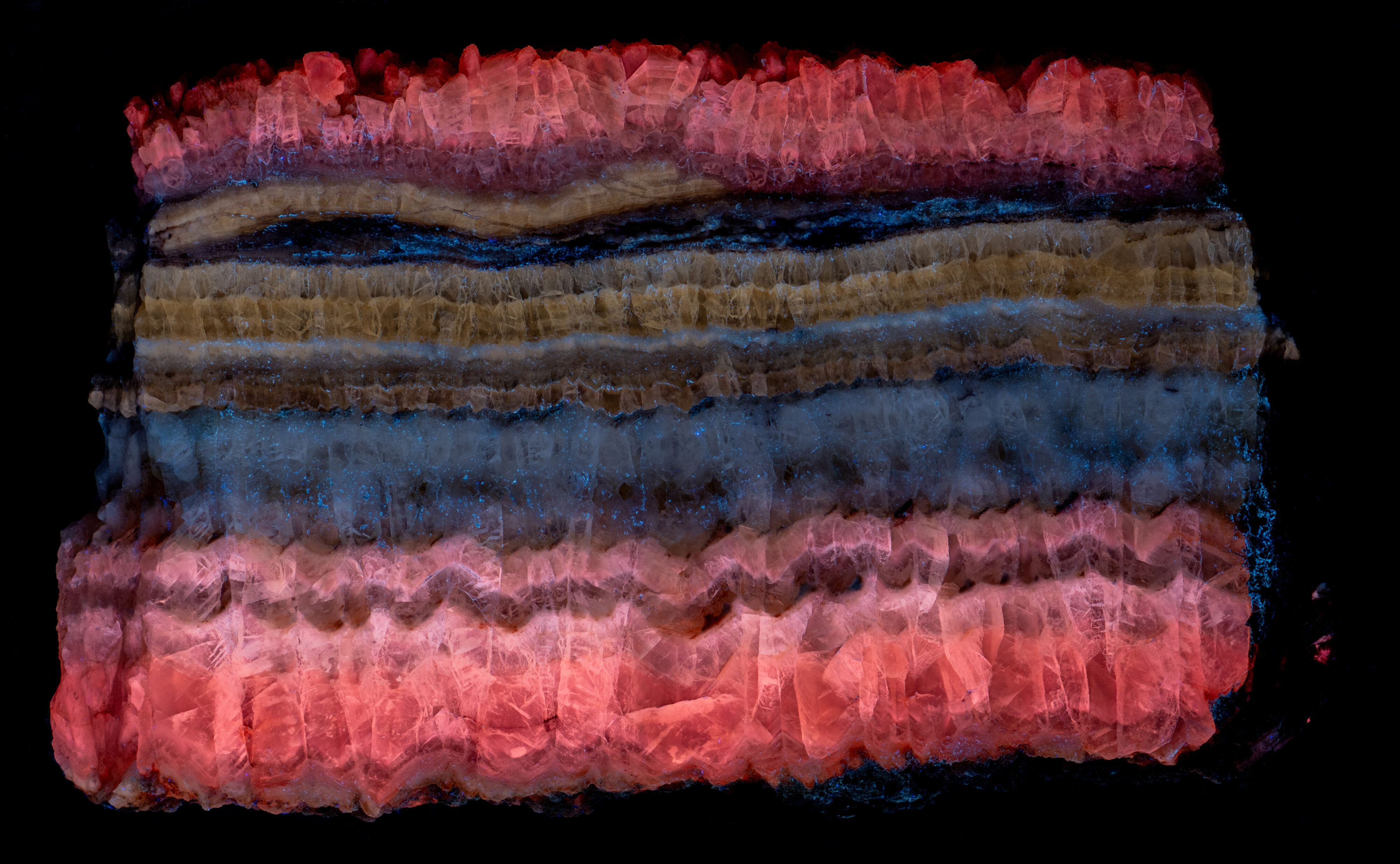
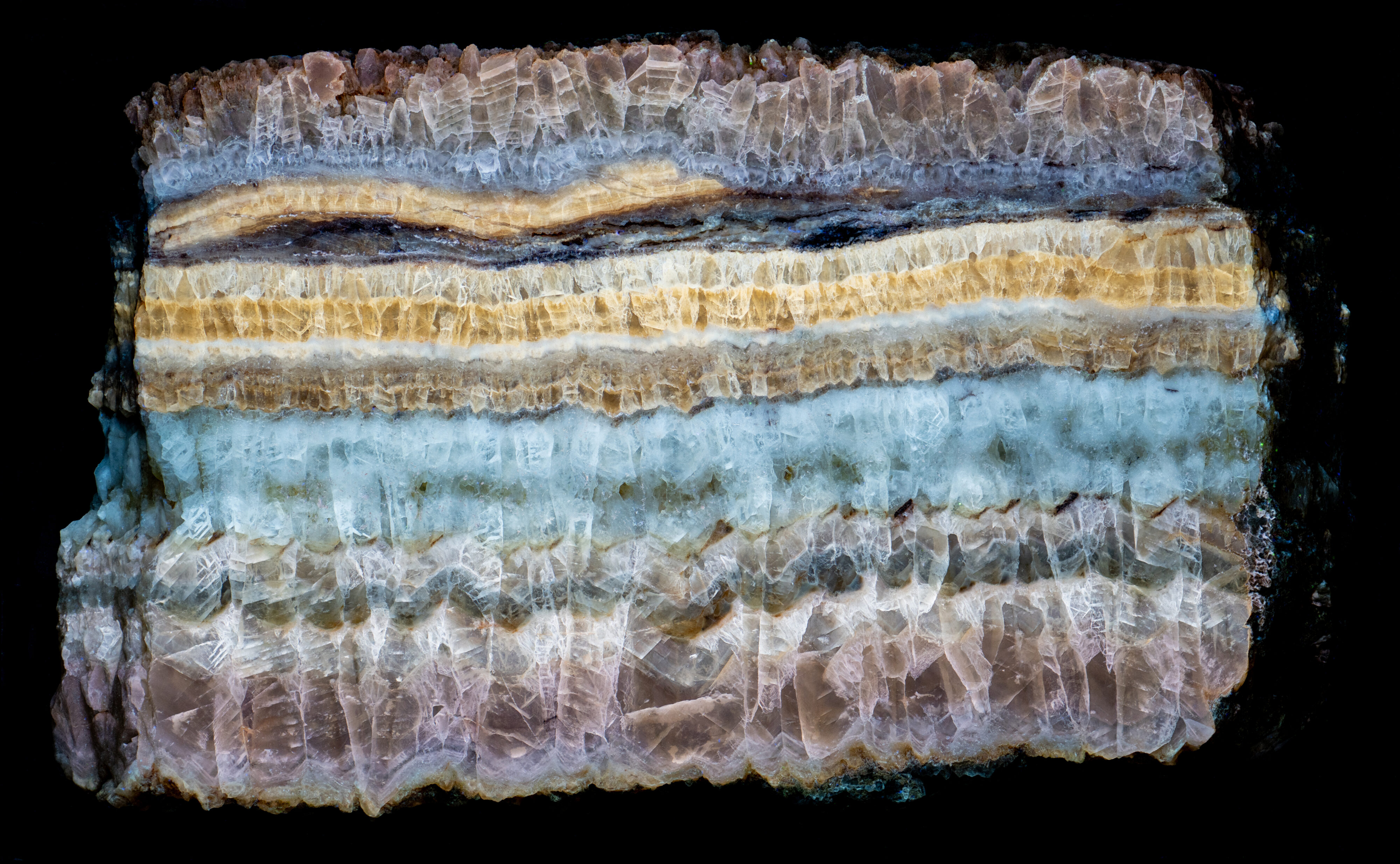
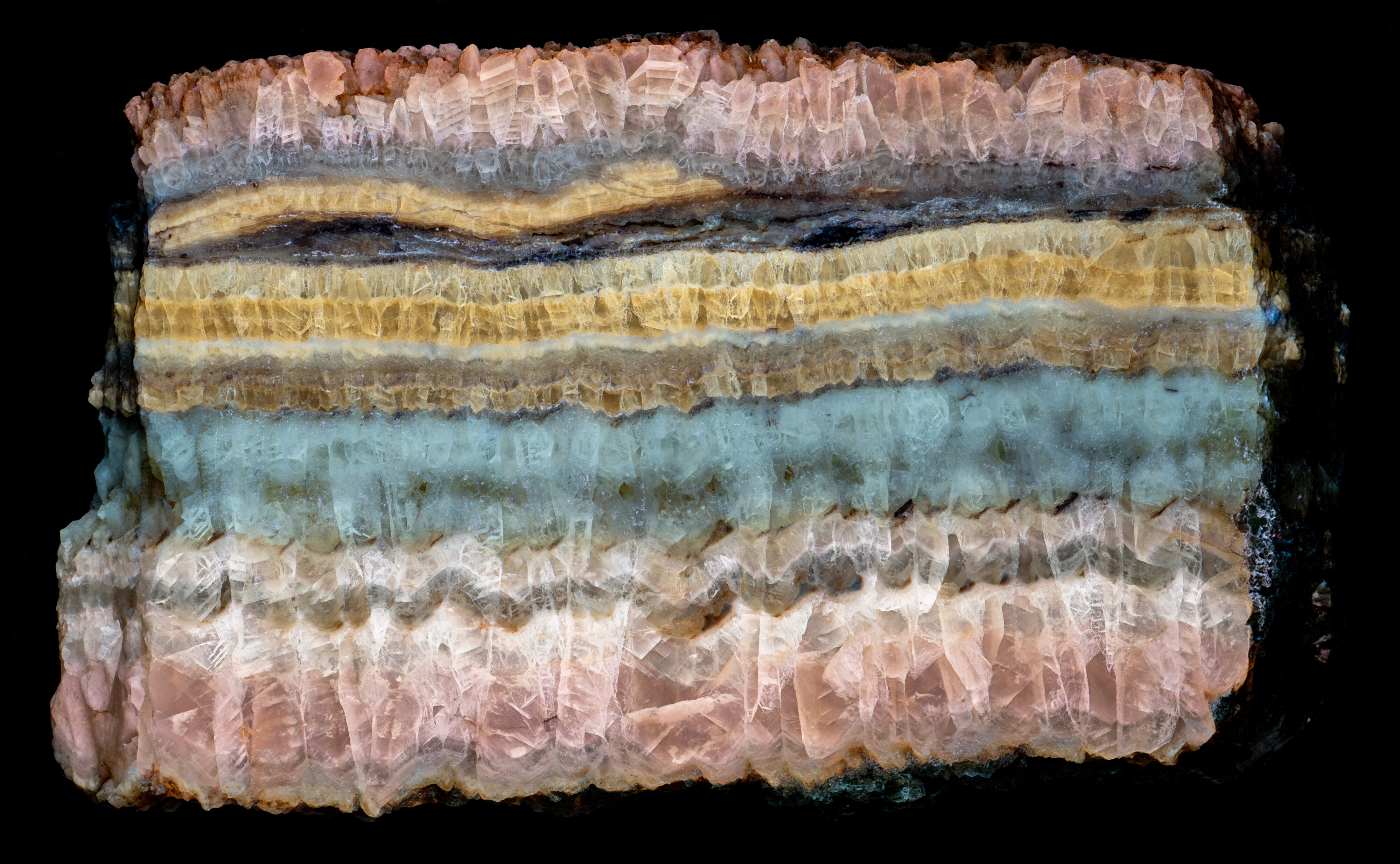
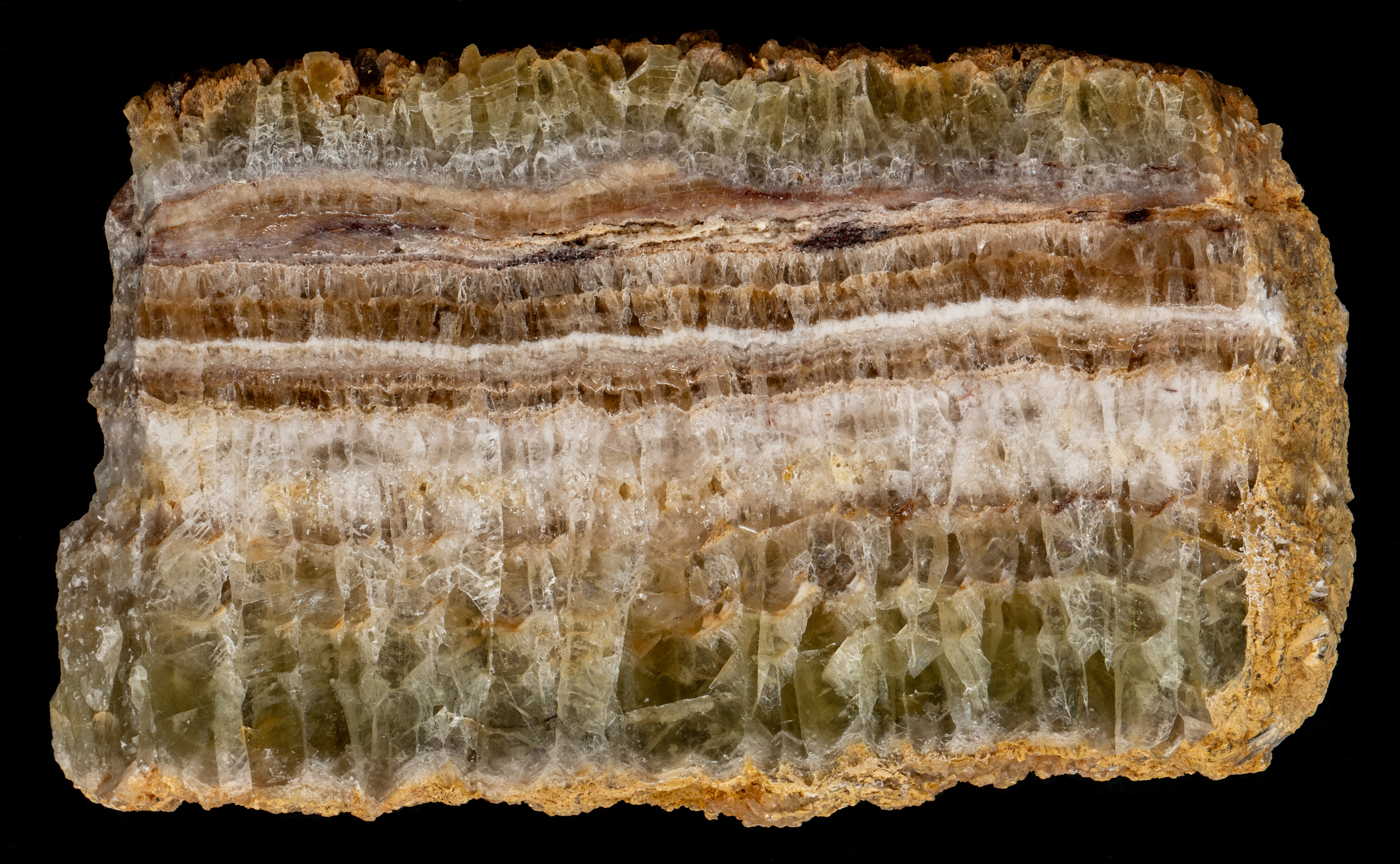
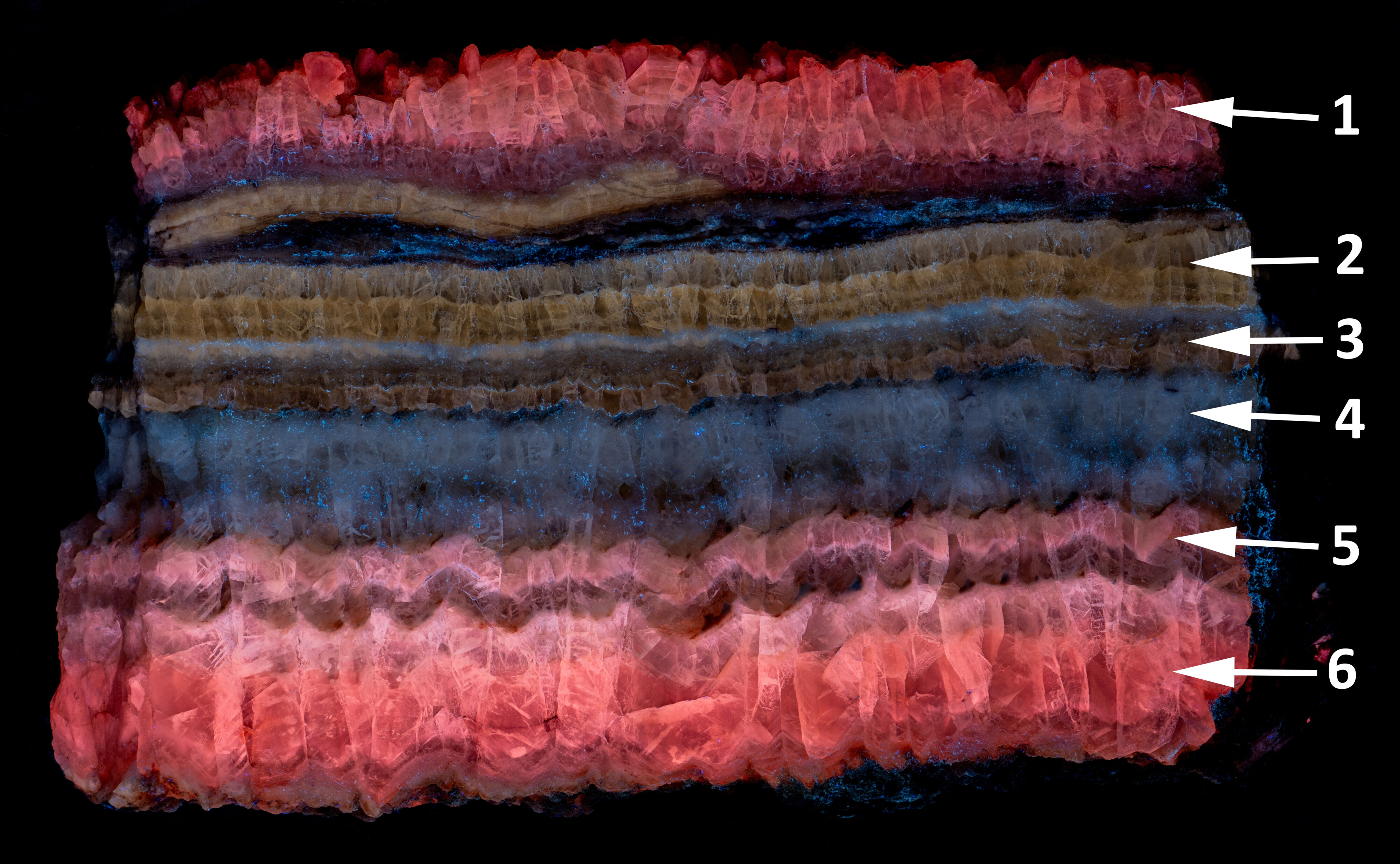
This is a polished slab of layered calcite from Cserhat, Vac, Naszaly, Hungary. The layers indicate that the calcite was deposited in an open space. Each layer represents a new episode of deposition. Each episode contained different trace elements and organic compounds to give each layer a unique visible color, unique fluorescent and phosphorescent properties.
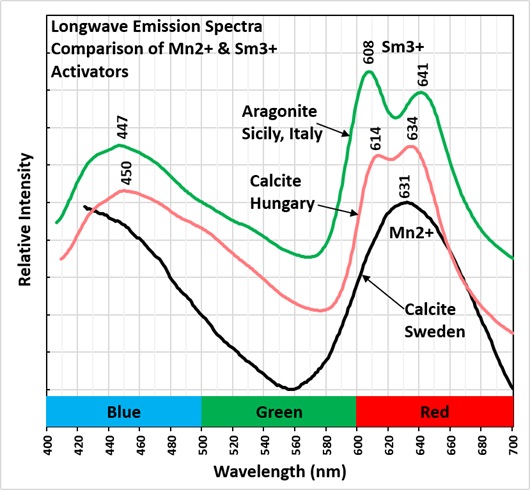
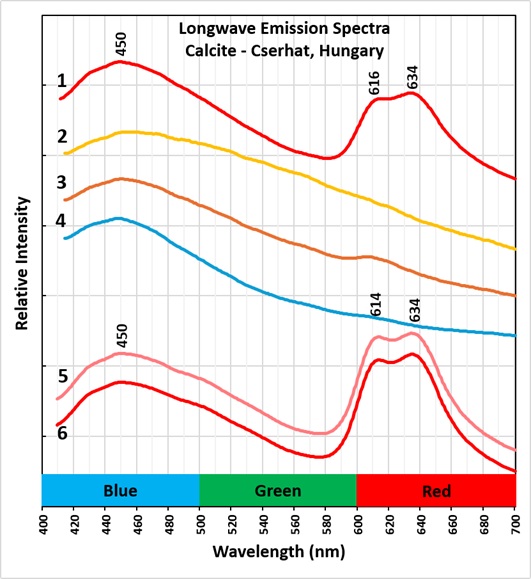
Under longwave UV light, the bottom and top layers fluoresce red. Red fluorescing calcite usually results from the activation from manganese (Mn2+) replacing calcium (Ca2+). However, the longwave emission spectra indicates that the red fluorescence in this specimen is activated by samarium (Sm3+) replacing calcium. Samarium causes two peaks at 614 nm and 634 nm in the emission spectrum. The double peaks are very different from the single broad peak with a maximum around 631 nm that is activated by manganese. The polymorph of calcite, aragonite, also has a longwave emission spectrum with a double peak when the fluorescence is activated by samarium. However, the peaks are at different wavelengths (608 nm and 641 nm) due to the different crystal structures. (aragonite is orthorhombic, calcite is trigonal).
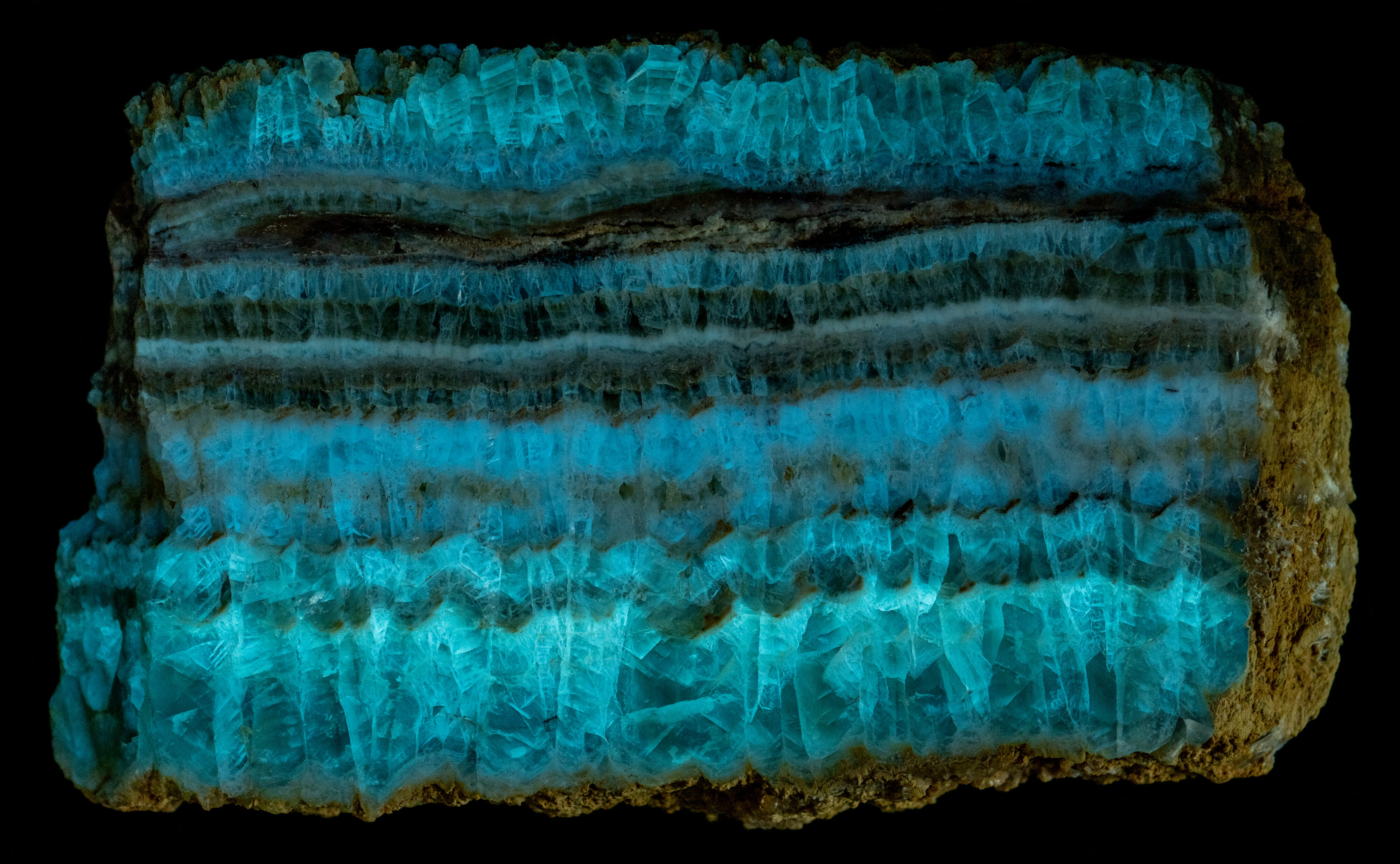
All of the layers in the specimen have fluorescence activated by organic compounds that are likely to include polycyclic aromatics, humic and fulvic acids. The organic activators create emission spectra with broad peaks with maxima around 450 nm. The organic compounds are also responsible for the phosphorescence. The phosphorescence is strongest in layers that glow red under longwave UV light.
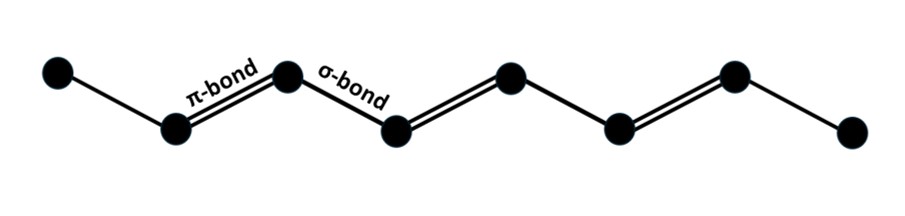
A carbon atom in organic compounds forms two types of bonds with other carbon atoms. A sigma bond (?-bond) is formed when the orbitals of two atoms overlap in line with the nuclei of the two carbon atoms. This bond is very strong, and UV photons cannot move electrons within ?-bonds to higher energy levels to create fluorescence. The second bond type between two carbon atoms is formed by p orbitals and is called a pi-bond (?-bond). The p orbitals in the two carbon atoms contact each other above and below the plane between the nuclei. The ?-bond is not as strong as a ?-bond and electrons in a ?-bond can be excited by UV light to a higher energy level.
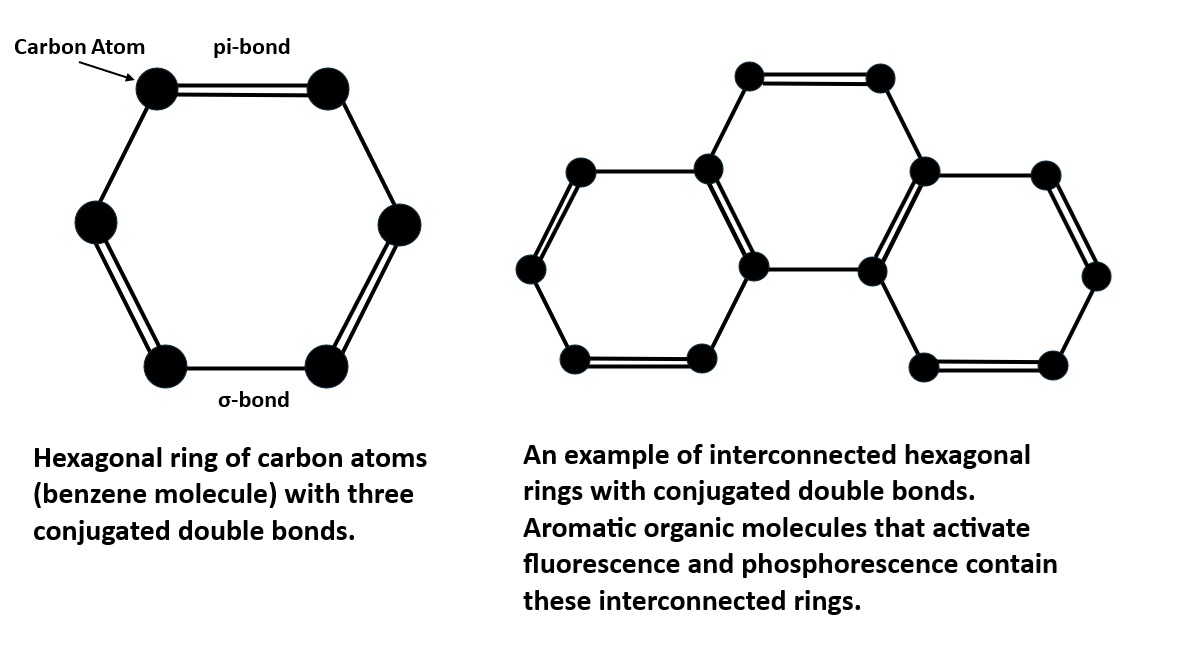
Many carbon atoms can be linked together with ?-bonds and ?-bonds. The geometry of the linkages is important factor in activating fluorescence. Linear molecules are less fluorescent because ?-bonds can rotate and the atoms can vibrate when excited by UV light. Energy input from UV light is lost to these motions in the linear molecule and in collisions with other molecules. The energy is lost to heat and very long wavelength radiation. A more rigid linkage formed from hexagonal benzene rings of carbon atoms with alternating single and double bonds found in aromatic compounds is more likely to activate fluorescence. This linkage of alternating single and double bonds is referred to conjugated bonds. The more benzene rings linked together increases the wavelength of the fluorescence.
A more detailed explanation of organic molecules activating fluorescence can be found in an article by Alex Emmermann in the FMS Journal V. 37, (2019).
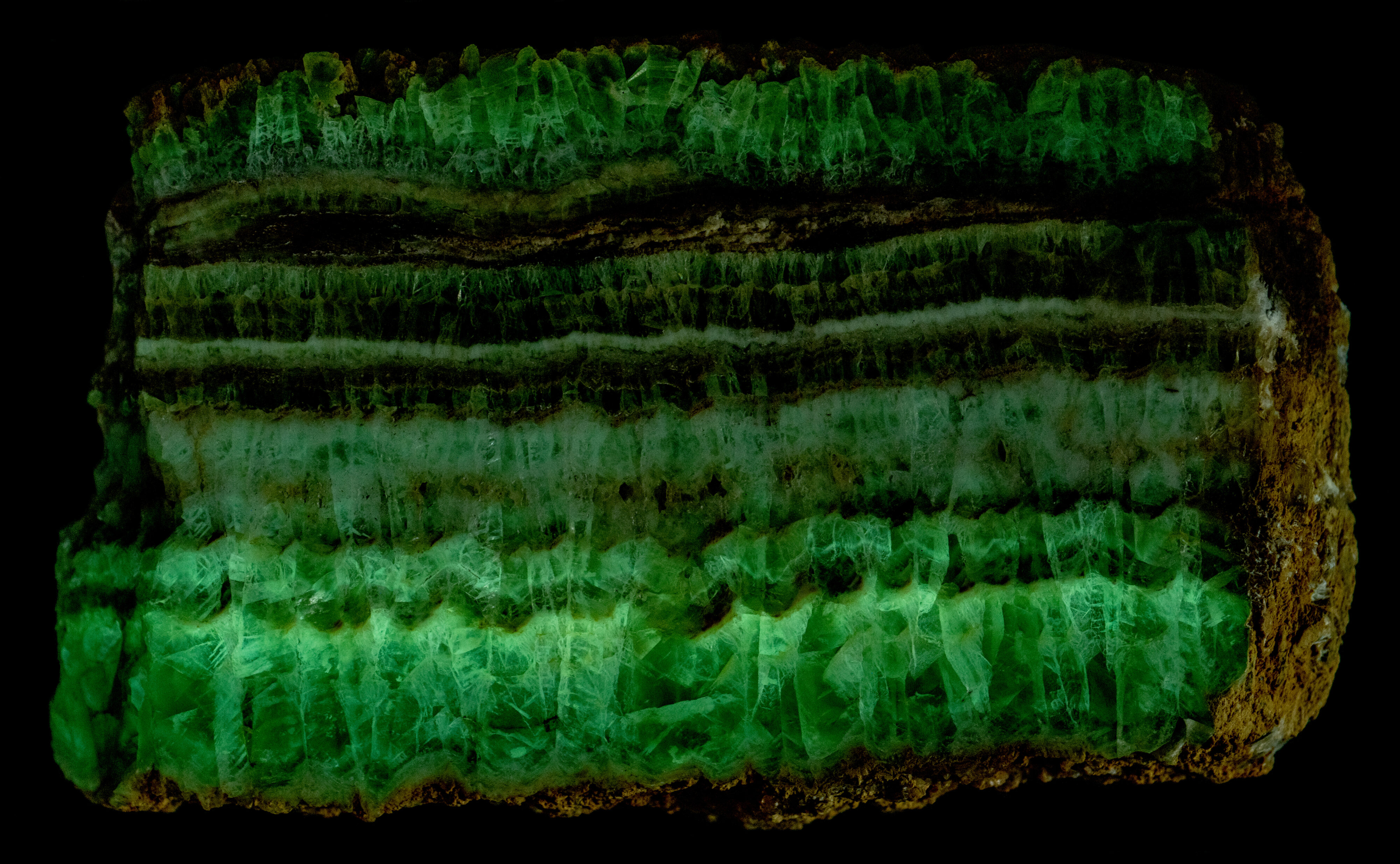
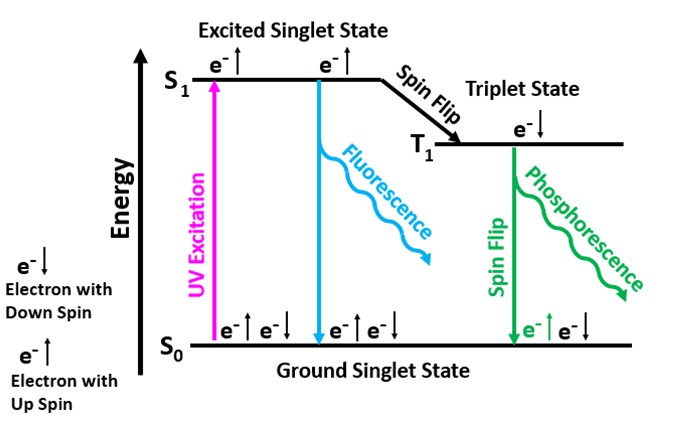
The aromatic compounds also activate long lasting green afterglow after exposure to LW light. This type of fluorescence and afterglow is referred to as a singlet-triplet process that involves electron excitation and flipping of electron spin. Conjugated double bonds allow electrons to easily move from the ground singlet state to an excited singlet state at a higher energy level by exposure to UV light. According to quantum mechanics, an electron orbital can contain either one or two electrons in the ground singlet state. If there are two electrons in the orbital, they must have opposite spins. In aromatic molecules, the singlet state contains two electrons with opposite spins and when excited by UV light one electron moves to a higher energy level of an excited singlet state. Excited singlet states are short-lived, so most electrons return to the original ground singlet state, and the excess energy is emitted as photons to produce blue-white fluorescence.
Some electrons move from the excited singlet state to a slightly lower energy level known as the triplet state. The electron spin is flipped in the triplet state, and it now has the same spin as the electron left in the ground singlet state. Quantum mechanics forbids electrons of the same spin in the ground singlet state, so the electron in the triplet state must flip its spin to return to the ground singlet state. Spin flipping has a very small probability, so the process takes seconds or minutes to occur. The electron must wait until the ambient thermal crystal lattice vibrations cause it to flip again before it can fall back down to its original state and emit a photon. The triplet state is at a lower energy level compared to the excited singlet state. Therefore, the energy of the photon emitted when the electron moves back to the ground singlet state from the triplet state is less. According to Planck's Law, lower photon energy corresponds to a longer wavelength (green) for the phosphorescence. Temperature affects the time for the spin to flip and for the electron to return from the triplet state to its original singlet state. Cooling the crystal extends the phosphorescent time.
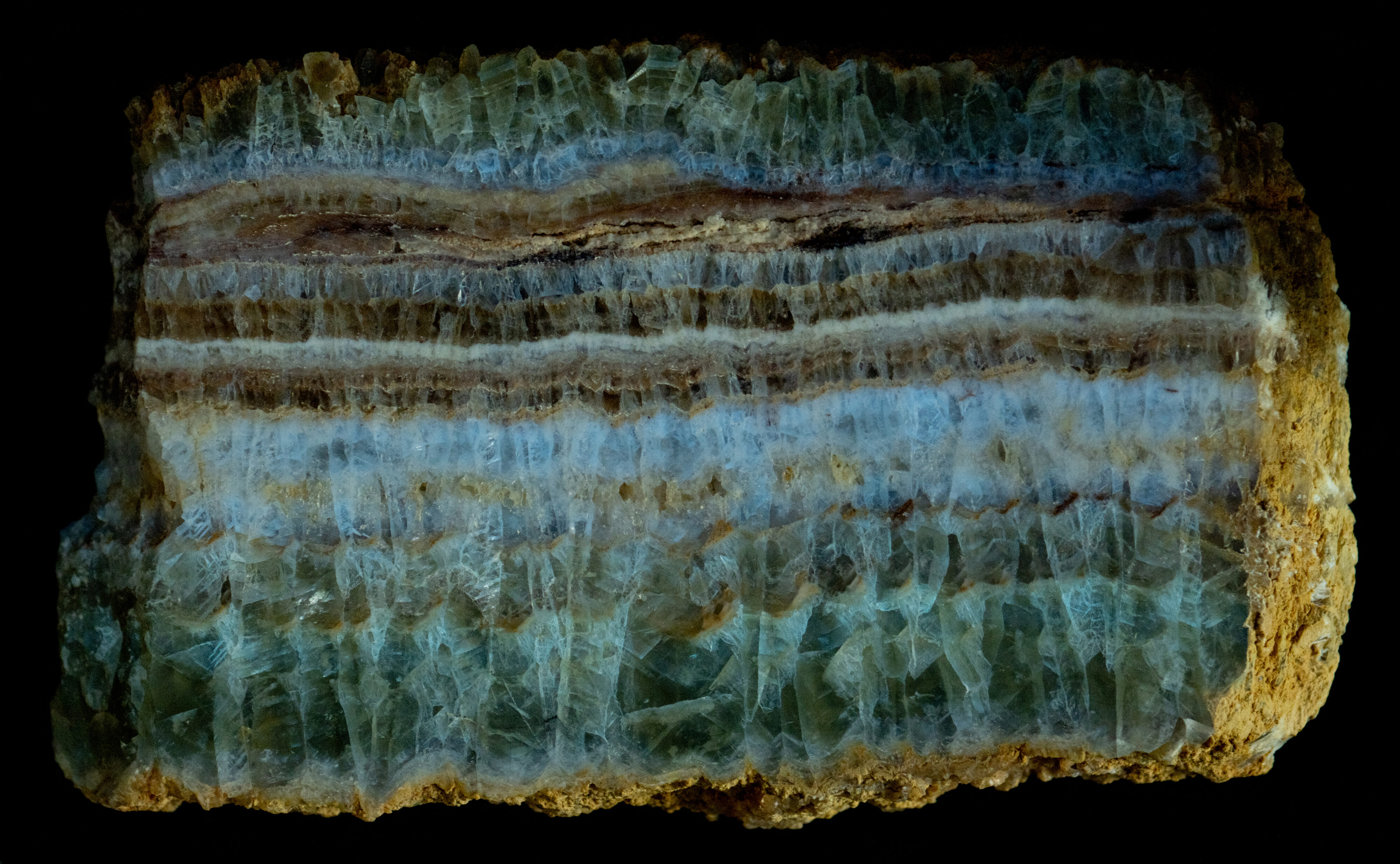
The phosphoresce from exposure to midwave and shortwave is not green like longwave phosphorescence. The color of the MW and SW phosphorescence is similar to the fluorescent color. This indicates that the singlet-triplet mechanism no longer occurs at these shorter excitation wavelengths. This change in the color of the phosphorescence may be caused by different organic molecules activating the afterglow.
Summary of luminescence responses:
Calcite (Mindat) (RRUFF)
- Fluorescence under Longwave (365nm LED) UV light: Red
- Fluorescence under Longwave (365nm LED) UV light: Blue
- Fluorescence under Longwave (365nm LED) UV light: Yellow
- Afterglow after exposure to Longwave (365nm LED) UV light: Green
- Fluorescence under Midwave (305nm LED) UV light: Blue
- Fluorescence under Midwave (305nm LED) UV light: White
- Afterglow after exposure to Midwave (305nm LED) UV light: White
- Fluorescence under Shortwave (255nm LED) UV light: Blue
- Fluorescence under Shortwave (255nm LED) UV light: White
- Afterglow after exposure to Shortwave (255nm LED) UV light: White