
Tourmaline var. Elbaite and Liddicoatite - Alaska
Contributed by: Michael Crawford
Date: Jun 7th, 2026
Locality: Black Rapids Glacier, Delta River Mining District, Southeast Fairbanks Census Area, Alaska, USA (See on Mindat)
Size: 11 x 11 x 11 cm
Description:
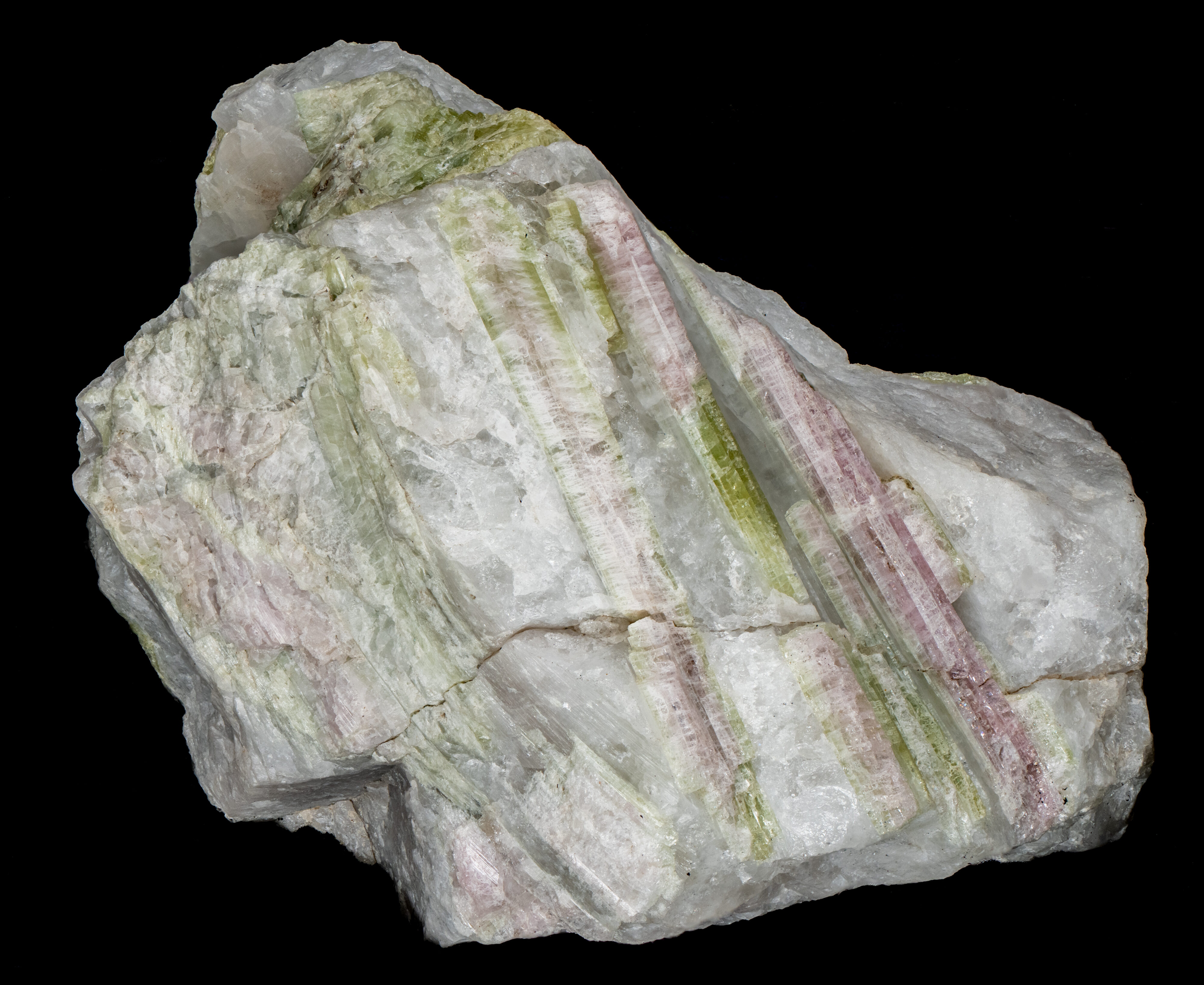
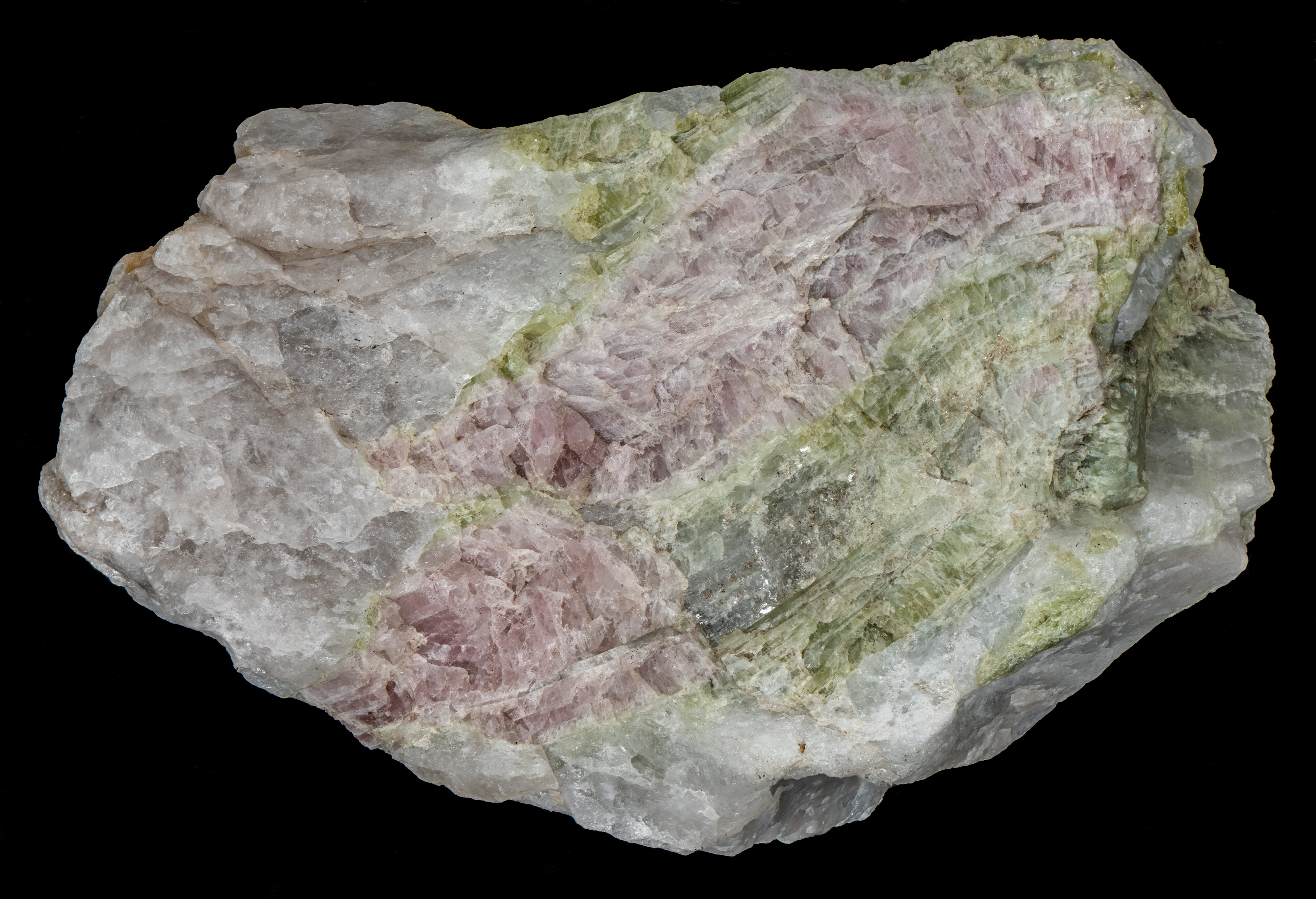
This specimen contains tourmaline in a quartz matrix from Black Rapids Glacier, Delta River Mining District, Alaska. The tourmaline is a light pink variety elbaite and a rare light green variety liddicoatite (Lussier and others, 2011). Elbaite and liddicoatite form a solid solution series within the tourmaline supergroup, spanning between sodium-rich elbaite and calcium-rich liddicoatite. The elbaite end member formula is Na(Li1.5Al1.5)Al6(Si6O18)(BO3) 3(OH)3(OH) and the liddicoatite end member formula is Ca(Li2Al)Al6(Si6O18)(BO3) 3(OH) 3(OH). The pink elbaite usually occurs in the core of the crystal and the liddicoatite forms a thin pale green rim around the crystal.
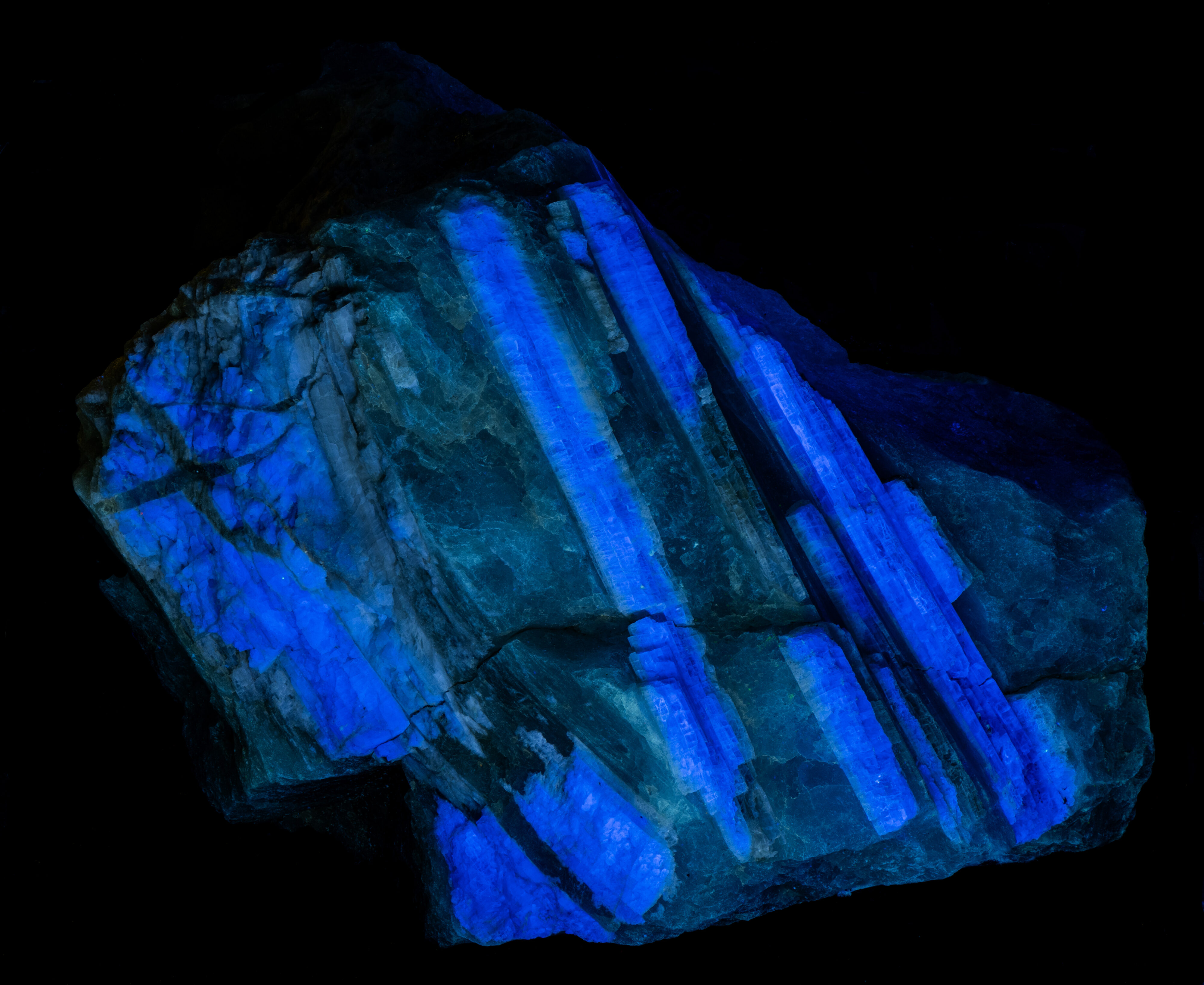
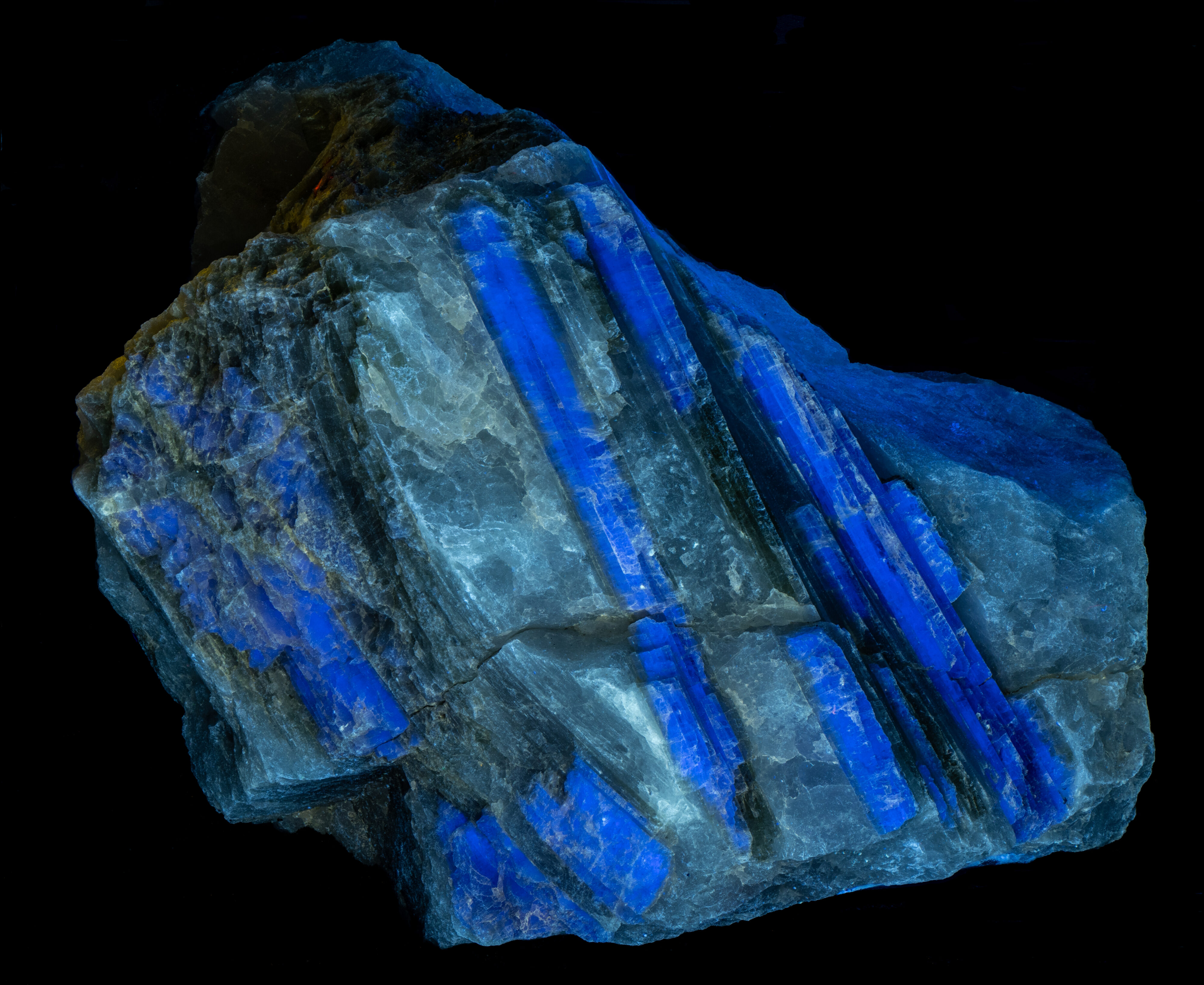
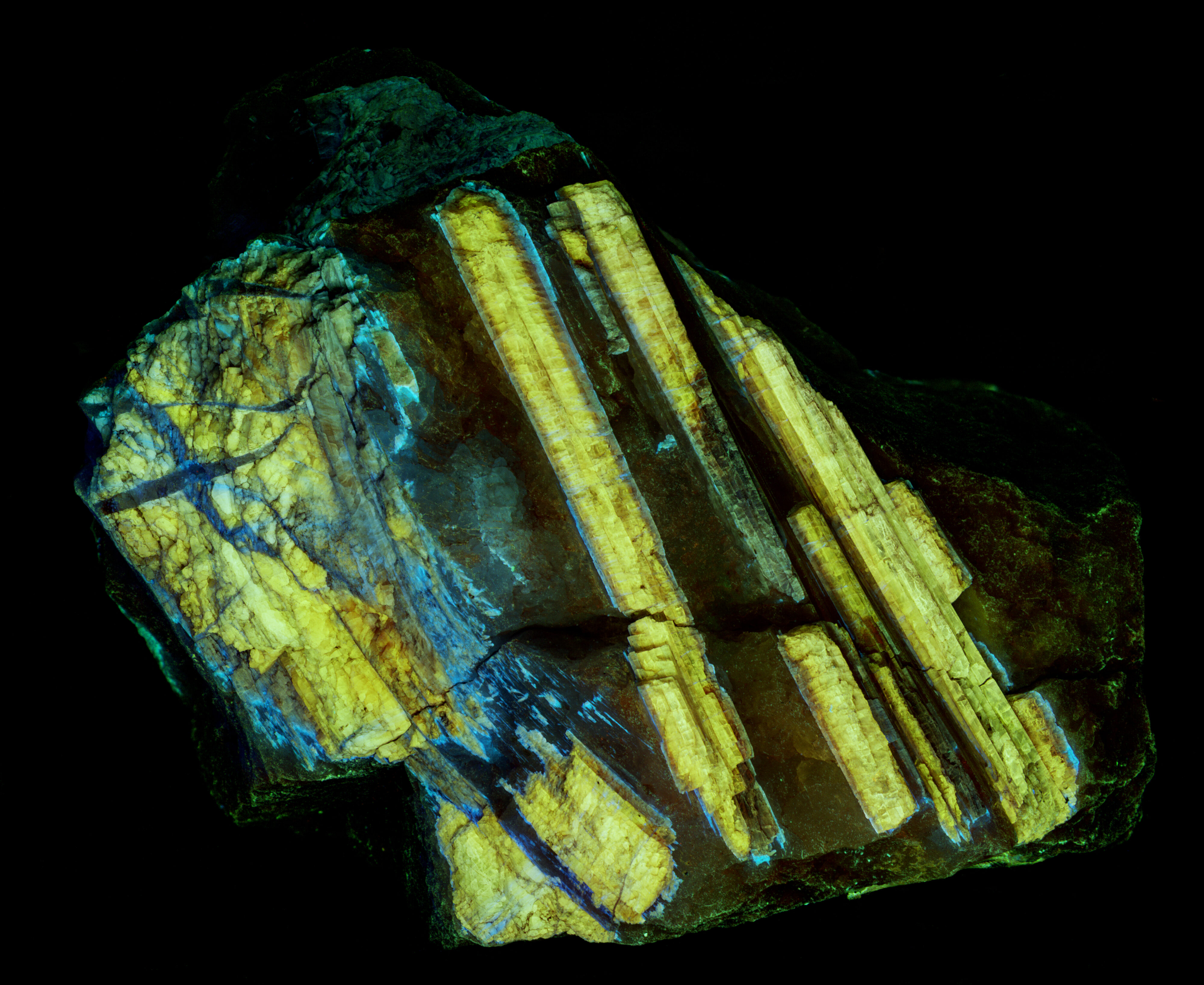
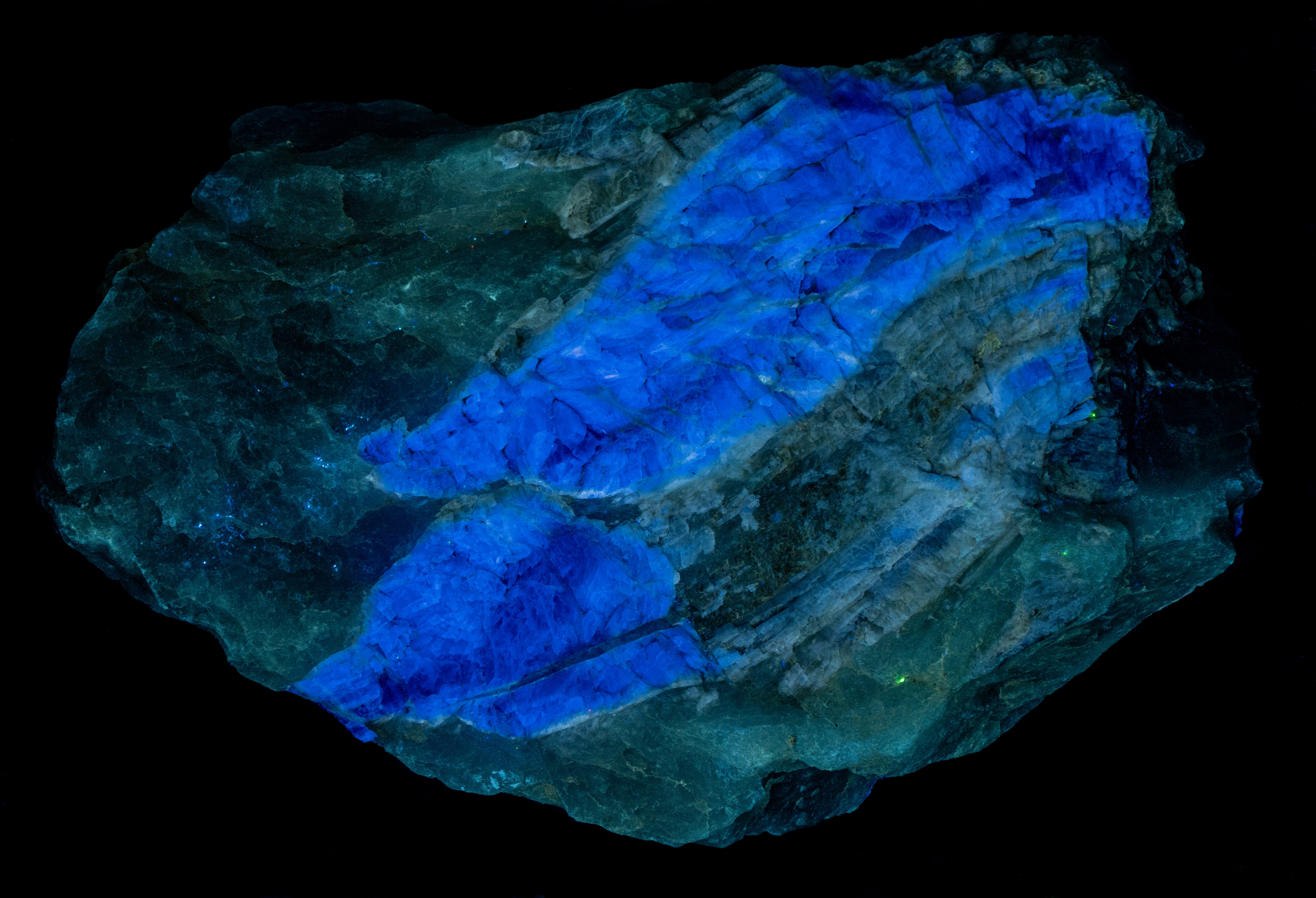
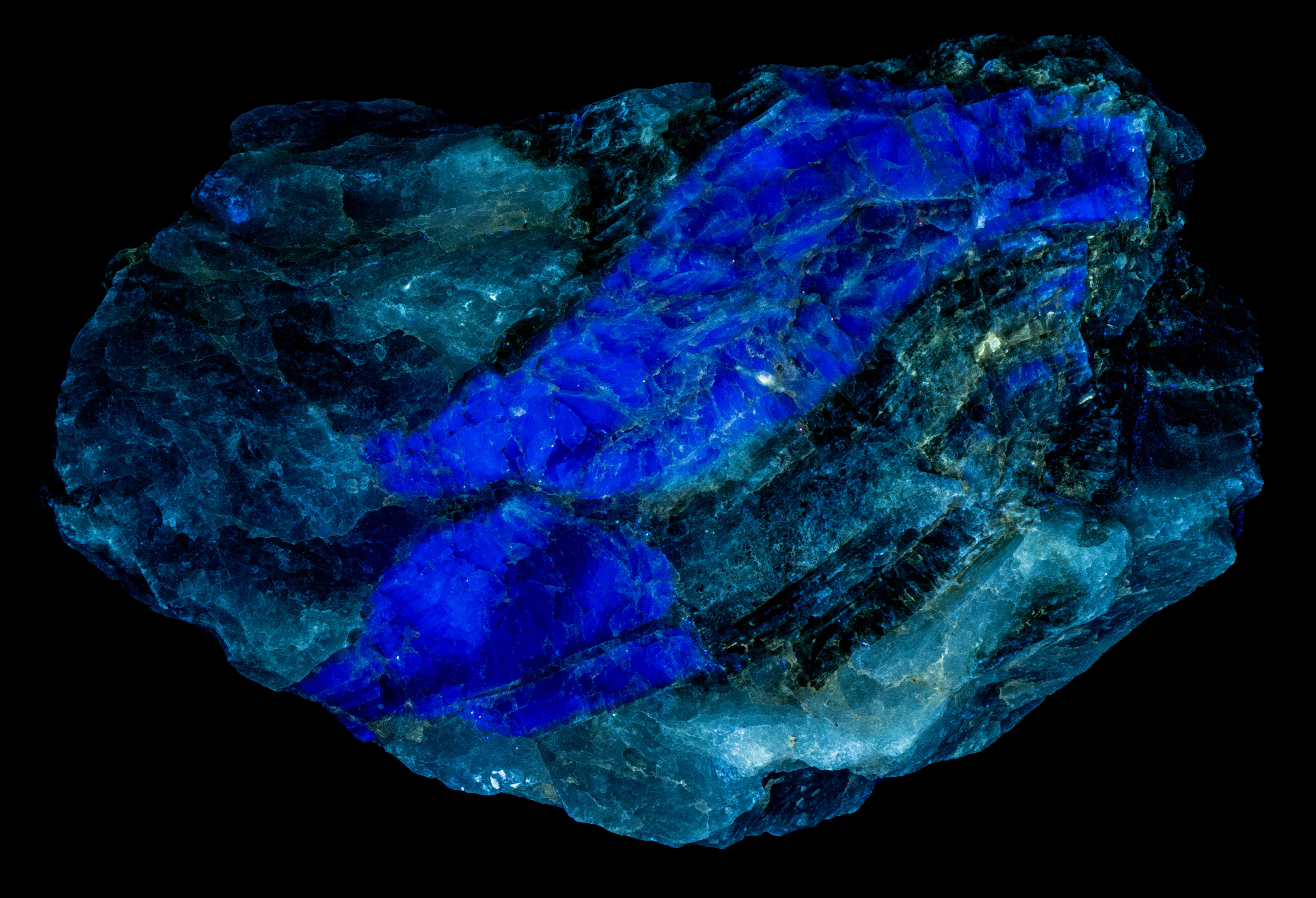
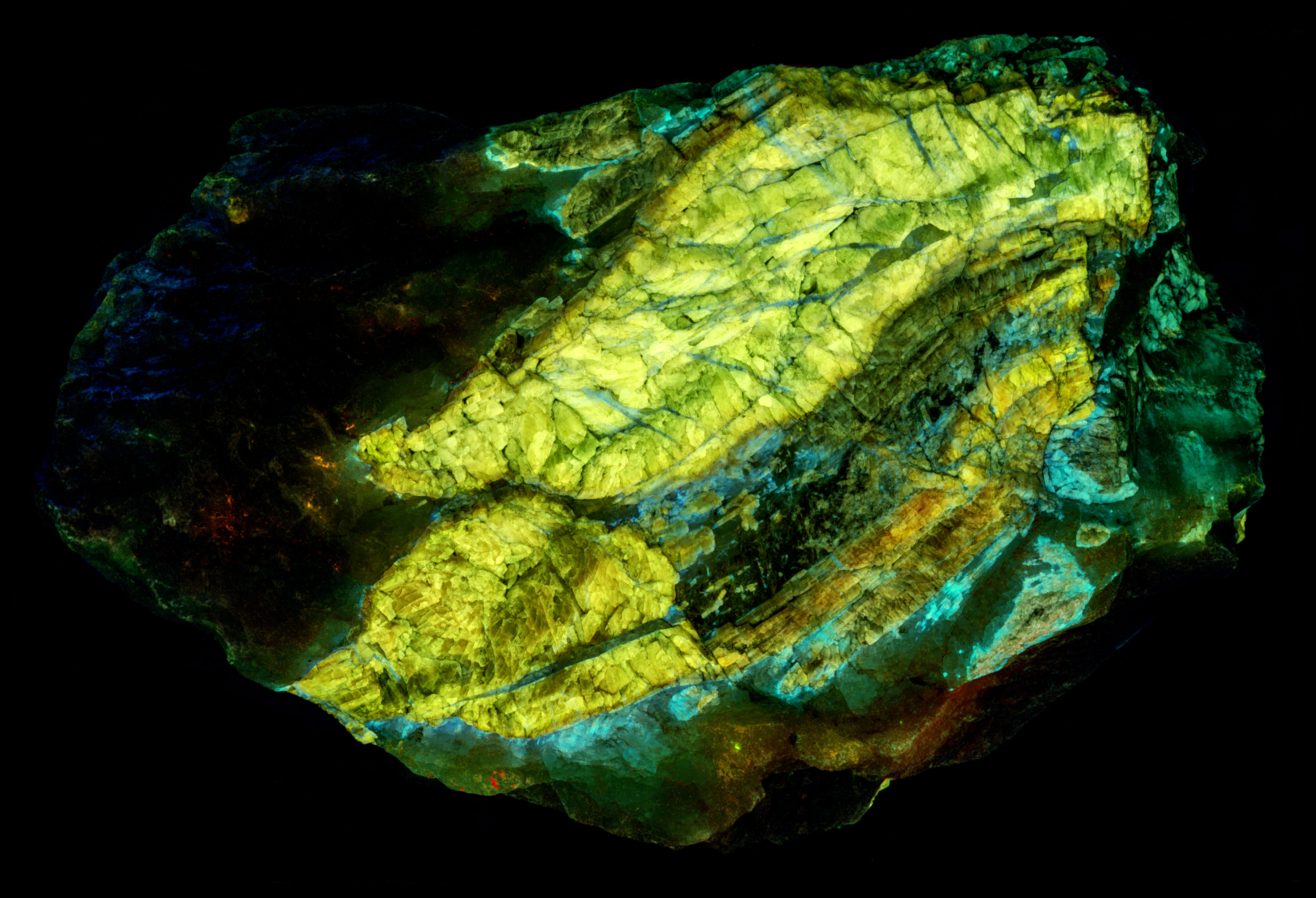
The pink elbaite fluoresces violet blue under shortwave and midwave UV light. There is no longwave fluorescence. There is no obvious visible fluorescence from the pale green liddicoatite. However, false color images of ultraviolet fluorescence show that some of the liddicoatite has ultraviolet fluorescence. Elbaite is brightly fluorescent in the ultraviolet region. Elbaite is yellow and liddicoatite is light blue gray in the false color image. The 7 cm prismatic crystal in the center of the false color image has a core of fluorescent elbaite (yellow) and a thin rim of fluorescent liddicoatite (blue gray).
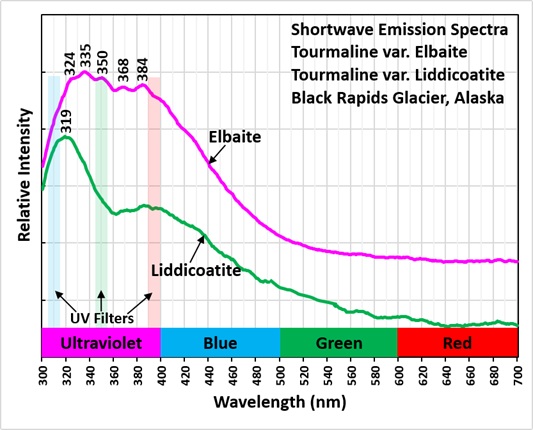
The shortwave emission spectrum of elbaite contains five small peaks in the ultraviolet region at 324 nm, 335 nm, 350 nm, 368 nm, and 384 nm that merge to create a broad overall peak in the ultraviolet that extends into the visible region. The shoulder of this broad peak in the visible region is the violet-blue fluorescence we see. It is not known what activates this fluorescence. It may be rare earths such cerium, europium, etc.
The shortwave emission spectrum of the liddicoatite has a peak in the ultraviolet with a maximum at 319 nm and dimmer emission in the 350 nm to 410 nm region. There is a small peak at 384 nm like the elbaite spectrum. Possible activators are rare earths or lead.
Reference:
Lussier, A.J., Hawthorne, F.C., Michaelis, V.K., Aguiar, P.M., Kroeker, S., 2011, Elbaite-liddicoatite from Black Rapids glacier, Alaska: Periodico di Mineralogia, V. 80, No. 1(Special Issue), pp. 57-73
Summary of luminescence responses:
Elbaite (Mindat) (RRUFF)
- Fluorescence under Shortwave (255nm LED) UV light: Blue
- Fluorescence under Midwave (305nm LED) UV light: Blue
- Fluorescence under Shortwave (255nm LED) UV light: Blue
- Fluorescence under Midwave (305nm LED) UV light: Blue