
Opal and Sepiolite - Cerro de los Batallones, Torrejón de Velasco, Madrid, Spain
Contributed by: Daniel C. Montero
Date: May 6th, 2026
Locality: Batallones Hill, Torrejón de Velasco, Community of Madrid, Spain (See on Mindat)
Description:
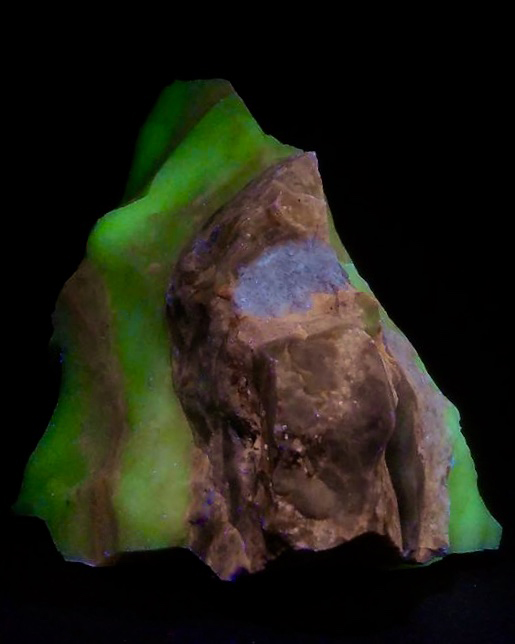
Opal and sepiolite from Cerro de los Batallones, Torrejón de Velasco, Madrid, Spain.
The green fluorescence with an orange contrast due to clay deposits and shows a central nucleus with sepiolite blue fluorescence that is very phosphorescent in longwave UV.
In this area ten fossiliferous deposits have been discovered in which the remains of vertebrates predominate, with invertebrates and plants being less represented. With about nine million years old, they are geologically located in the Upper Vallesian (Upper Miocene).
The first discovered deposit occurred by chance in July 1991 when the TOLSA company carried out sepiolite surveys in the Cerro de los Batallones. These prospects exposed a large concentration of fossils associated with clay sediments.
The set of sites is declared a Site of Cultural Interest in the category "Paleontological area".
Originally posted by Daniel C Montero on Nature's Rainbows in 2018.
Summary of luminescence responses:
Opal (Mindat) (RRUFF)
- Fluorescence under Longwave (365nm LED) UV light: Green
- Fluorescence under Longwave (365nm LED) UV light: Orange
- Fluorescence under Longwave (365nm LED) UV light: Blue