
Unusual Hauyne Crystals from Afghanistan
Contributed by: Michael Crawford
Date: Feb 25th, 2026
Locality: Sar-e-Sang, Kuran wa Munjan District, Badakhshan, Afghanistan (See on Mindat)
Size: 7.5 x 12 cm
Description:
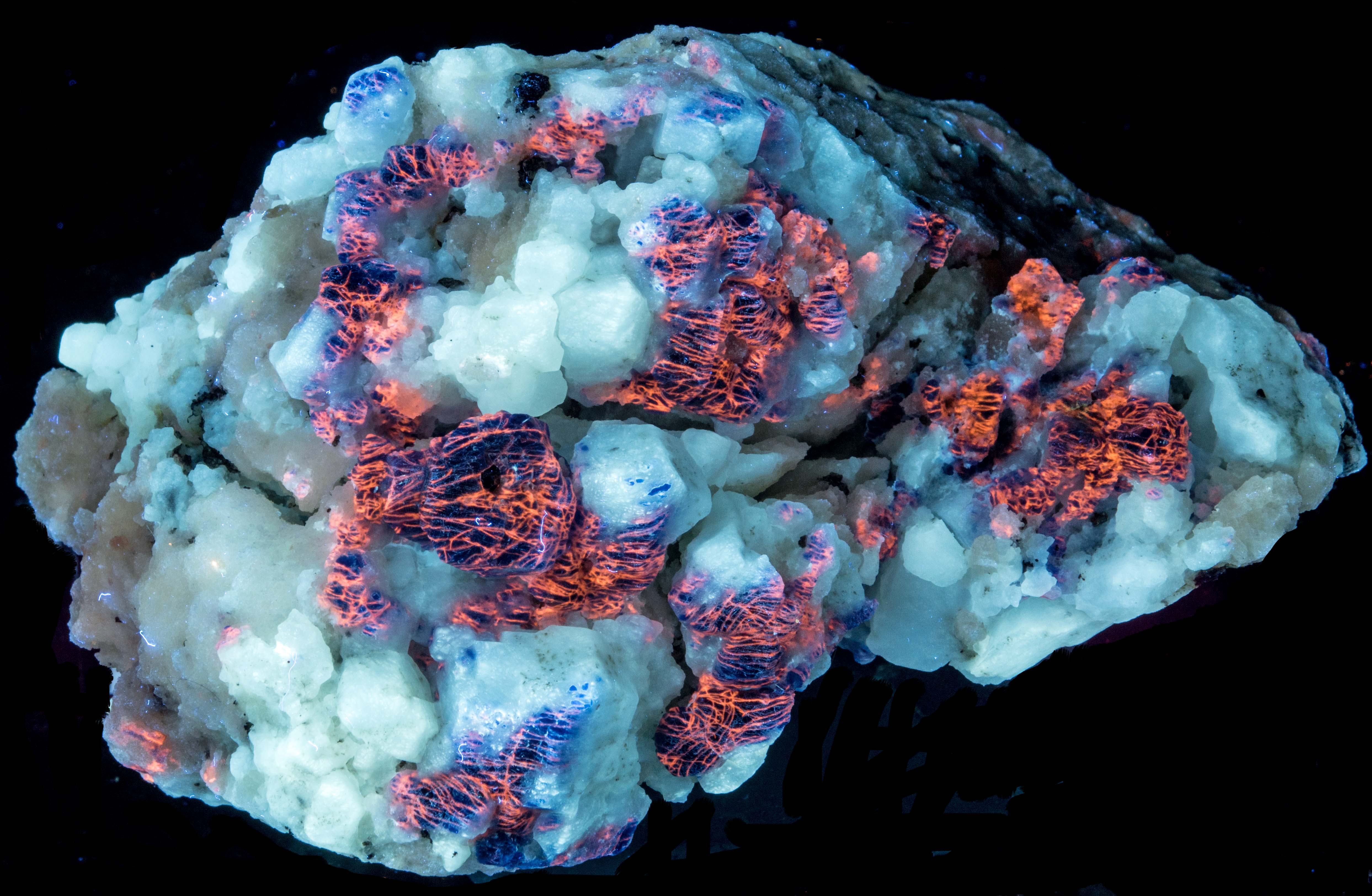
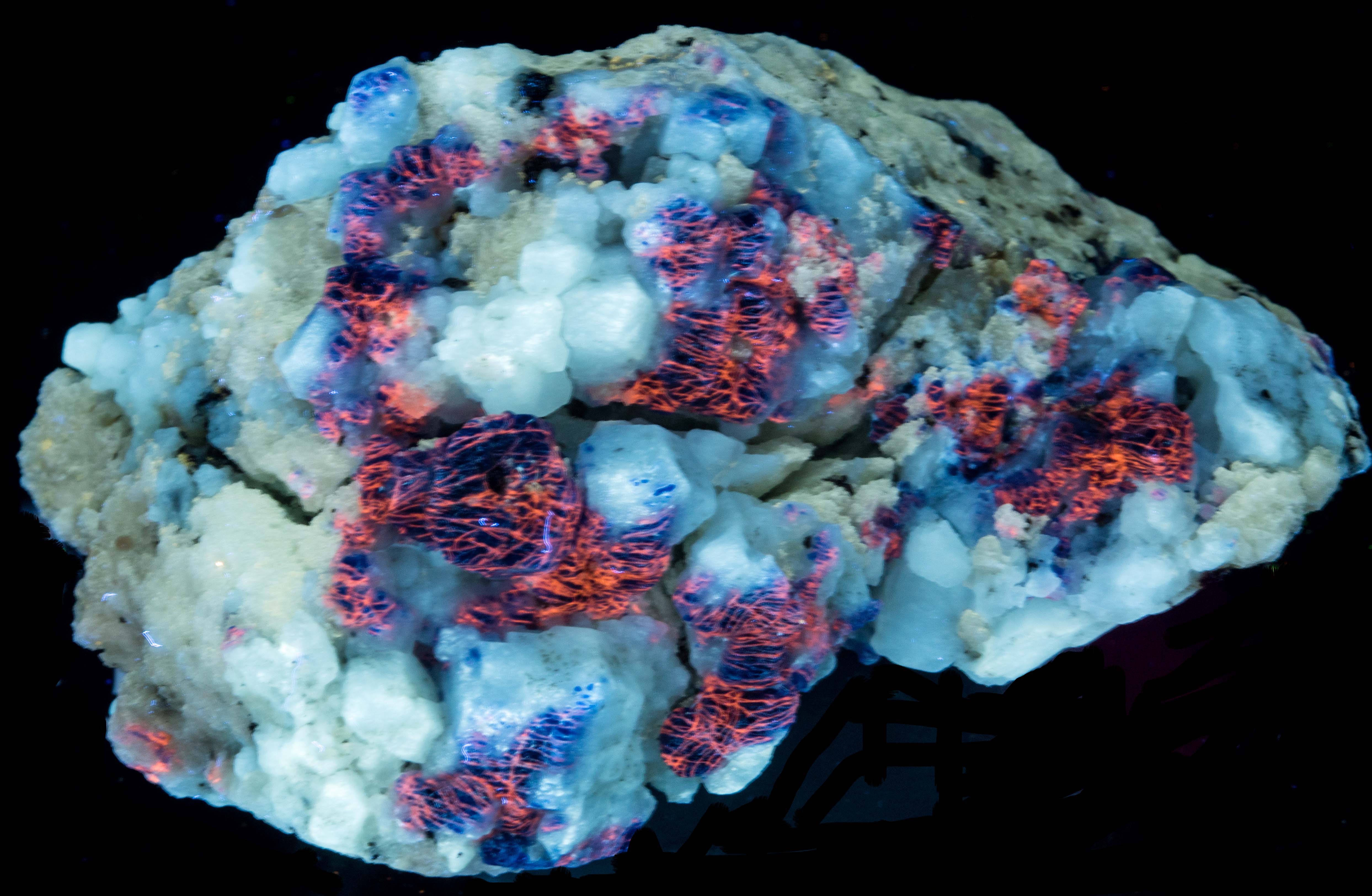
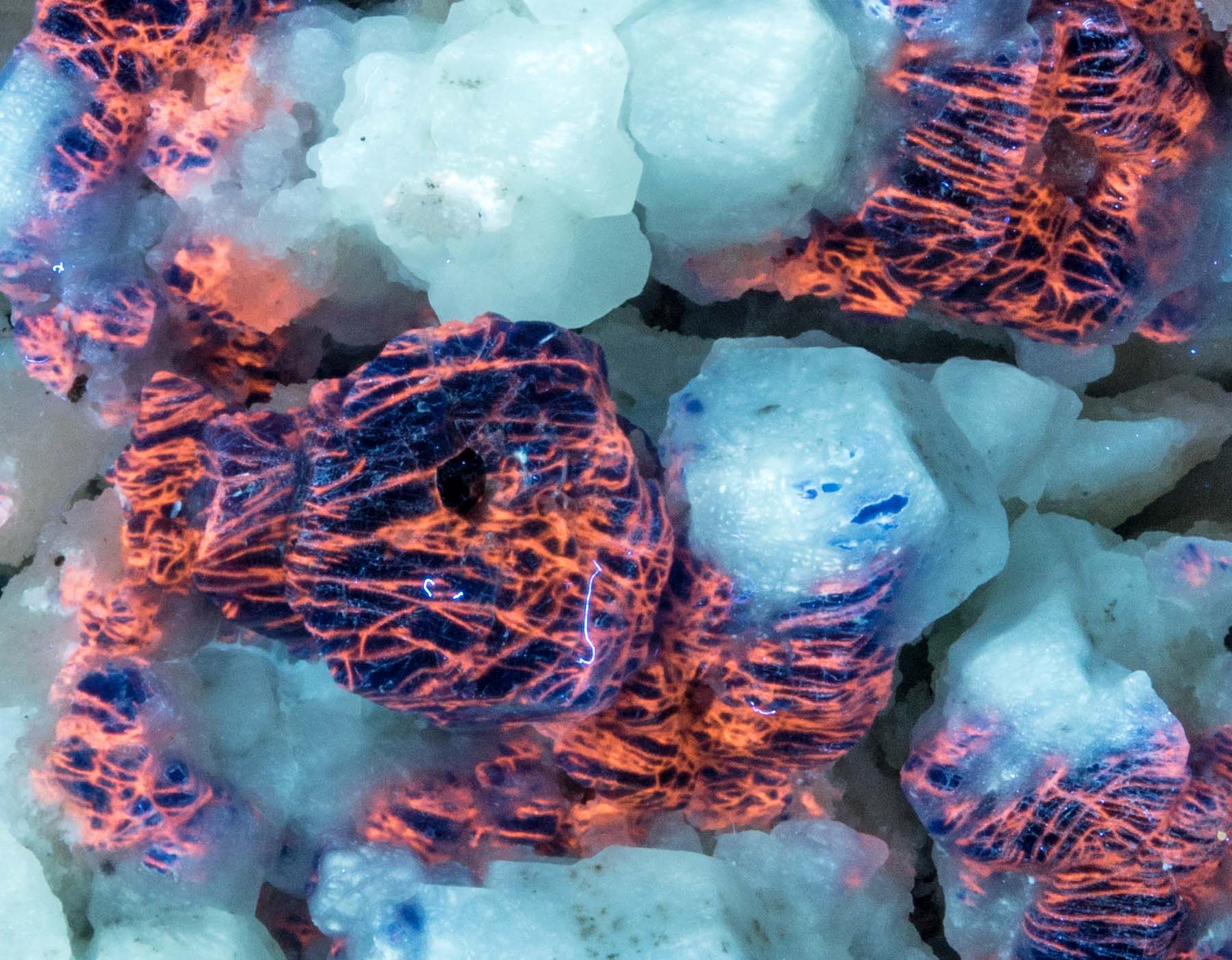
This specimen originates from Sar-e-Sang in Badakhshan Province, Afghanistan, and features three fluorescent minerals: gonnardite ((Na,Ca)2(Si,Al)5O10·3H2O), diopside (CaMgSi2O6), and hauyne ((Na,K)3(Ca,Na)(Al3Si3O12)(SO4,S,Cl)). Identification of gonnardite and diopside was confirmed through XRD analysis. While most blue hauyne crystals lack fluorescence, they contain veinlets that glow orange under UV light. The mechanism behind these veinlets is uncertain; it could be related to crystal formation processes, where fracturing and rapid shifts in pressure and temperature altered the chemistry or lattice structure of hauyne as it precipitated.
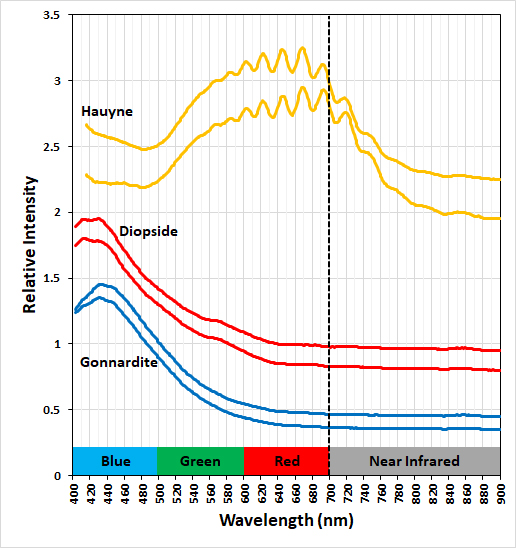
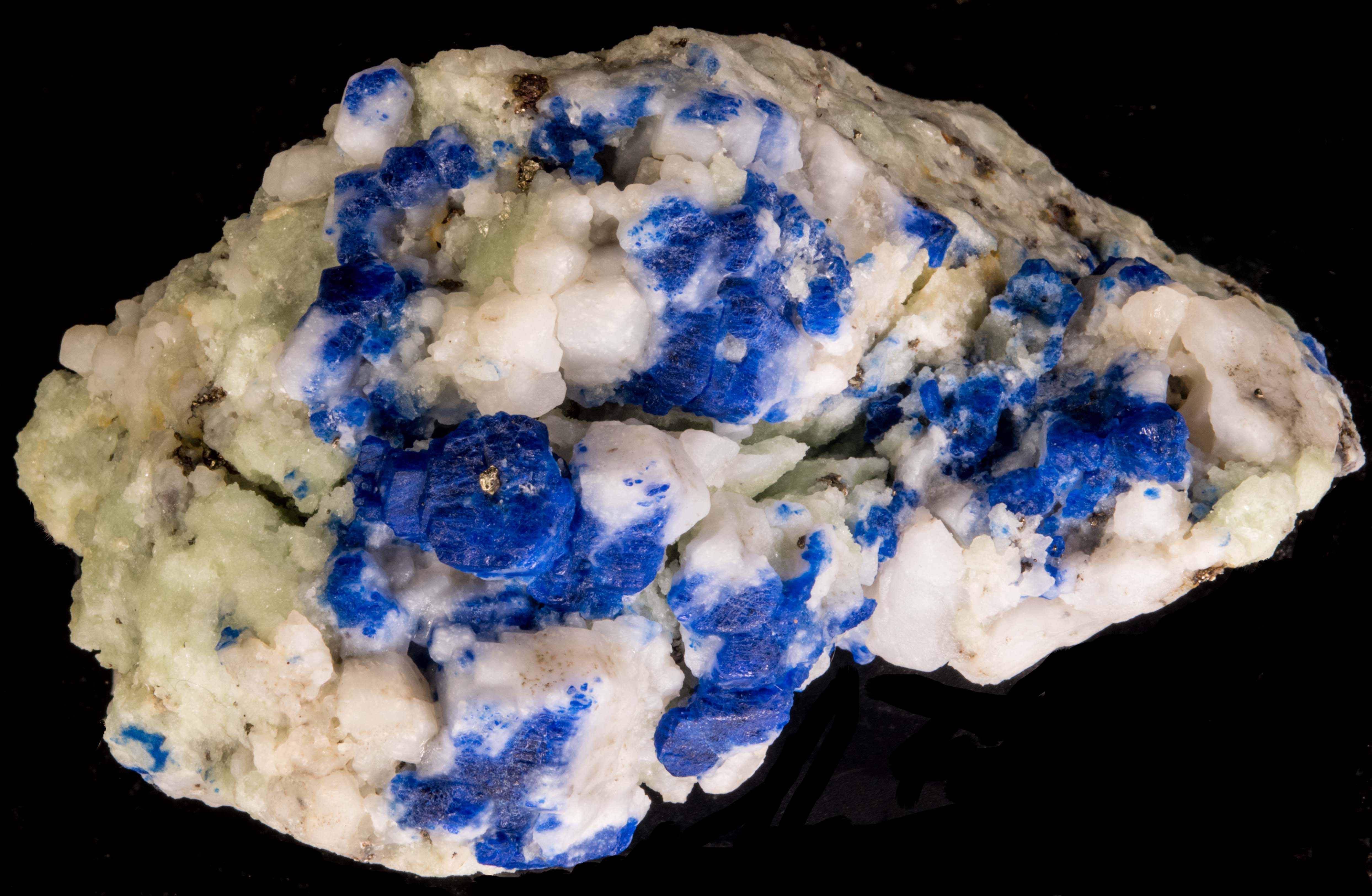
The ideal chemical formula for hauyne is (Na3Ca(Si3Al3)O12(SO4)), but substitutions involving potassium, sulfide, chloride, and changes in sodium and calcium proportions can influence its properties. Hauyne’s longwave UV emission spectrum exhibits several peaks resulting from di-sulfide ions replacing sulfate within its structure. Notably, lazurite—the blue mineral found in lapis lazuli—is a sulfide-rich and non-fluorescent form of hauyne. The blue mineral in this specimen is not lazurite: it is not opaque, its hue is paler than lazurite, and it does not produce a blue streak on a streak plate.
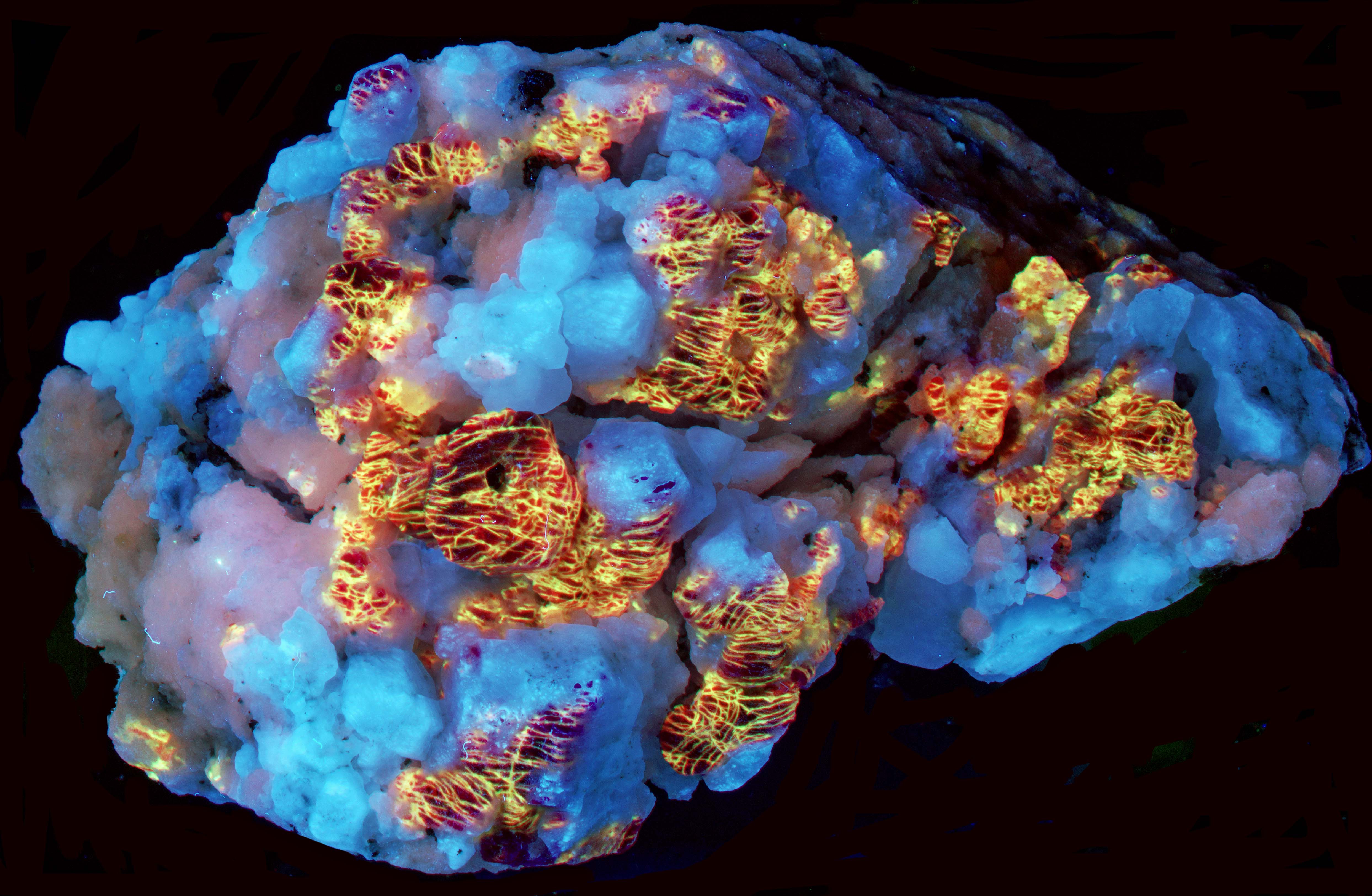
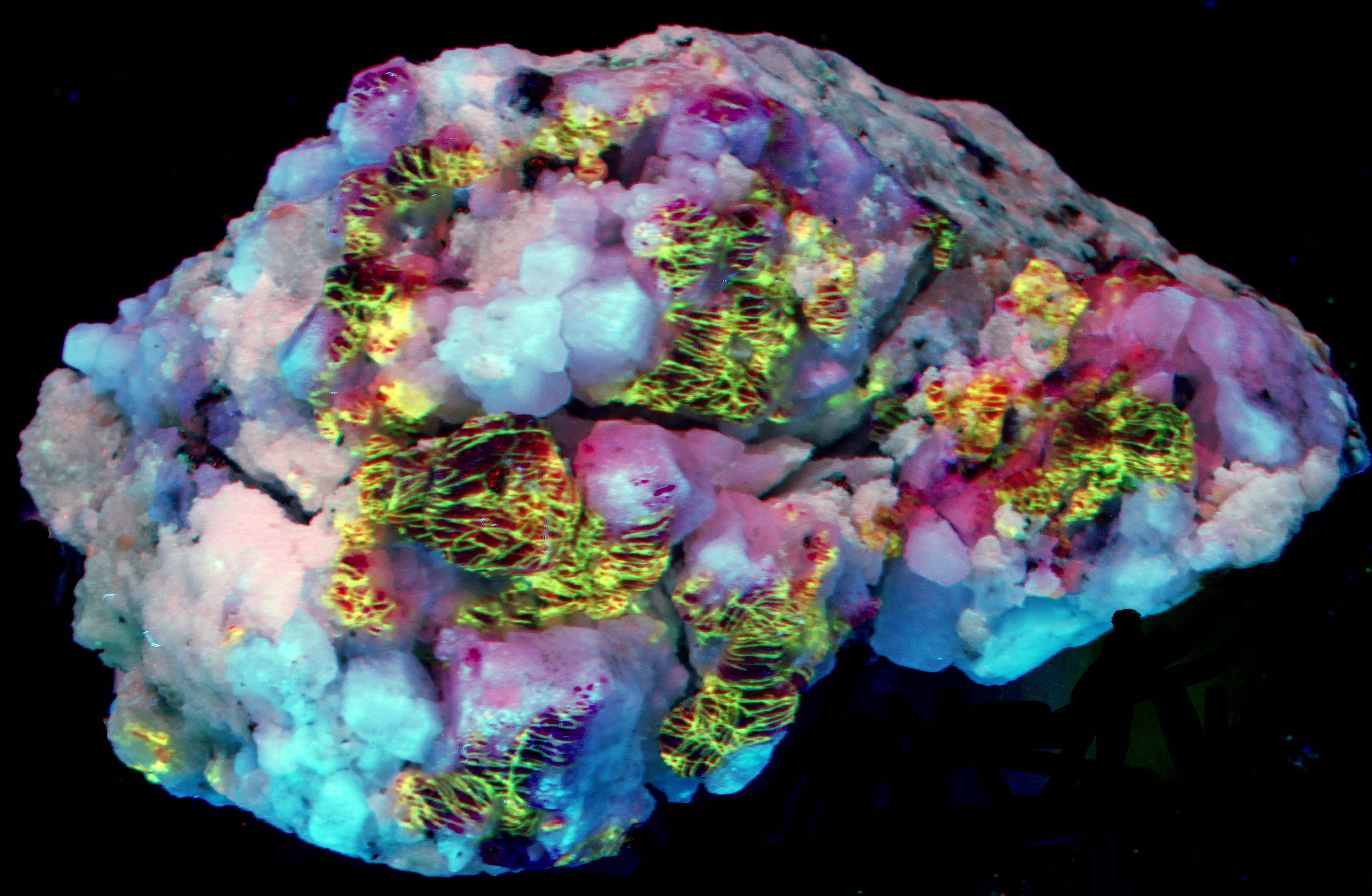
The first image displays the specimen under longwave UV illumination, revealing orange fluorescence from hauyne, white fluorescence from gonnardite, and gray from diopside. The second image presents a false-color infrared rendering of the longwave fluorescence: green fluorescent light is shown as blue, red as green, and infrared as red. Here, hauyne appears yellow (due to its red and near-infrared fluorescence), gonnardite is pale blue, and diopside manifests as pink.
The third image depicts the emission spectra of all three minerals. Hauyne’s spectrum shows multiple peaks attributed to the di-sulfide activator, while titanium likely triggers diopside’s fluorescence. The activator responsible for gonnardite’s fluorescence remains unidentified.
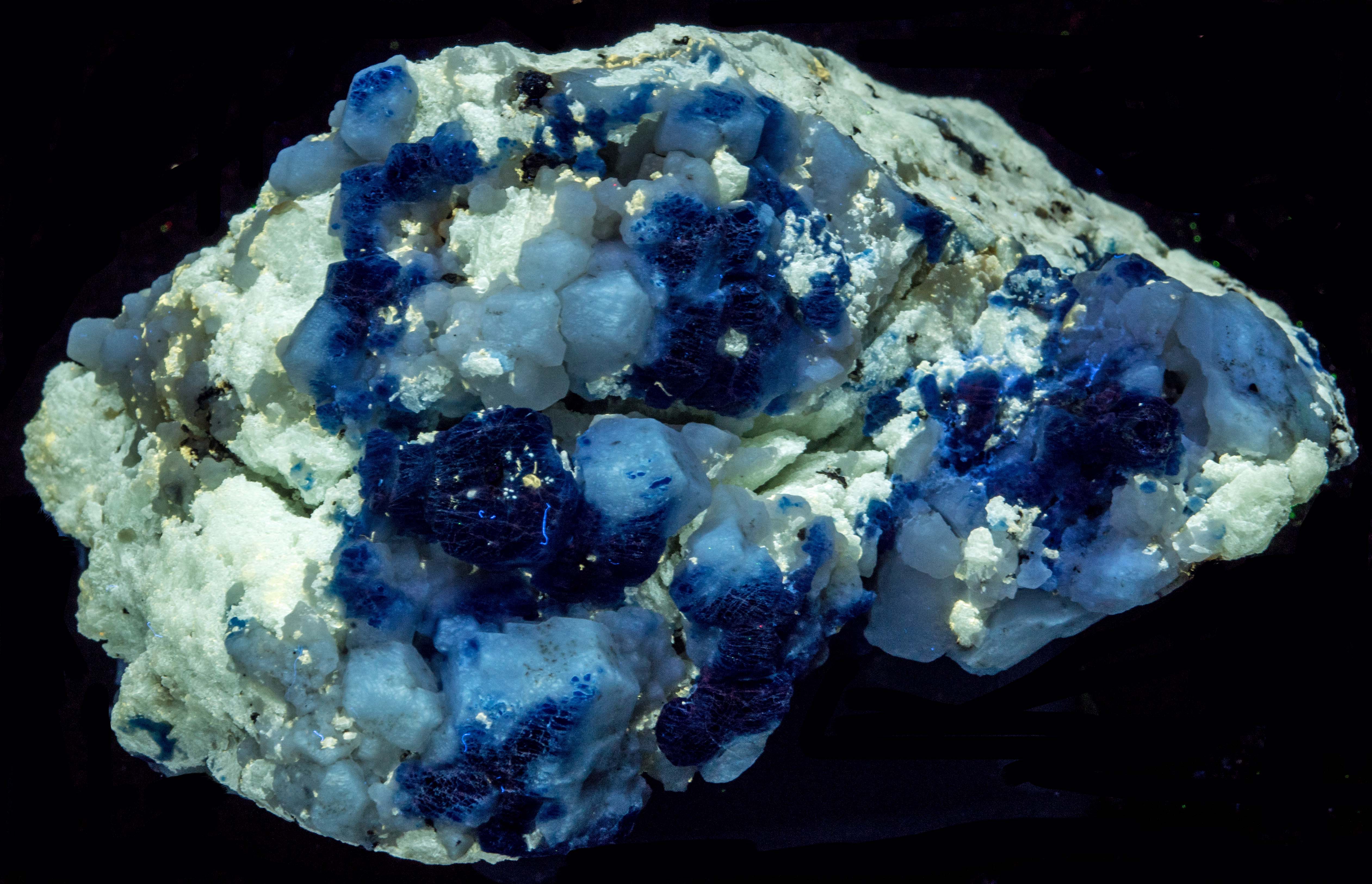
In the fourth picture, the specimen is exposed to shortwave UV light. Hauyne does not fluoresce under these conditions; gonnardite emits a blue-gray glow, whereas diopside shines bright white.
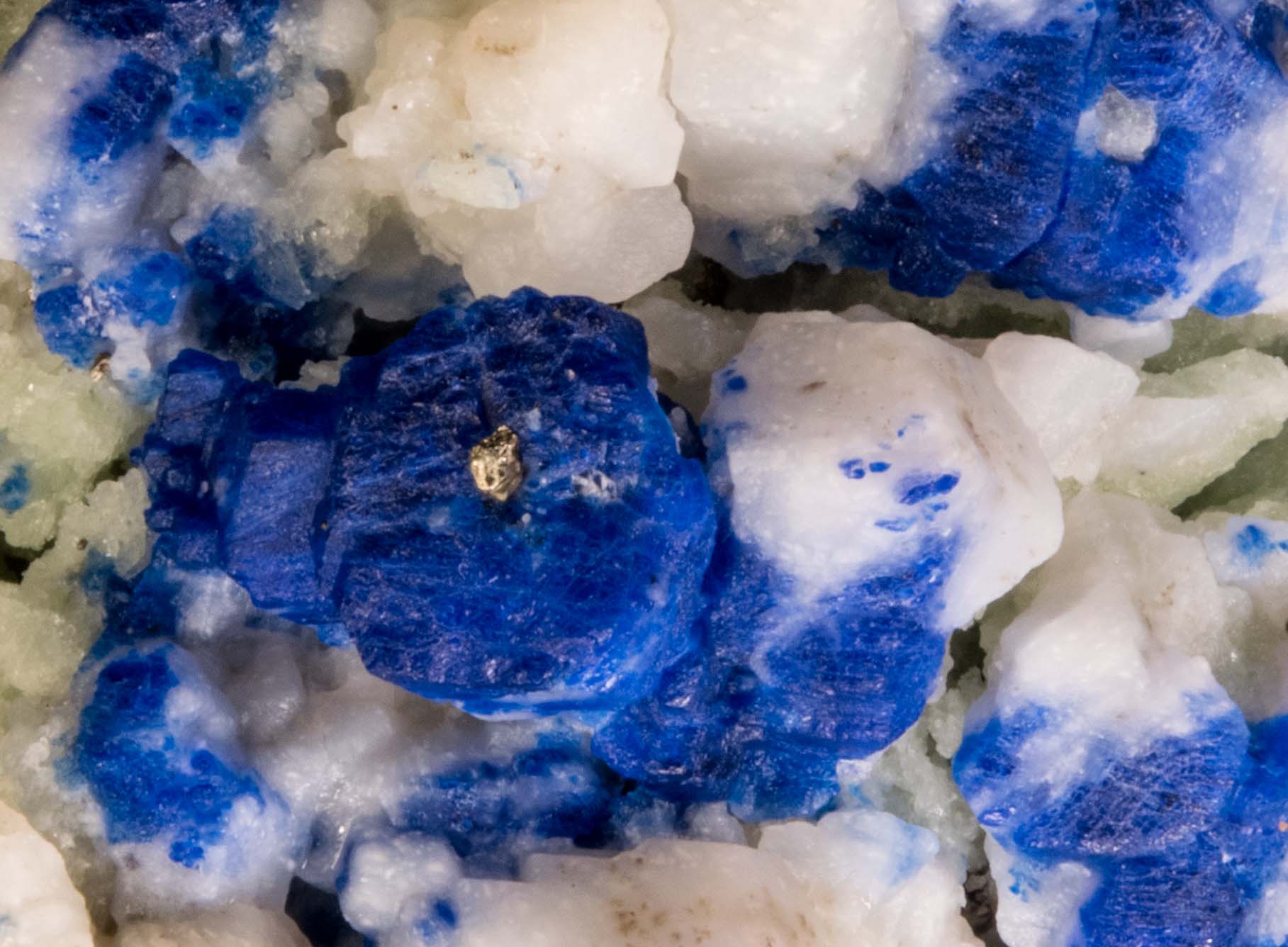
The fifth image is a composite showing the specimen under combined UV wavelengths (longwave, midwave, and shortwave). The sixth image utilizes false-color infrared to illustrate the full-wave fluorescence. The seventh picture shows the specimen under normal white light. The final two images are close-ups of the fluorescent orange veinlets in the blue hauyne crystals captured under longwave and white light.
Summary of luminescence responses:
Hauyne (Mindat) (RRUFF)
- Fluorescence under Longwave (365nm LED) UV light: Orange
- Fluorescence under Longwave (365nm LED) UV light: White
- Fluorescence under Shortwave (255nm LED) UV light: White
- Fluorescence under Longwave (365nm LED) UV light: White
- Fluorescence under Shortwave (255nm LED) UV light: Blue