
Willemite from Portugal
Contributed by: Michael Crawford
Date: Nov 13th, 2025
Locality: Preguiça Mine, Sobral da Adiça, Moura, Beja, Portugal (See on Mindat)
Size: 7 x 10 cm
Description:
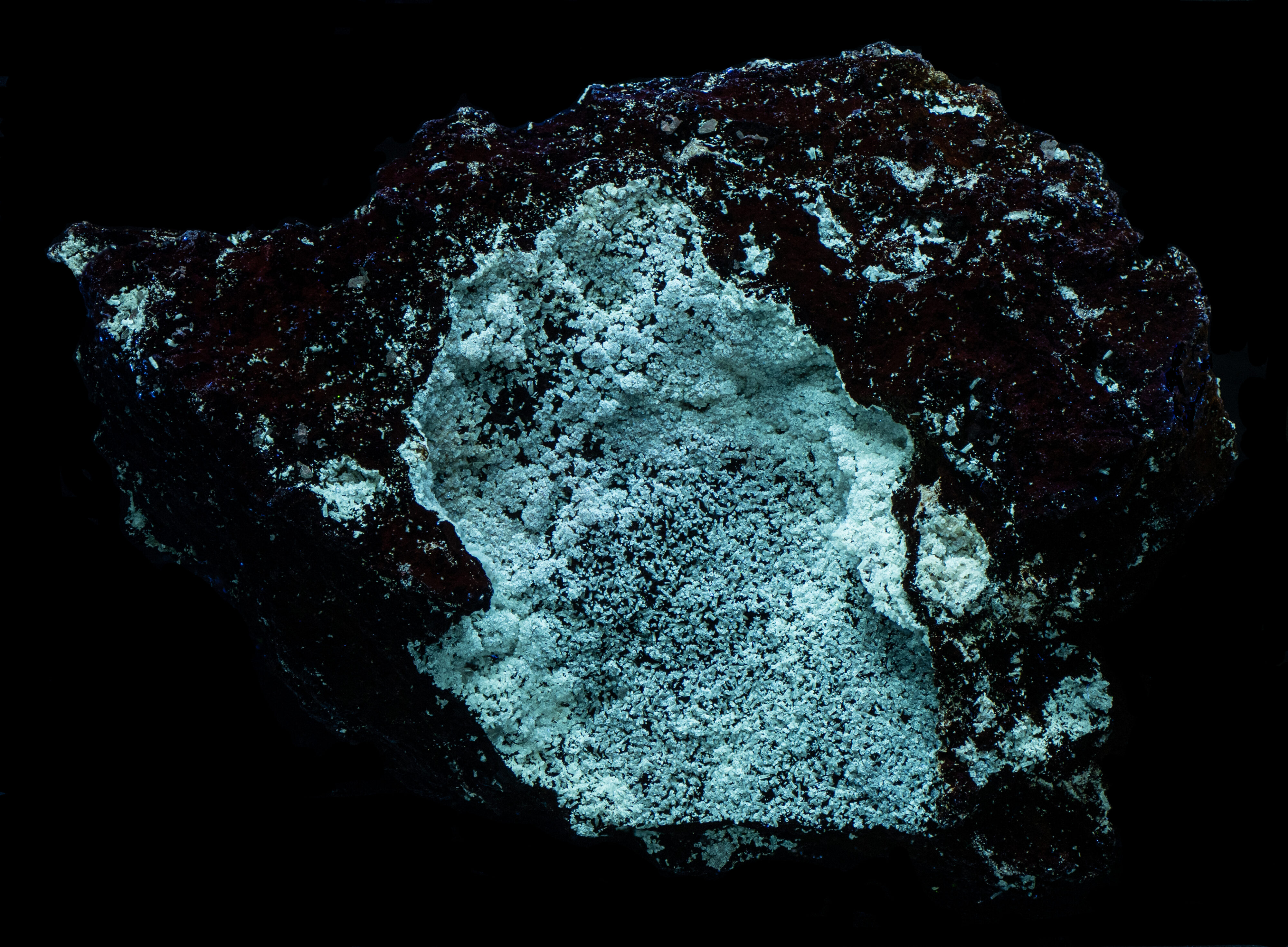
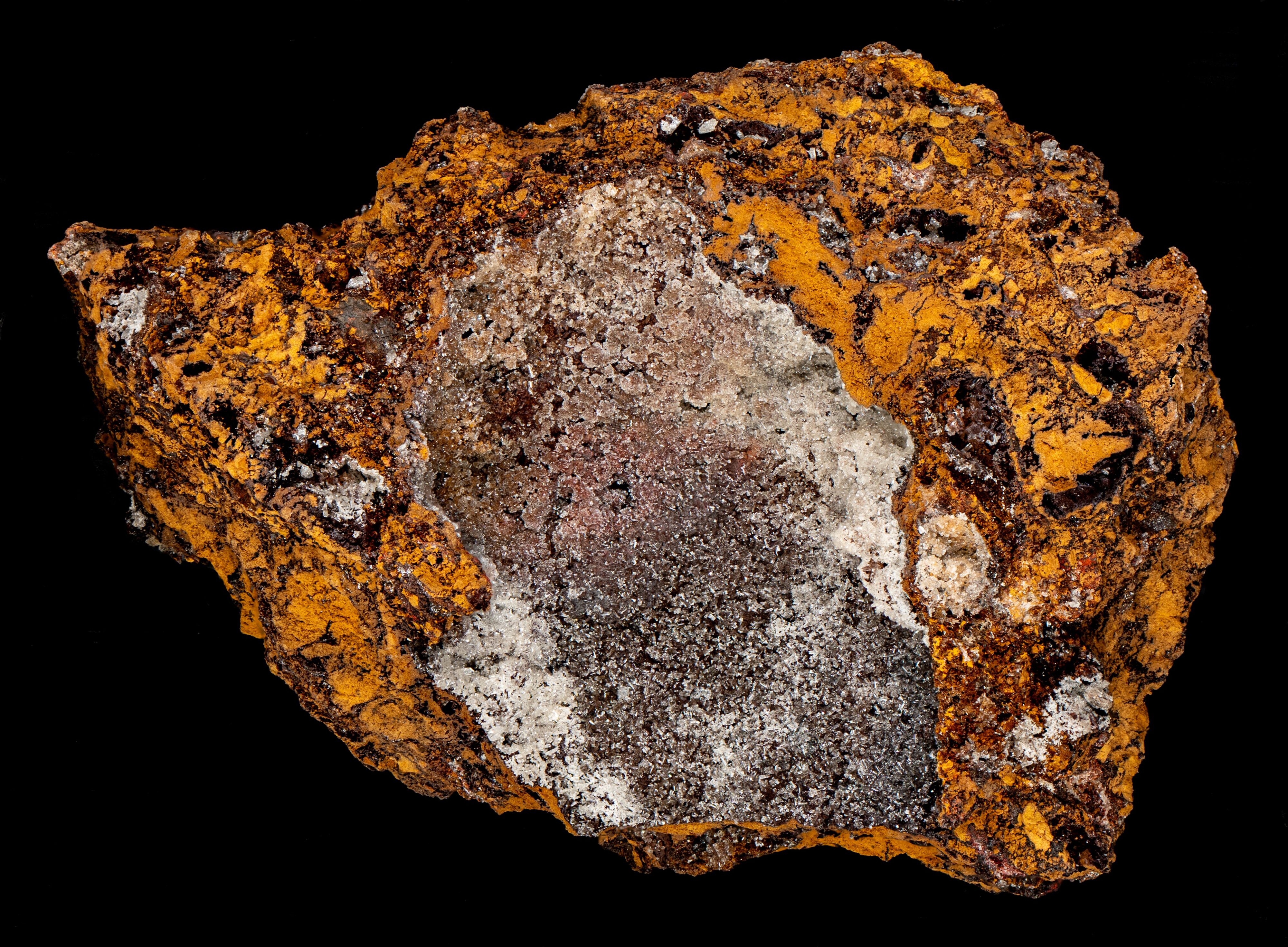
Willemite specimen from the Preguica Mine, Beja, Portugal. The specimen has a vug in limonite lined with willemite crystals. The willemite only fluoresces under shortwave UV illumination and it has very long-lasting afterglow. The blue-white color of the fluorescence is unusual for willemite which is typically green or has a greenish hue. The green fluorescence of willemite is activated by manganese replacing zinc. So, the lack of green fluorescence indicates that there is no manganese present in the specimen, and another activator is responsible for the blue-white fluorescence.
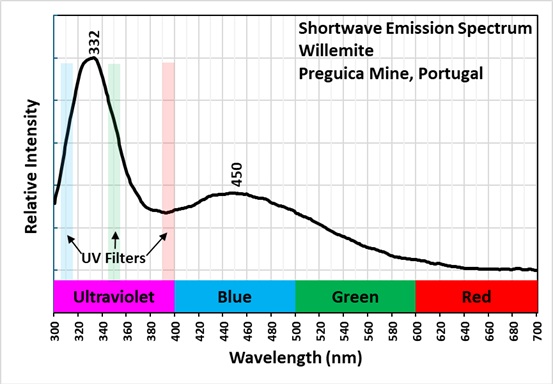
The emission spectrum provides some insight into this willemite’s fluorescent activator. The spectrum has a very bright peak in the ultraviolet with a maximum at 332 nm. This peak may be activated by lead replacing zinc. There is also a second broad peak with a maximum of around 450 nm that is the blue-white fluorescence we see. This peak may also be activated by lead and/or crystal defects such as oxygen atoms.
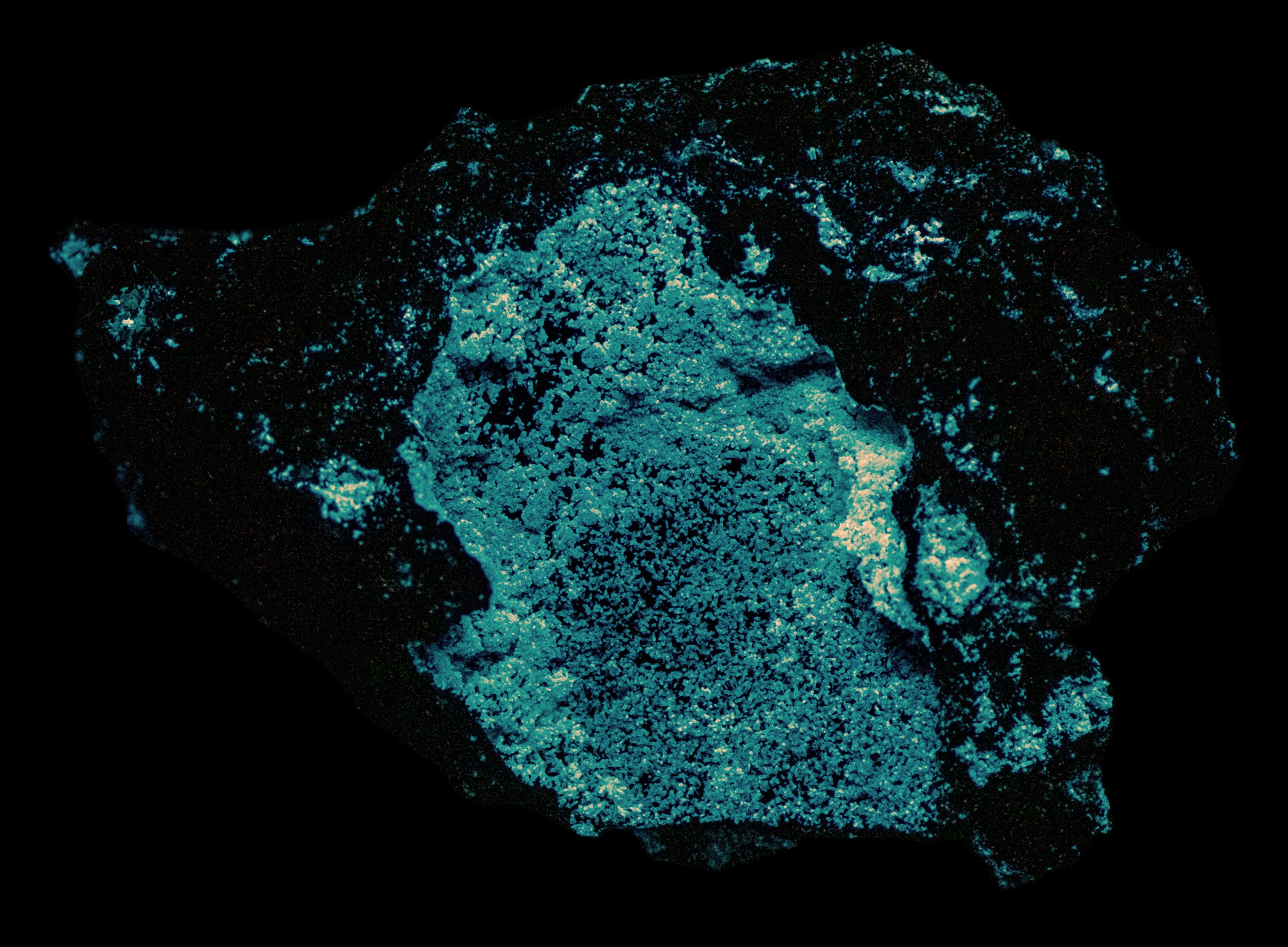
The emission spectrum plot also shows the location of three narrow bandpass filters used to create the false color image of ultraviolet fluorescence. The emission peak falls between the 310 nm and 350 nm filters. The color of the willemite’s ultraviolet fluorescence is a combination of blue assigned to the 310 nm bandpass image and green assigned to the 350 nm bandpass image.
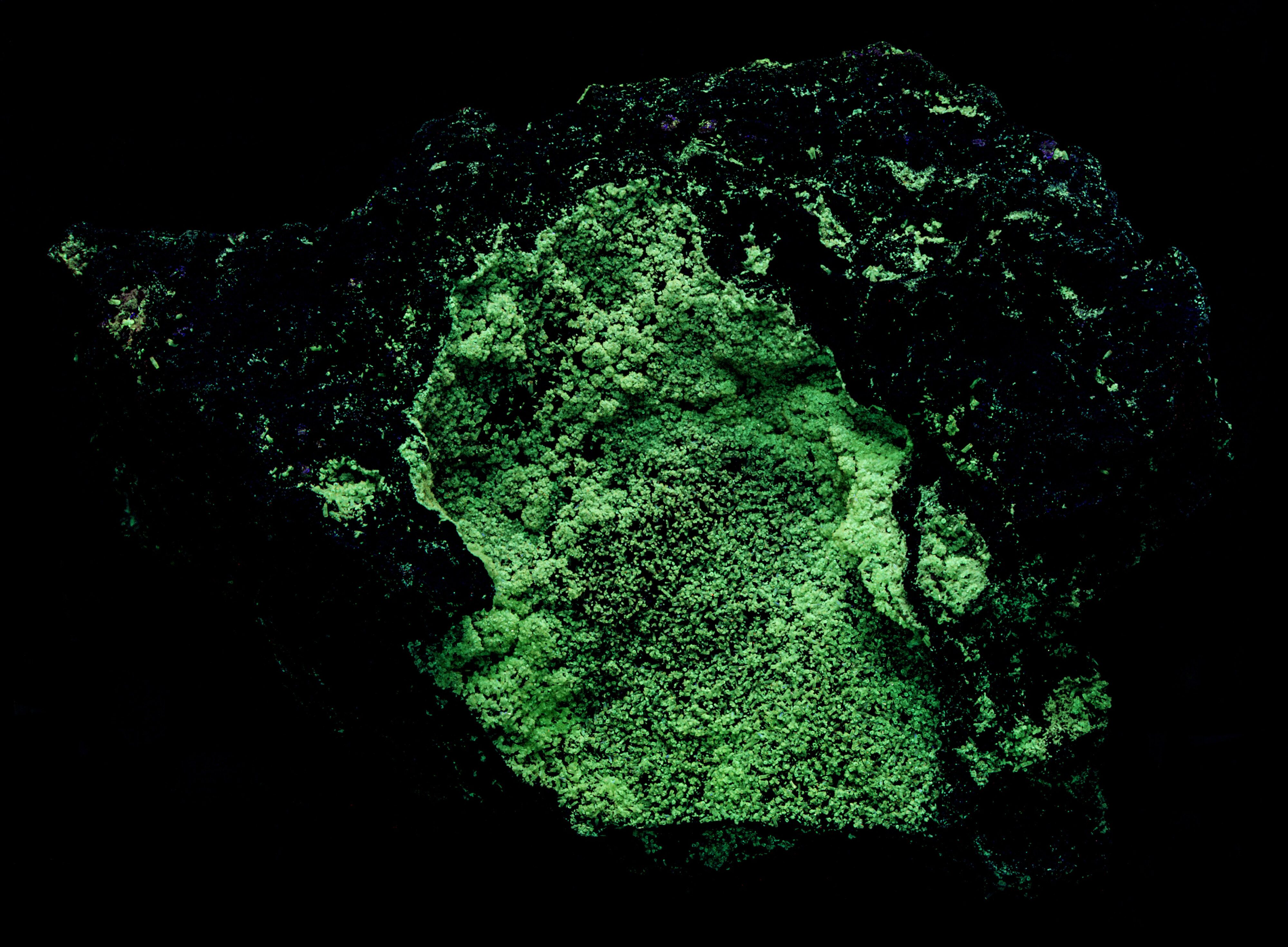
Arsenic is known to cause green afterglow in willemite with green fluorescence. Arsenic substitutes for silicon in the willemite structure. Arsenic is likely the cause of the afterglow in this willemite as well. Arsenic ions trap some of the electrons excited by the fluorescent activator and thermal energy slowly pushes the electrons back to the ground state with the emission of a photon of similar wavelengths of the fluorescence. This thermoluminescence is affected by temperature. Cooling the specimen lengthens the afterglow time and heating shortens the afterglow time.
Summary of luminescence responses:
Willemite (Mindat) (RRUFF)
- Fluorescence under Shortwave (255nm LED) UV light: White
- Afterglow after exposure to Shortwave (255nm LED) UV light: White