
Sphalerite, Fluorite, and Rhodocrosite from the Sweet Home Mine, Colorado
Contributed by: Michael Crawford
minID: AHY-6J3
Date: Sep 14th, 2025
Locality: Sweet Home Mine, Detroit City Claim Block, Mount Bross, Alma Mining District, Park County, Colorado, USA (See on Mindat)
Size: 6 x 8 cm
Description:
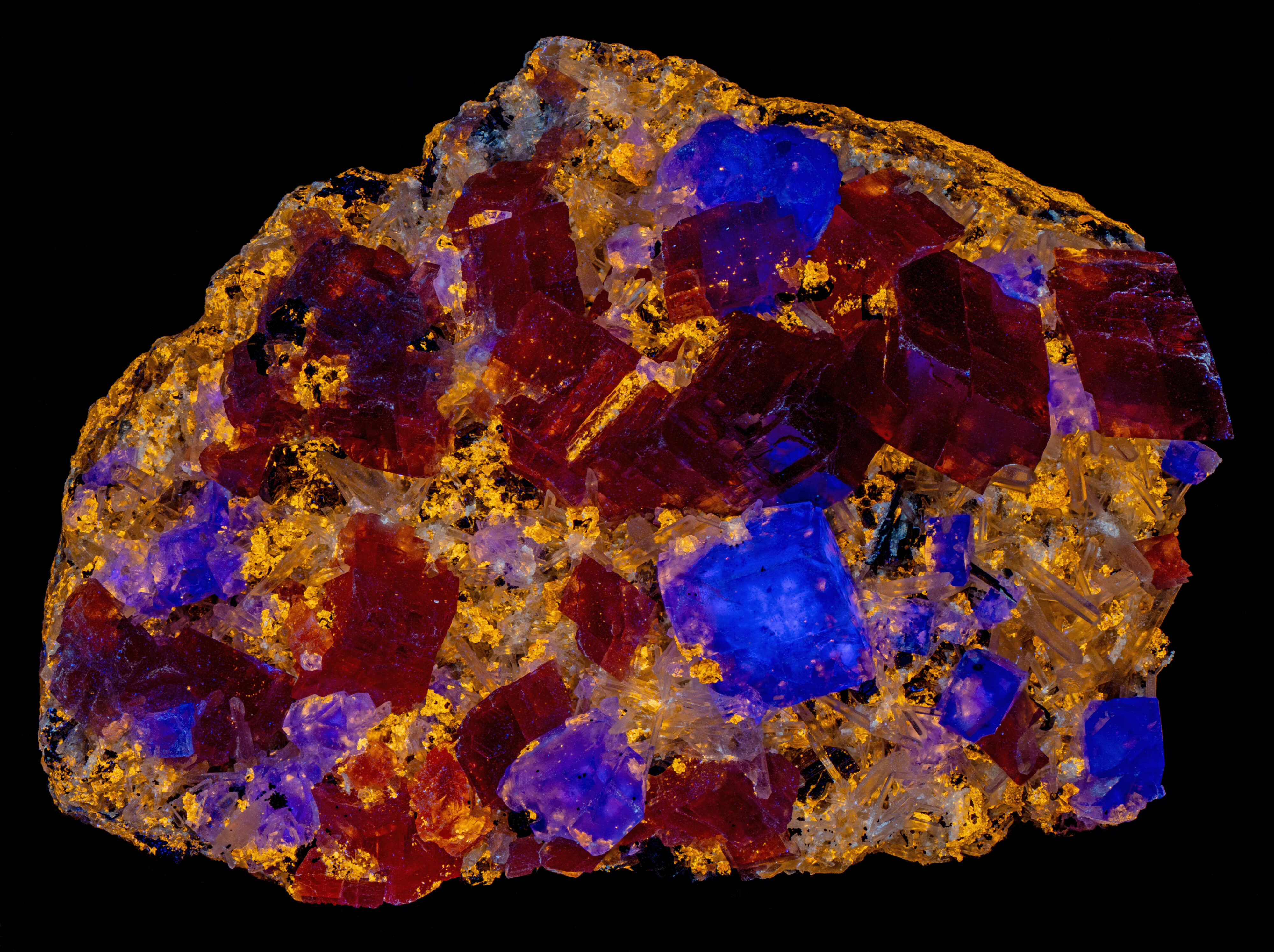
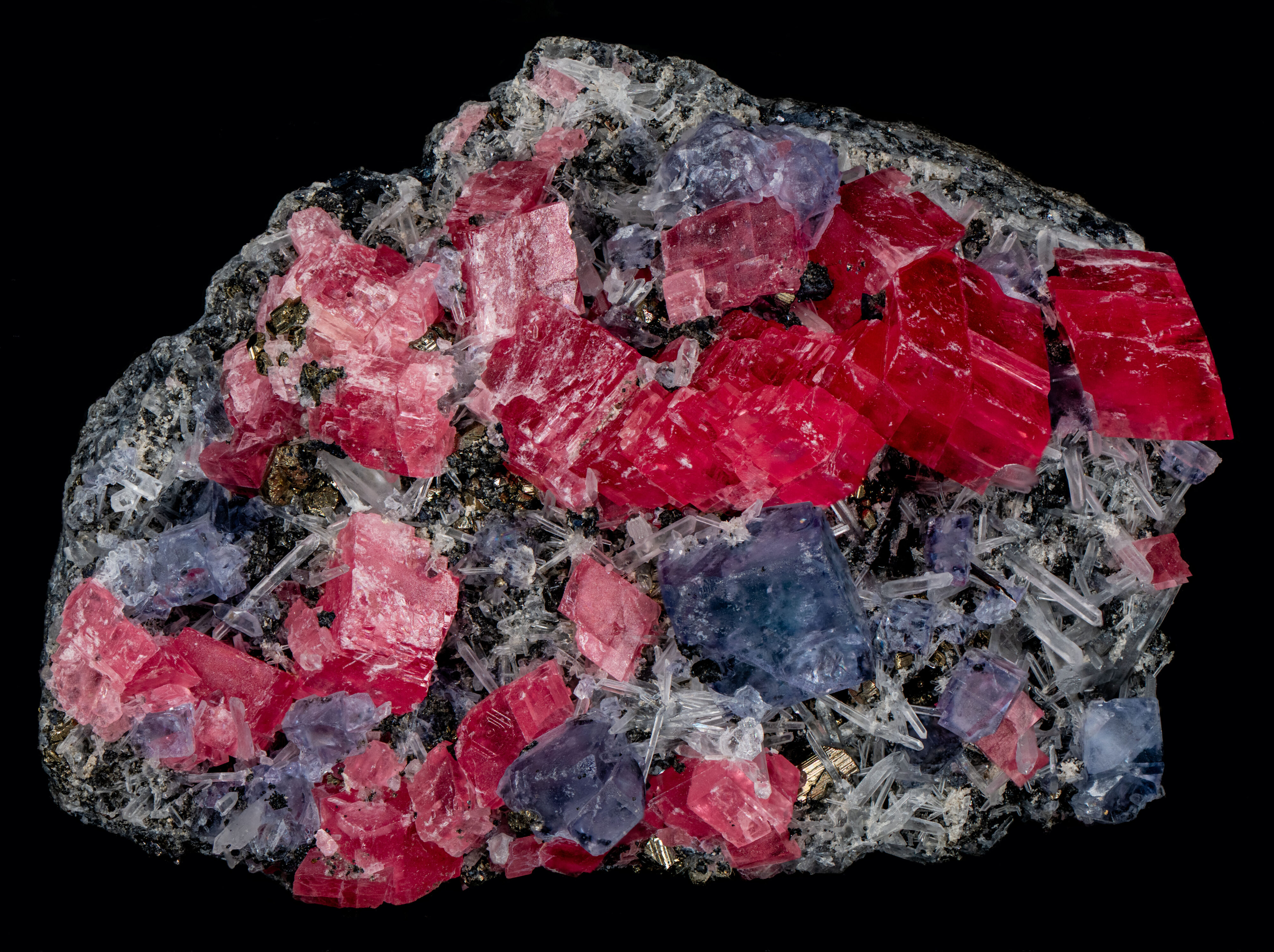
A colorful daylight and fluorescent specimen from the Sweet Home Mine, Park County, Colorado. The specimen contains purple fluorite (CaF2) that fluoresces blue under longwave UV light and black sphalerite that fluoresces yellow orange under longwave light. There is also red rhodocrosite (MnCO3) that fluoresces dark red under strong longwave illumination from a LED light. Most rhodocrosite is non-fluorescent. The fluorescence of all minerals in this specimen is much dimmer under midwave and shortwave UV light. The specimen also contains non-fluorescent quartz crystals and brass colored pyrite.
The specimen formed from hydrothermal fluids that precipitated these minerals in a vug formed within a vein. The open space of a vug allowed crystals of fluorite, rhododcrosite, and quartz to form. Vugs in the Sweet Home Mine were formed by three mechanisms.
1) Changes in strike and dip of a vein.
2) Intersections of veins.
3) Openings formed by fault bends controlled by metamorphic rock foliation.
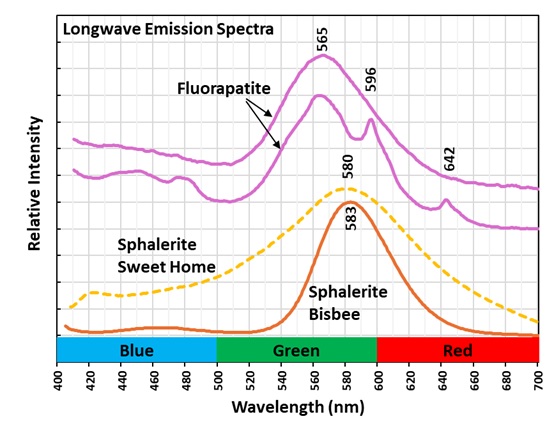
There is an entry in mindat.org of this specimen by the former owner. The yellow orange, fluorescent mineral is identified as fluorapatite. However, the fluorescent properties of this mineral are more characteristic of sphalerite. Fluorapatite is typically brightest under midwave illumination, whereas this mineral is brightest under longwave illumination. The longwave emission spectrum of this mineral is a single broad peak with a maximum at 580 nm. This spectrum is similar to the emission spectrum of sphalerite from Bisbee, Arizona. Longwave emission spectra of yellow fluorescent fluorapatite have a maximum at 562 nm compared to 580 nm of this mineral\'s spectrum. Fluorapatite longwave spectra often have sharp peaks in addition to the broader peak due to rare earth element (REE) activation. One spectrum I found does not have the sharp REE peaks, but under shortwave UV light it has a peak in the ultraviolet like many fluorapatite specimens. The yellow fluorescent mineral in this specimen has no ultraviolet fluorescence consistent with sphalerite.
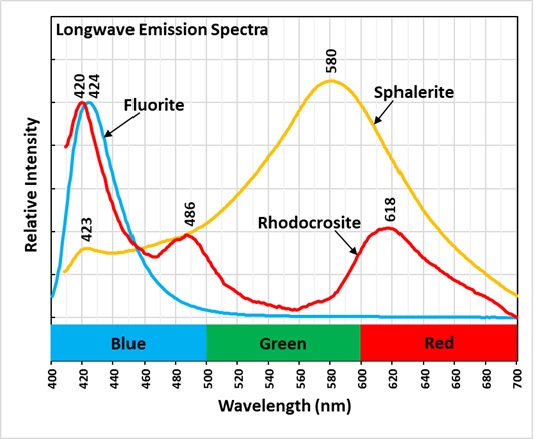
The second plot of longwave emission spectra shows the three fluorescent minerals in the specimen. All three minerals have a peak around 420 nm to 424 nm. This peak is due to the presence of fluorite mixed in with the sphalerite and rhodocrosite. The yellow orange sphalerite fluorescence is activated by manganese replacing zinc. Fluorite fluorescence is activated by europium replacing calcium. Rhodocrosite fluorescence has a peak at 618 nm that is likely activated by manganese. The rhodocrosite emission spectrum also has a peak at 486 nm. No reference material is available to determine what might activate this peak.
Summary of luminescence responses:
Fluorite (Mindat) (RRUFF)
- Fluorescence under Longwave (365nm LED) UV light: Blue
- Fluorescence under Longwave (365nm LED) UV light: Yellow
- Fluorescence under Longwave (365nm LED) UV light: Red