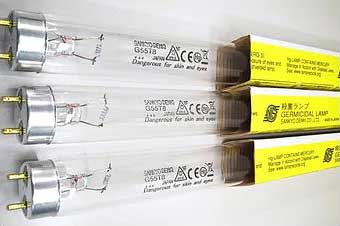
Ultraviolet lights are used for collecting and for illuminating displays of fluorescent specimens. They generally consist of a power supply, UV bulb, mechanical enclosure, and a UV filter.
Bulbs and filters are selected for best operation in a specific portion of the UV spectrum. Power supplies are designed to operate from house current and/or from a battery pack.
Specifications vary widely among different manufacturers.
The most common UV bulbs are similar in operation to fluorescent bulbs used in office lighting systems. They contain a low pressure mercury vapor.
Striking an electric arc through the bulb produces light which is mostly shortwave (SW UVC) ultraviolet, but includes some middlewave (MW UVB) UV, longwave (LW UVA) UV and visible light. Specifications vary widely among different manufacturers.
Become a Member
As a member driven 501(c)3 scientific and education based charitable organization, we rely on public support for our efforts. Currently, we have nearly 400 members from all over the globe and greatly appreciate their support. Come and join the fun!
Fluorescent Bulb Use
In a fluorescent bulb for office use, the tube is coated on the inside with a material that fluoresces white. Thus the UV is mostly converted to visible light and passes through the glass tube. The glass tube itself blocks all the shortwave UV.
Longwave (LW) UVA bulb
A longwave (LW) UVA bulb is much the same, except the material coating the inside of the tube is made to fluoresce in the longwave UV portion of the spectrum. But since the coating also emits a fair amount of visible light, an external filter is needed to block it so that only a dim purplish glow usually remains.
The popular blacklight uses a filter that is integrated into the glass of the tube, technically known as a “blacklight blue”, or BLB bulb. Blacklight blue bulbs from different manufacturers have slightly different peak wavelengths near the 365nm mercury line, which can give dramatically different fluorescence color in certain minerals such as Terlingua-type calcites.
In recent years, some very high power, low cost BLB lights have been produced for theatrical lighting, built around specialized HMI arc lamps. A new, low power technology uses LEDs that emit in near-visible LW range.
Power levels are increasing, and wavelengths are getting shorter. Because a small light source can be focused into a narrow spotlight beam, and leds typically don’t require a filter, this technology holds great promise for use as a prospecting light.
Fairly high power LED torches are now on the market for detecting scorpions.
Shortwave (SW) UVC bulb
In a shortwave (SW) UVC bulb, no fluorescent coating is used, but the tube must be made of quartz or a special glass which allows shortwave UV to pass through with minimal ozone production. These are typically low pressure mercury bulbs emitting mainly at a wavelength of 254nm. As above, a filter is added to suppress the small visible light component.
The modest amounts of middlewave and longwave UV produced by the mercury vapor also pass through the tube and filter, amounting to about 7% of the total radiation produced. Filters age with exposure to UV and will eventually ‘solarize’ and begin to block shortwave UV.
It used to be that shortwave filters were rather expensive and lasted only about 500 hours, but a newer kind of filter, introduced about 1980, has extended the useful life by a factor of 10.
Germicidal lights equipped with unfiltered shortwave bulbs are used by doctors to kill germs, and by the electronics industry to erase EPROM memory chips.
Midwave (MW) bulbs
Midwave (MW) bulbs have become more popular among fluorescent mineral collectors recently, because certain minerals display most prominently at the UVB wavelengths around 311nm. Broadband UVB bulb have been around for a while, using a phosphor driven by low pressure mercury emission.
Recently, narrow band phosphors have been developed for use in UVB phototherapy, and they may also be useful for showing certain mineral fluorescence.
Higher power UVB lamps are used for curing paints and polymers. These are often unfiltered medium pressure mercury lamps.