Introduction
As an amateur photographer, everything I know about photography has been learned from watching others do it or from reading books about how they do it. This is a normal learning process, I guess. However, when I got interested in fluorescent minerals, I came to realize that there was no one to learn from and practically no books at all (Remember that there were only a few and very expensive internet providers in Belgium in those days. These days you can buy filters, lamps, books or whatever on the Net). When I realized that I had to "invent a technique" for this kind of photography or quit, it became somewhat of a challenge to me. After some thinking, I bought a roll of film and got extremely lucky. The most beautiful photo I ever took of a fluorescent specimen was on that film! At a moment like that you know it can be done and no fallback will keep you from perfecting your work. I don't know what I would have done if that first film had been a complete failure. I might have quit or, then again, I might not…
I guess you could call me an inspired amateur. If you value the advice of an amateur, read on. But remember that this paper merely represents the way I do things. It most definitely is not the holy bible of fluorescent mineral photography!
It may work for you or not. It might, however, be a good idea to look at the work and advice of some other photographers too.
When attempting to record the beauty of fluorescence on photographic film, one must accept some basic facts. Photographic emulsions are designed to perform within well-defined physical boundaries. When one exceeds those boundaries, one trespasses in the realm of the unpredictable. This affects the way we have to approach our subjects profoundly. Most of the commercially available film requires exposure times that are comprised between a few milliseconds and one second. You will need very large specimens that fluoresce very strongly to meet those requirements. If the specimens fluorescence is weak, we still have a trick or two up our sleeves, don't worry.
A second consideration is the choice of specimens. Not every specimen can be photographed. Some can easily be shot on slides but refuses to be photographed on color print film obstinately. Some colors won't render realistically and some features just will not register on film. Be realistic in selecting the specimens you want to photograph. If a specimen looks like it will be difficult to photograph, it most probably is!
There is no reason why you shouldn't try to combine photomicrography (macro photography) with photography of fluorescent minerals. There is incredible detail in small and well-formed fluorescing crystals. Details that often cannot be seen with the naked eye, due to the fluorescence of the iris or because of the minute size of the specimen will in some cases stand out prominently on film.
Photo #1 - Calcite, Mont-sur-Marchienne, Belgium . Specimen size is approximately 1 cm high. Collection and photo: © Axel Emmermann.
Keep in mind though that each of these techniques has its own difficulties and pitfalls.
One should master both techniques separately before attempting to combine them.
This paper should suffice to get you started on fluorescent mineral photography.
Photomicrography is something entirely different and lies beyond the scope of this paper.
The best book that I could find on the subject is "Photographing Minerals, Fossils & Lapidary Minerals" by Jeffrey Scovil (1996 Geoscience Press, Inc. ISBN 0-945005-21-0).
It did miracles for me.
Don't throw away all your wasted exposures. They may contain valuable information that you should look at very carefully. Document them and put them away safely because there's a lot more to learn from them than from your successes.
Finally, a word about the equipment. Any good camera with a good lens will do the job. In comparable circumstances, the best camera and film will produce the best result, which is obvious. But keep in mind that the camera does NOT take pictures - YOU DO. Success lies in your tenacity, thoroughness and creativity.
As with the film, we stretch the capabilities of our equipment far beyond the limitations of its intended use. Your light metering device will lie to you and your lens will try to trick you. Still, we can and will get around those problems provided we see them coming.
This is always a hard choice. There are advantages and disadvantages in both.
Color slide film:Slides are also the preferred medium if you intend to publish your work in magazines. Publishing slides on the internet will require a good film scanner. If you haven't access to one, you'll have to make prints of your slides in order to scan them on a flatbed scanner. However, printing slides on photographic paper increases the contrast dramatically. Even the use of high quality products such as Illford Cibachrome cannot prevent this from occurring. You will have to make compromises and do the processing yourself. As an alternative, you could have your slides put on CD. Keep in mind that this process is fully automated and that the results may be very poor in quality.
Very small gradations in one color or luminance are often "overlooked" by commercial scanners and their software. A beautiful crystal group may look like an overexposed blob of color on CD. As with most photographic processes, the end result may depend largely on the shop that handles it.
Color print film:In my opinion, colored backgrounds distract ones attention from the specimen, and their colors tend to "leak" into the specimen's color. I therefore prefer a solid black background. Again, this poses a problem for the print processing software. If it sees a lot of black, it assumes that your negative is underexposed, and forces your negative to fit the set calibration, thus overexposing the print. The image of the specimen comes out overexposed. Reds and greens change toward yellow, blues toward white, and the black background changes toward brown (or blue if there's some residual blue light from your UV source on the negative).
Bottom line:The following tips and hints may help you to improve your work:
First rule of fluorescent photography is: "Whatever you do, THINK IT OVER FIRST!" The human eye, sensitive as it may be, has its limitations. It's mostly the things you cannot see that will ruin your exposures. I'll try to summarize them as completely as I can but keep in mind that Murphy has a complete set of laws for those who boldly shoot what no one has shot before…..
This is a hard choice. It largely depends on the amount of money you are willing to pay I'll try to summarize the most frequently used UV sources but this list may be far from complete Basically there are two important types of UV sources: long wave and short wave.
Long wave:Blacklights are fluorescent lamps that are filled with mercury vapor. The tube is made of Woods-glass coated on the inside with a phosphor. The short wave emission lines of the mercury vapor's spectrum excite this phosphor and cause it to emit long wave UV. The long wave passes throught the glass and is emitted from the lamp while the short wave is blocked.
Photo #2 - Aragonite, Agrigento, Sicily, Italy. Photographed under LW UV from a well filtered blacklight lamp. Collection and photo: © Axel Emmermann.
Unfortunately, a certain amount of visible blue light also passes through the glass tube. Some brands give off a lot of blue light, others very little. Visible blue light presents a problem in photographic applications. It's easy to spot this with a sheet of non-fluorescent white paper. If it turns even the slightest blue under the lamp, you'll have to buy some long wave UV-transparent filters if you want to use the blacklight for photography. Another disadvantage of this type of lamp is that it is tube shaped and long. As a consequence, only a fraction of the emitted UV will actually reach your specimen. In most cases you won't have enough room to fool around with reflectors or to put more that one or two lamps to work. This type of lamp is impractical for small specimens, but it's great for photographing really big pieces or entire display cabinets.
Photo #3 - The same specimen but this time photographed with a 125 watt UV spotlight as a UV source. This type of lamp generates shorter wavelengths than an ordinary blacklight causing the color of the fluorescence to shift to a lighter pinkish red. Collection and photo: © Axel Emmermann.
Mercury-vapor spotlights come in 125 and 250 watts. They cost about twice as much as a blacklight lamp. About a fifth of their energy output is UV and it is emitted in one direction. This makes it a good UV-source to work with. Most of my long wave photos were done with the 125-watt version of this lamp.
There is also another thing about this lamp that is less obvious. The pressure of the mercury vapor in this type of lamp is different from that in fluorescent lamps. By some complicated quantum-mechanical effect, this favors the emission-lines in the long wave section of the mercury spectrum and suppresses the shorter wavelengths. But still, the emission of UV comes in small, well-defined, spectral lines. Furthermore, there is no phosphor coating in this type of lamp. Some fluorescent mineral specimens may require wavelengths that are very weak or even absent in the lamp's light in order to fluoresce efficiently. A fine example is strontium-aragonite, which fluoresces bright red under blacklight lamps but turns a much paler pinkish red under a spotlight lamp.
Induction lamps are commonly known as energy-saving lamps or "economy"-lamps. They have a normal screw-in socket, just like any household lamp, that contains the necessary electronics. The lamp itself consists of two or three U-shaped glass (or quartz for the short-wave version) tubes. Their light has basically the same properties of that of a fluorescent lamp. There is a blacklight version of this lamp available although it may be hard to find a shop that actually sells it. The lamp is significantly smaller than fluorescent lamps and has a high output, compared to its size. The great advantage of this type of UV-source is that you can put it in a very small casing and that it requires only one filter (you'll need 3 or 4 filters to filter a normal blacklight lamp). It is therefore possible to setup a lighting for a specimen with 2 or 3 lamps which gives a much more uniform fluorescence and little shadows.
High-power halogen lights also produce quite a bit of UV. The main difference with mercury-vapor lamps is that their UV spectrum is almost continuous. There are no substantial gaps in this spectrum that ranges from long wave to mid-wave. This may cause minerals to exhibit a slightly different fluorescent behavior than under blacklights or spotlights. That's the advantage. Heat is the main disadvantage of this type of UV source. This has two consequences. First of all, you'll need a serious fan to cool your lamp and its encasing. Secondly, even more so than with the previous lamp, your UV transparent filter has to be very thick and absolutely heat-resistant! You can imagine the enormous amount of visible light and heat that comes out of a 400 or 800-watt halogen spot. This lamp is heavy and gets very hot but gives excellent results. If you have trouble finding the right UV transparent filter, try: TheatreFX
The SuperBright 2010 LW is the newest long wave UV source on the market. It's made by UV SYSTEMS who also make the famous SuperBright 2000 short wave lamp. I haven't seen this lamp yet but if its performance comes anywhere near that of the short wave version, then it's worth its price. You can check out the specs on this lamp at the UV SYSTEMS web site
Short wave:
Photo #4 - Again the same aragonite specimen as seen in the long wave section but this time under short wave UV. The source is a well filtered germicidal lamp.
Collection and photo: © Axel Emmermann.
Practically all short wave UV sources are based on the spectrum of mercury vapor in fluorescent lamps. All of these lamps have one thing in common. They are made of fused quartz and therefore somewhat more expensive than other fluorescent lamps. The reason for this is simple; glass won't transmit short wave UV. Lamps like this are often used to disinfect the air in government buildings. They come in all sizes, ranging from small 4-watt lamps up to full sized 40-watt tubes. This UV source emits a weak blue light that must be filtered out. A normal short wave -filter will do since these lamps don't emit much heat. To get more of the UV on your specimen, you'll have to use a reflector. Don't use glass mirrors or polished sheets of metal, they will either absorb the short wave UV or turn it into photoelectric energy. Aluminum foil will do the job.
There are several short wave UV sources readily available from quite a few manufacturers. The only one I have seen and tested is the SuperBright 2000SW. It has an amazingly powerful UV-output. If you want to photograph specimens that fluoresce rather weakly, this is the one you must have. If you use it, take care to select an absolutely non-fluorescing background or create a large enough distance between specimen and background! Almost anything will fluoresce under the SuperBright's power! Make sure to protect your eyes and skin, and ventilate your workspace because this lamp produces a lot of ozone.
If you haven't enough space to set up your lamp or if you don't want to spend too much money on purchasing one, you might want to consider an induction lamp. They are usually known as "economy" or "energy-saving" lamps that come in double U-shaped quartz tubes on a regular socket with built-in electronics. You'll need the "germicidal" type (see fluorescent lamps). This lamp also requires a filter and aluminum reflector.
Every successful photographer has to scrutinize his work to the smallest detail. Color rendering is always a sensitive issue to them. Some brands of film have softer or warmer colors than other brands. So, in the end, every photographer sticks to his favorite brand. This is a meaningful idea if your are photographing in normal light. After all, we want our pictures to look as realistic a possible. However, in fluorescent photography we run into a major problem. The technical term for this problem is "reciprocity failure".
Every film is balanced in a way that makes it near equally sensitive to all colors within a given range of exposure-times. When you expose your film for a time that is not within this range (extremely short or very long) it will be more sensitive to some colors than to others. This will cause your photo to shift in color. A perfectly white fluorescing mineral might very well look green on a photo that took 20 seconds exposure. It's possible to compensate for this color shift by using color compensation filters. You can look up their number and color in tables that are available for most brands of film. On the other hand, any piece of glass or gel that you put in front of your lens will increase exposure time and reduce the quality of the photo.
In my opinion, it's better to look for a film that is balanced for long exposure times. Fuji Astia, which is 100 ASA, can take up to two minutes of exposure without any noticeable shift in color! Longer exposure times are also needed when using extension-rings, filters, a bellows or a macro-adapter. Photograping very small or very dimly fluorescing specimens will require at least a 400 ASA film to avoid reciprocity failure, but keep in mind that films with higher ASA-numbers will show less detail because of the increasing graininess of the emulsion.
More than any other factor, the sensitivity of the film you use determines the exposure time. The use of bellows and extension-rings, filters or a macro-adapter will also increase the exposure time.
General rules:The trick is to select the specimens for one photo-session in a way that they have roughly the same brightness in fluorescence. You can then choose a film with an appropriate sensitivity to shoot a group of specimens without having to worry about reciprocity failure. Placing them under the UV source and using the light-metering device of your camera can help you do this. Put the selector-switch for the film sensitivity on its highest possible setting, open the diaphragm of your lens as far as you can (usually f=2.8 ) and make a rough setup for each specimen. Write down the readings from the light meter for each specimen, we'll call this number T. You'll probably get readings ranging from 1 sec. up to maybe 1/500 sec. for exceptionally bright specimens. While the specimen is still in front of your lens, put a normal light on the specimen and turn the aperture-ring until you have enough depth-of-field (don't worry if your light-meter runs off scale). Count the aperture-steps and call this number N. The shortest possible exposure time for the specimen using the most sensitive film your camera can handle, can now be calculated as:
Do this for every specimen you want to photograph and write these relative exposure times down. Also jot down the aperture at which you get optimal depth-of –field for the specimen. The next step is to divide the specimens in classes according to their relative exposure-times, just like you would in statistics, making the classes no more than one step wide (1-1/2 sec, 1/4-1/8 sec, 1/16-1/32 sec and so on).
The Choice of Film:The best way to explain how you finally come to a choice of film is to give an example. Let's say you want to photograph a series of minerals that have a TRelative that belongs in the class 1/4-1/8 of a second. Say you want to use a roll of Fuji Astia, which has an ASA number of 100 and is linear up to an incredible two minutes. Can you? Yes - by using a table which gives compensation factors for different film sensitivities. You determined the relative exposure times with your light-meter set on the highest possible ASA number (or any sufficiently high ASA number). Lets suppose that is 3200 ASA. Now look at the film sensitivity compensation table below.
In the table, locate the column with the ASA number you used. In our example, this would be 3200 or the second from the left. Then locate the row with the ASA number you want to try in the first column. In the matching cell we find the number 32 (2 to the 5th power since we took our film sensitivity 5 steps down). Now multiply the highest TRelative in the series of specimens and multiply it by the number you found in the table. In our example this would be: ¼ *32 = 8 seconds.
This is the basis on which we will build a series of exposures. You can imagine that the 8 seconds of exposure time we calculated are merely a guideline. To be on the safe side you best take 4 or 5 shots of the specimen, doubling the exposure time on each shot. So, the series would look like 8, 16, 32 and 64 seconds. If you stick to a series of 4 shots, you are well within the linear range of the film (two minutes)! If you make a fifth one you exceed the maximum time with 8 seconds. I wouldn't worry too much about this. Just make two minutes of those 128 seconds and you'll be fine.
It's obvious that the specs of the film are the decisive factor in this matter. In our example we use a 100 ASA film without any problems because it is linear for a very long two minutes of exposure. If you tried this with a 400 ASA film that has a maximum exposure time of 10 seconds, the shortest exposure would be ¼ * 8 = 2. The series of exposures would then be 2, 4, 8, 16 and 32 seconds. The fourth and fifth exposure will suffer from reciprocity failure unless you use the proper CC-filters. If you choose a 800 ASA film, you simply divide the exposure times by two, but this film would still have to be linear for at least sixteen seconds!
All this may look rather complicated and tedious but in the end it is, in my opinion, the most logical approach. After all, it works fine for me. If you don't like it, there may be alternatives. I have seen tables that list minerals together with the exposure times and film sensitivity one should use. It has the advantage that you can build on the experience of someone who has done it already. On the other hand there may be factors that are quite unpredictable. The UV-output of your lamp, distance between lamp and specimen, size and brightness of your specimen may differ a lot from the ones used to set up the table! In that case you are back where you started. The method I propose takes the most important parameters, like the aperture you want to use, already into account.
Note: You can photograph six or seven specimens on a roll of film (36 exposures). If you happen to have a "class" of minerals that has less members, you can always add some from a "brighter class" to your session.Fine Tuning Your Exposure time:
Step 3: - Turn off the lights in your workplace and switch on the UV-source. Take care to shield the lens from any direct UV. Now look through the camera and scrutinize your composition. (If you haven't read the section "Composing a shot" put the lights back on and read it first.) If you're not satisfied with it, make some improvements under UV but check if focus and depth-of-field are still OK in plain light after doing so! Again, make sure to turn off ALL lights when done. Step 4: - Try to find the relative exposure time by turning the knob that sets the shutter speed. Now there are two possibilities:Note: most lenses have their best performance around f=8. Any greater aperture will favor depth-of-field at the cost of resolution (sharpness of detail). A smaller aperture will give your photo more detail but less depth of field.
In this case you'll have to look up the number with which you have to multiply this reading. You'll find it back in our film sensitivity compensation table. Just follow the same procedure as for the determination of the film type. If your light-meter says 1/8 second and the table says 16, then your series of exposure would be: 2, 4, 8, 16 seconds (and 32 if you want to play it safe).
Are you sure you put the right specimen in front of your camera? Is your UV-source in good condition and close enough to the specimen? Is your camera set on the highest possible ASA-number? Check and double-check this. If the problem persists, turn the aperture to its largest opening while counting the steps. You should have a valid reading (R) now, otherwise your specimens fluorescence is way to weak to photograph. Note the number of steps (we'll call it S) and turn the aperture-ring back to its original position. At the set aperture, the exposure time would then be:
(or: Reading times 2 to the Sth power times compensation for film sensitivity).
Step 5: - In most cases the exposure times will be greater than 1 second, so put the shutter speed selector knob on position "B". You are now ready to take your first series of photos. In the example the exposure times would be: 8, 16, 32 and 64 seconds. Handle the camera gently and make sure you don't disturb the setup. It's a good idea to check between exposures if the positions of the camera or specimen haven't changed. This can often happen involuntarily if the camera's tripod is standing on a rug or slippery floor (polished wood or tiles). Specially look for movement of the specimen if you used dab to position it! Pitfalls:Example:
Your lens has following f-numbers: 2.8-3.5-5.6-8-11-16-22
The desired setting is 11 and you measured 1/8 second at 2.8 (four aperture steps up). For a film of 3200 ASA, the exposure time would be : 1/8 * 24 = 1/8 * 16 = 2 seconds.
If you are using a 800 ASA film you'll have to multiply these 2 seconds by 4 (see the table). The actual exposure time to build a series on would thus be 8 seconds.
It happened to me and it will undoubtedly happen to you to! Somewhere in this elaborate process you are likely to forget one of the following things. The best I can do is warn you about them. Don't worry, you'll get the hang of it!
Special problems arise when the specimen has large areas that are non-fluorescent or when the entire specimen fluoresces in the same color. In these cases the resulting image usually contains just blobs of color on a black background.
The Blob
Photo #6 - Andersonite, Utah, USA. This photo was taken under long wave UV. Although the specimen was well centered in normal light, the result under UV is poor. The main features of the specimen are almost at the bottom of the photo. The geen fluorescent specks, that outline the shape of the specimen, are life savers. Without them the photo would be unacceptable, with them it is just a shot of lesser quality. Collection and photo: © Axel Emmermann.
If you do want to capture the entire specimen on film, you must make the matrix visible somehow. The only way to do this is to have some normal light fall on it. The trick is to balance the amount of UV light and the amount of plain light.
The goal is to have just enough white light so the matrix becomes visible but not too much to swamp out the fluorescent image. Taking a severely underexposed photo of the specimen to fill in the dark areas will accomplish just that. You can either use an electronic flash or a cold light source (quartz halogen) for this.
Another way around this problem is to present the viewer with two photo's. - one that shows the specimen in normal light and the other that shows it under UV.
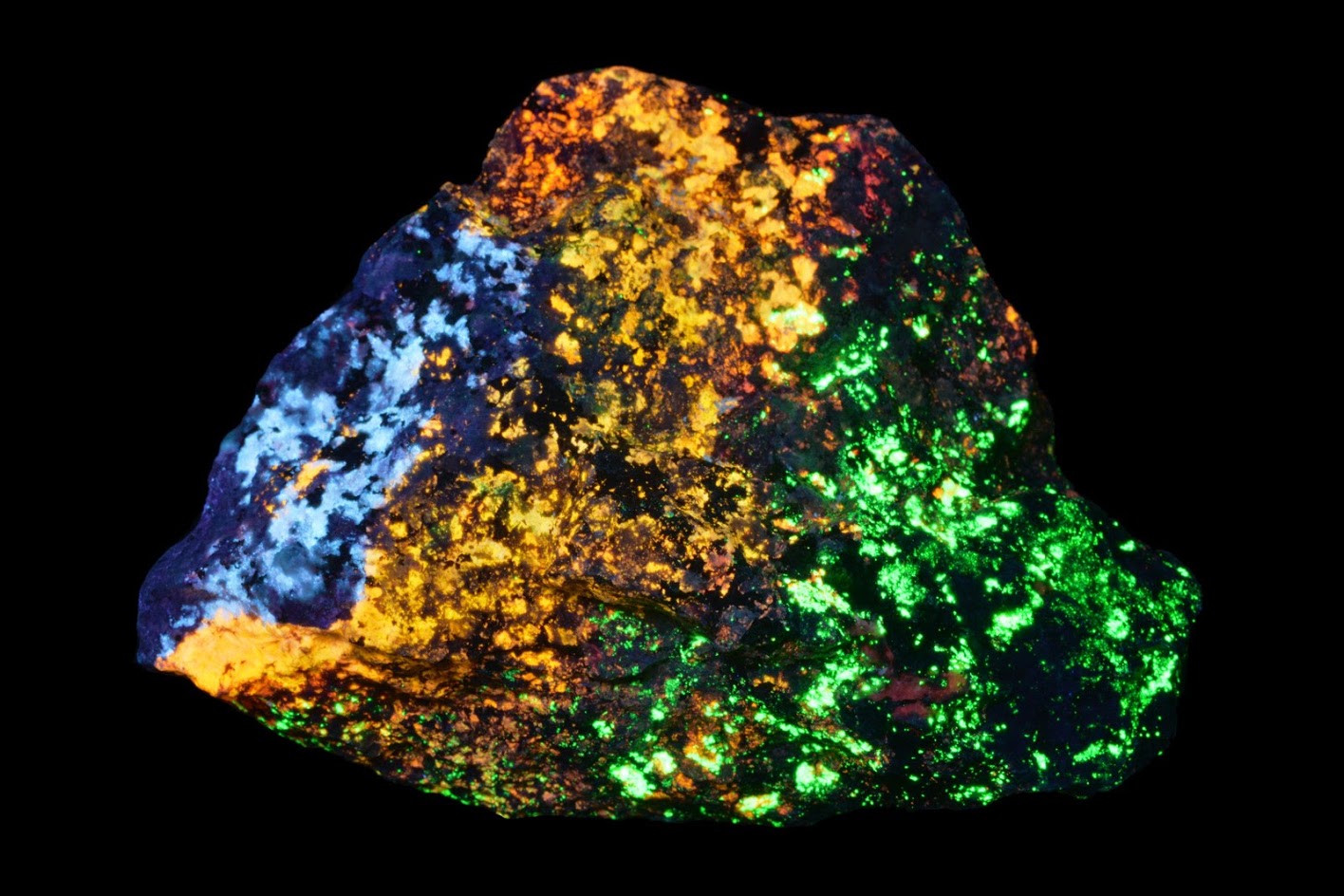
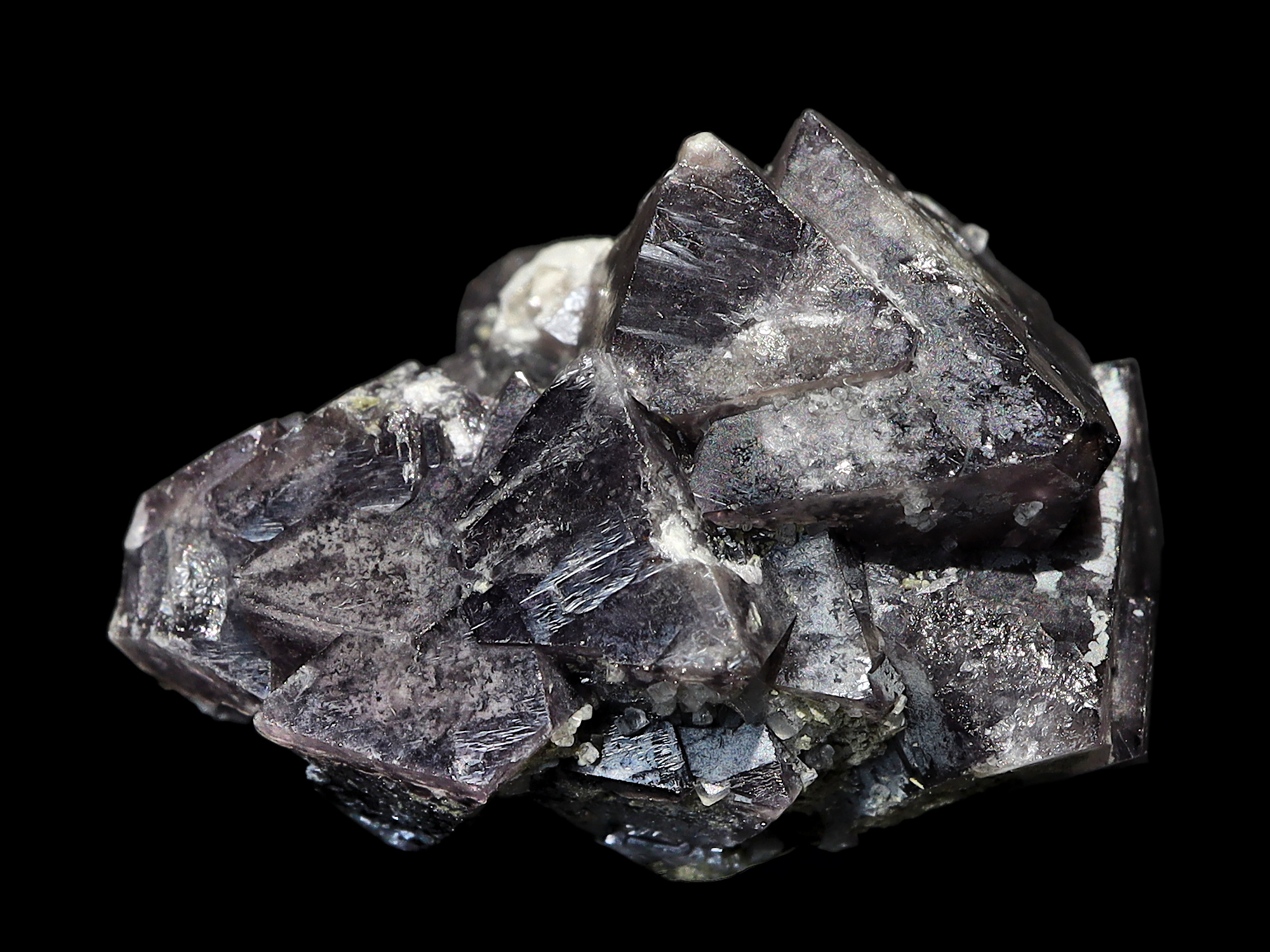
Photo #7 - Hydrocarbon, Washington, USA. Showing a photo of the specimen under both UV and normal light, eliminates the need for making double exposures. The green fluorescing specks are most likely uranium minerals that often accompany hydrocarbon deposits in rock. The photos were taken under halogen light and LW UV. Collection and photo: © Axel Emmermann.
Flash:I've never used an electronic flash for this type of photography before so I can't really give you any advice in this matter. I can offer a suggestion if you own a camera and flash that both allow TTL-metering, though! Try mounting the flash on your camera so that it overshoots the specimen (some flashes can be tilted upwards). The idea is to light the specimen indirectly by means of a reflector. A piece of white cardboard will do fine. Do not attempt direct flashing. Hot spots on crystal faces will ruin your shot. Now fool the camera and flash into believing that you use a film that is one or two steps more sensitive than the one you are actually using. If you use a 100 ASA film, put the ASA selector switches on 200 or 400 ASA and you'll have your specimen's matrix underexposed but still visible on photo. You'll have to determine the number of steps with which you fool the TTL metering by experiment. I can't help you there because my NIKON FM2 does not support TTL. But it's worth a try.
So, put your shutter-speed on B and turn on the UV-source. After the flash has gone off, just keep exposing the film for the duration you calculated. You don't have to compensate for the use of the flash since it lasted only a. few milliseconds.
Cold light source:You'll have to start by determining the exposure times under UV that you need for a series of shots. Then turn off the UV-lamp. With the UV-source off, light your specimen with the normal light source so that there are no reflections on any crystal faces. Put a Wratten 80A filter in front of your lens, to compensate for the color temperature of the halogen light. We want our specimen to be visible but underexposed, so set the ASA selector one or two steps higher than the ASA-number of the film you are using. Again, you'll have to experiment a little to find the ideal measure of underexposure! Now you can take the photo thereby using the exposure time that you light meter suggests. Now we have to be VERY careful not to disturb the camera or specimen! You now have to remove the Wratten 80A filter, and "cock" your camera while the capstan for the film-transport is disabled. Put the shutter-speed on "B"! Turn all lights off and the UV-source on. You can now photograph the specimen under UV while using the predetermined exposure time. That is, if my theory is right! (I really should try this some time…..)
Important notes:It is always a good idea to set your camera up so it can't move. If you have to change filters or turn the ASA selector knob for a double exposure, a tripod is useless. For such elaborate manipulations, I have devised an omega-shaped steel profile that is firmly screwed on a thick wooden board. The specimen-support is also attached to this board (see drawing 1). This way I'd have to use a baseball bat to disturb my camera's position. I also use a clamp to secure the lens whenever I use extension-rings or bellows.
Not every specimen is worth photographing. If you get carried away while selecting the subjects for a photo-session, you may find yourself staring at a series of colorful blobs on film. If there's absolutely no texture or depth in a fluorescing specimen, don't try to photograph it. No matter how rare or spectacular the specimen is, it will not look good on your slides or prints. Remember that a photo is two-dimensional and that our eyes need a frame of reference to create the illusion of depth. The features of the objects we photograph are just that: reference points for a make-believe third dimension! Any featureless object you photograph will look flat on photo.
Photo #8 - Sodalite, Illimaussaq, Greenland, Denmark. This specimen fluoresces fiercely under LW UV. Normally, it would photograph as a featureless blob of orange, but by setting up the UV source in such a way that the light "grazes" the surface of the specimen, you can create a subtle gradient in color. The strength of the fluorescence seems to decrease from the lower left to the upper right, while cracks, fissures and other surface features become clearly visible. Collection and photo: © Axel Emmermann.
You could try to create some depth in otherwise featureless object by moving the UV-source around. If the UV-light falls on the face of the specimen that you want to photograph at a shallow angle, it may create some "shadows". Spots on the specimen that receive less or indirect UV-light will fluoresce less bright and give an impression of its texture and surface features. There is of course something to be said in favor of a more documentary approach. Every photo you take doesn't have to be a masterpiece.
Photo #9 - This LW UV photo of a spodumene crystal clearly demonstrates that moving the UV-source around must be done with some discretion. The striation of this crystal is highly reflective and bounces the visible blue light that escaped the filter straight into the lens. Collection and photo: © Axel Emmermann.
A lot of my photos that are on the MKA web-site are merely rough approximations of a specimen's fluorescence. I'll always try to get the color and contrast right, but there's no such thing as a perfect photo in this line of work. So, I'm not proud of EVERY photo I posted on the site, but I think they all help to make the general public aware of the beauty of fluorescence.
Some minerals, like wernerite or sodalite, fluoresce very vividly and usually come in massive lumps. Such specimens are hard to photograph because their fluorescence is equally strong over their entire surface. This gives rise to a lack of color-gradient in our photos. In other words: just another colored blob. One way to add some depth to our photos of such specimens, is to photograph them on a slightly reflecting support. Depending on your personal taste and the strength of the fluorescence, there are several types of material you can use to put your specimen on.
Personally, I find that fluorescent minerals are best seen against a dark or black background. After all, this is the way we present them in our viewing cabinets. I think that it is best to photograph those specimens in the same setting. Colored backgrounds may very well distract ones attention from the specimen and are very hard to balance in lighting. On top of that, the choice of color is subject to ones personal taste. There is, however, a good reason why you might need some background in some cases.
Photographs of very intense fluorescing minerals (wernerite, willemite) may show a disturbing haze. This phenomenon is caused by stray light reflecting off dust particles in the air and on your lens. Nearly any lens will have microscopic scratches and imperfections that will scatter some of the light that falls trough it. In some cases you can reduce this haze by using a greater aperture (lower f-number). This will reduce the effects of birefringence on the edges of the aperture. If you need more depth-of field or if the haze is persistent, you may have to resort to the use of a colored background. The whole idea of this background is to remove the haze, not to add color to our photograph. Color should come from the specimen!
If you intend to use you slides or photographs only for electronic publishing like Internet, screen-savers or printing on an inkjet printer, don't worry about the haze. It can easily be removed by software. Not everybody can afford to buy computer programs like Adobe PhotoShop Ò, but don't panic. There are plenty good shareware programs available for very little money. Paint Shop will do the trick just fine without setting you back US$1000.
If you intend your work to be printed on photographic paper you have no alternative than to avoid that haze by using a background. The problem is to get the background properly lighted without making it louder than the subject. As I said earlier, I haven't worked with other than solid black backgrounds before so any advice on this matter would have to be sought elsewhere. I can, however, give you one absolute "don't" if you want to try it: don't put the specimen directly on the background! Use an alternate glass setup instead, and place the background on the bottom glass. If you attempt to put the specimen on a colored background, its color will inevitably reflect off the specimen with disastrous results.
I've written much explaining what I think you need to know to venture into this kind of photography, but there's still one thing left unsaid, and it's probably the most important item in this paper. .
You have to step back from time to time and look at your work from a distance!
One must realize that any photo is, by its nature, an approximation of a subject. A good photographer can come very close to capturing a life-like image, but no one can capture life itself. There simply is no such thing as a perfect photo! Any equipment you use has flaws. Cameras, lenses and films all have their shortcomings and the sum of those are to be found on the photo's you take. It is reasonable to assume that those flaws will become more visible when one stretches the use of one's equipment beyond its intended limitations.
Especially the film emulsion can play tricks on you. Some colors are notoriously hard to get on film. Pyrite and dioptase are good examples of minerals that are the proverbial problem children qua color. There are also many brands of film on the market. Each has its own qualities and shortcomings and each will yield a slightly different picture of the same specimen. Fluorescent colors are even more difficult to capture on film. Take hydrozincite or scheelite for instance. Their blue fluorescence tends to come out much more saturated on film than it is in reality. We must accept that there will always be some differences between real life and a photo.
If you over-scrutinize your work, you will never get to show it to anyone. You will be sitting on an ever-growing pile of slides or prints, wondering what people would say if they saw your work. Would they chase you out of town, or would they just nod their heads compassionately?
If you don't scrutinize your work at all, chances are that you'll still get some praising remarks from your friends and colleagues. This has nothing to do with the quality of your work, I'm afraid! It has everything to do with people who don't want to hurt your feelings.
There's no sense in being shy. You have to judge your work carefully but realistically. If you feel that the photos you took bear a good resemblance to the specimens that are on them, then you should show them to the world. If you feel that they don't, try again. It's as simple as that!
Fotografie van fluorescerende mineralen, tips en trucs." Geonieuws 18(7), September 1993.
Photo Gallery of fluorescent specimens contributed by other collectors.
Journal of the Fluorescent Mineral Society, Volume 17, 1991. Four articles on photography plus a supplement of color slides.
| Home | SiteMap | Specimens | Society | Publications | Join | Login |
|---|
Copyright © Axel Emmermann and the Fluorescent Mineral Society, Inc.